

Introduction
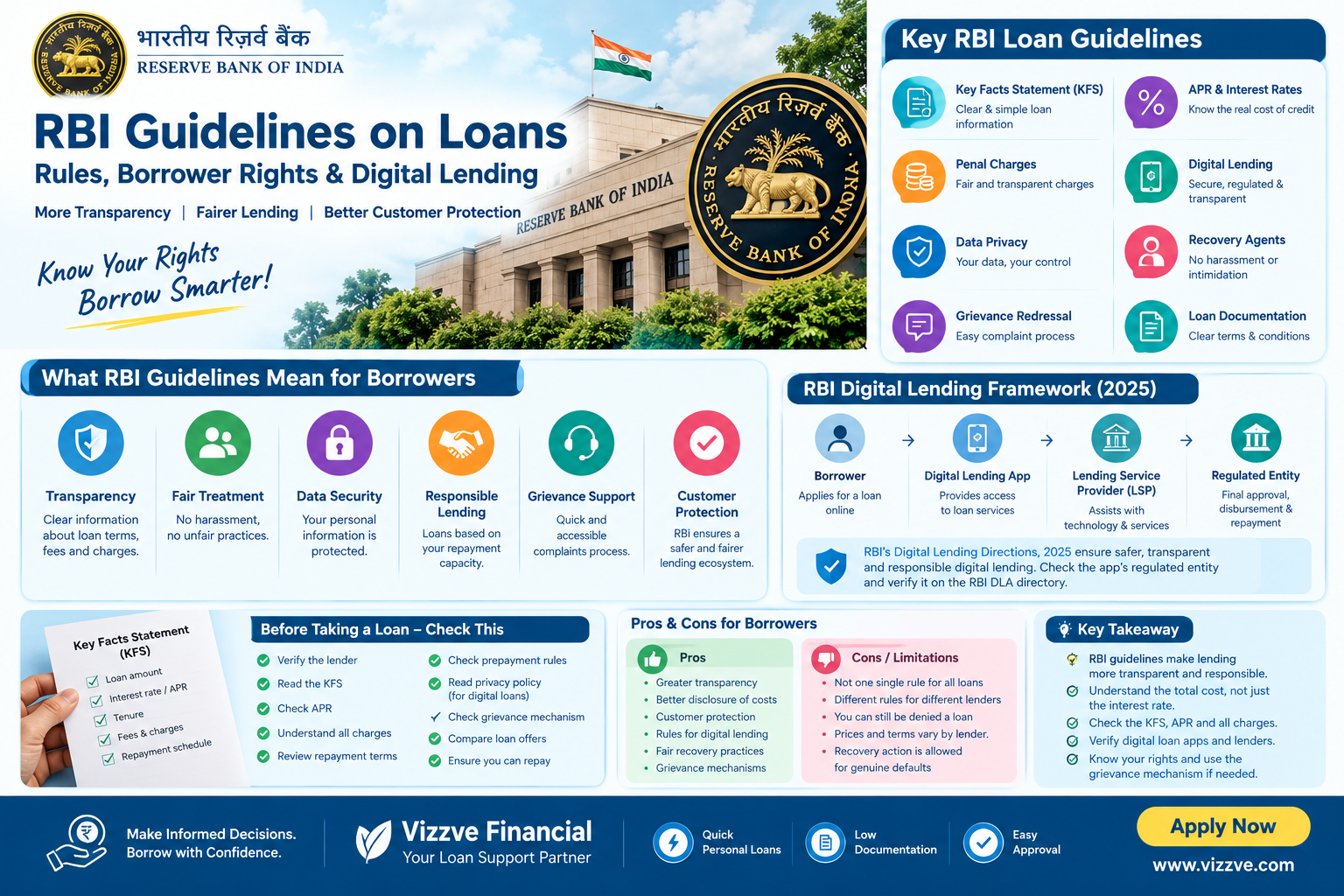
Taking a loan is a major financial decision. Whether it is a personal loan, home loan, vehicle loan, business loan or digital loan, borrowers should understand the rules that govern lending and their rights as customers.
The Reserve Bank of India (RBI) regulates banks and several categories of financial institutions and has introduced various measures aimed at improving transparency, responsible lending and customer protection.
Importantly, there is no single RBI guideline covering every type of loan in exactly the same way. Requirements can vary depending on the lender, product and type of credit.
For digital lending, RBI's Reserve Bank of India (Digital Lending) Directions, 2025 consolidate earlier digital-lending instructions and introduce additional requirements, including provisions concerning Lending Service Providers (LSPs), borrower disclosures and a public directory of Digital Lending Apps (DLAs).
This guide explains the major RBI loan-related rules in simple language and shows what borrowers should check before and after taking a loan.
AI Answer Box: What Are RBI Guidelines for Loans?
RBI loan guidelines are regulatory directions and frameworks issued by the Reserve Bank of India for regulated entities such as banks and applicable NBFCs and other financial institutions.
These rules cover areas such as:
- Fair lending practices
- Loan disclosures
- Interest and charges
- Key Facts Statements (KFS)
- Digital lending
- Data privacy
- Recovery-agent conduct
- Grievance redressal
- Repayment and foreclosure-related practices
- Responsible lending
In simple words:
RBI guidelines are designed to make lending more transparent and responsible while protecting borrowers from unfair practices. However, the exact rule applicable to a loan depends on the lender and type of loan.
What Are RBI Guidelines on Loans?
RBI guidelines establish standards that regulated lenders are expected to follow when offering and servicing credit.
The broader objective is to encourage:
- Transparency
- Responsible lending
- Fair customer treatment
- Proper disclosure of costs
- Secure digital lending
- Effective grievance redressal
- Responsible recovery practices
RBI's regulatory framework has evolved significantly as lending has moved from traditional branches to digital platforms.
Major RBI Loan Guidelines Borrowers Should Know
| RBI Area | What It Means for Borrowers |
|---|---|
| Key Facts Statement | Important loan terms and costs should be clearly disclosed |
| Annual Percentage Rate | Helps communicate the overall annualized cost of credit |
| Penal Charges | Default-related penalties must follow applicable RBI requirements |
| Digital Lending | Digital loan journeys are subject to specific requirements |
| Data Privacy | Digital lenders face requirements concerning collection and use of borrower data |
| Recovery Agents | Harassment and intimidation are prohibited |
| Grievance Redressal | Borrowers have access to complaint mechanisms |
| Loan Documentation | Important loan documents and terms must be communicated appropriately |
| Credit Assessment | Regulated lenders are expected to assess borrower creditworthiness |
RBI Key Facts Statement (KFS) for Loans
One of the most important borrower-protection measures is the Key Facts Statement (KFS).
The KFS provides important information about a loan in a standardized and easy-to-understand format.
RBI's 2024 KFS framework requires applicable regulated entities to provide borrowers with key information about loan agreements, including the all-inclusive cost of the loan.
What Does a KFS Tell You?
Depending on the applicable framework, a KFS can include information such as:
- Loan amount
- Loan tenure
- Interest rate
- Annual Percentage Rate (APR)
- Repayment schedule
- Fees and charges
- Other important loan terms
For digital lending, RBI's framework also requires the KFS to contain information including APR, recovery mechanism, grievance-redressal details and the applicable cooling-off/look-up period.
Why Is KFS Important?
Imagine you are comparing two loans.
Loan A advertises a lower interest rate, while Loan B has a slightly higher rate but substantially lower fees.
Looking only at the headline interest rate could lead to the wrong decision.
The KFS is intended to make important loan costs easier to understand and compare.
RBI Guidelines on Annual Percentage Rate (APR)
APR represents the annualized cost of credit and can include interest and applicable charges associated with the credit facility.
RBI's KFS framework requires applicable charges to be reflected appropriately in the APR and disclosed to borrowers.
Borrowers Should Compare:
- Interest rate
- APR
- Processing fees
- Insurance or third-party charges, where applicable
- Other disclosed charges
- EMI
- Total repayment
Do not judge a loan solely by its advertised interest rate.
RBI Guidelines on Penal Charges
Penal charges are another important area of borrower protection.
Under RBI's Fair Lending Practice – Penal Charges in Loan Accounts, penalties for non-compliance with material terms of a loan contract are to be treated as penal charges, rather than being added to the interest rate as penal interest.
RBI also states that penal charges should not be capitalised, meaning further interest should not be calculated on those penal charges.
The framework also requires the amount and reason for penal charges to be clearly disclosed to customers in applicable loan documentation and, where applicable, the KFS.
Important Points
- Penal charges should be reasonable and proportionate.
- They should not be used simply as a revenue-enhancement tool.
- They should be disclosed clearly.
- Penal charges should not be capitalised.
- Applicable reminders should communicate the relevant penal charges.
The instructions apply to applicable regulated entities and have been implemented for fresh loans from April 1, 2024, with the specified transition arrangements for existing loans.
RBI Guidelines for Digital Lending Apps
Digital lending has become an important part of India's credit ecosystem.
RBI issued its original Guidelines on Digital Lending in September 2022 and subsequently consolidated the framework through the Digital Lending Directions, 2025.
The framework addresses concerns including:
- Mis-selling
- Data privacy
- Unfair business practices
- Excessive or unclear costs
- Unethical recovery practices
- Third-party involvement
Who Is Responsible for a Digital Loan?
A digital lending platform may involve several parties, including:
Borrower → Digital Lending App → Lending Service Provider → Regulated Entity
The important point is that an LSP's involvement does not eliminate the regulated lender's responsibilities.
RBI's 2025 Directions contain requirements governing relationships between regulated entities and LSPs.
RBI Rules for Loan Disbursement and Repayment
For digital lending covered by RBI's framework, loan servicing and repayment are required to flow directly between the borrower and the regulated entity's bank account, subject to specified exceptions.
The digital lending framework also provides that disbursement should generally go directly into the borrower's bank account, subject to regulatory exceptions.
Borrower Safety Tip
Be cautious if someone asks you to send your loan repayment to an unrelated personal bank account or an unexplained third-party account.
Always verify payment instructions through the lender's official channel.
RBI Guidelines on Digital Loan Data and Privacy
Digital lending involves the collection and processing of personal information, so data handling is an important part of RBI's framework.
RBI's digital lending requirements include principles around:
- Need-based data collection
- Explicit borrower consent
- Clear audit trails
- Privacy policies
- Restrictions on unnecessary personal-data storage
- Appropriate data security
The 2022 framework stated that data should be collected only with prior and explicit consent and that borrowers should have discretion regarding consent for specific data uses.
The 2025 Directions continue the regulatory focus on responsible digital lending and customer protection.
RBI Guidelines on Digital Lending Apps and Transparency
Borrowers should be able to identify the regulated entity behind a digital lending service.
RBI has also established a public directory of Digital Lending Apps (DLAs) submitted by regulated entities to help customers verify claims about an app's association with a regulated lender.
This is especially useful because fraudulent applications may falsely claim connections with legitimate banks or NBFCs.
Before Using a Loan App:
Check:
- Name of the regulated lender
- Whether the app's association can be verified
- Loan terms
- KFS
- APR
- Privacy policy
- Grievance mechanism
- Repayment instructions
- Applicable fees
RBI Guidelines for Recovery Agents
If a borrower defaults, a lender may use recovery agents in accordance with applicable rules.
However, debt recovery must not become harassment.
RBI's recovery-agent framework prohibits regulated entities and their agents from intimidation or harassment, including threatening or anonymous calls, abusive behaviour, public humiliation and inappropriate contact with family members, friends or referees.
For the relevant RBI framework covering banks and regulated entities, recovery calls should not be made before 8:00 a.m. or after 7:00 p.m.
What Recovery Agents Should Not Do
Recovery agents should not:
- Threaten borrowers
- Use abusive language
- Use physical intimidation
- Publicly humiliate borrowers
- Harass relatives or colleagues
- Make threatening or anonymous calls
- Mislead borrowers about the debt
- Intrude improperly into a borrower's privacy
RBI Guidelines on Grievance Redressal
A strong grievance mechanism is an important part of customer protection.
Borrowers should generally follow this escalation path:
Customer → Lender's Grievance Mechanism → Appropriate RBI Ombudsman Route, where eligible
Before approaching an external grievance mechanism, keep:
- Complaint reference number
- Loan account details
- Copies of correspondence
- Payment records
- Screenshots
- Relevant call details
- Recovery-agent information, if applicable
The applicable RBI Ombudsman mechanism provides an avenue for eligible complaints against covered regulated entities after the required complaint process with the regulated entity.
RBI Guidelines on Floating-Rate Personal Loans
Floating-rate loans can create repayment uncertainty because changes in the benchmark rate can affect the borrower's EMI or loan tenure.
RBI has required regulated lenders to consider the borrower's repayment capacity and provide appropriate options when applicable to EMI-based floating-rate personal loans.
Possible mechanisms can include:
- Increase in EMI
- Extension of tenure
- Switching from floating to fixed rate, where offered
- Other options permitted under the applicable framework
The objective is to ensure that borrowers have adequate headroom when interest rates rise.
RBI Rules on Prepayment and Foreclosure
Prepayment rules depend on the loan type, lender and applicable RBI directions.
For example, RBI has prohibited certain regulated lenders from charging foreclosure/prepayment penalties on floating-rate term loans sanctioned to individual borrowers for purposes other than business, subject to the applicable regulatory framework.
Before Prepaying a Loan
Check:
- Whether the loan is fixed or floating rate
- Purpose of the loan
- Whether the borrower is an individual
- Applicable prepayment rules
- Contractual charges
- Outstanding principal
- Any other applicable costs
RBI Guidelines for Loan Applications
RBI's fair-lending principles emphasize transparency around loan terms and charges.
A borrower should receive clear information about important terms before committing to the loan.
When applying for a loan, check:
- Interest rate
- APR, where applicable
- Processing fee
- Penal charges
- EMI
- Tenure
- Repayment schedule
- Prepayment conditions
- Recovery mechanism
- Grievance mechanism
For applicable loans, the KFS is an important document to review before entering into the credit agreement.
Key Takeaways
- RBI guidelines are not one single set of rules for every loan.
- The applicable requirements depend on the lender and type of credit.
- The Key Facts Statement (KFS) is an important transparency tool for applicable loans.
- APR helps borrowers understand the overall annualized cost of credit.
- Penal charges must follow applicable RBI requirements and cannot simply be added as penal interest.
- Digital lending is governed by a dedicated RBI framework, including the Digital Lending Directions, 2025.
- Recovery agents cannot use intimidation or harassment.
- Borrowers should verify digital lending apps and the regulated entity behind them.
- Read the loan agreement before accepting credit.
- Keep copies of financial documents and payment records.
- Use the lender's grievance mechanism if you have a complaint.
- Eligible unresolved complaints can be taken through the applicable RBI Ombudsman mechanism.
Frequently Asked Questions
1. What are RBI guidelines for loans?
RBI guidelines are regulatory directions that govern various aspects of lending by regulated financial entities, including transparency, customer protection, digital lending and recovery practices.
2. Does RBI regulate personal loans?
RBI regulates banks and applicable NBFCs and other regulated entities that provide personal loans, subject to the regulatory framework applicable to the particular lender and product.
3. What is KFS in a loan?
KFS stands for Key Facts Statement. It provides important information about a loan, including applicable costs and other key terms, in a standardized format.
4. What is APR in a loan?
APR, or Annual Percentage Rate, represents the annualized cost of credit and includes applicable interest and charges according to the relevant RBI framework.
5. Are loan processing fees regulated by RBI?
Applicable lenders must follow RBI's disclosure and fair-lending requirements. The exact treatment of fees depends on the loan and regulatory framework.
6. Can banks charge penal interest?
Under RBI's penal-charge framework, penalties for non-compliance with material loan terms are to be treated as penal charges, rather than being added to the interest rate as penal interest. Penal charges also cannot be capitalised.
7. What are RBI rules for recovery agents?
Recovery agents must follow applicable conduct requirements. Intimidation, harassment, abusive language, public humiliation and certain inappropriate communications are prohibited.
8. Can recovery agents call borrowers at night?
For the relevant RBI recovery-agent framework, recovery calls should not be made before 8:00 a.m. or after 7:00 p.m.
9. What are RBI guidelines for digital lending apps?
RBI's digital-lending framework covers areas such as regulated-entity/LSP arrangements, borrower disclosures, loan disbursement and repayment, data requirements, grievance redressal and customer protection. The current consolidated framework is the Digital Lending Directions, 2025.
10. How can I verify a digital lending app?
Borrowers can check the regulated entity associated with the app and use the RBI's available information on digital lending apps to help verify claims of association.
11. Can RBI guarantee my loan approval?
No. RBI regulates applicable lending entities but does not guarantee that an individual loan application will be approved.
12. Can I complain against a lender?
Yes. Start with the lender's internal grievance-redressal mechanism. If the complaint remains unresolved and qualifies under the applicable framework, it may be escalated through the RBI Ombudsman mechanism.
13. Can a lender use a recovery agency?
A regulated lender may engage recovery agents subject to applicable RBI requirements. The regulated entity remains responsible for the conduct of its outsourced agents.
14. Does RBI control personal loan interest rates?
RBI regulates aspects of lending and interest-related practices, but there is not one universal personal-loan interest rate applicable to every lender and borrower.
15. What should I check before taking an online loan?
Verify the lender, read the KFS and loan agreement, check APR and all applicable charges, understand repayment terms, review the privacy policy and make sure you know how to raise a complaint if necessary.