

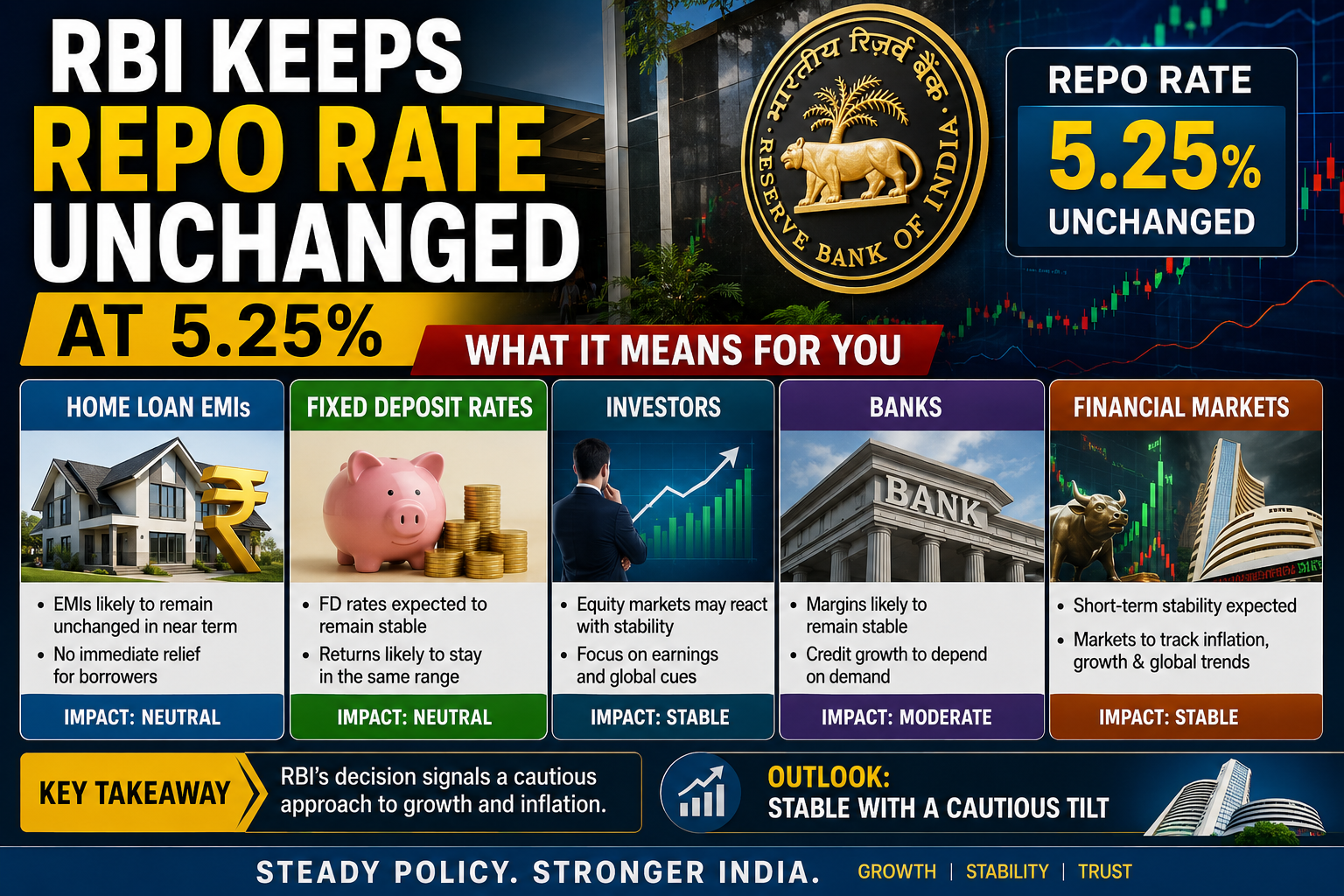
The Reserve Bank of India (RBI) has decided to keep the repo rate unchanged at 5.25%, providing stability for borrowers, depositors, businesses, and financial markets.
The decision comes amid concerns over rising crude oil prices, global uncertainty, inflation risks, and the need to maintain India's growth momentum.
For millions of Indians, the RBI's repo rate decision directly influences:
- Home loan EMIs
- Personal loan rates
- Fixed deposit returns
- Corporate borrowing costs
- Stock market sentiment
The latest announcement suggests that the central bank is adopting a cautious approach while monitoring inflation and economic conditions.
AI Answer Box
What is the repo rate now?
The RBI has kept the repo rate unchanged at 5.25%.
Will my EMI increase?
For most borrowers, EMIs are expected to remain largely unchanged unless banks independently revise lending rates.
What happens to FD rates?
Fixed deposit rates are likely to remain stable in the near term, although individual banks may adjust rates based on liquidity needs.
Why the RBI Kept Rates Unchanged
The central bank faces a difficult balancing act.
Supporting Growth
India continues to show strong economic activity through:
- Rising GST collections
- Strong services-sector growth
- Healthy consumption demand
- Infrastructure investment
Managing Inflation
At the same time, policymakers remain cautious due to:
- Higher crude oil prices
- Global geopolitical tensions
- Imported inflation risks
- Currency volatility
Keeping rates unchanged allows the RBI to monitor developments without disrupting growth.
What the Repo Rate Means
The repo rate is the interest rate at which the RBI lends money to commercial banks.
Why It Matters
Changes in the repo rate eventually influence:
- Home loan rates
- Car loans
- Personal loans
- Fixed deposit rates
- Corporate borrowing costs
An unchanged repo rate generally means borrowing costs remain stable.
Impact on Home Loan EMIs
This is the biggest concern for most borrowers.
Good News for Homeowners
Since the repo rate remains unchanged:
- Existing EMIs are unlikely to increase immediately.
- New home-loan rates may remain stable.
- Borrowers gain predictability in financial planning.
Example
| Loan Amount | EMI Impact |
|---|---|
| ₹20 lakh | No major change |
| ₹50 lakh | Stable |
| ₹1 crore | Stable |
Actual rates may vary by lender.
Impact on Personal Loans and Auto Loans
Borrowers looking for:
- Personal loans
- Car loans
- Education loans
are unlikely to see major interest-rate changes in the short term.
Banks may continue offering competitive lending rates to attract customers.
What It Means for Fixed Deposits (FDs)
FD investors often pay close attention to RBI policy decisions.
Since Rates Are Unchanged
- FD rates are expected to remain broadly stable.
- Banks may continue offering attractive rates on select tenures.
- Senior citizens may continue receiving higher returns.
FD Investors Benefit From Stability
Stable rates provide certainty for savers seeking predictable returns.
Impact on Bank Deposits
Banks use RBI policy signals when determining deposit rates.
Because the repo rate remains unchanged:
- Deposit rates may not change significantly.
- Savings-account rates are likely to remain stable.
- Banks will continue balancing liquidity and funding requirements.
How Stock Markets May React
Markets generally prefer policy stability.
Positive Factors
- Predictable borrowing costs
- Stable economic outlook
- Reduced uncertainty
Areas Investors Will Watch
- RBI's inflation outlook
- Growth projections
- Future policy guidance
The central bank's commentary may influence markets more than the rate decision itself.
Sector-Wise Market Impact
| Sector | Likely Impact |
|---|---|
| Banking | Stable |
| Financial Services | Positive |
| Real Estate | Supportive |
| Automobiles | Neutral-Positive |
| Consumer Goods | Stable |
| Infrastructure | Positive |
Impact on Businesses
Businesses benefit from predictable financing costs.
Advantages
- Easier budgeting
- Stable borrowing environment
- Improved investment planning
- Reduced uncertainty
This can support corporate expansion and capital expenditure plans.
Why Investors Should Pay Attention
Even though the repo rate remains unchanged, investors should closely watch:
Inflation Outlook
Future inflation trends could affect subsequent policy decisions.
Oil Prices
Higher crude prices remain a significant risk.
RBI Commentary
Forward guidance often shapes market expectations.
Inflation Remains a Key Risk
The RBI's decision suggests inflation remains under control but requires close monitoring.
Major risks include:
- Crude oil prices
- Food inflation
- Global supply disruptions
- Currency volatility
Future policy decisions will likely depend on these factors.
What Happens Next?
The RBI will continue evaluating:
- Inflation data
- Economic growth
- Global developments
- Financial-market conditions
Future rate changes will depend on how these variables evolve over the coming months.
Expert Commentary
Economists generally view the decision as a balanced approach.
Key reasons include:
Strong Growth
India continues to perform well compared with many major economies.
Inflation Risks Persist
Oil-price volatility remains a concern.
Stability Matters
Maintaining rates provides certainty for households and businesses.
Most analysts believe the RBI is keeping flexibility for future policy adjustments if conditions change.
Key Takeaways
✅ RBI has kept the repo rate unchanged at 5.25%.
✅ Home-loan EMIs are likely to remain stable.
✅ Personal-loan and auto-loan rates may not change significantly.
✅ Fixed deposit rates are expected to stay broadly unchanged.
✅ Stock markets generally view policy stability positively.
✅ Inflation and oil prices remain important risks.
Pros & Cons of the Decision
Pros
- Stable EMIs
- Predictable borrowing costs
- Supportive for economic growth
- Positive for financial planning
- Reduced market uncertainty
Cons
- Savers may not see higher FD returns
- Inflation risks remain
- Future rate flexibility may be limited if oil prices rise sharply
Conclusion
The RBI's decision to keep the repo rate unchanged at 5.25% offers welcome stability for borrowers, depositors, businesses, and investors.
For homeowners, EMIs are expected to remain steady. For FD investors, returns should remain largely unchanged. For markets, the focus now shifts to the RBI's inflation outlook, growth projections, and future guidance.
As India navigates rising oil prices and global uncertainty, policy stability may help support economic momentum while allowing the RBI to respond flexibly to future developments.
Frequently Asked Questions (FAQs)
1. What is the RBI repo rate now?
The repo rate remains at 5.25%.
2. Will my home-loan EMI increase?
Most borrowers should not see immediate EMI changes.
3. Will FD rates increase?
FD rates are likely to remain broadly stable.
4. Why did RBI keep rates unchanged?
To balance growth support and inflation control.
5. How does repo rate affect loans?
It influences bank borrowing costs and lending rates.
6. What happens to personal loans?
Interest rates are expected to remain stable.
7. Is this good for the stock market?
Markets generally favor policy stability.
8. What sectors benefit most?
Banking, real estate, infrastructure, and financial services.
9. Why are oil prices important?
They affect inflation and future policy decisions.
10. Could RBI change rates later?
Yes, future decisions will depend on economic conditions.
Published on : 7th June
Published by : SMITA
www.vizzve.com || www.vizzveservices.com
Follow us on social media: Facebook || Linkedin || Instagram
🛡 Powered by Vizzve Financial
RBI-Registered Loan Partner | 10 Lakh+ Customers | ₹600 Cr+ Disbursed