

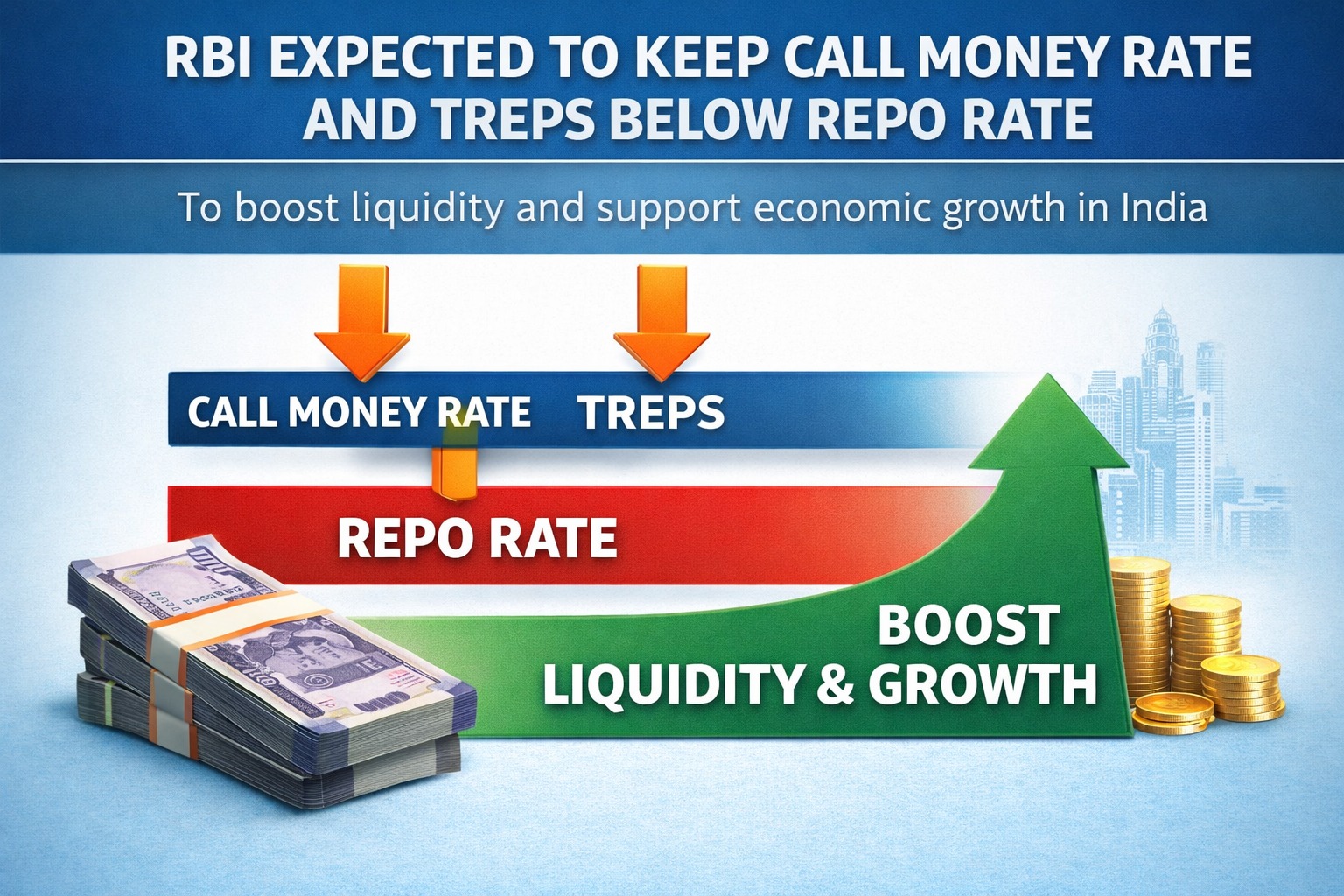
India’s central bank, the Reserve Bank of India, is expected to adopt a pro-growth liquidity strategy by keeping short-term money market rates—such as call money and TREPS—below the repo rate.
This move signals a clear intent: ensure ample liquidity in the banking system while supporting economic growth. But what does this really mean, and how does it impact you?
Let’s break it down in simple terms.
AI ANSWER BOX
What is happening?
RBI may keep call money and TREPS rates below repo rate.
Why?
- To boost liquidity
- To lower short-term borrowing costs
- To support economic growth
Impact:
- Cheaper loans
- Improved market liquidity
- Positive signal for markets
SUMMARY BOX
| Factor | Current Strategy |
|---|---|
| Repo Rate | Policy benchmark |
| Call Money Rate | Below repo |
| TREPS Rate | Below repo |
| Objective | Liquidity boost |
What Are Call Money Rate & TREPS?
🔹 Call Money Rate
- Short-term borrowing rate between banks (overnight)
- Reflects liquidity conditions in the system
🔹 TREPS (Tri-Party Repo)
- Short-term borrowing using government securities
- Safer and widely used in money markets
👉 Both rates indicate how easily banks can access funds.
Why RBI Keeps These Rates Below Repo Rate
🔹 1. Ensure Adequate Liquidity
When call rates stay below repo:
- Banks have enough cash
- No funding stress
🔹 2. Lower Borrowing Costs
- Cheaper short-term borrowing
- Supports credit growth
🔹 3. Boost Economic Activity
- Encourages lending
- Drives consumption and investment
🔹 4. Maintain Market Stability
- Reduces volatility
- Builds investor confidence
Repo Rate vs Market Rates Comparison
| Rate Type | Role | Position |
|---|---|---|
| Repo Rate | RBI policy rate | Benchmark |
| Call Money Rate | Interbank rate | Below repo |
| TREPS Rate | Secured borrowing | Below repo |
Impact on Economy & Markets
💼 For Banks
- Easier access to funds
- Increased lending capacity
🏠 For Individuals
- Lower loan interest rates
- Better credit availability
📊 For Markets
- Positive sentiment
- Increased liquidity-driven rally
Expert Commentary
Experts highlight:
“Keeping short-term rates below repo ensures liquidity comfort and signals accommodative policy stance.”
From real market behavior:
- Liquidity-driven rallies are common
- Lower rates boost borrowing and spending
- RBI uses this strategy during growth phases
Pros & Cons of This Strategy
✅ Pros
- Boosts economic growth
- Supports credit expansion
- Stabilizes financial markets
❌ Cons
- May increase inflation risk
- Excess liquidity can create asset bubbles
How RBI Manages Liquidity
The Reserve Bank of India uses:
- Repo operations
- Reverse repo / SDF
- Open market operations (OMO)
- Variable rate auctions
Scenario Analysis
| Situation | RBI Action |
|---|---|
| Liquidity shortage | Inject funds |
| Excess liquidity | Absorb funds |
| Growth slowdown | Keep rates low |
Key Takeaways
- RBI may keep call money & TREPS below repo rate
- This ensures liquidity and supports growth
- Positive for loans, markets, and economy
- Needs careful balance to avoid inflation risks
Frequently Asked Questions (FAQs)
1. What is call money rate?
Short-term borrowing rate between banks.
2. What is TREPS?
Tri-party repo for secured short-term borrowing.
3. What is repo rate?
Rate at which RBI lends to banks.
4. Why keep rates below repo?
To ensure liquidity.
5. Does it affect loans?
Yes, it can reduce interest rates.
6. Is this good for economy?
Yes, supports growth.
7. Can inflation rise?
Yes, if liquidity is excessive.
8. Who decides repo rate?
RBI MPC.
9. What is liquidity?
Availability of cash in system.
10. How often does RBI act?
Based on market conditions.
11. What is money market?
Market for short-term funds.
12. Does this affect stock market?
Yes, positively.
13. What is reverse repo?
Rate at which RBI borrows from banks.
14. Is this long-term strategy?
Usually short-term adjustment.
15. What should investors do?
Track RBI signals and stay cautious.
🧾 Conclusion
The Reserve Bank of India’s strategy to keep call money and TREPS rates below the repo rate highlights its focus on supporting liquidity and economic growth.
👉 For borrowers, investors, and businesses, this signals easier financial conditions and improved market sentiment.
Need funds in a low-rate environment?
👉 Apply now at www.vizzve.com
Published on : 26th March
Published by : SMITA
www.vizzve.com || www.vizzveservices.com
Follow us on social media: Facebook || Linkedin || Instagram
🛡 Powered by Vizzve Financial
RBI-Registered Loan Partner | 10 Lakh+ Customers | ₹600 Cr+ Disbursed