

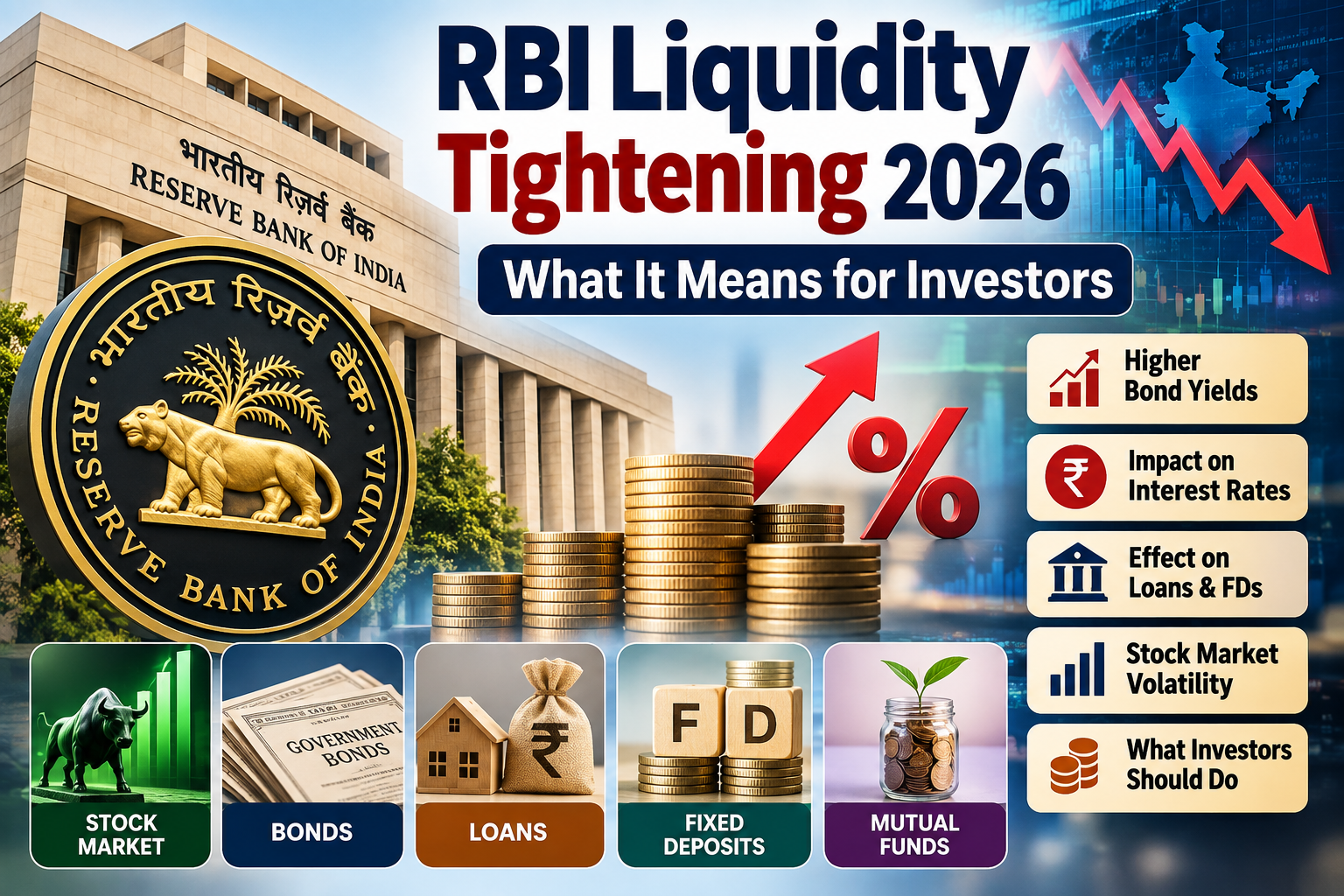
Introduction
The Reserve Bank of India (RBI) has shifted attention toward managing excess liquidity in India's banking system in 2026.
Liquidity may sound like a technical banking term, but it has a direct connection with the financial markets. The amount of money available in the banking system can influence short-term interest rates, bond yields, credit availability, currency markets and investor sentiment.
In September 2026, the RBI intensified liquidity absorption through government bond sales and foreign-exchange operations. Reuters reported that the banking system's liquidity surplus had fallen by around 55%, from ₹11.16 trillion to ₹4.92 trillion, following RBI interventions.
Earlier in September, the RBI announced a ₹1 trillion open-market government bond sale programme to absorb excess liquidity. The move followed a large increase in liquidity associated with foreign-exchange mobilisation.
For investors, the important question is not simply whether liquidity is "tight" or "easy."
The bigger question is:
How can changes in banking liquidity affect the assets you own, the interest you pay on loans and the returns available from fixed-income investments?
This article explains the issue in simple terms.
AI Answer Box: RBI Liquidity Tightening 2026 Explained
RBI liquidity tightening means the central bank is reducing excess money available in the banking and financial system. In 2026, the RBI has used tools including government bond sales and foreign-exchange swaps to absorb surplus rupee liquidity.
The effect can flow through several parts of the economy:
- Short-term money-market rates may move higher.
- Government bond yields can come under upward pressure.
- Banks may face a higher marginal cost of funds.
- Loan pricing can become more sensitive to funding conditions.
- Fixed-income investments may become more attractive if yields rise.
- Equity markets can become more sensitive to liquidity conditions.
- The rupee can be influenced by RBI foreign-exchange operations.
- Investors may need to pay greater attention to asset allocation and interest-rate risk.
However, liquidity tightening does not automatically mean the stock market will fall or interest rates will rise immediately. The actual impact depends on inflation, economic growth, credit demand, global rates, crude oil prices, government borrowing and the RBI's broader monetary-policy stance.
What Is Liquidity in the Banking System?
Liquidity refers broadly to the amount of readily available funds in the financial system.
Banks need liquidity to:
- Meet customer withdrawals
- Make new loans
- Settle payments
- Participate in financial markets
- Meet regulatory requirements
- Manage daily cash-flow requirements
When the banking system has abundant surplus liquidity, overnight money-market rates can remain relatively low.
When the RBI absorbs excess liquidity, the supply of immediately available funds can decline.
This can gradually influence market interest rates.
A Simple Example
Imagine banks collectively have far more cash than they need for immediate operations.
They may be willing to lend that money in the short-term market at relatively low rates.
Now suppose the RBI removes part of that surplus liquidity.
Banks have less excess cash available.
The price of short-term money can therefore increase.
That is one of the basic mechanisms through which liquidity management affects financial markets.
Why Is the RBI Tightening Liquidity in 2026?
The current episode is closely connected with a large increase in foreign-exchange-related liquidity.
Reuters reported that a special foreign-exchange mobilisation scheme brought a substantial amount of foreign currency into India's financial system, creating additional rupee liquidity. The resulting surplus pushed some short-term rates below the RBI's desired operating range.
The RBI has therefore been using several instruments to bring liquidity conditions closer to its desired operating framework.
Key reasons include:
- Managing excess banking liquidity
- Keeping money-market rates aligned with the policy framework
- Containing inflationary risks
- Managing currency-market conditions
- Maintaining orderly financial-market functioning
The RBI's official data currently lists the policy repo rate at 5.25%, with the Standing Deposit Facility rate at 5.00% and Marginal Standing Facility rate at 5.50%.
These rates provide important context for understanding the transmission of liquidity conditions into the broader financial system.
RBI Liquidity Tightening Tools in 2026
The RBI does not rely on one single instrument.
1. Open Market Bond Sales
One of the most important recent measures has been the sale of government securities.
When the RBI sells government bonds to financial institutions, buyers pay the RBI.
That payment effectively removes rupee liquidity from the banking system.
In September 2026, the RBI announced open-market bond sales worth ₹1 trillion, beginning with a ₹500 billion tranche.
Why does this matter?
Large bond sales can influence:
- Government bond yields
- Banking liquidity
- Borrowing costs
- Bond-market sentiment
- Portfolio allocation
2. Foreign-Exchange Swaps
The RBI has also used FX swaps to manage rupee liquidity.
In a sell-buy swap, the central bank can sell dollars in the spot market while agreeing to buy them back later.
The immediate effect can be to absorb rupees from the financial system.
Reuters reported that the RBI conducted FX swaps in September as part of its liquidity-management efforts.
3. Liquidity Absorption Operations
The RBI can use various short-term operations to absorb excess cash.
These operations help influence the amount of liquidity available to banks and the rates at which banks lend to each other.
The objective is not necessarily to eliminate liquidity.
Instead, the central bank can seek to prevent excessive surplus liquidity from pushing short-term rates too far below its desired operating framework.
How Does RBI Liquidity Tightening Affect Investors?
The impact is different across asset classes.
| Asset / Area | Possible Impact of Tighter Liquidity |
|---|---|
| Government Bonds | Yields may face upward pressure |
| Corporate Bonds | Funding costs may increase |
| Bank Stocks | Funding and NIM dynamics may change |
| Other Equities | Liquidity-sensitive stocks may see volatility |
| Fixed Deposits | Deposit rates may respond depending on funding demand |
| Loans | Borrowing costs may become more sensitive to rate conditions |
| Mutual Funds | Debt-fund returns can be affected by bond yields |
| Rupee | FX intervention can influence currency conditions |
| Gold | Can react to rates, dollar movements and global uncertainty |
These are potential transmission channels, not guaranteed outcomes.
Impact on the Stock Market
Liquidity is an important driver of financial markets.
When money is abundant and financing conditions are easy, investors may be more willing to allocate capital toward risk assets.
When liquidity becomes tighter, the cost of capital can increase.
That can affect the valuation of companies.
Why can tighter liquidity affect equity valuations?
Stock prices reflect expectations about future earnings and the rate used to value those earnings.
If market interest rates rise:
- Future cash flows can be discounted at a higher rate.
- Borrowing costs may increase.
- Highly leveraged companies may face greater interest expenses.
- Investors may reassess risk-reward trade-offs.
- Some investors may shift toward fixed-income opportunities.
However, equity-market performance depends on many other factors, including earnings growth, economic activity, global markets, crude oil and foreign portfolio flows.
Therefore, RBI liquidity tightening alone should not be treated as a forecast for the direction of the Sensex or Nifty.
Impact on Government Bonds
Government bonds are among the markets most directly connected to liquidity and interest rates.
When the RBI sells government securities into the market, additional bonds become available to investors.
If demand does not fully absorb the supply at existing prices, bond prices can fall and yields can rise.
Bond price and yield relationship
There is an important principle every fixed-income investor should understand:
Bond prices and yields generally move in opposite directions.
For example:
- Bond price ↓ → Yield ↑
- Bond price ↑ → Yield ↓
Recent reporting showed India's 10-year benchmark government bond yield moving above 7% amid liquidity withdrawal and broader rate concerns.
What Does Liquidity Tightening Mean for Mutual Fund Investors?
The impact depends on the type of mutual fund.
Equity Mutual Funds
Equity funds may be affected indirectly through:
- Stock-market valuations
- Corporate borrowing costs
- Investor sentiment
- Earnings expectations
- Foreign and domestic fund flows
Debt Mutual Funds
Debt funds can be more directly sensitive to interest-rate movements.
For example, if yields rise sharply, existing bonds with lower coupons may decline in market value.
This can temporarily affect the NAV of debt funds.
On the other hand, higher market yields can eventually create opportunities for funds to invest in newer securities offering higher yields.
Impact on Fixed Deposits
Many investors immediately ask:
Will RBI liquidity tightening increase FD interest rates?
The answer is: possibly, but not automatically.
Banks determine deposit rates based on several factors, including:
- Credit demand
- Deposit growth
- Competition between banks
- Liquidity conditions
- RBI policy rates
- Funding requirements
If banks need more deposits to fund loan growth, they may increase deposit rates.
But if banks already have sufficient deposits, liquidity tightening may not translate immediately into higher FD rates.
Impact on Personal Loans and Home Loans
Liquidity conditions can influence lending rates, but the impact depends on how a particular loan is priced.
Borrowers should distinguish between:
- Repo-linked loans
- External benchmark-linked loans
- MCLR-linked loans
- Fixed-rate loans
- Other lending-rate structures
A change in banking liquidity does not mean every borrower's EMI changes immediately.
Borrowers should monitor:
- Current interest rate
- Benchmark used for the loan
- Reset frequency
- Outstanding principal
- Remaining tenure
- Processing or switching charges
For a large loan, even a relatively small interest-rate movement can materially affect total interest paid over time.
Impact on Banking Stocks
Banks sit at the centre of the liquidity transmission mechanism.
Tighter liquidity can affect banks through several channels.
Possible effects include:
Funding costs: Banks may have to compete harder for deposits or other funding.
Net interest margins: The effect on NIMs depends on how quickly lending and deposit rates adjust.
Credit growth: Higher funding costs can affect borrowing demand.
Asset quality: If borrowers face higher financing costs, repayment capacity can become an important consideration.
Treasury portfolios: Changes in bond yields can affect banks holding government securities.
This means investors looking at banking stocks should consider more than the RBI repo rate alone.
RBI Liquidity Tightening vs Repo Rate Hike
These two concepts are related but not identical.
| Factor | Liquidity Tightening | Repo Rate Hike |
|---|---|---|
| Main mechanism | Reduces surplus system liquidity | Raises policy borrowing rate |
| Direct focus | Money-market liquidity | Monetary-policy rate |
| Common tools | Bond sales, FX swaps, absorption operations | Change in repo rate |
| Effect on short-term rates | Can push rates upward | Directly raises policy rate |
| Effect on bonds | Can pressure yields higher | Usually puts upward pressure on yields |
| Effect on loans | Indirect or variable | Can be more direct |
| Purpose | Manage liquidity conditions | Influence inflation and economic activity |
The RBI can tighten liquidity without necessarily changing the repo rate.
This distinction is important when reading financial news.
Why the Rupee Matters
Liquidity management in 2026 is also connected with foreign-exchange conditions.
India has faced pressure from factors such as:
- Crude oil prices
- Global interest rates
- Dollar strength
- Geopolitical uncertainty
- Import demand
- Foreign portfolio flows
Reuters reported that the rupee was trading around ₹95–96 per US dollar in September amid oil-price volatility and RBI intervention.
A weaker rupee can increase the domestic cost of imported commodities, particularly crude oil.
That can feed into inflation and corporate costs.
This is one reason why liquidity, currency markets and inflation cannot always be viewed separately.
What Investors Should Watch in the Coming Months
Investors should monitor a combination of indicators rather than relying on a single headline.
1. RBI Liquidity Data
Watch whether the banking-system liquidity surplus continues to shrink.
2. Government Bond Yields
The 10-year government bond yield is an important indicator of market expectations.
3. Inflation
Higher inflation can reduce the scope for monetary easing.
4. Crude Oil
India imports a large share of its crude oil requirements, making oil prices important for inflation and the rupee.
5. Credit Growth
Strong credit demand can increase banks' need for stable funding.
6. Deposit Growth
The relationship between deposits and loans can provide clues about banking-system funding conditions.
7. RBI Policy Communication
Investors should pay attention not only to the repo rate but also to the RBI's language around liquidity, inflation and monetary-policy transmission.
Key Indicators at a Glance
| Indicator | Why Investors Watch It |
|---|---|
| Repo Rate | Signals monetary-policy stance |
| Banking Liquidity | Indicates availability of surplus funds |
| 10-Year Bond Yield | Reflects government borrowing and rate expectations |
| CPI Inflation | Important for monetary policy |
| Crude Oil | Influences inflation and trade balance |
| USD/INR | Affects imports and foreign investors |
| Credit Growth | Shows borrowing demand |
| Deposit Growth | Shows availability of bank funding |
| FPI Flows | Influences equity and currency markets |
| RBI Bond Sales | Direct liquidity-absorption signal |
Pros and Cons of Liquidity Tightening
Potential Benefits
- Helps prevent excessive surplus liquidity.
- Supports orderly money-market conditions.
- Can strengthen monetary-policy transmission.
- May help contain inflationary pressures.
- Can reduce distortions caused by unusually abundant liquidity.
- Helps the RBI manage currency-market conditions.
Potential Challenges
- Bond yields may face upward pressure.
- Borrowing costs can increase.
- Liquidity-sensitive equities may become more volatile.
- Banks may face higher marginal funding costs.
- Government borrowing costs can be affected.
- Highly leveraged businesses may face additional pressure.
The overall economic effect depends on the scale and duration of the tightening and on broader domestic and global conditions.
How Should Investors Respond?
Liquidity tightening does not require investors to make sudden portfolio changes.
Instead, investors can focus on fundamentals and risk management.
Step 1: Review your asset allocation
Check how much of your portfolio is exposed to:
- Equities
- Debt funds
- Government bonds
- Corporate bonds
- Fixed deposits
- Gold
- Cash
Step 2: Understand interest-rate sensitivity
Long-duration bonds generally have greater sensitivity to changes in market yields than short-duration instruments.
Step 3: Review your loans
Check whether your loans are floating or fixed rate and understand the applicable benchmark.
Step 4: Maintain adequate liquidity
An emergency fund can help prevent investors from selling long-term investments during short-term market stress.
Step 5: Avoid reacting to individual headlines
One RBI announcement should not automatically determine a long-term investment decision.
Step 6: Focus on investment horizon
Short-term market volatility and long-term investment objectives are different considerations.
Real-World Investor Perspective
Consider two investors.
Investor A: Long-Term Equity Investor
This investor has a 10-year investment horizon and invests regularly.
Short-term liquidity tightening may increase market volatility, but the investor's focus remains on company earnings, valuation and long-term financial goals.
Investor B: Short-Term Bond Investor
This investor owns longer-duration government bonds.
A rise in yields can create mark-to-market losses even if the investor ultimately receives the bond's contractual payments at maturity.
The same RBI action can therefore have very different implications for different investors.
This is why asset allocation matters.
Expert Commentary: What Matters Beyond the Headline?
The key lesson from the 2026 liquidity episode is that investors should distinguish between liquidity management and a conventional rate-hike cycle.
The RBI's actions show that central-bank policy can influence financial conditions through several channels at the same time.
Recent market reporting indicates that the RBI has been using bond sales and FX swaps to absorb surplus liquidity while dealing with currency and inflation pressures.
For investors, this means monitoring the combination of liquidity, bond yields, inflation, crude oil and currency movements is more informative than watching one policy number in isolation.
RBI Liquidity Tightening 2026: Quick Comparison
| Scenario | Liquidity Condition | Possible Market Effect |
|---|---|---|
| Excess liquidity | Very high | Short-term rates may remain low |
| Moderate liquidity | Balanced | Policy transmission can be smoother |
| Tight liquidity | Lower surplus | Money-market rates may rise |
| Very tight liquidity | Funding pressure | Borrowing and market volatility may increase |
These are simplified scenarios for educational purposes.
Frequently Asked Questions
1. What is RBI liquidity tightening?
RBI liquidity tightening refers to measures used by the Reserve Bank of India to reduce excess liquidity available in the financial system.
2. Why is the RBI tightening liquidity in 2026?
The RBI has been managing a large surplus of banking-system liquidity associated partly with foreign-exchange inflows and has used bond sales and FX swaps to absorb excess rupee liquidity.
3. Does liquidity tightening mean the RBI has increased the repo rate?
No. Liquidity tightening and a repo-rate increase are different policy mechanisms. The RBI can alter liquidity conditions without changing the repo rate.
4. How does RBI liquidity tightening affect the stock market?
It can affect market liquidity, interest rates, borrowing costs and valuations. However, stock-market performance also depends on corporate earnings, global markets, crude oil and investor flows.
5. Does RBI liquidity tightening increase loan interest rates?
It can contribute to higher funding costs, but the impact depends on the loan's benchmark, bank funding conditions and broader monetary-policy transmission.
6. Will FD rates increase because of liquidity tightening?
Not necessarily. FD rates depend on banks' funding requirements, deposit competition, credit demand and interest-rate expectations.
7. How does liquidity tightening affect government bonds?
If liquidity withdrawal contributes to higher market yields, existing bond prices can come under pressure because bond prices and yields generally move in opposite directions.
8. Is liquidity tightening good or bad for investors?
Its effect depends on the investor's asset allocation, investment horizon and risk exposure. Different asset classes can respond differently to changing liquidity conditions.
9. What is an RBI open market bond sale?
It is an operation in which the RBI sells government securities in the market, receiving payment and thereby absorbing rupee liquidity.
10. What are RBI FX swaps?
Foreign-exchange swaps are transactions involving the exchange of currencies with an agreement to reverse the transaction at a future date. They can also be used as a liquidity-management tool.
11. Does tighter liquidity affect mutual funds?
Yes, particularly debt mutual funds because changes in market yields can affect the market value of their underlying bonds.
12. Why are bond yields important for investors?
Bond yields influence borrowing costs, fixed-income returns and the valuation of existing bonds. They can also affect how investors compare bonds with other asset classes.
13. What should investors monitor during RBI liquidity tightening?
Investors can monitor RBI announcements, banking liquidity, bond yields, inflation, crude oil, USD/INR movements, credit growth and deposit growth.
14. Can RBI liquidity tightening affect the rupee?
Yes. Liquidity operations and foreign-exchange intervention can influence currency-market conditions, although the rupee is also affected by oil prices, global dollar movements, capital flows and external factors.
15. Should investors change their portfolio because of RBI liquidity tightening?
There is no universal answer. Investors should consider their financial goals, risk tolerance, time horizon, asset allocation and the specific exposure they have to interest-rate-sensitive assets.
Key Takeaways
- RBI liquidity tightening means reducing excess liquidity in the financial system.
- In September 2026, the RBI used government bond sales and FX swaps to absorb surplus liquidity.
- The banking-system liquidity surplus has fallen substantially from its earlier peak.
- Tighter liquidity can influence short-term interest rates and bond yields.
- Government bonds and debt funds can be sensitive to yield movements.
- Banks may experience changes in funding costs and margins.
- Borrowers should understand their loan benchmark and reset mechanism.
- Equity-market effects are indirect and depend on several economic variables.
- Crude oil, inflation and the rupee remain important variables for Indian investors.
- Investors should focus on asset allocation and long-term financial goals rather than reacting to individual headlines.
Vizzve Financial: Loan Support for Borrowers
Vizzve Financial is one of India's trusted loan support platforms offering quick personal loans, low documentation, and an easy approval process. Apply at www.vizzve.com.
Borrowers should compare the applicable interest rate, fees, repayment schedule, eligibility requirements and other loan terms before applying.
Published on : 25 th September
Published by : G REDDY KUMAR
www.vizzve.com || www.vizzveservices.com
Follow us on social media: Facebook || Linkedin || Instagram
🛡 Powered by Vizzve Financial
RBI-Registered Loan Partner | 10 Lakh+ Customers | ₹600 Cr+ Disbursed