

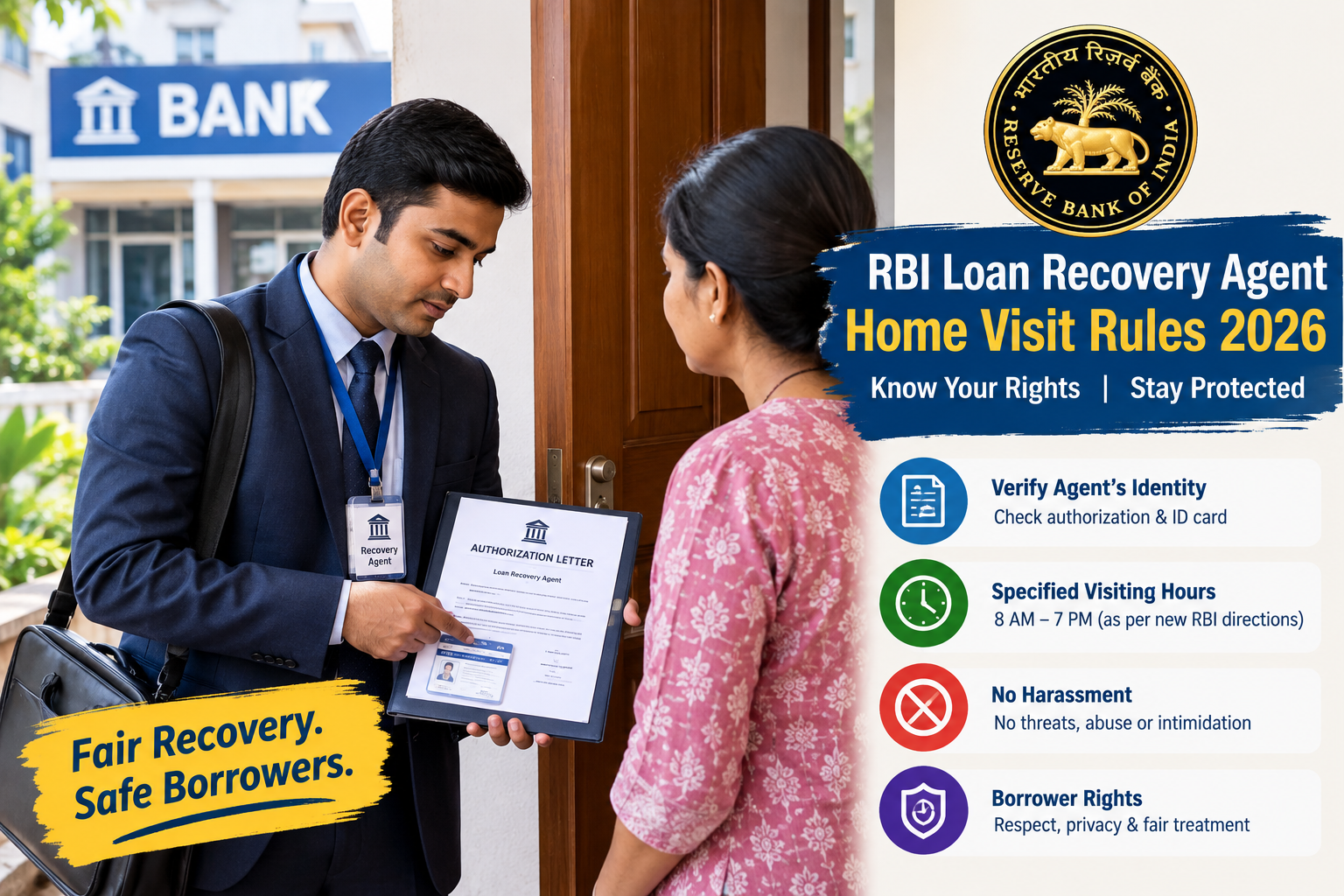
Introduction
Missing a loan EMI can be stressful, especially when a bank or financial institution sends a recovery agent to your home. Many borrowers are unsure whether recovery agents can visit their homes, contact family members, or demand immediate payment.
The Reserve Bank of India (RBI) has established rules to regulate recovery practices and protect borrowers from harassment, intimidation and unfair treatment.
In 2026, the RBI also introduced a comprehensive framework for recovery agents engaged by commercial banks, with the new directions scheduled to take effect from January 1, 2027.
These developments make it important for borrowers to understand the difference between legitimate loan recovery and unlawful recovery practices.
This article explains RBI loan recovery agent home visit rules, borrower rights, permitted contact hours and complaint procedures.
RBI Loan Recovery Agent Rules 2026: Latest Update
The RBI's recovery framework focuses on professional conduct, proper identification, transparency and accountability.
Existing RBI instructions prohibit intimidation, harassment, public humiliation and persistent contact at inappropriate hours.
The RBI's 2026 amendment directions for covered commercial banks introduce more detailed requirements for recovery agents, including advance notice for visits, identification and prescribed contact hours.
Important: The new commercial-bank directions are scheduled to come into effect on January 1, 2027. Borrowers should not confuse these future-effective provisions with the existing RBI instructions that already prohibit harassment and coercive recovery practices.
The new directions apply to the commercial banks specified in the amendment. Other regulated lenders may be governed by their applicable RBI directions.
RBI Guidelines for Loan Recovery Agent Home Visits
A bank or lender may appoint a recovery agent to contact a borrower regarding overdue loan payments. However, the recovery process must follow applicable RBI requirements.
1. Can a loan recovery agent visit your home?
Yes. A recovery agent may visit a borrower's residence for legitimate loan recovery purposes, subject to applicable rules and procedures.
Under the new commercial-bank directions effective January 1, 2027, agents should ordinarily contact borrowers at their preferred location.
If the borrower has not specified a preferred location, or fails to appear at the chosen place on two or more successive occasions, the agent may contact the borrower at their residence or workplace.
2. Is prior notice required before a home visit?
Under the new RBI commercial-bank directions, the borrower must be informed at least one day before the first in-person visit by a recovery agency.
The bank must also provide details of the recovery agency assigned to the case.
This advance-notice requirement is part of the directions scheduled to take effect on January 1, 2027.
3. What documents should a recovery agent carry?
Borrowers should verify the identity and authorization of anyone claiming to represent a bank or lender.
Under the new directions, recovery agents must carry the prescribed identification and authorization documents, including:
- Identity card
- Authorization letter
- Relevant recovery notice
The authorization letter and notice must contain the required contact details, including the recovery agency and the bank's grievance redressal officer.
Borrowers should verify the agent's credentials with the lender before making a payment.
RBI Rules on Recovery Agent Calling and Visiting Hours
The new commercial-bank directions prescribe a general contact window for recovery agents.
| Recovery Activity | New RBI Commercial-Bank Directions |
|---|---|
| Permitted calling hours | 8:00 AM to 7:00 PM |
| Permitted home visit hours | 8:00 AM to 7:00 PM |
| Contact outside these hours | Only when expressly requested or authorised by the borrower |
| Borrower's preferred contact time | Should ordinarily be respected |
These provisions are scheduled to take effect on January 1, 2027.
Existing RBI instructions already prohibit persistent recovery contact at odd hours and other forms of undue harassment.
What Recovery Agents Cannot Do
RBI instructions prohibit recovery agents from using abusive, threatening or intimidating behaviour.
Recovery agents must not:
- Threaten borrowers with physical harm.
- Use abusive or humiliating language.
- Make threatening or anonymous calls.
- Publicly shame borrowers over unpaid loans.
- Intrude into the privacy of borrowers' family members, friends or referees.
- Use force or intimidation to recover loan dues.
- Misrepresent themselves or make false claims to pressure borrowers.
Banks remain responsible for ensuring that recovery agents engaged by them follow applicable RBI requirements.
A loan default does not give a recovery agent permission to threaten, humiliate or intimidate a borrower.
Borrower Rights During a Loan Recovery Home Visit
Borrowers have important protections when dealing with recovery agents.
| Borrower Right | What It Means |
|---|---|
| Right to respectful treatment | Recovery agents must not use intimidation or harassment |
| Right to verify identity | Borrowers can ask for identification and authorization |
| Right to privacy | Recovery agents must not improperly involve family members or friends |
| Right to raise a complaint | Borrowers can report misconduct to the lender |
| Right to seek repayment assistance | Borrowers can discuss repayment options with the bank |
| Right to lawful recovery procedures | Recovery must follow applicable legal and regulatory requirements |
Borrowers should remember that these protections do not automatically cancel outstanding loan dues or prevent a lender from pursuing lawful recovery.
What Should You Do If a Recovery Agent Harasses You?
If a recovery agent threatens or harasses you during a home visit, take the following steps:
Step 1: Verify the agent's identity
Ask for the agent's name, identity card, authorization letter and the name of the recovery agency.
Step 2: Contact the bank directly
Use the bank's official customer care number to confirm whether the agent has been assigned to your loan account.
Step 3: Preserve evidence
Keep records of calls, messages, visit dates and other relevant evidence. Save any threatening messages or communications.
Step 4: File a complaint with the lender
Submit a written complaint to the bank's grievance redressal officer. Include relevant dates, details of the incident and supporting evidence.
Step 5: Escalate the complaint
If the bank does not resolve your complaint satisfactorily within the applicable period, you may be eligible to approach the RBI through its Complaint Management System under the RBI Integrated Ombudsman Scheme.
For immediate threats or physical intimidation, contact the local police.
Can a Bank Recover a Loan After an EMI Default?
Yes. Missing an EMI can lead to recovery action under the applicable loan agreement and legal framework.
However, recovery action must follow due process.
For secured loans, such as certain home loans and vehicle loans, lenders must follow the applicable legal procedures before taking possession of secured assets.
A missed EMI does not give a recovery agent unrestricted authority to enter your home, seize property by force or threaten your family.
Borrowers facing repayment difficulties should contact their lender to discuss possible repayment arrangements, restructuring or other available options.
Key Takeaways
- RBI rules prohibit harassment, intimidation and coercive loan recovery practices.
- Recovery agents may visit borrowers' homes for legitimate recovery purposes, subject to applicable requirements.
- The RBI's new commercial-bank directions are scheduled to take effect on January 1, 2027.
- The new directions prescribe an 8 AM to 7 PM contact window, subject to specified exceptions.
- The new framework requires advance notice before the first in-person recovery agency visit.
- Borrowers can verify an agent's identity and report misconduct to the lender.
- Loan repayment obligations remain in place even when borrowers report recovery-related harassment.
Conclusion
RBI loan recovery guidelines are designed to ensure that banks and recovery agents follow fair, transparent and lawful practices.
Borrowers should understand their rights during home visits, verify recovery agents before making payments and maintain records of any misconduct.
If you are facing repayment difficulties, contact your lender through official channels and explore available repayment options. If an agent engages in harassment or intimidation, use the lender's grievance redressal process and escalate the matter where appropriate.
Frequently Asked Questions (FAQs)
1. Can a loan recovery agent visit my home in India?
Yes. Recovery agents can visit borrowers' homes for legitimate recovery purposes, subject to applicable RBI rules and legal requirements.
2. Can a recovery agent visit without prior notice?
The new RBI commercial-bank directions require at least one day's notice before the first in-person visit by a recovery agency. These directions take effect on January 1, 2027.
3. What are the permitted home visit timings for recovery agents?
The new directions prescribe 8:00 AM to 7:00 PM as the general contact and visit window, with specified exceptions.
4. Can recovery agents threaten borrowers?
No. RBI instructions prohibit threatening, abusive, intimidating and harassing recovery practices.
5. Can a recovery agent talk to my family about my loan?
Recovery agents must respect borrower privacy. The new commercial-bank directions require recovery discussions to be limited to the borrower or guarantor, as applicable.
6. Can a recovery agent force entry into my home?
A loan default does not give an agent unrestricted authority to force entry into a borrower's home.
7. Can recovery agents seize my property?
Recovery agents cannot use force or bypass applicable legal procedures. Secured asset recovery is subject to the relevant legal framework.
8. What should I do if a recovery agent visits without identification?
Ask for the agent's identity card and authorization documents. Contact your bank through its official channels to verify the agent.
9. Where can I complain about recovery agent harassment?
You can complain to the bank's grievance redressal officer. Eligible complaints may subsequently be escalated to the RBI Ombudsman.
10. Can a bank send a recovery agent after one missed EMI?
A lender may initiate recovery steps after a missed payment, subject to the loan agreement and applicable rules. Recovery agents must still follow proper conduct requirements.
11. Are RBI loan recovery rules applicable to NBFCs?
Yes. NBFCs are subject to applicable RBI recovery and fair-practice requirements. The precise directions may differ from those applicable to commercial banks.
12. When do the new RBI commercial-bank recovery directions take effect?
The RBI's 2026 amendment directions are scheduled to take effect on January 1, 2027.
13. Can I refuse to speak to a recovery agent?
You can verify the agent's identity and request communication through official lender channels. However, refusing to engage does not eliminate your loan repayment obligations.
14. Can recovery agents call after 7 PM?
The new commercial-bank directions generally restrict calls to 8 AM–7 PM, except when the borrower has expressly requested or authorised contact outside those hours.
15. Does RBI protect borrowers from loan recovery harassment?
Yes. RBI instructions prohibit undue harassment, intimidation, public humiliation and other improper recovery practices.
Published on : 22st September
Published by : MONISHA
www.vizzve.com || www.vizzveservices.com
Follow us on social media: Facebook || Linkedin || Instagram
🛡 Powered by Vizzve Financial
RBI-Registered Loan Partner | 10 Lakh+ Customers | ₹600 Cr+ Disbursed