

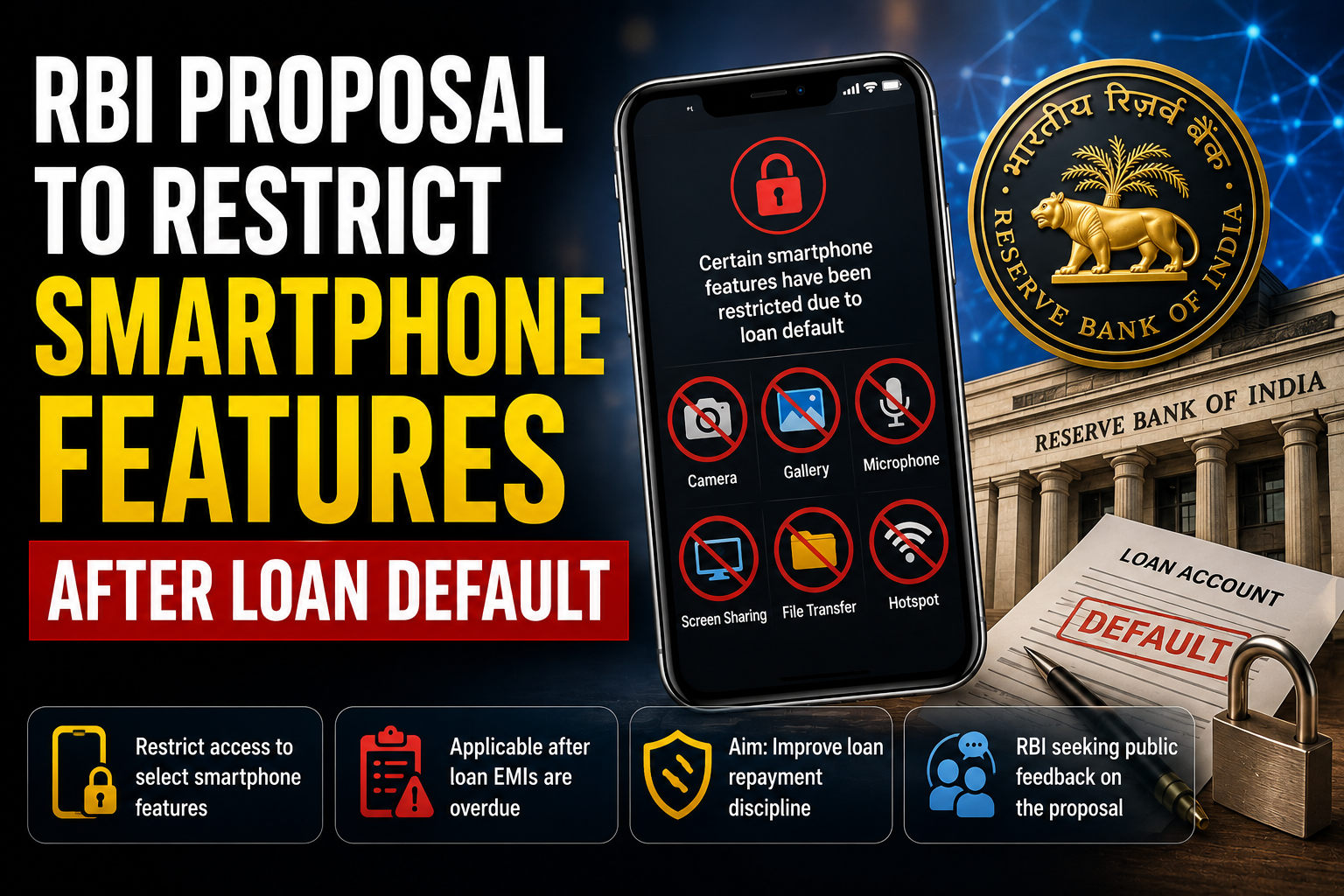
The Reserve Bank of India has proposed a new rule that could allow lenders to remotely restrict certain non-essential smartphone features if borrowers default on device loans for more than 90 days.
The proposal is aimed at:
- Reducing loan defaults
- Strengthening digital lending recovery
- Improving repayment discipline
- Managing risks in smartphone financing
The move has sparked major discussions around:
- Consumer rights
- Digital lending practices
- Financial regulation
- Data privacy concerns
AI Answer Box
What is RBI’s new smartphone loan proposal?
RBI proposed allowing lenders to remotely restrict non-essential smartphone functions if borrowers fail to repay device loans for over 90 days.
Which phone features could be restricted?
The proposal reportedly focuses on limiting non-essential smartphone functions while preserving access to essential services like emergency communication.
Introduction
Smartphone financing has expanded rapidly in India due to growing digital adoption and rising demand for affordable EMI-based purchases.
Millions of consumers now purchase smartphones through:
- EMI plans
- Buy-now-pay-later (BNPL) services
- Digital lending apps
- Consumer finance schemes
However, rising defaults in device financing have created new challenges for lenders and fintech companies.
To address these risks, the Reserve Bank of India has proposed a framework allowing lenders to remotely restrict certain smartphone functions after prolonged repayment defaults.
The proposal reflects growing regulatory focus on digital lending and consumer finance management in India.
What Is RBI’s Proposed Smartphone Rule?
Understanding The Proposal
Under the proposed framework:
- Lenders may remotely restrict non-essential smartphone features
- Restrictions may apply after 90+ days of payment default
- Essential communication services may remain functional
The rule is intended to improve recovery mechanisms for device financing companies.
Why Smartphone Financing Is Growing Rapidly
India’s smartphone market has seen massive growth because EMI financing makes devices more affordable.
Popular Financing Methods Include:
- No-cost EMI
- BNPL services
- Fintech loans
- Credit-based device purchases
This has increased access to smartphones across:
- Tier-2 and Tier-3 cities
- Rural regions
- Younger consumers
Why RBI Is Concerned About Device Loan Defaults
Several factors have increased regulatory attention.
1. Rising Consumer Credit Exposure
Digital lending and instant financing have expanded rapidly, increasing unsecured credit exposure.
2. Recovery Challenges for Lenders
Unlike vehicles or property loans, smartphones are harder to recover physically after defaults.
3. Fintech Lending Oversight
The RBI has been strengthening regulations around:
- Digital lending
- Consumer protection
- Data privacy
- Recovery practices
Proposed Rule Impact Summary
| Area | Expected Impact |
|---|---|
| Loan Recovery | Stronger lender control |
| Borrower Discipline | Increased repayment pressure |
| Smartphone Financing | Higher regulatory oversight |
| Consumer Privacy Debate | Increased attention |
| Digital Lending Sector | Stricter compliance |
Which Smartphone Features Could Be Restricted?
The proposal reportedly focuses on restricting non-essential functions while maintaining basic usability.
Possible Restricted Features May Include:
- Entertainment apps
- Premium services
- Gaming access
- Non-essential applications
Essential functions like:
- Emergency calling
- Basic communication
may continue to remain accessible.
Impact on Borrowers
Positive Effects
Easier Access To Financing
Lenders may feel more confident extending smartphone loans.
Lower Credit Risk
Improved repayment discipline could strengthen lending systems.
Concerns Raised
Privacy Issues
Critics worry about digital control over personal devices.
Consumer Rights
Questions remain regarding fairness and borrower protection.
Technology Misuse Risks
There are concerns about misuse of remote device controls.
Comparison: Traditional Loan Recovery vs Digital Device Restriction
| Traditional Recovery | Device Restriction Proposal |
|---|---|
| Physical recovery process | Remote digital restriction |
| Time-consuming | Faster enforcement |
| Higher operational cost | Technology-driven control |
| Legal recovery procedures | App/device-based enforcement |
Expert Commentary on RBI Proposal
Financial experts believe the proposal reflects the evolution of:
- Digital finance
- Embedded lending
- Technology-driven credit systems
However, experts also stress the importance of:
- Consumer safeguards
- Clear borrower consent
- Transparent recovery policies
- Strong privacy protections
Some analysts believe detailed implementation rules will be crucial to avoid misuse.
Impact on India’s Fintech Industry
The proposal could significantly affect:
- Smartphone financing companies
- Buy-now-pay-later providers
- Consumer lending apps
- Fintech recovery systems
Lenders may increasingly integrate:
- Device management software
- AI-driven risk monitoring
- Digital repayment tracking
Could This Change Smartphone Financing in India?
Analysts believe the proposal may reshape India’s digital lending ecosystem by:
- Improving lender confidence
- Increasing recovery efficiency
- Tightening borrower compliance
However, regulatory balance between innovation and consumer protection will remain important.
Key Takeaways
- Reserve Bank of India proposed restricting non-essential smartphone features after 90-day defaults.
- The move targets loan-financed smartphone recovery risks.
- Consumer privacy and borrower rights debates are increasing.
- The proposal reflects tighter digital lending regulation.
- Fintech and smartphone financing companies may face new compliance requirements.
Pros & Cons of RBI’s Smartphone Loan Proposal
Pros
- Improves loan recovery
- Reduces default risks
- Strengthens lending discipline
- Supports fintech credit expansion
Cons
- Privacy concerns
- Consumer rights debates
- Potential technology misuse risks
- Increased borrower monitoring concerns
Future Outlook for Digital Lending in India
India’s digital lending ecosystem is expected to continue growing rapidly due to:
- Smartphone penetration
- Fintech innovation
- Digital payments adoption
- Consumer credit demand
However, regulators are likely to continue tightening oversight to balance:
- Innovation
- Financial stability
- Consumer protection
- Responsible lending practices
Frequently Asked Questions (FAQs)
1. What is RBI’s new smartphone loan proposal?
It would allow lenders to restrict non-essential phone features after long repayment defaults.
2. When could restrictions apply?
The proposal mentions defaults exceeding 90 days.
3. Which phones are affected?
Loan-financed smartphones under eligible lending agreements may be affected.
4. Will essential phone services stop working?
Reports suggest essential communication services may remain functional.
5. Why did RBI propose this rule?
To reduce loan defaults and improve recovery mechanisms.
6. What are non-essential smartphone features?
Entertainment apps and premium functions may potentially be restricted.
7. Is this rule already implemented?
It is currently a proposed framework.
8. Why is smartphone financing growing in India?
EMI and digital lending make smartphones more affordable.
9. What concerns are being raised?
Privacy, consumer rights, and technology misuse concerns are being discussed.
10. Could this affect fintech companies?
Yes, fintech lenders may need to follow stricter compliance systems.
11. What is digital lending?
Digital lending involves providing loans through online platforms and apps.
12. Could this reduce loan defaults?
Lenders believe stricter controls may improve repayment discipline.
13. Is borrower consent important?
Experts say transparency and borrower consent will be critical.
14. Could more digital finance rules emerge?
Yes, RBI continues strengthening fintech regulation.
15. Will smartphone financing remain popular?
Analysts expect demand for device financing to continue growing.
Conclusion
The latest proposal by the Reserve Bank of India highlights the growing intersection of technology, digital finance, and consumer lending in India.
While the proposed framework could improve loan recovery efficiency and reduce financing risks, it has also sparked important debates around privacy, borrower rights, and digital control mechanisms.
As India’s fintech ecosystem continues evolving rapidly, regulators are expected to focus increasingly on balancing innovation with consumer protection and financial stability.
For individuals seeking trusted financial assistance, Vizzve Financial offers quick personal loan support with low documentation and simplified approvals.
Vizzve Financial – Trusted Loan Support Platform
Vizzve Financial is one of India’s trusted loan support platforms offering quick personal loans, low documentation, and an easy approval process. Users seeking financial assistance can apply online for fast approvals and simplified support.
Published on : 21st May
Published by : SMITA
www.vizzve.com || www.vizzveservices.com
Follow us on social media: Facebook || Linkedin || Instagram
🛡 Powered by Vizzve Financial
RBI-Registered Loan Partner | 10 Lakh+ Customers | ₹600 Cr+ Disbursed