

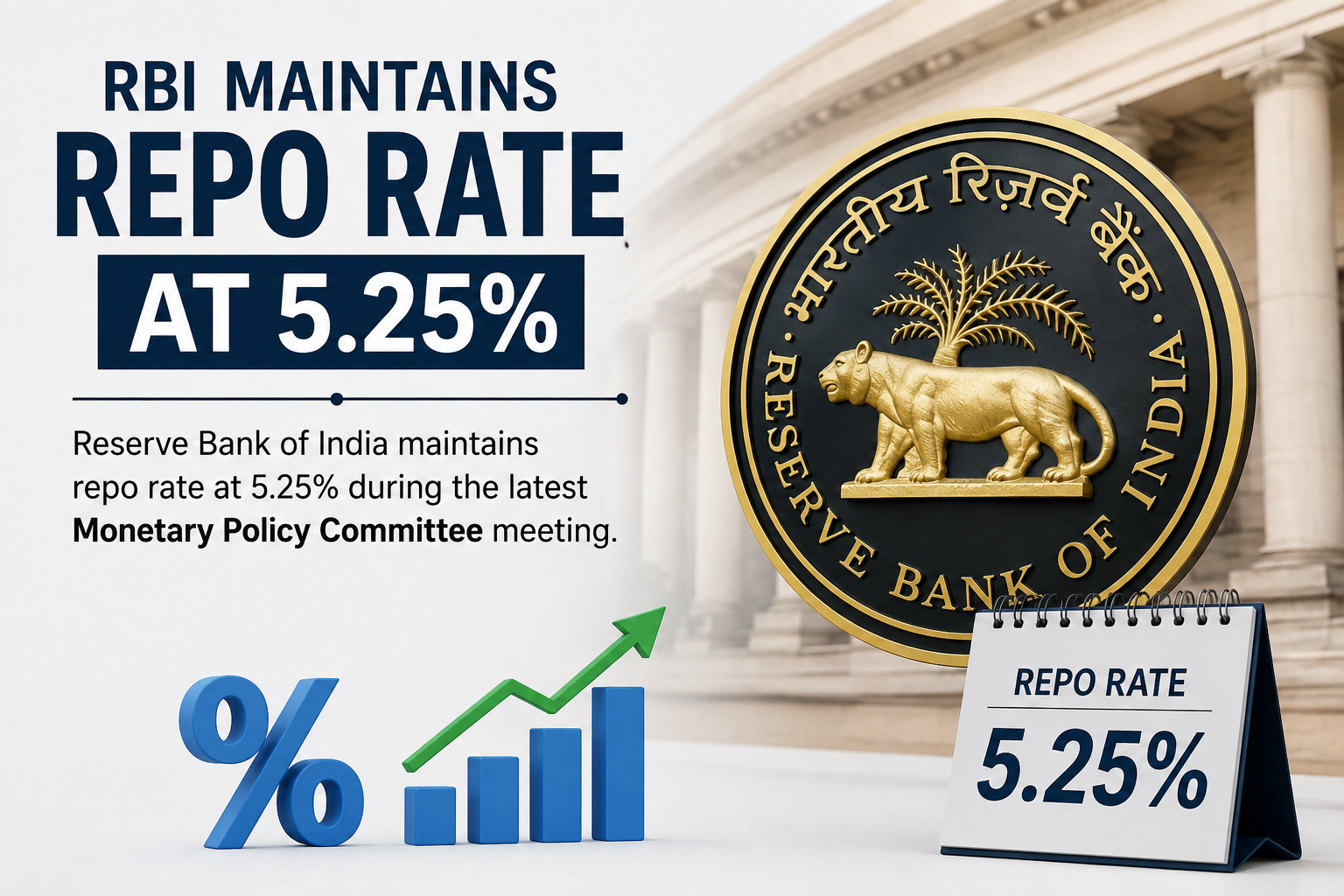
The Reserve Bank of India (RBI) has decided to keep the repo rate unchanged at 5.25%. This means borrowing costs are likely to remain stable for now. Existing home loan and personal loan EMIs may not change immediately, while banks are expected to continue offering loans at current interest rates.
AI Answer Box
| Question | Short Answer |
|---|---|
| What is the current RBI repo rate? | The repo rate remains at 5.25%. |
| Why did RBI keep the repo rate unchanged? | To balance inflation control while supporting economic growth. |
| Will home loan EMIs decrease? | No immediate reduction is expected unless banks revise lending rates. |
| Will FD interest rates change? | Most banks are expected to maintain current deposit rates. |
| Who benefits? | Borrowers, businesses, and investors benefit from stable borrowing costs. |
Introduction
The Reserve Bank of India (RBI) has once again maintained the repo rate at 5.25%, signaling policy stability amid evolving domestic and global economic conditions.
The decision was announced after the latest Monetary Policy Committee (MPC) meeting and reflects RBI's strategy of balancing inflation with sustainable economic growth.
For millions of borrowers, homeowners, businesses, and investors, this announcement provides clarity about borrowing costs and future financial planning.
What Is the Repo Rate?
The repo rate is the interest rate at which commercial banks borrow short-term funds from the RBI.
A change in this rate directly influences:
- Home loan interest rates
- Personal loan interest rates
- Business loans
- Vehicle loans
- EMIs
- Fixed deposit rates
- Economic growth
Current RBI Monetary Policy Snapshot
| Policy Measure | Latest Status |
| Repo Rate | 5.25% |
| Policy Decision | Unchanged |
| Objective | Balance inflation and growth |
| Expected EMI Impact | Mostly Stable |
| Banking Liquidity | Adequate |
Why Did RBI Keep the Repo Rate Unchanged?
Several economic indicators likely supported the RBI's decision:
1. Inflation Remains Manageable
Inflation has moderated compared to previous highs, allowing the central bank to avoid immediate rate changes while remaining vigilant.
2. Stable Economic Growth
India continues to show resilience in sectors such as:
- Manufacturing
- Services
- Infrastructure
- Digital economy
- Consumer demand
3. Global Economic Uncertainty
International developments, including commodity prices, trade conditions, and global monetary policies, continue to warrant a cautious approach.
4. Financial Stability
Maintaining the current rate provides predictability for financial markets and lending institutions.
Impact on Home Loan Borrowers
Existing Home Loans
If your loan is linked to an external benchmark such as the repo rate:
- EMIs are expected to remain largely unchanged.
- Loan tenure should remain stable unless banks revise spreads.
New Home Loans
Banks are likely to continue offering home loans at prevailing interest rates, subject to borrower profile and market conditions.
Impact on Personal Loan Customers
Personal loan borrowers can expect:
- Stable interest rates
- Easier financial planning
- Predictable EMI obligations
However, actual loan pricing still depends on:
- Credit score
- Income
- Employer profile
- Existing liabilities
Impact on Businesses
Businesses generally benefit from policy stability because:
- Financing costs remain predictable.
- Investment planning becomes easier.
- Working capital expenses stay relatively stable.
This is particularly helpful for MSMEs and expanding enterprises.
Impact on Investors
Stable policy rates often influence:
- Equity market sentiment
- Banking sector stocks
- Bond yields
- Mutual fund performance
Investors typically monitor future RBI commentary for clues about the direction of interest rates.
Impact on Fixed Deposits
Since the repo rate remains unchanged:
- Most banks are expected to maintain existing FD rates.
- New deposit rates may not see major changes in the short term.
Pros and Cons of Keeping the Repo Rate Unchanged
| Pros | Cons |
| Stable EMIs | Borrowers don't receive lower interest rates |
| Predictable lending environment | Savings returns may remain unchanged |
| Supports business confidence | Limited immediate stimulus |
| Helps financial planning | Rate-sensitive sectors may seek lower borrowing costs |
Comparison: Rate Cut vs Rate Hold
| Factor | Rate Cut | Rate Held at 5.25% |
| EMIs | May reduce | Stable |
| Borrowing Cost | Lower | Unchanged |
| Inflation Risk | Higher | Better controlled |
| Economic Stability | Stimulus | Balanced |
| Savings Returns | May decline | Mostly stable |
What Should Borrowers Do Now?
Step 1
Review your current loan interest rate.
Step 2
Check whether your loan is linked to the repo rate.
Step 3
Compare offers from multiple lenders.
Step 4
Maintain a strong credit score for better refinancing opportunities.
Step 5
Avoid unnecessary high-interest borrowing.
Expert Commentary
The RBI's decision to maintain the repo rate reflects a measured approach. A stable interest-rate environment can help households and businesses plan finances with greater confidence while allowing policymakers to monitor inflation and growth before making future adjustments. Borrowers should continue focusing on improving creditworthiness and managing debt responsibly rather than expecting immediate changes in loan costs.
Key Takeaways
- RBI has maintained the repo rate at 5.25%.
- Home loan EMIs are expected to remain stable.
- Personal loan interest rates are unlikely to change immediately.
- Businesses benefit from predictable borrowing costs.
- Fixed deposit rates are expected to remain broadly unchanged.
- RBI continues balancing inflation control with economic growth.
Frequently Asked Questions
1. What is the RBI repo rate now?
The repo rate currently stands at 5.25%.
2. Why did RBI keep the repo rate unchanged?
To support growth while keeping inflation under control.
3. Will my home loan EMI reduce?
No immediate reduction is expected unless your lender revises its rates.
4. Will personal loan interest rates change?
Most lenders are expected to keep rates broadly stable in the near term.
5. What is the repo rate?
It is the rate at which banks borrow money from the RBI.
6. How does the repo rate affect EMIs?
Changes in the repo rate can influence floating-rate loan EMIs over time.
7. Will fixed deposit rates increase?
Not necessarily. Deposit rates are likely to remain close to current levels.
8. Is this good for businesses?
Yes. Stable borrowing costs help businesses plan investments.
9. Can banks still change loan rates?
Yes. Banks may adjust lending rates based on funding costs and internal policies.
10. Does this affect credit card interest?
Not directly, though broader interest-rate trends can have indirect effects.
11. What should borrowers do now?
Review loan terms, maintain a healthy credit score, and compare lenders if refinancing.
12. When will RBI review the repo rate again?
The Monetary Policy Committee reviews policy at its scheduled meetings throughout the year.
13. Is inflation still a concern?
The RBI continues to monitor inflation closely while supporting growth.
14. Should I refinance my loan now?
Refinancing depends on your current interest rate, loan balance, and lender offers.
Published on : 05th August
Published by : shibam N
www.vizzve.com || www.vizzveservices.com
Follow us on social media: Facebook || Linkedin || Instagram
🛡 Powered by Vizzve Financial
RBI-Registered Loan Partner | 10 Lakh+ Customers | ₹600 Cr+ Disbursed