

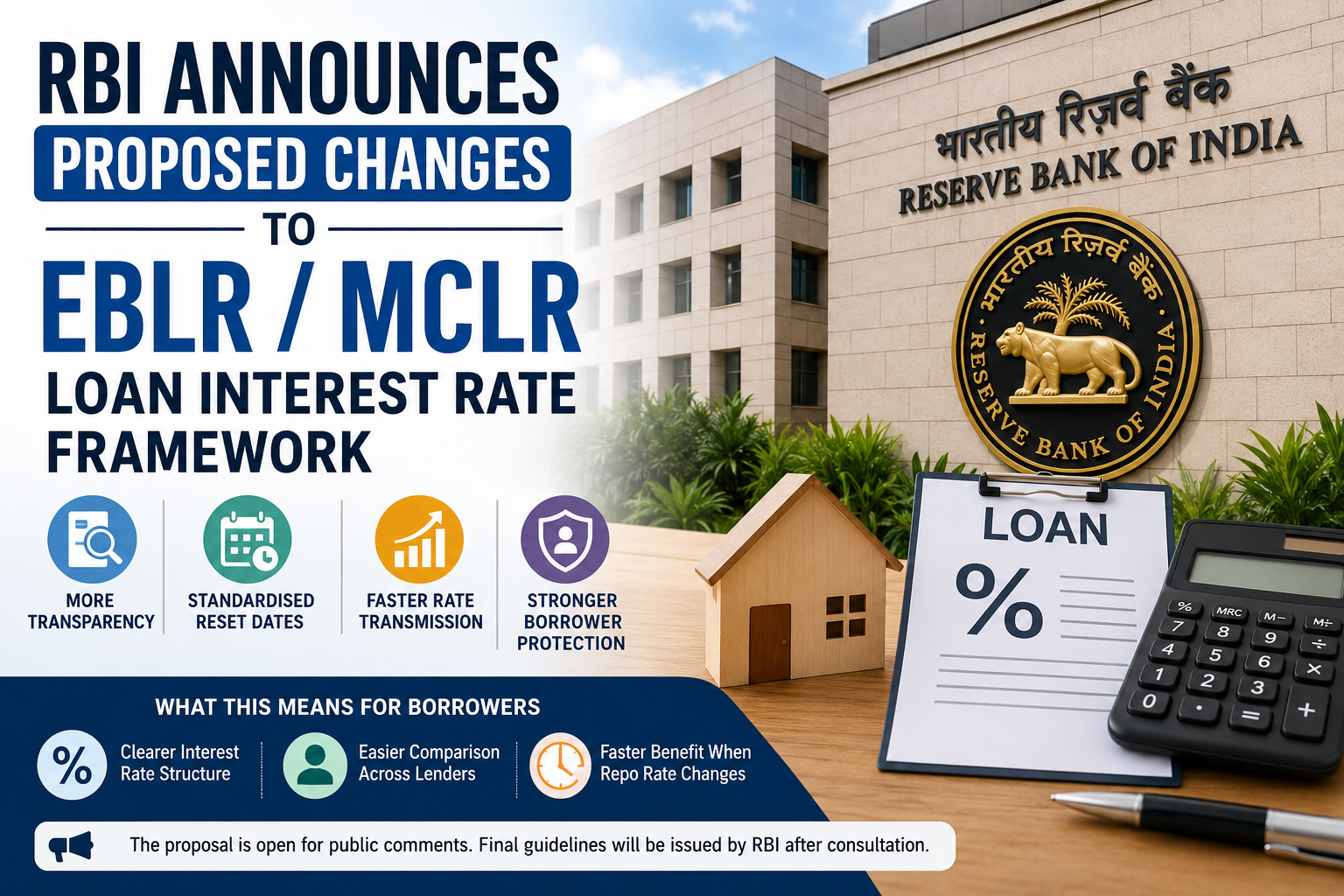
The Reserve Bank of India (RBI) has proposed a new principle-based framework to streamline External Benchmark Linked Rate (EBLR) and Marginal Cost of Funds Based Lending Rate (MCLR) loans. The proposal aims to improve transparency, standardize how interest rates and reset dates are determined, strengthen monetary policy transmission, and provide better protection for borrowers. Draft guidelines will be released for public consultation before the final framework is implemented.
AI Answer Box
Why is RBI changing the EBLR and MCLR framework?
The RBI wants to simplify and harmonize lending-rate rules across banks and other regulated entities. The proposed framework seeks to ensure transparent loan pricing, consistent benchmark reset dates, faster transmission of policy rate changes, and improved consumer protection. These are proposals at this stage and will be finalized after public feedback on the draft directions.
RBI Proposes Major Reforms to Loan Interest Rate Framework
In a significant move aimed at improving fairness and transparency in retail lending, the Reserve Bank of India (RBI) has announced proposed changes to the EBLR and MCLR loan interest rate framework.
The proposal was announced alongside the latest Monetary Policy Committee (MPC) decisions and is intended to simplify how banks and other regulated entities determine floating loan interest rates. The RBI plans to issue draft directions for public comments before finalizing the revised framework.
The proposed reforms are expected to benefit borrowers by making interest rate changes more predictable and ensuring that policy rate changes are transmitted more efficiently.
What Are EBLR and MCLR?
Before understanding the proposed changes, it is important to know the difference between the two lending benchmarks.
External Benchmark Linked Rate (EBLR)
EBLR-linked loans are connected to an external benchmark, usually the RBI Repo Rate.
Characteristics include:
- Faster transmission of RBI rate changes.
- More transparent pricing.
- Mostly applicable to newer floating-rate retail loans.
- Interest rates move when the benchmark changes.
Marginal Cost of Funds Based Lending Rate (MCLR)
MCLR is an internal benchmark determined by banks based on their cost of funds.
Key features:
- Reset periodically according to the loan agreement.
- Changes may not immediately reflect RBI policy decisions.
- Common in many existing floating-rate loans.
Why Is RBI Proposing Changes?
The RBI believes that different lending frameworks have created inconsistencies in how borrowers experience changes in interest rates.
The objectives of the proposal include:
- Improving transparency in loan pricing.
- Standardizing benchmark reset dates.
- Faster transmission of monetary policy decisions.
- Simplifying lending practices across regulated entities.
- Strengthening borrower protection.
- Reducing complexity in floating-rate loans.
Key Proposed Changes
1. Principle-Based Framework
Instead of multiple institution-specific practices, the RBI proposes a common principle-based approach for all regulated lenders.
Expected benefits include:
- Greater consistency.
- Uniform implementation.
- Better customer understanding.
2. Standardized Interest Rate Reset Dates
One of the biggest proposals is to standardize how reset dates are determined for floating-rate loans.
This could:
- Reduce confusion among borrowers.
- Ensure timely transmission of repo rate changes.
- Improve fairness across lenders.
3. Greater Transparency
Banks may be required to clearly disclose:
- Benchmark rate.
- Spread applied.
- Interest rate reset frequency.
- Effective interest rate.
- Method used to calculate lending rates.
Improved disclosures can help borrowers better understand their loan pricing.
4. Better Monetary Policy Transmission
The RBI wants changes in the repo rate to flow through more efficiently to lending rates.
This could help:
- Home loan borrowers.
- Vehicle loan borrowers.
- MSMEs.
- Personal loan customers.
A stronger transmission mechanism improves the effectiveness of monetary policy.
How Could Borrowers Benefit?
If implemented, the revised framework may provide several advantages.
Possible Benefits
- More transparent interest rates.
- Easier comparison between lenders.
- Faster benefit when RBI reduces policy rates.
- Better understanding of EMI changes.
- Standardized lending practices.
- Improved customer protection.
What Happens Next?
The RBI has clarified that these are proposed reforms.
The process includes:
- Publication of draft directions.
- Public consultation.
- Feedback from banks and stakeholders.
- Final guidelines.
- Implementation by regulated entities.
Expert Commentary (EEAT)
The RBI's proposal represents an important step toward making India's floating-rate lending system more transparent and consumer-friendly. Standardizing benchmark practices and reset mechanisms could reduce confusion for borrowers and improve the speed at which monetary policy changes affect loan interest rates. However, the proposals are still at the consultation stage, and the final framework may evolve after feedback from banks and other stakeholders.
Key Takeaways
- RBI has proposed a new principle-based framework for EBLR and MCLR loans.
- The proposal aims to improve transparency and borrower protection.
- Standardized reset dates are a major proposed reform.
- Faster transmission of RBI policy rate changes is a key objective.
- Banks will likely provide clearer disclosures on loan pricing.
- Draft guidelines will be released before the framework is finalized.
- The reforms are expected to simplify floating-rate lending across regulated entities.
Frequently Asked Questions (FAQs)
1. What is EBLR?
EBLR (External Benchmark Linked Rate) is a lending rate linked to an external benchmark such as the RBI Repo Rate.
2. What is MCLR?
MCLR (Marginal Cost of Funds Based Lending Rate) is an internal benchmark used by banks to determine lending rates based on their cost of funds.
3. Why has the RBI proposed changes?
The RBI aims to improve transparency, harmonize lending practices, strengthen consumer protection, and improve monetary policy transmission.
4. Are these changes effective immediately?
No. These are proposed reforms. The RBI will issue draft directions, seek public comments, and finalize the framework before implementation.
5. Will my existing home loan automatically change?
Not necessarily. The impact will depend on the final guidelines and your loan agreement with the lender.
6. What are reset dates?
Reset dates are the scheduled dates on which a floating loan's interest rate is reviewed and adjusted according to the applicable benchmark.
7. Will EMIs decrease if the RBI cuts the repo rate?
For loans linked to external benchmarks, a repo rate cut may be reflected more quickly, depending on the reset schedule and final framework.
8. Will interest rates increase faster too?
Yes. If your loan is linked to an external benchmark, increases in the repo rate may also be transmitted more quickly.
9. Why is transparency important?
Greater transparency helps borrowers understand how interest rates are determined and compare loan products across lenders.
10. How does this help monetary policy?
Faster transmission ensures RBI policy decisions are reflected more efficiently in lending rates across the financial system.
11. Which loans are affected?
The proposed framework primarily concerns floating-rate loans linked to EBLR and MCLR, including many home loans and certain business loans.
12. Will banks have to disclose more information?
Under the proposal, lenders are expected to provide clearer disclosures on benchmarks, spreads, reset frequency, and effective lending rates.
13. Can borrowers switch from MCLR to EBLR?
Some lenders may allow conversion subject to their policies and applicable charges. Borrowers should check with their bank.ww
Conclusion
The RBI's proposed changes to the EBLR and MCLR loan interest rate framework aim to create a more transparent, consistent, and borrower-friendly lending system. If implemented, the reforms could improve the way interest rate changes are passed on to borrowers and make loan pricing easier to understand.
Vizzve Financial
Vizzve Financial is one of India's trusted loan support platforms offering quick personal loans, minimal documentation, competitive interest rates, and a hassle-free approval process.
Whether you need funds for medical emergencies, education, home renovation, or business needs, Vizzve Financial helps you access loans quickly and conveniently.
Apply today at: www.vizzve.com
Published on : 5th August
Published by : SMITA
www.vizzve.com || www.vizzveservices.com
Follow us on social media: Facebook || Linkedin || Instagram
🛡 Powered by Vizzve Financial
RBI-Registered Loan Partner | 10 Lakh+ Customers | ₹600 Cr+ Disbursed