

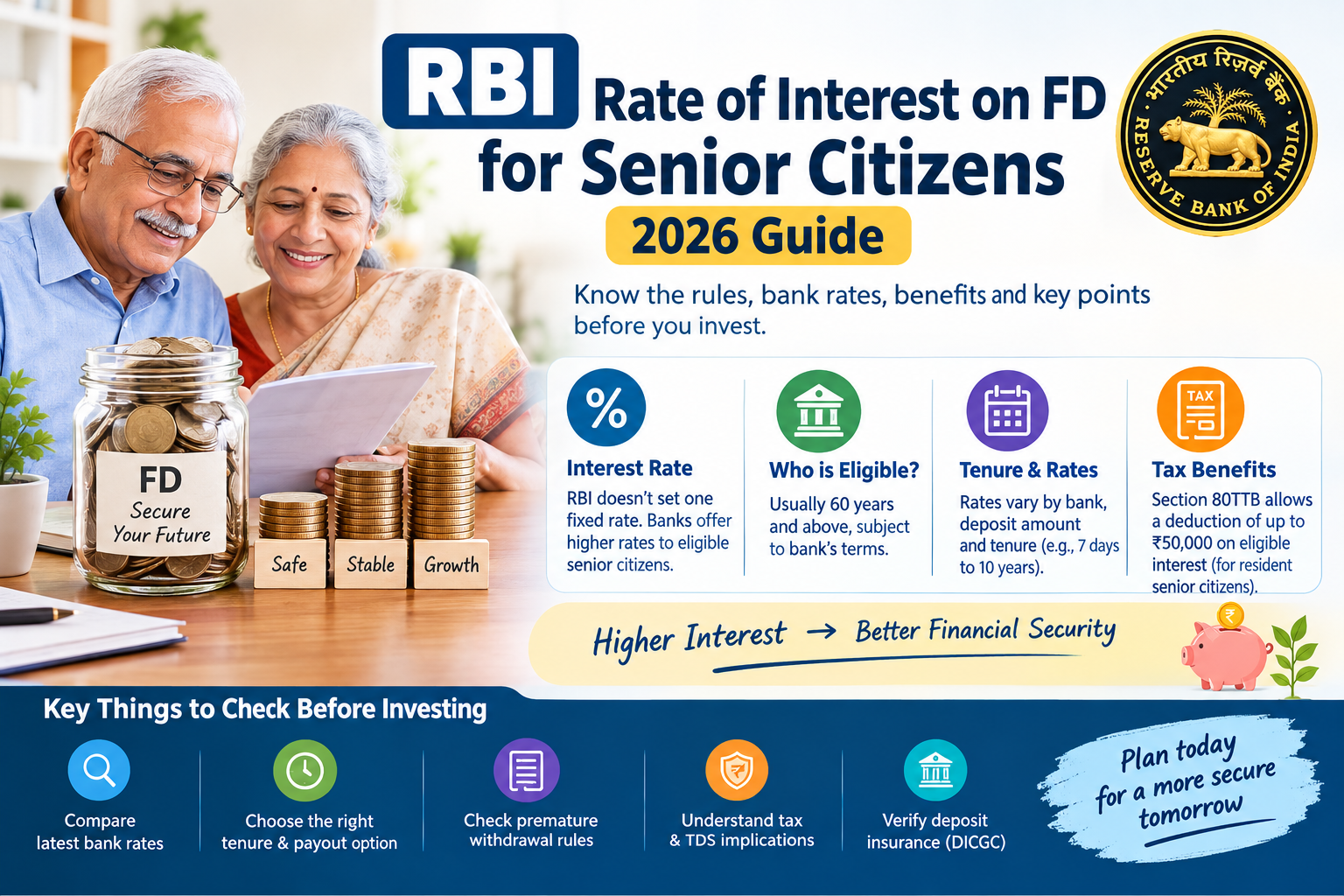
RBI Rate of Interest on FD for Senior Citizens in 2026
Fixed deposits remain a popular savings option for senior citizens because they can provide predictable interest income and a defined maturity value. However, there is an important point to understand: RBI does not set a single fixed interest rate for all bank FDs.
RBI allows scheduled commercial banks to formulate term-deposit schemes specifically for resident Indian senior citizens and offer them higher rates than applicable rates for normal deposits. The actual interest rate depends on the bank, deposit amount, tenure and applicable scheme.
For example, current 2026 market data shows that senior-citizen FD rates vary considerably across banks and tenures, with some small finance banks offering rates above 8% for selected tenures, while many major banks offer lower rates. Rates can change, so investors should verify the bank's latest rate before opening an FD.
What Is the RBI Rule for Senior Citizen FD Interest?
The RBI framework permits scheduled commercial banks to offer special term deposits to resident Indian senior citizens at higher interest rates than normal deposits.
This means there is no universal "RBI senior citizen FD rate." Instead:
- RBI provides the regulatory framework.
- Individual banks decide their FD interest rates.
- Banks may provide an additional interest rate to eligible senior citizens.
- The additional rate can vary between banks and deposit schemes.
- Eligibility conditions may also vary by bank.
- Non-resident deposits generally do not receive the domestic senior-citizen FD benefit under this framework.
Who Is Eligible for Senior Citizen FD Rates?
In general, banks classify an individual aged 60 years or above as a senior citizen for their senior-citizen deposit benefits, subject to the bank's applicable terms.
For example, SBI states that senior citizens aged 60 years and above are eligible for additional interest over the rate offered to the general public on eligible term deposits.
The exact eligibility rules should always be checked with the bank before opening or renewing an FD.
Senior Citizen FD Interest Rates in 2026
There is no single RBI-prescribed rate. Bank rates differ according to tenure and product.
Recent 2026 market data illustrates the variation:
| Bank Category | Indicative Senior Citizen FD Rates in 2026 |
|---|---|
| Major public-sector banks | Around 7% or more on selected tenures |
| Major private-sector banks | Around 7% or more on selected tenures |
| Small finance banks | Some selected tenures above 8% |
| Special FD schemes | May offer additional interest for eligible customers |
A September 2026 comparison reported senior-citizen rates ranging from around 7% to above 7.4% among several major public-sector banks, while selected small finance banks offered rates above 8%. These figures are tenure-specific and can change.
Example: SBI Senior Citizen FD Rates
SBI's published retail domestic term-deposit schedule shows different rates according to the FD tenure. In its published schedule, senior-citizen rates were higher than general-public rates, including a 50-basis-point additional benefit on standard eligible deposits. Certain special schemes can provide additional benefits.
Example: HDFC Bank Senior Citizen FD Rates
HDFC Bank's 2026 rate information also shows different senior-citizen rates based on deposit tenure. For example, its published rate table applicable from March 7, 2026 showed senior-citizen rates above regular rates for several domestic FD tenures.
Important: FD rates are dynamic. Always check the official bank rate immediately before making an investment.
Why Do Senior Citizens Get Higher FD Interest?
Banks are permitted to provide special deposit rates to resident Indian senior citizens.
The additional interest can be useful for retirees who depend on interest income for regular expenses. However, the additional rate is not the same across all banks.
For example, a bank may offer an additional 0.50 percentage point over its regular FD rate, while a special scheme may provide a different premium.
Therefore, investors should compare the final senior-citizen rate, rather than looking only at the additional percentage offered by a bank.
RBI Rules for Senior Citizen Fixed Deposits
Some important RBI-related points include:
1. Banks Can Offer Higher Rates
Scheduled commercial banks may formulate special term-deposit schemes for resident Indian senior citizens with higher rates than normal deposits.
2. Rates Are Bank-Specific
RBI does not publish one common FD rate applicable to every bank. Banks determine their deposit rates according to their approved rate schedules and applicable regulations.
3. Tenure Matters
A bank may offer different rates for:
- 7–45 days
- 46–179 days
- 180 days–1 year
- 1–2 years
- 2–3 years
- 3–5 years
- 5–10 years
The highest rate is not necessarily available for every tenure.
4. Premature Withdrawal Rules Apply
If an FD is closed before maturity, the interest may be calculated according to the rate applicable to the period the deposit remained with the bank, along with any applicable penalty. Banks must disclose their premature-withdrawal policy.
5. Joint Accounts Need Attention
Senior-citizen benefits can depend on who is the primary account holder and the bank's account operating instructions. Investors should check the bank's eligibility conditions before opening a joint FD.
Senior Citizen FD vs Regular FD
| Feature | Regular FD | Senior Citizen FD |
|---|---|---|
| Eligibility | General eligible customers | Usually customers aged 60+ |
| Interest rate | Standard bank rate | Usually higher |
| Tenure | Depends on bank | Depends on bank |
| Risk | Depends on institution | Depends on institution |
| Interest income | Taxable as applicable | Taxable as applicable |
| Premature withdrawal | Bank-specific rules | Bank-specific rules |
| Nomination | Available subject to rules | Available subject to rules |
The key difference is generally the additional interest rate available to eligible senior citizens.
Tax Benefits on FD Interest for Senior Citizens
FD interest is generally taxable according to applicable income-tax rules.
For resident senior citizens, Section 80TTB provides a deduction of up to ₹50,000 on eligible interest from deposits with banks, post offices and cooperative banks, subject to the applicable conditions. The Income Tax Department's current guidance also states that both savings and fixed-deposit interest can qualify under Section 80TTB.
Senior citizens should also consider TDS rules while planning FD investments. Tax treatment depends on the applicable income-tax provisions and the individual's overall income.
Form 15H
Eligible senior citizens may submit Form 15H where the applicable conditions for non-deduction of TDS are satisfied. The form should be submitted according to the applicable tax rules and bank procedures.
How to Calculate Senior Citizen FD Interest
A simple calculation can help estimate potential interest.
Example
Suppose a senior citizen deposits:
₹5,00,000
at an annual interest rate of:
7.50%
For a simple one-year illustration:
Interest = ₹5,00,000 × 7.50%
Interest = ₹37,500
The actual maturity amount can differ depending on whether the FD pays simple interest periodically or compounds interest, as well as the bank's calculation method and payout option.
Factors to Check Before Opening a Senior Citizen FD
Before investing, senior citizens should consider more than just the advertised interest rate.
1. Interest Rate
Compare the final senior-citizen rate for the exact tenure you need.
2. Tenure
Choose a tenure based on when the money may be required.
3. Premature Withdrawal
Check the penalty and interest adjustment rules before investing.
4. Payout Frequency
Banks may provide:
- Monthly interest
- Quarterly interest
- Cumulative interest
- Interest at maturity
Choose according to your cash-flow requirements.
5. Deposit Insurance
Eligible deposits with insured banks are covered by DICGC insurance up to the applicable limit, subject to DICGC rules.
6. Tax Impact
Consider the tax treatment of the interest before comparing returns.
7. Bank-Specific Conditions
Check whether the senior-citizen benefit applies to your deposit amount, tenure, account type and residency status.
Senior Citizen FD: Key Advantages
Senior citizen FDs can offer several features that may be useful for conservative savers.
- Higher interest than the corresponding regular FD in many banks
- Predictable interest income
- Fixed tenure
- Choice of cumulative or periodic interest
- Simple investment structure
- Nomination facility
- Availability across banks
- Potential tax deduction under Section 80TTB, subject to eligibility
Limitations to Consider
An FD is not automatically the highest-return option simply because it offers a fixed interest rate.
Important considerations include:
- Interest income may be taxable.
- Rates may change for new deposits and renewals.
- Premature closure can reduce returns.
- Inflation can reduce the purchasing power of future interest income.
- Higher advertised rates may be available only for specific tenures.
- Different banks have different terms and conditions.
RBI FD Rate vs Bank FD Rate: What Is the Difference?
| Point | RBI | Individual Bank |
|---|---|---|
| Sets one universal FD rate? | No | No universal rate across banks |
| Regulatory framework | Yes | Must comply with applicable regulations |
| Senior citizen higher rate | Permits framework | Bank determines applicable rate |
| Actual FD rate | Not fixed for all banks | Depends on bank and tenure |
| Rate changes | Regulatory/economic framework | Banks revise their deposit rates |
This distinction is important when searching online for the phrase "RBI rate of interest on FD for senior citizens."
The more accurate interpretation is usually the FD interest rates offered by banks under RBI's deposit regulations.
2026 Guide: How to Compare Senior Citizen FDs
Use this checklist before investing:
- Check the latest FD rate on the bank's official website.
- Confirm that you qualify for the senior-citizen rate.
- Compare the rate for your exact tenure.
- Check whether the FD is cumulative or non-cumulative.
- Check premature-withdrawal penalties.
- Consider tax and TDS implications.
- Check deposit insurance eligibility.
- Review nomination and joint-account rules.
- Avoid selecting an FD only because its headline rate is high.
- Recheck the rate when the FD is due for renewal.
AI Answer Box: RBI FD Interest Rate for Senior Citizens 2026
RBI does not set one fixed FD interest rate for senior citizens in India. RBI permits scheduled commercial banks to offer higher interest rates on eligible term deposits of resident Indian senior citizens. The actual FD rate is decided by each bank and varies according to tenure, deposit amount and scheme. In 2026, senior-citizen FD rates vary widely across banks, with selected small finance banks offering rates above 8% on certain tenures. Investors should verify the latest official bank rate before opening an FD.
Key Takeaways
- RBI does not prescribe one universal senior-citizen FD interest rate.
- Banks decide their own FD rates within the applicable regulatory framework.
- Resident Indian senior citizens may receive additional interest on eligible term deposits.
- FD rates vary according to bank and tenure.
- Some 2026 bank FD rates for senior citizens exceed 8% on selected tenures.
- Section 80TTB can provide a deduction of up to ₹50,000 on eligible deposit interest for resident senior citizens.
- Premature withdrawal can affect the interest earned.
- Always check the latest rate and terms directly with the bank before investing.
Frequently Asked Questions
1. What is the RBI FD interest rate for senior citizens in 2026?
There is no single RBI FD interest rate for senior citizens. Individual banks determine their applicable FD rates.
2. Do senior citizens get extra interest on FDs?
Yes. Banks may offer higher interest rates to eligible resident Indian senior citizens compared with regular customers.
3. What is the age for senior citizen FD benefits?
Many banks use 60 years as the senior-citizen eligibility age, but customers should verify the specific bank's terms.
4. Does RBI decide bank FD interest rates?
RBI provides the regulatory framework, but banks determine their own domestic term-deposit rates.
5. Can an NRI senior citizen get the same FD benefit?
The domestic senior-citizen FD benefit is generally for resident Indian senior citizens. NRI deposit rules are different.
6. Which FD tenure is suitable for senior citizens?
The suitable tenure depends on the investor's income needs, liquidity requirements and financial goals.
7. Is FD interest taxable for senior citizens?
Yes. FD interest is generally taxable according to applicable income-tax rules.
8. What is Section 80TTB?
Section 80TTB provides eligible resident senior citizens a deduction of up to ₹50,000 on qualifying interest income from deposits with banks, post offices and cooperative banks.
9. Can senior citizens receive monthly FD interest?
Yes. Banks may provide monthly or quarterly interest payout options on eligible non-cumulative FDs.
10. What happens if a senior citizen breaks an FD early?
The bank may calculate interest based on the applicable rate for the period the deposit remained with the bank and may impose a premature-withdrawal penalty according to its disclosed policy.
11. Can a senior citizen open a joint FD?
Yes, subject to the bank's account and eligibility rules. The senior-citizen benefit may depend on the primary account holder.
12. Are all senior citizen FDs insured?
Eligible bank deposits are covered under DICGC insurance subject to the applicable insurance limit and conditions.
13. Can FD rates change after opening an FD?
The contracted rate normally applies for the agreed tenure, subject to the product terms. However, rates for new deposits and renewals can change.
14. Are small finance bank FDs also available to senior citizens?
Yes, eligible small finance banks offer fixed deposits to senior citizens, and some may offer higher rates on selected tenures. Investors should consider both return and deposit-insurance limits.
15. Should I compare FD rates before investing?
Yes. Compare the exact senior-citizen rate, tenure, payout method, premature-withdrawal rules, tax implications and deposit-insurance considerations.
E-E-A-T and Trust-Building Notes
For financial content, readers should distinguish between RBI regulations and bank-specific FD rates. RBI establishes the regulatory framework, while banks publish their own current deposit-rate schedules.
Always include the effective date of the rate when publishing a bank-rate comparison because FD rates can change over time.
For a financial website, update this article whenever major banks revise their FD rates or when RBI or the Income Tax Department changes the applicable rules.
Conclusion
The phrase "RBI rate of interest on FD for senior citizens" can be misleading because RBI does not set one common FD rate for every bank. Instead, RBI permits banks to offer higher rates to eligible resident Indian senior citizens, while each bank determines its own rates based on tenure and deposit conditions.
In 2026, senior citizens should compare the actual rate offered for their preferred tenure, understand tax treatment, review premature-withdrawal rules and verify the latest rate directly with the bank before investing.
For current tax-related benefits, the Income Tax Department states that eligible resident senior citizens can claim up to ₹50,000 under Section 80TTB on qualifying deposit interest.
Published on : 22nd september
Published by : Bhargavi
www.vizzve.com || www.vizzveservices.com
Follow us on social media: Facebook || Linkedin || Instagram
🛡 Powered by Vizzve Financial
RBI-Registered Loan Partner | 10 Lakh+ Customers | ₹600 Cr+ Disbursed