

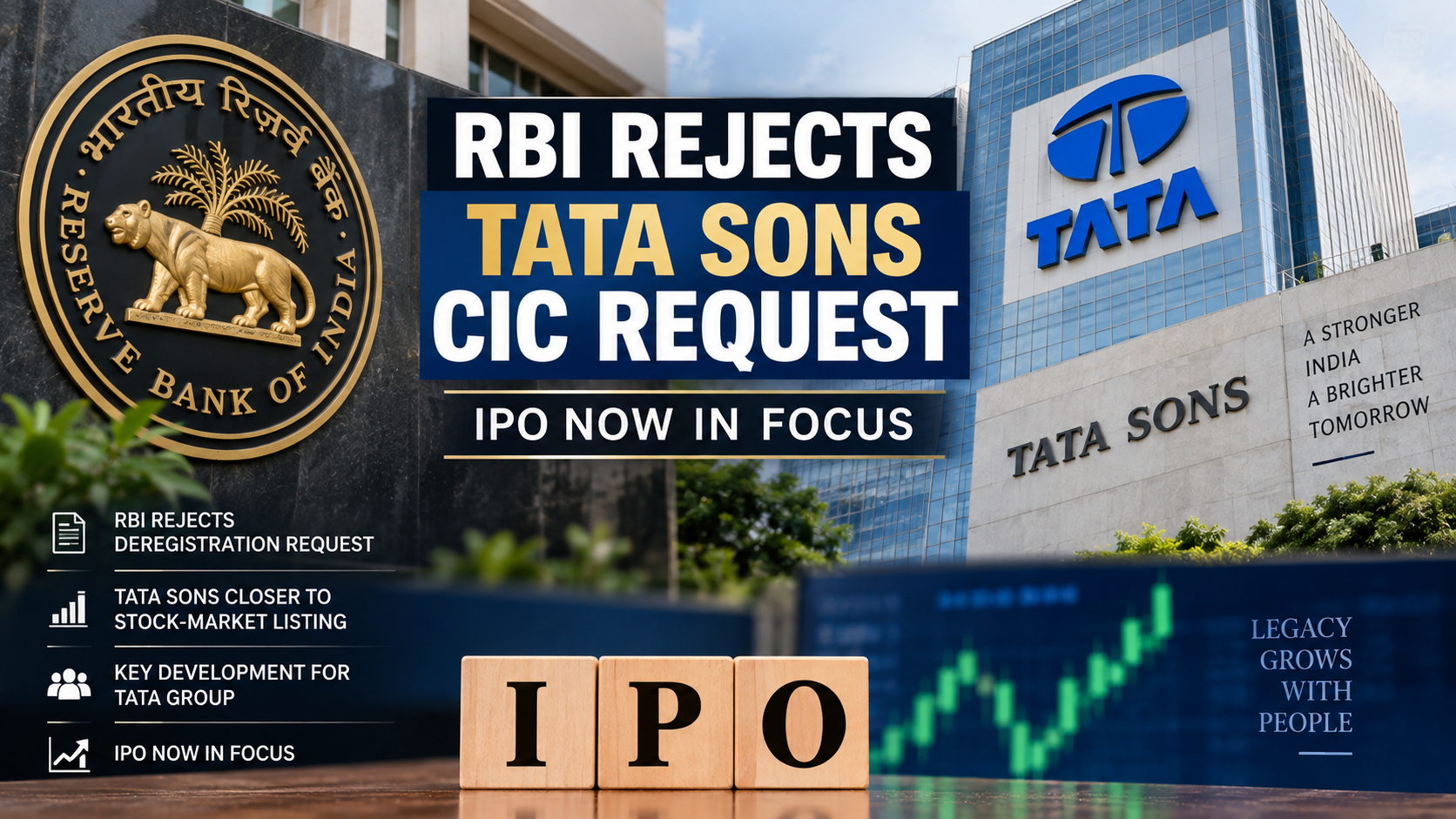
The Reserve Bank of India (RBI) has rejected Tata Sons’ request to surrender its registration as a Core Investment Company (CIC), bringing the holding company of the Tata Group closer to a possible stock-market listing.
The decision, communicated to Tata Sons on September 12, 2026, effectively closes the route the company had pursued to remain outside the RBI’s registration framework. Tata Sons had applied in March 2024 to surrender its Certificate of Registration as a CIC after becoming debt-free.
The RBI's decision means Tata Sons remains an Upper Layer Non-Banking Financial Company (NBFC-UL) and will have to comply with the regulatory framework applicable to such entities, including the requirement for public listing.
However, it is important to note that the RBI rejection does not mean a Tata Sons IPO will launch immediately. The company could still examine legal and regulatory options before deciding its next steps.
What Did the RBI Decide?
Tata Sons had sought to surrender its CIC registration, a move that could have allowed it to remain a privately held and unlisted holding company.
The RBI has now rejected that application.
As a result, Tata Sons continues to fall under the Upper Layer NBFC framework. The RBI had classified Tata Sons as an Upper Layer NBFC in 2022, and it was retained in the regulator's FY2026-27 list in August.
The latest rejection removes a major uncertainty that had surrounded the company's listing status for years.
Why Is Tata Sons Expected to Move Toward an IPO?
The key reason is its classification as an Upper Layer NBFC.
Under RBI regulations, companies in this category are subject to stricter regulatory requirements, including public listing.
Tata Sons is well above the asset-size threshold used for Upper Layer classification. Reuters reported that its standalone assets were around ₹1.75 lakh crore as of March 2025, while other recent reports put its FY2026 assets at around ₹2.01 lakh crore.
This makes it difficult for Tata Sons to avoid the regulatory framework simply by remaining private.
What Is Tata Sons?
Tata Sons is the principal holding company of the Tata Group, one of India's largest and most diversified business groups.
It has interests across sectors including:
- Information technology
- Automobiles
- Steel
- Consumer products
- Airlines
- Hotels
- Financial services
- Chemicals
- Electronics
- Infrastructure
- Energy
Major Tata Group businesses include Tata Consultancy Services (TCS), Tata Motors, Tata Steel and Air India, among many others.
Because Tata Sons sits at the centre of this large corporate ecosystem, a public listing would be a significant event for India's capital markets.
Tata Sons IPO Could Be One of India's Biggest Listings
A potential Tata Sons IPO has attracted enormous interest because of the company's extensive ownership and investments across the Tata Group.
Some market estimates have placed Tata Sons' potential valuation at very high levels, although there is currently no officially announced IPO valuation, issue size or price band.
That means investors should be careful with reports quoting specific Tata Sons IPO valuations before the company formally announces its plans.
If Tata Sons eventually lists, it could become one of India's most closely watched corporate listings.
Why Did Tata Sons Want to Surrender Its CIC Registration?
Tata Sons had applied for deregistration after significantly reducing its standalone debt.
The company's argument was that becoming debt-free and changing its funding structure could allow it to operate outside the CIC registration framework.
Remaining private also has several advantages for a large holding company:
- Greater control for existing shareholders
- No public share-price pressure
- Less extensive market disclosure
- More flexibility in long-term capital allocation
- Avoidance of the complexities associated with public shareholders
The RBI's rejection means this strategy has now faced a major regulatory setback.
Tata Trusts vs Other Shareholders
The potential listing also has an important shareholder dimension.
Tata Trusts holds roughly 66% of Tata Sons, making it the dominant shareholder. The Trusts have historically preferred maintaining the holding company as a private entity.
Meanwhile, the Shapoorji Pallonji Group, which owns roughly 18% of Tata Sons, has supported a public listing.
For the Shapoorji Pallonji Group, a listing could provide greater liquidity and potentially allow it to monetise part of its stake.
This difference in shareholder interests makes the Tata Sons listing issue more complicated than a simple regulatory decision.
What Could a Tata Sons Listing Mean for Investors?
If Tata Sons eventually goes public, investors could gain direct exposure to the holding company sitting above several major Tata businesses.
A listed Tata Sons could provide:
1. Greater Transparency
Public companies must disclose financial information, related-party transactions and other important corporate developments to shareholders and regulators.
2. Price Discovery
A stock-market listing would establish a publicly traded market value for Tata Sons.
3. Better Liquidity for Shareholders
Existing shareholders could potentially sell shares through the public market, subject to applicable rules and the structure of the offering.
4. Greater Corporate-Governance Scrutiny
Public shareholders and market regulators would add another layer of oversight to the holding company.
Why a Tata Sons IPO Could Also Be Complicated
Taking Tata Sons public would not be a simple process.
The company would need to address several important issues, including:
- IPO structure
- Shareholder interests
- Valuation
- Regulatory compliance
- Corporate governance
- Related-party transactions
- Ownership dilution
- Public disclosures
- Treatment of Tata Group investments
The company may also need to balance the interests of Tata Trusts with those of other shareholders.
What Does This Mean for the Tata Group?
The RBI's decision is important not only for Tata Sons but also for the wider Tata Group.
Tata Sons owns stakes in several major Tata companies. Any major change in its ownership structure could therefore attract attention from investors across the group.
A potential listing could also increase scrutiny of how Tata Sons allocates capital among its subsidiaries and investments.
For listed Tata companies, however, it is too early to assume that the RBI decision will automatically create a major financial impact. The eventual effect would depend on the structure and timing of any Tata Sons listing.
What Happens Next?
The immediate focus will be on Tata Sons' response to the RBI decision.
The company is expected to evaluate its regulatory and legal options before deciding how to proceed.
Reports indicate that a Tata Sons board meeting on September 17 is expected to discuss the latest developments.
The key questions for investors will be:
- Will Tata Sons challenge the RBI decision?
- Will it begin preparations for an IPO?
- What valuation could the company command?
- How much stake could be offered?
- Would Tata Trusts dilute its holding?
- How would the IPO affect other Tata Group companies?
Is a Tata Sons IPO Guaranteed?
It is more accurate to say that the RBI decision significantly strengthens the case for a public listing rather than saying an IPO is already confirmed.
The RBI has rejected the deregistration route, while Tata Sons remains classified as an Upper Layer NBFC.
Therefore, the regulatory pressure for listing is now substantially stronger.
However, the exact timing, structure, valuation and size of any IPO remain unknown.
Why This Matters for the Indian Stock Market
A Tata Sons listing could become a major event for India's capital markets.
The Tata Group is one of the country's most recognised business conglomerates, and a public offering of its holding company could attract significant interest from:
- Retail investors
- Mutual funds
- Domestic institutions
- Foreign portfolio investors
- Global investment funds
- Long-term institutional investors
It could also become a major test of investor appetite for diversified holding companies.
Key Takeaways
- RBI has rejected Tata Sons' request to surrender its CIC registration.
- Tata Sons remains an Upper Layer NBFC.
- The decision brings the company closer to a potential mandatory public listing.
- Tata Sons had applied for deregistration in March 2024.
- Tata Sons was classified as an Upper Layer NBFC in 2022.
- Its large asset base keeps it within the upper-layer regulatory framework.
- Tata Trusts owns roughly 66% of Tata Sons.
- Shapoorji Pallonji Group, a major minority shareholder, has supported listing.
- A potential Tata Sons IPO could become one of India's most closely watched listings.
- No official IPO price, valuation, issue size or launch date has been announced yet.
Frequently Asked Questions
1. Why did RBI reject Tata Sons' request?
The RBI rejected Tata Sons' application to surrender its Core Investment Company registration, meaning the company remains within the regulatory framework applicable to Upper Layer NBFCs.
2. Does this mean Tata Sons will definitely launch an IPO?
The decision puts Tata Sons much closer to a public listing, but it does not mean an IPO launches immediately. The company may consider its legal and regulatory options first.
3. What is Tata Sons?
Tata Sons is the principal holding company of the Tata Group and holds interests in several major Tata businesses.
4. What is a Core Investment Company?
A Core Investment Company, or CIC, is a specialised type of non-banking financial company whose principal business involves holding investments in group companies.
5. What is an Upper Layer NBFC?
An Upper Layer NBFC is a large or systemically important non-bank financial company subject to enhanced regulatory requirements under the RBI's scale-based framework.
6. When did Tata Sons apply for deregistration?
Tata Sons applied to surrender its CIC registration in March 2024.
7. How much is Tata Sons worth?
There is currently no official IPO valuation. Various market estimates have suggested very high valuations, but investors should wait for official disclosures before relying on specific numbers.
8. Who owns Tata Sons?
Tata Trusts owns approximately 66% of Tata Sons, while the Shapoorji Pallonji Group is a major minority shareholder.
9. Could Tata Sons IPO benefit investors?
A listing could provide direct market access to Tata Sons and establish public price discovery, but the investment case would depend on valuation, IPO structure and future performance.
10. When could Tata Sons IPO launch?
There is currently no officially announced IPO launch date.
Conclusion
The RBI's rejection of Tata Sons' CIC deregistration request marks a major development in one of India's longest-running corporate listing stories.
The decision removes a key route through which Tata Sons had hoped to remain private and strengthens the regulatory pressure for the company to comply with Upper Layer NBFC requirements.
For investors, the biggest question now is no longer simply “Will Tata Sons list?” but rather “How and when will Tata Sons list?”
With Tata Sons sitting at the heart of one of India's largest business groups, any future IPO could become a landmark event for the Indian stock market.
For now, investors should watch Tata Sons' response, the upcoming board discussions and any further communication from the RBI before making assumptions about the company's IPO timing or valuation.
Disclaimer: This article is for informational purposes only and does not constitute investment advice. Tata Sons has not officially announced an IPO price, issue size or listing date as of the latest available information.
Published on : 13th September
Published by : SMITA
www.vizzve.com || www.vizzveservices.com
Follow us on social media: Facebook || Linkedin || Instagram
🛡 Powered by Vizzve Financial
RBI-Registered Loan Partner | 10 Lakh+ Customers | ₹600 Cr+ Disbursed