

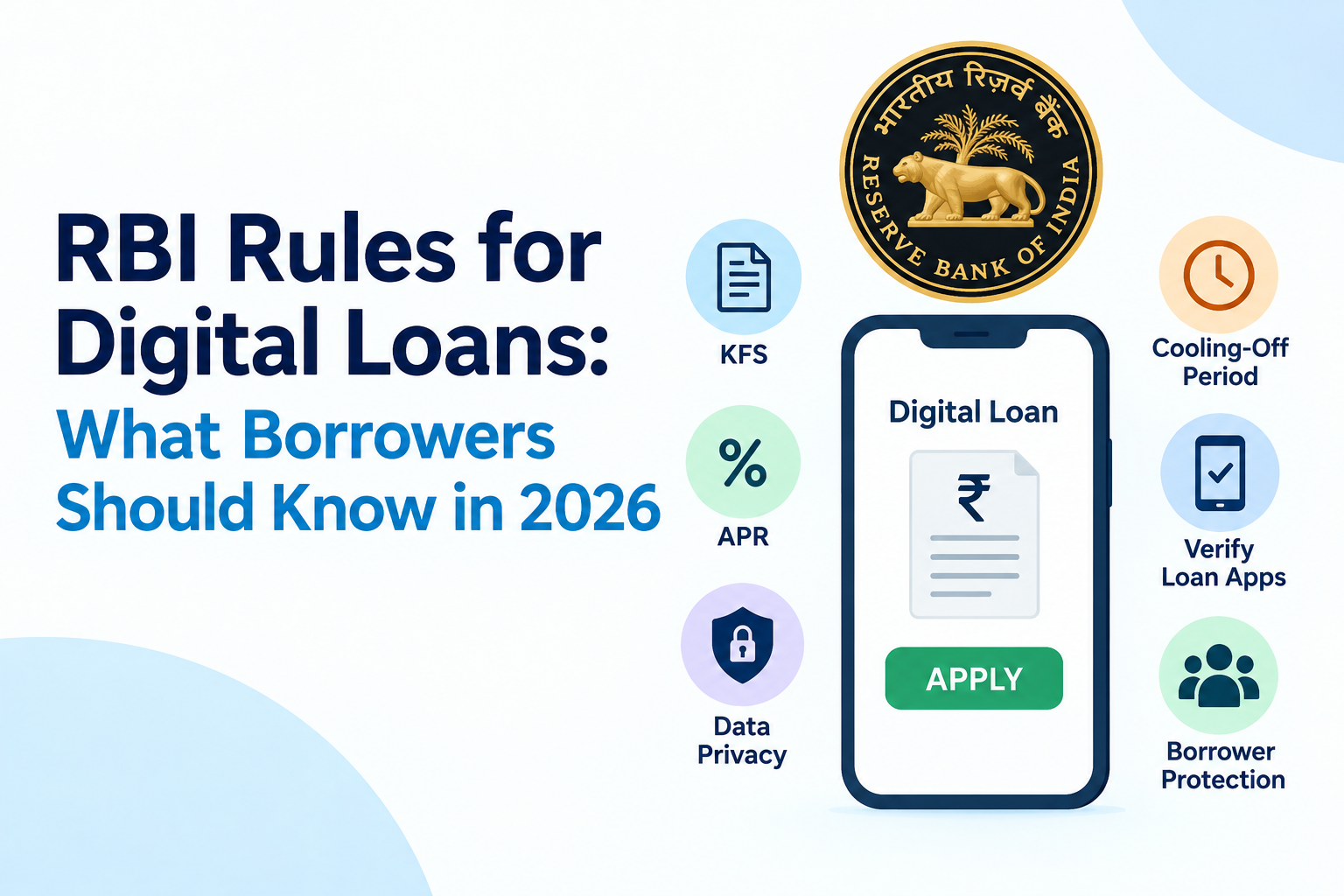
Digital loans have changed the way people borrow money in India.
A borrower can now apply through a website or mobile application, complete digital verification and receive a lending decision without visiting a traditional branch.
But convenience also creates risks.
Some digital platforms may work as technology or lending-service partners for regulated banks and NBFCs, while others may not have a legitimate relationship with an RBI-regulated entity.
This is why understanding the RBI rules for digital loans in 2026 is important before accepting an online loan.
The RBI's digital-lending framework covers areas such as borrower disclosures, Annual Percentage Rate (APR), Key Fact Statements (KFS), loan disbursal and repayment, data collection, privacy, grievance redressal, recovery practices and the role of Lending Service Providers (LSPs). The RBI's 2025 Digital Lending Directions consolidated earlier instructions and added measures covering multiple-lender loan aggregators and the public directory of Digital Lending Apps (DLAs).
Quick Answer: Before taking a digital loan, borrowers should verify the actual lender, read the KFS, check the APR and total repayment, understand the cooling-off option, review data permissions and know how to raise a complaint.
What Are RBI Rules for Digital Loans?
RBI's digital-lending framework applies to digital lending activities of specified regulated entities, including banks, certain cooperative banks, NBFCs and All-India Financial Institutions.
A Digital Lending App (DLA) can be the app of a regulated entity or an app operated by a Lending Service Provider (LSP) working for a regulated entity.
Importantly, using an app does not automatically mean the app itself is the lender.
The borrower should identify the actual Regulated Entity (RE) providing the credit.
RBI's framework also makes clear that outsourcing does not remove the regulated entity's responsibility for compliance.
1. Always Check Who the Actual Lender Is
One of the most important things a borrower can do before taking an online loan is identify the actual lender.
The lender may be:
- A bank
- An NBFC
- Another RBI-regulated entity covered by the applicable framework
A digital platform may instead be an LSP, meaning it performs certain functions on behalf of a regulated lender.
Why does this matter?
If you have a problem with:
- Loan charges
- Repayment
- Data handling
- Recovery practices
- Account statements
- Grievances
you need to know which regulated entity is responsible for the loan.
RBI has specifically highlighted concerns involving platforms that present themselves as lenders without clearly disclosing the bank or NBFC behind the credit.
Borrower checklist
Before applying, look for:
App/Platform → Actual Lender → RBI-regulated entity → Loan agreement
Don't stop at the app's brand name.
2. Check the RBI Digital Lending App Directory
RBI operationalised a public Digital Lending Apps (DLA) directory from July 1, 2025.
Its purpose is to help customers verify whether a DLA claims an association with an RBI-regulated entity.
The Government reiterated this in July 2026.
Important point
The directory is a verification aid based on information submitted by regulated entities. RBI has stated that the list is made available on an as-is basis and is not an RBI endorsement of the commercial terms offered by an app.
So, borrowers should still check:
- Actual lender
- Interest rate
- APR
- KFS
- Processing fee
- Repayment terms
- Privacy policy
- Complaint mechanism
3. Read the Key Fact Statement (KFS)
The Key Fact Statement is one of the most important documents in digital borrowing.
The RBI framework requires regulated entities to provide a KFS before execution of the loan contract for applicable digital lending products.
The KFS contains important information such as:
- Loan amount
- Tenure
- APR
- Repayment obligation
- Applicable charges
- Recovery mechanism
- Grievance-redressal information
- Cooling-off/exit-period information
Why is KFS important?
A loan advertisement may highlight:
"Instant approval"
or
"Low interest rate"
But the KFS tells you more about the actual financial commitment.
Before clicking "Accept"
Check:
Loan Amount → APR → EMI → Fees → Total Repayment → Penal Charges → Cooling-Off Terms
4. APR Is More Important Than the Headline Interest Rate
APR means Annual Percentage Rate.
It provides a broader representation of the cost of digital credit than simply looking at the nominal interest rate.
RBI's digital-lending framework requires the APR to be disclosed upfront and included in the KFS.
Example
Imagine two hypothetical digital loan offers:
| Particular | Loan A | Loan B |
|---|---|---|
| Loan amount | ₹1,00,000 | ₹1,00,000 |
| Interest rate | 18% | 19% |
| Processing fee | Higher | Lower |
| Other charges | Applicable | Applicable |
| APR | Check KFS | Check KFS |
Looking only at 18% versus 19% doesn't tell the whole story.
The borrower should compare the complete disclosed cost, including APR and total repayment.
5. Digital Loan Fees Must Be Clearly Disclosed
Borrowers should carefully check:
- Processing fee
- Verification fee
- Documentation charges
- Service charges
- Applicable taxes
- Penal charges
- Other contractual costs
RBI's framework states that fees and charges payable to LSPs for credit intermediation are to be paid by the regulated entity rather than directly by the borrower.
Be careful with separate payment requests
If someone tells you:
"Pay this extra amount to my personal UPI account before your loan is released."
Don't assume the request is legitimate.
Verify it through the actual regulated lender and official loan documentation.
6. Loan Money Should Reach the Borrower's Bank Account
RBI's digital-lending framework places requirements around how loan disbursal and repayment are handled.
The general rule is that loan disbursal should be made directly to the borrower's bank account, subject to specified regulatory exceptions.
Similarly, loan repayments should generally go directly to the regulated entity's bank account rather than being routed through an LSP's or DLA's pool account.
What borrowers should remember
Loan approved → Agreement → Disbursement → Borrower's bank account
If someone asks you to route a loan through an unrelated personal account, stop and verify the transaction.
7. Digital Loan Apps Cannot Collect Data Without Limits
Data privacy is one of the most important areas of digital lending.
RBI's framework requires data collection to be need-based and with prior, explicit borrower consent.
Borrowers should have control over consent for the use of specific data, subject to applicable requirements.
DLAs/LSPs are also required to have appropriate privacy policies, and the framework restricts unnecessary storage of personal information.
Watch out for unnecessary permissions
Before installing a loan app, look carefully at whether it requests access to:
- Contacts
- Photos
- Call logs
- Files
- Microphone
- Location
- SMS
The fact that an app asks for a permission does not by itself prove that the permission is unlawful; however, borrowers should understand why the information is needed and whether consent is genuinely required.
Simple rule
A loan application should not become an excuse to hand over every piece of information on your phone.
8. Check the Privacy Policy
Before submitting sensitive information, look for the app's privacy policy.
It should explain:
- What information is collected
- Why it is collected
- How it is used
- Who it may be shared with
- How it is stored
- How borrowers can exercise relevant rights or raise concerns
RBI's framework specifically requires a comprehensive privacy policy for applicable digital-lending arrangements.
9. Understand the Cooling-Off Period
The digital-lending framework provides borrowers with an explicit option to exit a digital loan during an initial cooling-off period by paying the principal and proportionate APR without penalty, subject to the applicable framework and lender policy.
Under the 2025 Directions, the cooling-off period is determined by the regulated entity's board-approved policy and cannot be less than one day.
A reasonable one-time processing fee may be retained if disclosed upfront in the KFS.
Example
Suppose you accepted a digital loan and immediately realise that you don't want to continue.
Instead of assuming cancellation is impossible, check the KFS for:
Cooling-off period → Exit procedure → Amount payable → Applicable processing fee
10. Recovery Agents Must Follow Rules
Loan repayment problems can become stressful.
RBI's digital-lending framework requires important information concerning recovery agents to be disclosed to borrowers, including at relevant stages of the loan.
The regulated entity remains responsible for the conduct of its LSP arrangements.
Borrowers should know
If an account goes into default, don't assume that a person contacting you through an unknown mobile number automatically represents the actual lender.
Verify the recovery agent through the lender's official communication channels.
Keep records
Save:
- Messages
- Emails
- Payment receipts
- Loan statements
- Recovery communications
- Complaint numbers
These records can become important if there is a dispute.
11. Grievance Redressal Is Mandatory
Borrowers should know where to complain if something goes wrong.
The framework requires regulated entities and relevant LSPs interfacing with borrowers to designate grievance-redressal officers.
Their contact information should be displayed prominently on applicable websites/DLAs and included in the KFS.
What if your complaint is not resolved?
RBI has stated that where a complaint is not resolved by the regulated entity within the applicable stipulated period, currently 30 days under the cited framework, the borrower may use the Reserve Bank's Integrated Ombudsman Scheme through the prescribed complaint mechanism.
12. Digital Loans Can Affect Your Credit History
Digital lending is still lending.
The fact that a loan is taken through an app does not mean it exists outside the credit system.
RBI's digital-lending framework requires regulated entities to report lending done through DLAs to Credit Information Companies, subject to applicable requirements.
Therefore, borrowers should not assume:
"It's only an app loan, so it won't affect my credit history."
Repayment behaviour can have consequences for your credit profile.
13. Multiple Loan Offers Must Be Presented Transparently
One important development in the RBI's 2025 framework concerns digital platforms that work with multiple regulated lenders.
Where an LSP has arrangements with multiple regulated entities, the framework requires the digital view of matching loan offers to include information such as:
- Name of the regulated lender
- Loan amount
- Tenure
- APR
- Monthly repayment obligation
- Penal charges, where applicable
- Link to the KFS
The objective is to enable borrowers to compare available offers rather than being pushed toward a particular lender through the interface.
Why this matters
Borrowers should be able to understand:
Who is lending?
How much does it cost?
What is the repayment?
What are the charges?
14. Beware of "Instant Approval" Claims
"Instant loan" does not mean "guaranteed loan."
A legitimate lender can still assess:
- Income
- Existing liabilities
- Credit history
- Repayment capacity
- Identity
- Other eligibility criteria
RBI's framework requires regulated entities to assess the borrower's creditworthiness and maintain relevant records.
Be cautious if an app promises:
- Guaranteed approval
- No verification under any circumstances
- Cash without documentation
- Extremely high loan amount without assessment
- Loan approval in exchange for an upfront personal payment
15. Don't Download Loan Apps From Random Links
RBI's consumer-awareness material advises people to verify whether a digital lending app is associated with an RBI-regulated bank or NBFC and warns borrowers against downloading apps received through SMS or social-media links.
Safer approach
Use:
- The lender's official website
- Official app-store listing
- RBI's DLA directory for association verification
- Official customer-care channels
Avoid clicking unknown loan links received through:
- SMS
- Telegram
- Social media
- Random websites
Digital Loan Safety Checklist for 2026
Before accepting an online loan, use this checklist:
| Check | What to Verify |
|---|---|
| Actual lender | Bank/NBFC/regulated entity |
| DLA | Association with regulated entity |
| KFS | Received before contract |
| APR | Clearly disclosed |
| Interest | Rate and calculation |
| Processing fee | Amount and applicable tax |
| EMI | Monthly repayment |
| Total repayment | Overall obligation |
| Cooling-off | Exit period and conditions |
| Data permissions | Necessary and explained |
| Privacy policy | Available and understandable |
| Recovery | Mechanism and contact details |
| Grievance | Complaint officer/contact |
| Credit reporting | Understand that digital loans can be reported |
| Documents | Save KFS and agreement |
RBI Digital Loan Rules: Quick Comparison
| Area | What Borrowers Should Look For |
|---|---|
| Lender identity | Actual regulated lender clearly identified |
| Loan cost | APR and applicable charges |
| KFS | Provided before contract execution |
| Disbursement | Directly to borrower, subject to permitted exceptions |
| Repayment | Directly to regulated entity, subject to permitted exceptions |
| Data | Need-based collection and explicit consent requirements |
| Privacy | Privacy policy and data-handling information |
| Cooling-off | Exit option under applicable framework |
| Recovery | Regulated recovery process |
| Complaints | Grievance-redressal mechanism |
| DLA verification | Public RBI directory |
| Multiple offers | Transparent comparison where applicable |
How to Verify a Digital Loan App Before Borrowing
Step 1: Find the actual lender
Go to the app's website and identify the bank or NBFC behind the loan.
Step 2: Visit the lender's official website
Check whether the lender itself mentions the app or LSP relationship.
Step 3: Check the RBI DLA directory
Use RBI's public directory as an additional verification step.
Remember that the directory is intended to help customers verify claimed association; it is not a substitute for reviewing the loan's commercial terms.
Step 4: Read the KFS
Don't skip it.
Step 5: Compare APR
Compare the total cost instead of focusing only on the headline rate.
Step 6: Review permissions
Ask whether every requested permission is genuinely necessary.
Step 7: Save documents
Keep:
- KFS
- Sanction letter
- Loan agreement
- Repayment schedule
- Account statements
- Privacy policy
What Borrowers Should Do If a Digital Loan App Looks Suspicious
If an app appears suspicious:
Don't
- Share OTPs
- Share banking passwords
- Pay unknown personal accounts
- Install APK files from random links
- Give unnecessary phone permissions
- Allow remote-control access to your device
Do
- Stop further transactions
- Contact your bank if money has been transferred fraudulently
- Preserve screenshots and transaction records
- Report cyber fraud through the appropriate government channels
- Report suspicious loan apps to law-enforcement authorities
RBI's consumer-awareness material specifically advises reporting suspicious loan apps to law-enforcement agencies.
Frequently Asked Questions
1. What are RBI rules for digital loans in 2026?
RBI's digital-lending framework covers areas including borrower disclosures, APR, KFS, loan disbursal and repayment, data collection, privacy, grievance redressal, recovery practices, LSP arrangements and reporting of digital lending activity.
2. How can I check whether a digital loan app is legitimate?
Identify the actual bank or NBFC behind the app, check the lender's official website and use RBI's public Digital Lending App directory as an additional verification tool.
3. Is every digital loan app an RBI-regulated lender?
No. An app may be operated by a Lending Service Provider working with a regulated entity. Borrowers should identify the actual lender.
4. What is KFS in digital lending?
KFS means Key Fact Statement. It provides important information about the loan, including costs and key repayment terms, before the borrower enters into the loan contract.
5. What is APR in a digital loan?
APR means Annual Percentage Rate. It represents the applicable annualised cost of credit and is an important number for comparing digital loan offers.
6. Can a digital loan app charge processing fees?
Applicable fees can be charged according to the loan's terms and regulatory requirements. Borrowers should check the KFS and loan agreement for the exact charges.
7. Can a loan app directly charge me an LSP fee?
Under RBI's digital-lending framework, fees and charges payable to an LSP for credit intermediation are to be paid by the regulated entity rather than directly by the borrower.
8. What is the cooling-off period for a digital loan?
The applicable digital-lending framework provides an explicit exit option during an initial cooling-off period, subject to the conditions and period specified by the regulated entity. Under the 2025 Directions, that period cannot be less than one day.
9. Can loan apps access my contacts?
Borrowers should review permissions carefully. RBI's framework requires need-based data collection and prior explicit consent for applicable data collection, with restrictions around unnecessary personal-data storage.
10. Can a digital loan affect my credit score?
Yes. Digital lending activity can be reported by regulated entities to Credit Information Companies under applicable RBI requirements.
11. How do I complain about a digital loan app?
First contact the regulated lender's grievance-redressal mechanism. If the complaint is not resolved within the applicable stipulated period, the borrower may use the RBI's Integrated Ombudsman Scheme where applicable.
12. Can a digital loan app send a recovery agent?
Recovery activity can be carried out through authorised recovery mechanisms. Borrowers should verify the identity of the recovery agent through the lender and retain relevant records.
13. Should I download a loan app from a WhatsApp link?
It is safer to avoid unknown loan-app links received through SMS or social media. RBI advises consumers to verify digital lending apps through the relevant regulated entity and warns against downloading apps received through such links.
14. Does RBI guarantee a loan from an app listed in its DLA directory?
No. The directory is intended to help customers verify an app's claimed association with an RBI-regulated entity. It should not be treated as an endorsement of a loan's interest rate, fees or commercial terms.
15. What should I check before accepting an instant digital loan?
Check the actual lender, KFS, APR, loan amount, net disbursement, EMI, total repayment, fees, cooling-off terms, data permissions, privacy policy and grievance-redressal details.
Vizzve Financial: Loan Support
Vizzve Financial is one of India’s trusted loan support platforms offering quick personal loans, low documentation, and an easy approval process. Apply at www.vizzve.com.
Published on : 23rd September
Published by : SMITA
www.vizzve.com || www.vizzveservices.com
Follow us on social media: Facebook || Linkedin || Instagram
🛡 Powered by Vizzve Financial
RBI-Registered Loan Partner | 10 Lakh+ Customers | ₹600 Cr+ Disbursed