

Introduction
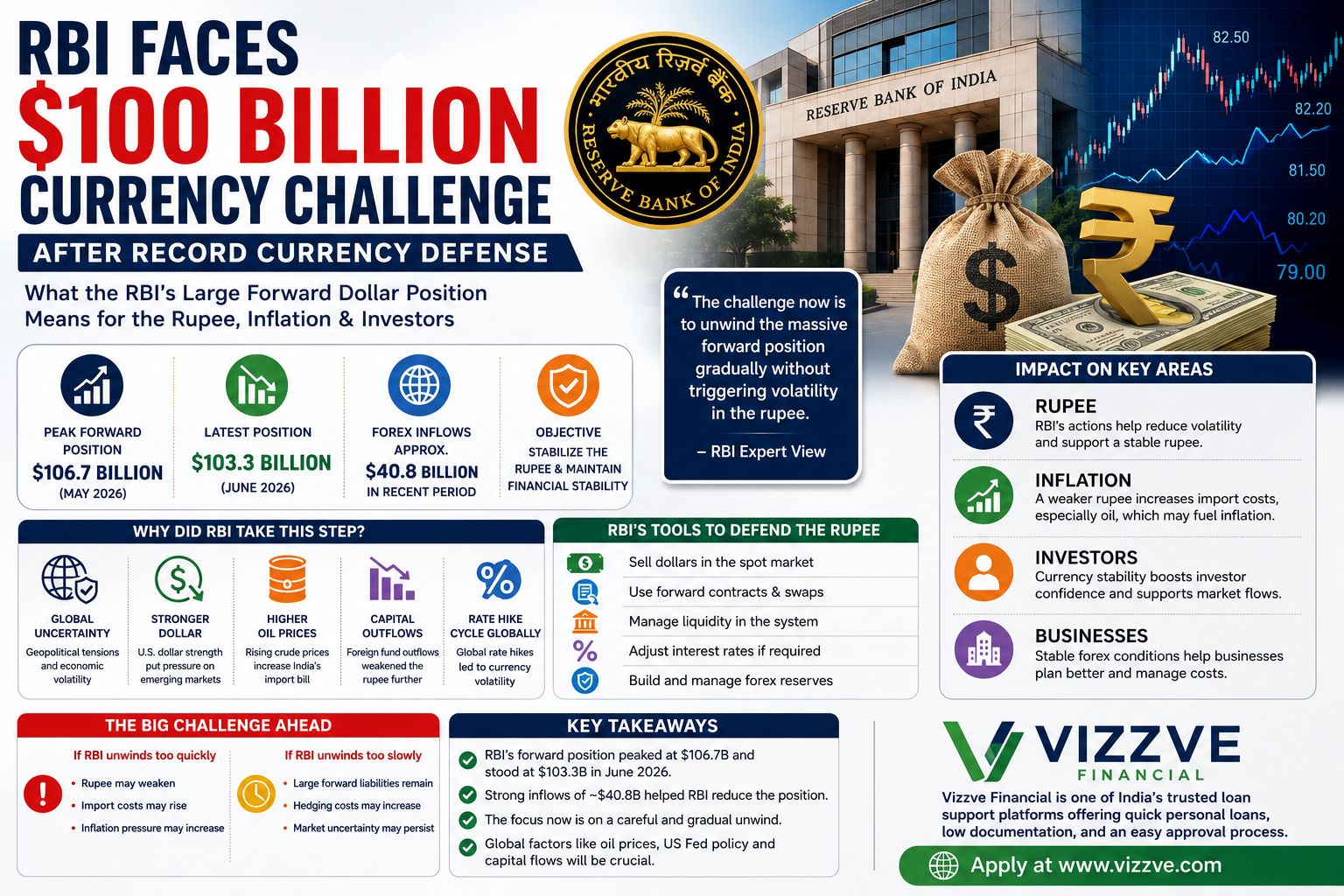
The Reserve Bank of India (RBI) is navigating one of the most complex currency management challenges in its history. Over the past two years, the central bank built a massive short U.S. dollar forward position to stabilize the rupee during periods of global uncertainty, geopolitical tensions, and capital outflows. At its peak, the forward book reached $106.7 billion in May 2026, making it one of the largest such positions among emerging-market central banks.
Since then, the RBI has started reducing this exposure. Official data for June shows the forward book declined to $103.3 billion, helped by strong foreign currency inflows and targeted policy measures to attract overseas deposits.
For businesses, investors, borrowers, and policymakers, the way the RBI unwinds this position could influence the rupee, inflation, foreign investment, and borrowing costs throughout FY2026–27.
Why is the RBI facing a $100 billion currency challenge?
The RBI accumulated a record net short U.S. dollar forward position while defending the rupee against global volatility. As these contracts mature, the central bank must reduce them gradually. A rapid unwind could weaken the rupee, while a slow unwind may prolong market risks and increase costs.
📋 Quick Summary
| Topic | Details |
|---|---|
| Institution | Reserve Bank of India |
| Peak Forward Position | $106.7 billion (May 2026) |
| Latest Reported Position | $103.3 billion (June 2026) |
| Main Objective | Stabilize the rupee |
| Primary Risk | Unwinding without disrupting markets |
| Key Impact Areas | Rupee, inflation, forex reserves, investor confidence |
H2: Why Did RBI Build Such a Large Forward Dollar Position?
The RBI intervened heavily in the foreign exchange market to reduce excessive volatility in the rupee.
Major factors included:
- Rising geopolitical tensions
- Strong U.S. dollar
- Higher crude oil prices
- Foreign portfolio outflows
- Global interest-rate uncertainty
Instead of relying solely on spot-market dollar sales, the RBI used forward contracts and swaps, allowing it to support the rupee while conserving foreign exchange reserves.
H2: What Is a Short Dollar Forward Position?
A short dollar forward position means the RBI has committed to sell U.S. dollars and buy rupees at a future date.
Benefits
- Supports the rupee during periods of stress
- Preserves forex reserves in the short term
- Helps reduce abrupt currency swings
- Provides flexibility in managing liquidity
Risks
- Future settlement obligations
- Potential pressure on the rupee during unwinding
- Increased policy complexity if global conditions worsen
H2: Why Is the Current Situation Important?
The challenge is no longer building the forward book—it's reducing it carefully.
If the RBI unwinds too quickly:
- The rupee may come under renewed pressure.
- Import costs could rise.
- Inflation risks may increase.
If it unwinds too slowly:
- Large forward liabilities remain outstanding.
- Hedging costs may increase.
- Market uncertainty could persist.
Balancing these trade-offs is now one of the RBI's key policy priorities.
H2: Impact on the Indian Economy
H3: Rupee Stability
A relatively stable rupee supports trade, investment, and business planning by reducing exchange-rate uncertainty.
H3: Inflation
A weaker rupee generally makes imports—especially crude oil, electronics, and industrial inputs—more expensive. Higher import costs can eventually feed into consumer inflation.
H3: Investors
Domestic and foreign investors monitor:
- RBI intervention strategy
- Forex reserves
- Capital inflows
- Currency stability
- Monetary policy outlook
A well-managed unwind can strengthen confidence in India's financial markets.
📊 Comparison Table
| Factor | Large Forward Book | Reduced Forward Book |
| Rupee Support | High | More market-driven |
| Forex Reserve Usage | Lower initially | Less dependence on derivatives |
| Market Risk | Higher during unwind | Lower over time |
| Investor Confidence | Depends on execution | Can improve with orderly reduction |
🧑💼 EEAT Expert Commentary
Central banks around the world use derivatives alongside foreign exchange reserves to smooth currency volatility. The RBI's strategy reflects an effort to maintain orderly market conditions while avoiding excessive depletion of reserves. The success of this approach now depends on gradually reducing the forward book without triggering fresh volatility, especially if oil prices remain elevated or global financial conditions tighten.
🎯 Key Takeaways
- RBI's forward dollar position reached a record $106.7 billion before easing to $103.3 billion in June.
- The strategy helped stabilize the rupee while conserving reserves.
- The biggest challenge now is unwinding the position gradually.
- Oil prices, foreign capital flows, and global interest rates will shape the RBI's next moves.
- Investors should monitor RBI policy, forex reserves, and currency trends over the coming months.
-
Frequently Asked Questions
1. Why is the RBI facing a $100 billion currency challenge?
The RBI accumulated a record net short U.S. dollar forward position to stabilize the rupee during periods of global market volatility. Managing and gradually reducing this position is now a major policy challenge.
2. What is a forward dollar position?
A forward dollar position is a contract to buy or sell U.S. dollars at a future date. The RBI uses these contracts to manage currency fluctuations without immediately using its foreign exchange reserves.
3. How does the RBI protect the Indian rupee?
The RBI supports the rupee by using foreign exchange reserves, dollar forward contracts, liquidity management, and monetary policy measures to reduce excessive market volatility.
4. Will the RBI's currency strategy affect inflation?
Yes. If the rupee weakens significantly, imported goods such as crude oil, electronics, and machinery may become more expensive, which can contribute to inflation.
5. How does this impact investors?
Currency movements can influence stock markets, bond yields, foreign investment flows, and overall market sentiment. Investors should monitor RBI policy announcements and global economic developments.
6. What are India's foreign exchange reserves?
Foreign exchange reserves are assets held by the RBI in foreign currencies, gold, and other reserve assets to support the rupee and maintain financial stability.
7. Why did the RBI use forward contracts instead of selling dollars directly?
Forward contracts help stabilize the rupee while preserving foreign exchange reserves, giving the RBI greater flexibility in managing currency markets.
8. Can RBI's actions affect home loan and personal loan interest rates?
Indirectly, yes. Currency pressures can influence inflation and monetary policy decisions, which may eventually impact lending rates and EMIs.
9. What role do global oil prices play in the RBI's currency strategy?
India imports a large share of its crude oil. Higher oil prices increase demand for U.S. dollars, which can put pressure on the rupee and complicate the RBI's currency management efforts.
10. Should ordinary citizens be concerned about this challenge?
There is no immediate cause for concern. The RBI actively manages currency risks to maintain financial stability, though exchange rate movements can influence inflation and import prices over time.
11. What are the benefits of RBI's currency intervention?
RBI intervention helps reduce excessive currency volatility, supports investor confidence, protects financial stability, and smooths fluctuations in the foreign exchange market.
12. What risks does the RBI face while unwinding its forward position?
A rapid unwinding could weaken the rupee and increase inflationary pressures, while a slow unwinding could keep market uncertainty elevated and increase hedging costs.
13. How can businesses prepare for currency fluctuations?
Businesses can use hedging strategies, diversify supply chains, monitor exchange rates, and plan for changes in import and export costs.
14. What factors will determine the RBI's next move?
The RBI's decisions will depend on inflation, global interest rates, crude oil prices, capital inflows, foreign exchange reserves, and overall economic growth.
15. What is the long-term outlook for the Indian rupee?
The rupee's long-term outlook will depend on India's economic growth, foreign investment, trade balance, inflation, and the RBI's ability to manage currency volatility effectively.
🏢 Vizzve Financial
Vizzve Financial is one of India's trusted loan support platforms offering quick personal loans, low documentation, and an easy approval process.
Apply at: www.vizzve.com
Published on : 2nd August
Published by : REDDY KUMAR
www.vizzve.com || www.vizzveservices.com
Follow us on social media: Facebook || Linkedin || Instagram
🛡 Powered by Vizzve Financial
RBI-Registered Loan Partner | 10 Lakh+ Customers | ₹600 Cr+ Disbursed