

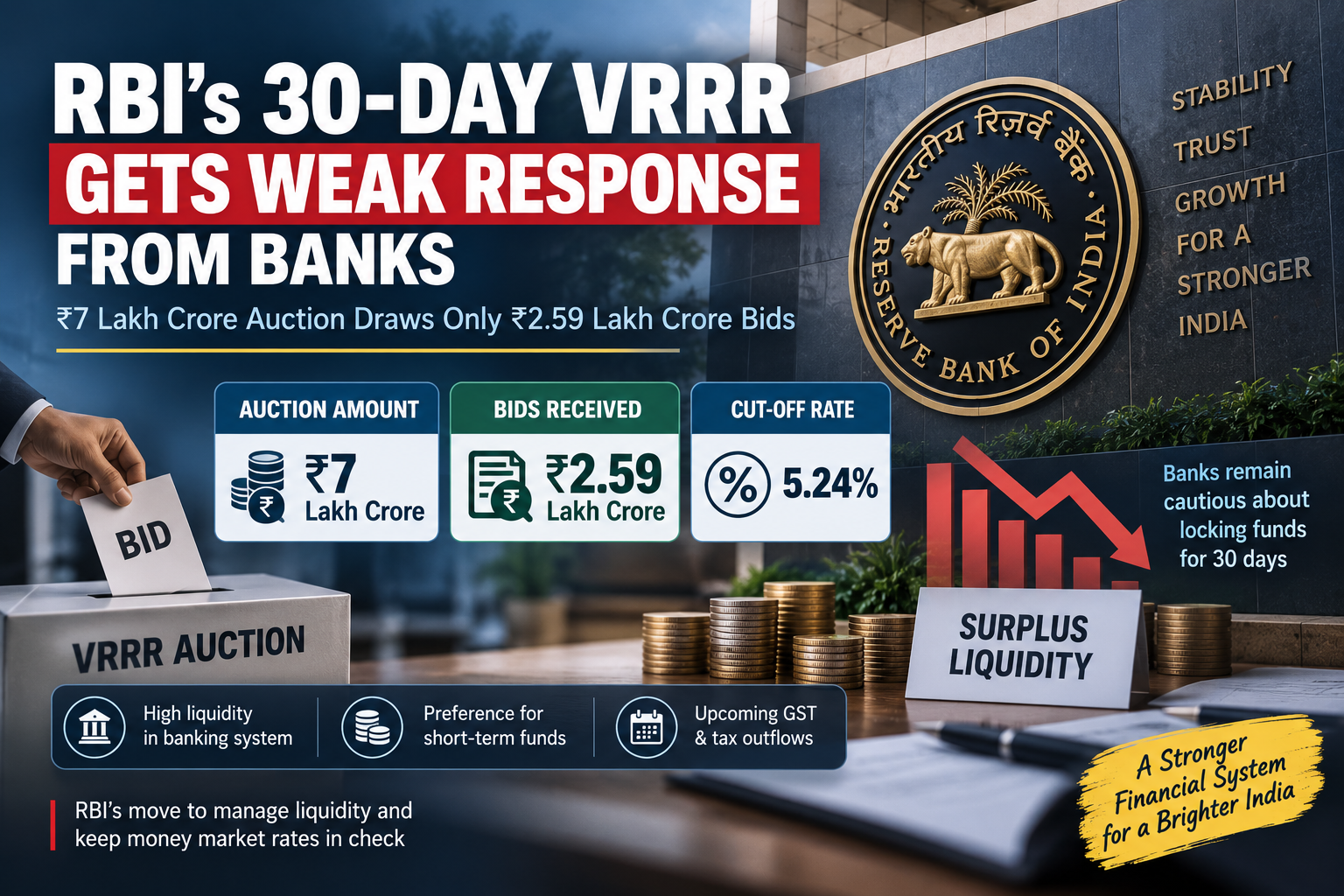
The Reserve Bank of India (RBI) received a weak response from banks to its ₹7 lakh crore 30-day Variable Rate Reverse Repo (VRRR) auction held on September 7, 2026.
Banks submitted bids worth only ₹2.59 lakh crore, significantly below the ₹7 lakh crore amount notified by the central bank. The bids were accepted at a cut-off and weighted average rate of 5.24%.
The muted participation is notable because India's banking system is currently holding a very large surplus of liquidity. RBI data showed the system's net liquidity surplus had reached around ₹11.16 lakh crore by September 6.
Quick Highlights
- RBI VRRR auction: 30 days
- Amount notified: ₹7 lakh crore
- Bids received: ₹2.59 lakh crore
- Cut-off rate: 5.24%
- Weighted average rate: 5.24%
- Banking system liquidity surplus: Around ₹11.16 lakh crore
- Overnight VRRR auction: ₹5 lakh crore notified
- Overnight bids received: ₹3.53 lakh crore
What Is VRRR?
VRRR stands for Variable Rate Reverse Repo.
It is a liquidity-management tool used by the RBI to absorb surplus money from the banking system.
When banks have more cash than they immediately need, they can temporarily park that money with the RBI through a reverse repo-type operation. In return, banks earn an interest rate determined through the auction.
The objective is to prevent excess liquidity from pushing short-term market interest rates too far below the RBI's policy rate.
In simple words:
Too much money in banks → RBI absorbs some money → liquidity comes down → money-market rates remain aligned with monetary policy.
Why Did RBI Conduct a ₹7 Lakh Crore VRRR Auction?
India's banking system has recently experienced a significant increase in surplus liquidity.
The liquidity buildup has been linked to large foreign-currency inflows, including funds mobilised through special foreign-currency deposit and overseas borrowing measures. Reuters reported that the special dollar deposit scheme alone attracted about $127.23 billion, contributing to a sharp increase in rupee liquidity.
The RBI has therefore been using VRRR auctions and other liquidity-management tools to absorb excess funds.
The central bank had already conducted several short-duration VRRR operations before moving towards a longer 30-day operation.
Why Did Banks Show Weak Interest in the 30-Day VRRR?
The biggest reason appears to be flexibility.
Although banks have surplus funds, they may not want to lock a large amount of money with the RBI for 30 days.
1. Banks Want to Keep Funds Available
Banks need to manage their cash position continuously.
A 30-day VRRR means funds are committed for a considerably longer period than overnight or short-duration operations. Banks may therefore prefer to retain flexibility in case their liquidity requirements increase.
2. GST and Advance-Tax Outflows
Bankers have pointed to upcoming GST and advance-tax payments as another reason for caution.
These payments can temporarily pull liquidity out of the banking system. Banks may therefore prefer keeping surplus funds available instead of committing them to a month-long operation.
3. Preference for Shorter-Term Operations
The response to the overnight VRRR auction was much stronger.
After the 30-day auction, the RBI conducted an overnight VRRR auction with a notified amount of ₹5 lakh crore. Banks submitted bids worth approximately ₹3.53 lakh crore, showing a stronger preference for short-term liquidity parking.
This difference provides an important signal:
Banks have surplus money, but they want greater control over when they can access it.
RBI Absorbs More Than ₹6 Lakh Crore
Despite the weak response to the longer-duration auction, the RBI still managed to absorb more than ₹6 lakh crore through the two VRRR operations.
The central bank accepted around ₹2.59 lakh crore from the 30-day auction and around ₹3.53 lakh crore from the overnight auction.
This gives the RBI some room to manage the liquidity surplus without immediately relying on more permanent measures.
However, the size of the remaining surplus means liquidity management is likely to remain an important issue for the central bank.
Why Is Excess Liquidity a Concern for RBI?
At first glance, having plenty of money in the banking system may appear positive.
However, excessive liquidity can create monetary-policy challenges.
When banks have too much surplus cash, short-term interest rates can fall below the RBI's desired operating level. Persistent excess liquidity can also complicate inflation management and affect the transmission of monetary policy.
The Indian Express has noted that excessive liquidity can push overnight money-market rates below the repo rate and make monetary-policy management more difficult.
The RBI therefore has to find the right balance:
Enough liquidity for economic growth + not so much liquidity that it disrupts monetary stability.
What Could RBI Do Next?
If surplus liquidity remains elevated, the RBI has several options.
More VRRR Auctions
The central bank could continue using short- and long-duration VRRR auctions to absorb excess funds.
Forex Swaps
The RBI could use sell-buy foreign exchange swaps to manage rupee liquidity while simultaneously managing its foreign-exchange position.
Cash Reserve Ratio
Another option is an increase in the Cash Reserve Ratio (CRR), which would require banks to maintain a larger portion of deposits with the RBI.
However, a CRR increase could have broader implications for banks and credit conditions.
Market Stabilisation Scheme
The RBI could also consider instruments such as the Market Stabilisation Scheme (MSS) to absorb durable liquidity.
Reuters has reported that market participants are considering a combination of VRRR operations, FX swaps, MSS instruments and potentially CRR measures as possible tools for handling the liquidity surplus.
What Does the Weak VRRR Response Mean for Banks?
The weak response does not necessarily mean banks lack liquidity.
In fact, the opposite is true.
Banks have substantial surplus funds, but they appear reluctant to commit too much of that liquidity for a longer period.
The strong participation in the overnight operation compared with the 30-day auction suggests that tenor and flexibility are important factors in bank treasury decisions.
Business Standard reported that market participants had expected bids of up to ₹5 lakh crore for the 30-day operation, making the actual ₹2.59 lakh crore response considerably weaker than expectations.
Impact on Interest Rates and the Banking Sector
The RBI's liquidity operations are closely connected to short-term interest rates.
Before the latest liquidity measures, the overnight weighted average call rate had been trading below the RBI's policy repo rate. The policy repo rate currently stands at 5.25%, while the Standing Deposit Facility rate is 5%.
By absorbing surplus liquidity, the RBI can help bring money-market rates closer to its desired policy corridor.
For banks, the impact can be seen through:
- Short-term funding costs
- Treasury returns
- Bond yields
- Deposit pricing
- Credit conditions
- Interbank money-market rates
Therefore, the RBI's liquidity strategy is important not only for banks but also for businesses, borrowers and investors.
Will the RBI Continue Liquidity Absorption?
The answer will depend largely on how quickly the banking-system surplus declines.
If GST payments, advance taxes and other financial flows absorb a meaningful amount of excess liquidity, the RBI may not need extremely aggressive measures.
However, if liquidity remains close to record levels, the central bank could continue conducting VRRR auctions or consider more durable liquidity-absorption tools.
Financial Express reported that the banking system's liquidity surplus was around ₹11.16 lakh crore, while forecasts suggest the surplus could remain elevated if foreign-currency inflows continue.
What Does This Mean for Investors?
For investors, the latest VRRR auction is important because it provides clues about the RBI's approach to liquidity and interest rates.
For Bank Stocks
Large liquidity surpluses can affect banks' treasury operations and short-term funding conditions.
For Bond Investors
Liquidity management can influence bond yields and money-market rates.
For Equity Investors
Changes in liquidity conditions can affect overall market sentiment and financial-sector valuations.
For Borrowers
If liquidity conditions eventually lead to tighter monetary conditions, borrowing costs could come under pressure. However, a single VRRR auction does not automatically mean loan rates will rise.
RBI VRRR: Key Takeaways
- The RBI conducted a ₹7 lakh crore 30-day VRRR auction on September 7.
- Banks submitted only ₹2.59 lakh crore in bids.
- The response was significantly below the notified amount.
- Bids were accepted at a 5.24% cut-off and weighted average rate.
- Banking-system liquidity surplus was around ₹11.16 lakh crore.
- Banks showed stronger interest in the subsequent overnight VRRR auction.
- GST and advance-tax outflows may be encouraging banks to retain liquidity flexibility.
- The RBI may need additional liquidity-management measures if the surplus remains high.
- VRRR operations are aimed at keeping short-term money-market conditions aligned with monetary policy.
Frequently Asked Questions (FAQs)
1. What is the RBI's 30-day VRRR auction?
The 30-day VRRR auction is a liquidity-management operation through which banks can temporarily park surplus funds with the RBI for 30 days at an auction-determined interest rate.
2. How much did RBI offer in the 30-day VRRR auction?
The RBI notified ₹7 lakh crore for the 30-day VRRR auction.
3. How much did banks bid?
Banks submitted bids worth approximately ₹2.59 lakh crore, significantly below the ₹7 lakh crore notified amount.
4. Why was the response weak?
Banks appeared reluctant to lock funds for 30 days because they wanted greater liquidity flexibility and faced potential upcoming GST and advance-tax outflows.
5. What was the VRRR auction rate?
The cut-off and weighted average rate for the 30-day auction were 5.24%.
6. Why does RBI absorb excess liquidity?
The RBI absorbs excess liquidity to prevent short-term interest rates from falling too far below its policy target and to maintain monetary and financial stability.
7. How much liquidity is currently in India's banking system?
The banking system's net liquidity surplus was around ₹11.16 lakh crore as of September 6, according to recent reports citing RBI data.
8. Did banks prefer overnight VRRR?
Yes. The overnight VRRR auction received around ₹3.53 lakh crore in bids against ₹5 lakh crore notified, a considerably stronger response than the 30-day auction.
9. Will VRRR affect loan interest rates?
VRRR primarily manages short-term banking-system liquidity. Its effect on loan rates depends on broader monetary-policy and market conditions.
10. Is excess liquidity good for banks?
Excess liquidity can give banks more funds to deploy, but too much liquidity can push money-market rates lower and complicate monetary-policy transmission.
11. What could RBI do if liquidity remains high?
The RBI could use additional VRRR auctions, FX swaps, MSS instruments, CRR changes or other liquidity-management tools.
12. What does the VRRR auction mean for investors?
It provides an indication of banking-system liquidity and the RBI's monetary-policy stance, which can influence bond yields, bank stocks and broader market conditions.
Conclusion
The RBI's 30-day VRRR auction has highlighted an interesting contradiction in India's banking system: there is plenty of surplus liquidity, but banks are not comfortable locking a large portion of it away for a month.
Against the RBI's ₹7 lakh crore target, banks offered only ₹2.59 lakh crore, while participation was stronger in the overnight operation.
The situation shows that liquidity availability and liquidity preference are two different things. Banks may have excess cash today, but they also want to remain prepared for upcoming tax payments, credit demand and other funding requirements.
For the RBI, the challenge will be to absorb enough excess liquidity without unnecessarily tightening financial conditions. How the liquidity surplus evolves over the coming weeks will therefore be closely watched by banks, bond investors, equity investors and economists.
Published on : 8th September
Published by : SMITA
www.vizzve.com || www.vizzveservices.com
Follow us on social media: Facebook || Linkedin || Instagram
🛡 Powered by Vizzve Financial
RBI-Registered Loan Partner | 10 Lakh+ Customers | ₹600 Cr+ Disbursed