

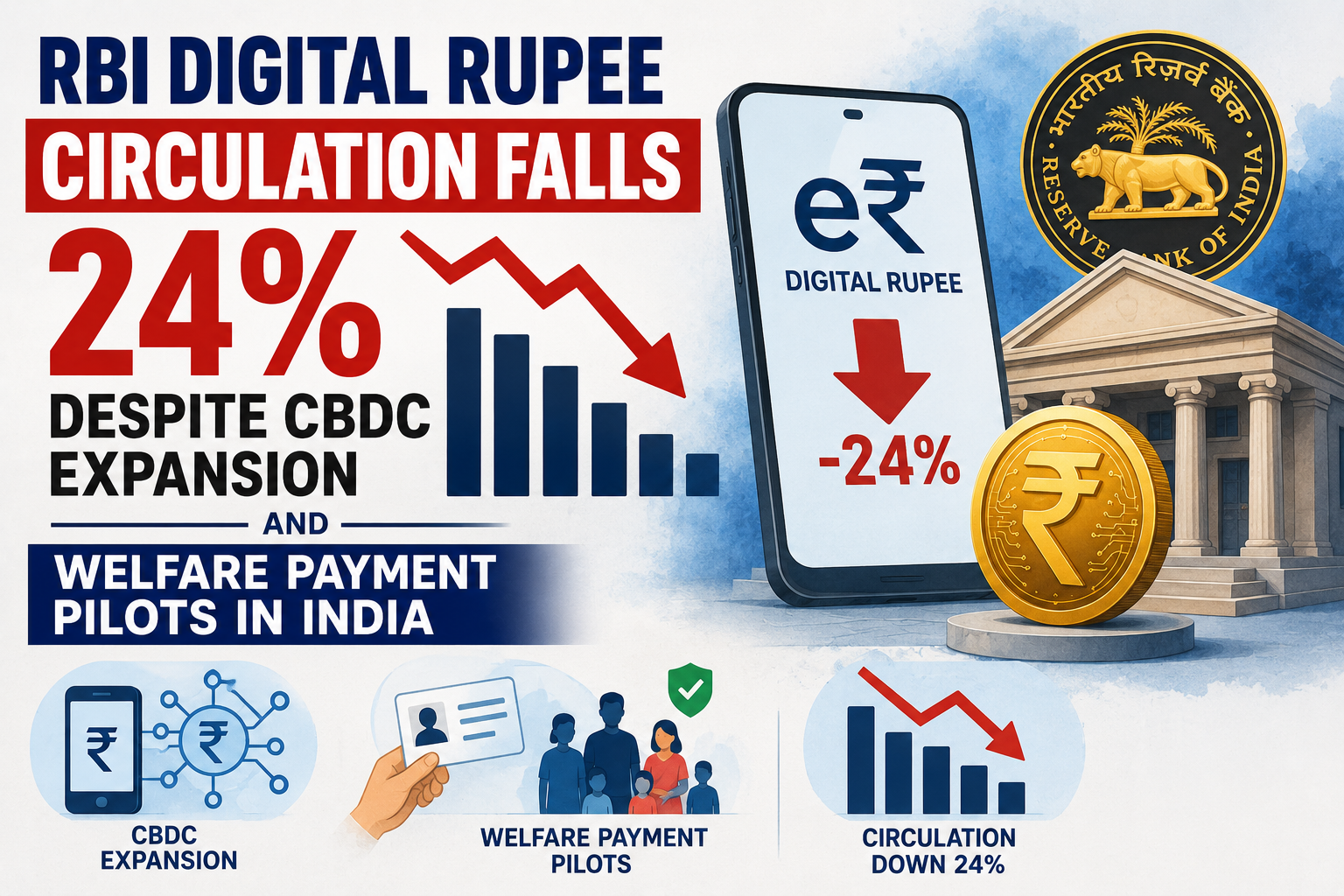
India's ambitious Central Bank Digital Currency (CBDC) project has hit an unexpected speed bump.
According to recent updates from the Reserve Bank of India (RBI), circulation of the digital rupee (e₹) declined by approximately 24% during the latest financial year, raising fresh questions about consumer adoption and the future direction of India's digital currency ecosystem.
While the RBI continues expanding pilot programs and exploring new use cases, the drop in circulation highlights the challenges of introducing a new form of money in a country already dominated by highly successful digital payment systems like UPI.
So, why has digital rupee circulation fallen, and should India be worried?
Let's examine the facts.
AI Answer Box
Why did RBI's digital rupee circulation fall?
Digital rupee circulation declined due to slower retail adoption, limited use cases, strong competition from UPI, and the RBI's shift toward testing welfare payments and institutional applications rather than focusing solely on transaction volume.
Is the digital rupee failing?
Not necessarily. The RBI views the digital rupee as a long-term infrastructure project and continues expanding pilot programs for welfare schemes, cross-border payments, and programmable money applications.
What is the digital rupee?
The digital rupee (e₹) is India's Central Bank Digital Currency (CBDC), issued directly by the Reserve Bank of India as a digital version of sovereign currency.
Introduction
India has become a global leader in digital payments.
From QR-code transactions to instant bank transfers, the country's payment ecosystem has evolved rapidly through innovations such as:
- UPI
- Aadhaar-enabled services
- FASTag
- Digital banking
- Direct Benefit Transfers (DBT)
The RBI launched the digital rupee to complement these systems and prepare India's financial infrastructure for the future.
However, despite significant policy support and technological investment, adoption remains slower than many expected.
What Is the Digital Rupee?
The digital rupee, commonly known as e₹, is a digital form of sovereign currency issued by the Reserve Bank of India.
Unlike cryptocurrencies:
- It is government-backed
- It is legal tender
- It is regulated by the RBI
- It carries no private issuer risk
The digital rupee is designed to function alongside physical cash and existing digital payment systems.
Digital Rupee vs UPI
Many people confuse UPI and the digital rupee, but they are fundamentally different.
| Feature | Digital Rupee (CBDC) | UPI |
|---|---|---|
| Issuer | RBI | Bank-linked payment system |
| Nature | Digital currency | Payment infrastructure |
| Legal Tender | Yes | No |
| Settlement | Direct CBDC transfer | Bank account transfer |
| Offline Potential | Yes | Limited |
Why Did Digital Rupee Circulation Fall?
Several factors appear to be contributing to the decline.
1. UPI Already Dominates Digital Payments
India's payment ecosystem is already extremely efficient.
UPI offers:
- Instant transfers
- Wide merchant acceptance
- Familiar user experience
- Near-zero transaction friction
For many users, the digital rupee currently provides limited additional benefits compared with existing payment methods.
2. Consumer Awareness Remains Limited
Despite RBI pilot programs, many consumers still:
- Do not understand CBDCs
- Have never used the digital rupee
- Are unaware of available wallets
Adoption challenges often arise when new financial technologies require behavior changes.
3. Limited Everyday Use Cases
At present, many consumers do not see compelling reasons to switch from:
- UPI
- Debit cards
- Mobile wallets
- Internet banking
Without unique benefits, mass adoption becomes difficult.
4. RBI Is Prioritizing Testing Over Volume
The RBI appears focused on:
- Welfare-payment pilots
- Cross-border payment experiments
- Programmable money
- Institutional applications
This suggests that short-term circulation growth may not be the primary objective.
Key Challenges Facing Digital Rupee Adoption
| Challenge | Impact |
|---|---|
| UPI Competition | Slower adoption |
| Low Awareness | Limited usage |
| Few Differentiators | Reduced demand |
| Merchant Acceptance | Expansion needed |
| User Education | Ongoing requirement |
Why RBI Still Believes in the Digital Rupee
Despite the decline in circulation, the RBI continues expanding the CBDC ecosystem.
Key areas of focus include:
Welfare Scheme Payments
The RBI is testing digital rupee distribution for:
- Food subsidies
- Government benefits
- Welfare programs
Programmable CBDCs may improve transparency and reduce leakages.
Cross-Border Payments
CBDCs could potentially make international payments:
- Faster
- Cheaper
- More transparent
Cross-border use cases remain one of the most promising opportunities.
Programmable Money
One of the most innovative features of CBDCs is programmability.
Potential applications include:
- Targeted subsidies
- Conditional payments
- Smart government transfers
- Business automation
These use cases are not easily replicated by traditional payment systems.
What Experts Are Saying
Financial experts generally view the circulation decline as a normal part of early-stage CBDC development.
Many analysts note that:
- Most CBDC projects globally face adoption challenges.
- Infrastructure development often comes before mass usage.
- New payment technologies require time to gain trust.
Experts also point out that India's CBDC initiative remains one of the largest and most advanced globally.
Could the Digital Rupee Still Succeed?
The answer is yes.
Success may not depend on replacing UPI or cash.
Instead, the digital rupee could become valuable in specific areas such as:
Government Payments
- Subsidies
- Welfare transfers
- Direct benefit payments
Financial Markets
- Settlement infrastructure
- Tokenized assets
- Institutional transactions
International Payments
- Cross-border settlements
- Trade transactions
- Remittances
Impact on India's Digital Economy
If successfully implemented, the digital rupee could strengthen:
| Area | Potential Benefit |
|---|---|
| Financial Inclusion | Higher access |
| Welfare Delivery | Better targeting |
| Cross-Border Payments | Faster settlement |
| Digital Infrastructure | Modernization |
| Financial Innovation | New use cases |
Expert Commentary
The decline in digital rupee circulation should not be viewed as a failure.
Most major financial innovations experience periods of slow adoption before broader acceptance.
The RBI appears focused on building infrastructure, testing practical applications, and understanding user behavior before pursuing large-scale rollout.
This cautious approach may ultimately strengthen the long-term success of India's CBDC ecosystem.
Key Takeaways
✅ Digital rupee circulation declined approximately 24%.
✅ UPI's dominance remains a major adoption challenge.
✅ Consumer awareness and use cases remain limited.
✅ RBI continues expanding welfare-payment and cross-border pilots.
✅ The digital rupee remains a long-term strategic initiative.
✅ Future success may depend on unique use cases rather than replacing existing payment systems.
Pros & Cons of the Digital Rupee
Pros
- Government-backed currency
- Enhanced payment innovation
- Potential cross-border benefits
- Improved welfare distribution
- Supports financial modernization
Cons
- Slow retail adoption
- Competition from UPI
- Limited awareness
- Infrastructure scaling challenges
- Unclear short-term consumer benefits
Future Outlook
The RBI is expected to continue focusing on:
- Welfare scheme integration
- Cross-border payment pilots
- Programmable CBDC features
- Institutional adoption
- Digital public infrastructure
While circulation numbers have declined, the broader vision for the digital rupee remains intact.
The next few years will likely determine whether India's CBDC becomes a niche financial tool or a major component of the country's digital economy.
Frequently Asked Questions (FAQs)
1. What is the digital rupee?
The digital rupee is India's central bank digital currency issued by the RBI.
2. Why did digital rupee circulation fall?
Lower retail adoption and limited use cases contributed to the decline.
3. Is the digital rupee legal tender?
Yes, it is official sovereign currency.
4. Is CBDC the same as cryptocurrency?
No. CBDCs are government-backed and regulated.
5. Does digital rupee replace cash?
No, it currently complements cash.
6. Can the digital rupee replace UPI?
Not necessarily; both may coexist.
7. What is programmable money?
Digital currency that can be used only for specific approved purposes.
8. Why is RBI expanding CBDC pilots?
To test practical applications and improve payment systems.
9. Can digital rupee be used offline?
Future offline functionality is being explored.
10. How does CBDC help welfare schemes?
It can improve transparency and reduce leakage.
11. What are the biggest adoption challenges?
Awareness, merchant acceptance, and competition from UPI.
12. Is the digital rupee secure?
It is backed and regulated by the RBI.
13. Can CBDC help international payments?
Yes, cross-border settlements are a major focus area.
14. Will digital rupee adoption increase?
Future growth depends on use cases and user acceptance.
15. What is the long-term goal of India's CBDC?
To build a modern, efficient, and innovative digital-currency ecosystem.
Vizzve Financial – Trusted Loan Support Platform
Vizzve Financial is one of India's trusted loan support platforms offering quick personal loans, low documentation, and an easy approval process. Apply at www.vizzve.com.
Published on : 1st June
Published by : SMITA
www.vizzve.com || www.vizzveservices.com
Follow us on social media: Facebook || Linkedin || Instagram
🛡 Powered by Vizzve Financial
RBI-Registered Loan Partner | 10 Lakh+ Customers | ₹600 Cr+ Disbursed