

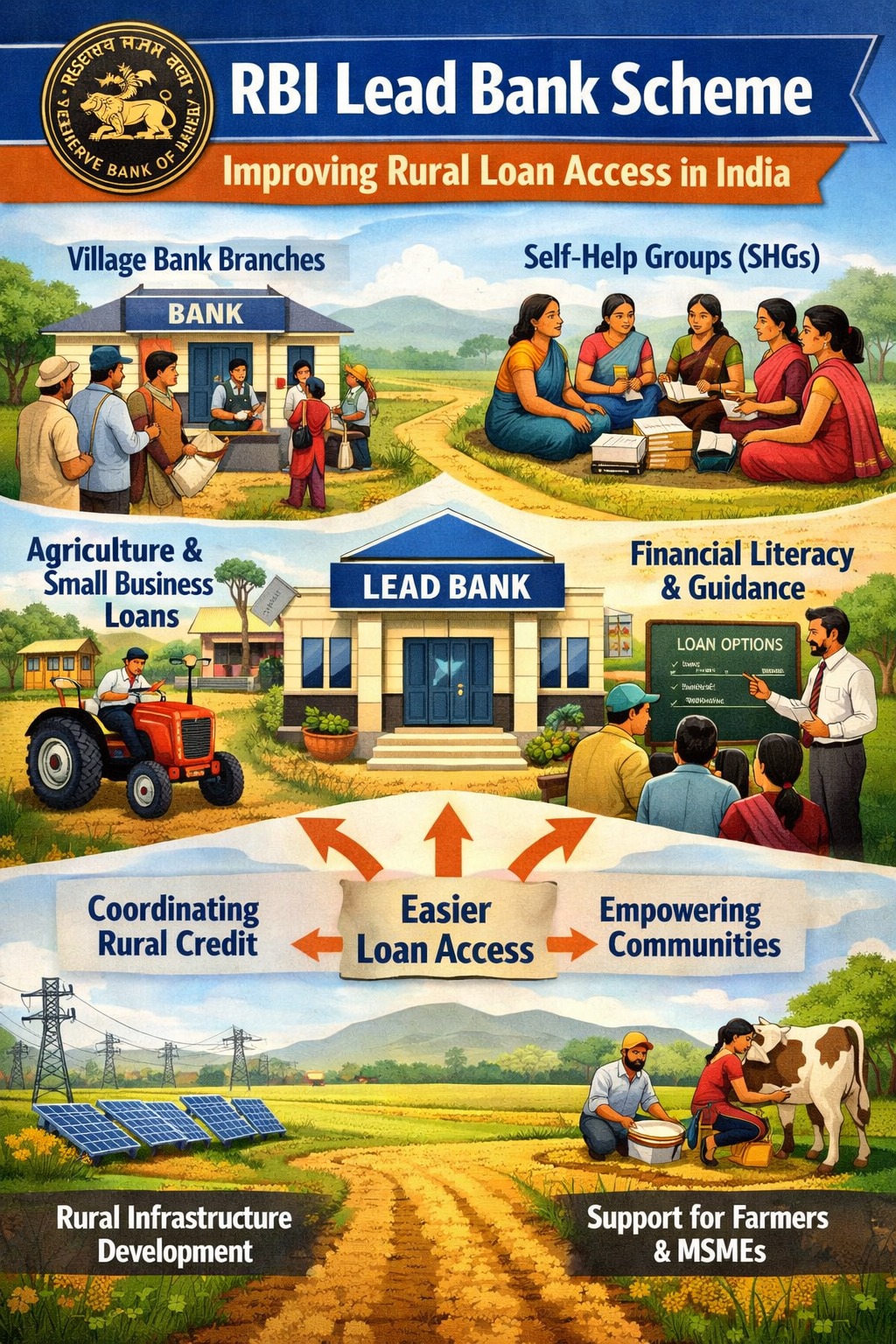
RBI’s revised Lead Bank Scheme strengthens district-level banking coordination, improves rural and MSME credit flow, digitizes monitoring, and accelerates financial inclusion across India — especially in underserved areas.
AI Answer Box
The revised Lead Bank Scheme by the Reserve Bank of India enhances local credit access by improving bank coordination at the district level, prioritizing MSME and agriculture financing, increasing digital monitoring, and ensuring targeted financial inclusion programs reach rural and semi-urban populations faster.
Introduction
Access to affordable credit has always been a challenge in India’s rural and semi-urban regions. While big cities enjoy competitive banking services, smaller districts often struggle with loan awareness, coordination gaps, and slow approvals.
To fix this, RBI recently strengthened the Lead Bank Scheme (LBS) — a framework where one major bank takes responsibility for driving credit growth and financial inclusion in each district.
These revisions aren’t just technical updates.
They directly impact:
✔ Farmers seeking crop loans
✔ Small businesses applying for MSME finance
✔ Self-help groups & women entrepreneurs
✔ Rural households accessing banking services
Let’s break down exactly what changed — and why it matters.
What Is the Lead Bank Scheme (In Simple Terms)?
The Lead Bank Scheme assigns:
👉 One main bank per district
👉 To coordinate all banking activities
👉 Ensure credit flows to priority sectors
Core Objectives:
Financial inclusion
Rural credit expansion
MSME funding
District-level loan planning
Why RBI Revised the Lead Bank Scheme
| Old Challenges | New RBI Focus |
|---|---|
| Poor coordination between banks | Centralized district planning |
| Slow credit approvals | Digitized monitoring |
| Low rural loan penetration | Targeted inclusion |
| Data gaps | Real-time reporting |
Key Revisions in RBI’s Lead Bank Scheme
✅ 1. Stronger District Credit Committees
Banks now meet more frequently to:
Track loan disbursement targets
Resolve bottlenecks quickly
Monitor priority sector lending
Impact: Faster loan approvals locally
✅ 2. Digital Tracking of Credit Flow
RBI introduced:
Online dashboards
District-wise performance monitoring
Real-time reporting systems
Impact: Less delay + more accountability
✅ 3. Higher Focus on MSMEs & Farmers
Priority lending is now sharpened for:
Small manufacturers
Kirana stores
Agri entrepreneurs
Rural startups
Impact: Easier loan access beyond big cities
✅ 4. Financial Inclusion Drive
Banks must:
Expand Jan Dhan accounts
Promote digital payments
Increase credit awareness camps
Impact: More people enter formal banking system
How Local Credit Access Improves After Revisions
Before vs After Comparison
| Factor | Earlier | After Revisions |
|---|---|---|
| Loan processing | Slow | Faster |
| Awareness | Low | High |
| MSME funding | Limited | Expanded |
| Rural coverage | Patchy | Systematic |
| Bank accountability | Weak | Strong |
Expert Commentary
Banking Policy Analyst – Mumbai:
“RBI’s revised Lead Bank Scheme brings real-time accountability into district credit planning. This is a major shift from paperwork-driven banking to performance-driven inclusion.”
Rural Finance Consultant – Uttar Pradesh:
“Small entrepreneurs who earlier depended on informal lenders now have structured access to bank loans.”
Real-World Impact on Communities
✔ Village SHGs receiving faster microloans
✔ Farmers getting seasonal credit on time
✔ Small shops accessing working capital
✔ Women entrepreneurs opening credit lines
This is quietly transforming India’s grassroots economy.
Pros & Cons of RBI’s Revised Lead Bank Scheme
👍 Advantages
Faster credit delivery
Better rural coverage
Stronger MSME support
Transparency
Improved financial inclusion
👎 Challenges
Some districts still lack banking infrastructure
Digital literacy gaps
Coordination learning curve
How Local Businesses Can Benefit (Step-by-Step)
1️⃣ Identify your district’s Lead Bank
2️⃣ Attend financial awareness camps
3️⃣ Apply under priority sector schemes
4️⃣ Use digital banking services
5️⃣ Track loan status through bank portals
Key Takeaways
RBI strengthened district-level banking coordination
Faster loan approvals at local level
Major boost to MSMEs and rural finance
Increased financial inclusion
Better transparency & accountability
Conclusion
RBI’s revised Lead Bank Scheme is quietly reshaping India’s grassroots economy by bringing faster credit, better coordination, and stronger financial inclusion to districts that need it most.
From farmers to startups — local credit access is becoming easier, faster, and more transparent.
👉 Looking for quick loan assistance today?
Apply with Vizzve Financial at www.vizzve.com
Published on : 13th February
Published by : SMITA
www.vizzve.com || www.vizzveservices.com
Follow us on social media: Facebook || Linkedin || Instagram
🛡 Powered by Vizzve Financial
RBI-Registered Loan Partner | 10 Lakh+ Customers | ₹600 Cr+ Disbursed