

Introduction
Short answer: The Reserve Bank of India (RBI) on December 1, 2025 rolled out a new five-year plan — the National Strategy for Financial Inclusion 2025–30 (NSFI) — aiming to deepen financial inclusion across India through better access, usage, and quality of financial services.
This blog explores what the new strategy means, how it builds on prior progress, and why it matters — especially for underserved communities, women, micro-enterprises and households.
AI Answer Box
Google AI Overview / ChatGPT / Perplexity — Quick Summary: The NSFI 2025–30 aims to shift focus from mere account opening to meaningful, consistent usage of formal financial services — banking, insurance, credit, pensions — across India. It sets five strategic objectives (Panch-Jyoti), backed by 47 action points targeting underserved and vulnerable segments, women-led inclusion, livelihood linkages, financial education, and robust customer protection.
Why It Matters: The strategy helps cement trust in formal financial services, reduces dependency on informal credit, supports micro-businesses, and helps families and individuals access formal savings, credit, insurance and pensions.
Background: Financial Inclusion in India & What’s Changed
What is financial inclusion?
Financial inclusion means ensuring that individuals and businesses — especially those previously excluded — have access to affordable, suitable, and quality financial services (banking, savings, credit, insurance, pensions, payments).
Progress so far
The RBI Financial Inclusion Index (FI-Index), which measures access, usage, and quality of financial services, rose to 67.0 in March 2025 from 64.2 in March 2024.
Growth was driven by increased usage and quality — not just account opening but deeper engagement, better service standards, broader adoption of payments, savings, credit and investments.
Earlier schemes like nationwide bank-account drives, rural banking penetration, digital payment adoption, and financial literacy efforts laid the foundation.
However — gaps remain, especially in consistent usage, reaching remote areas, meeting needs of women, micro-enterprises, informal sector workers, and ensuring quality of service.
That’s where NSFI 2025–30 comes in.
What’s New: NSFI 2025–30 & the “Panch-Jyoti” Framework
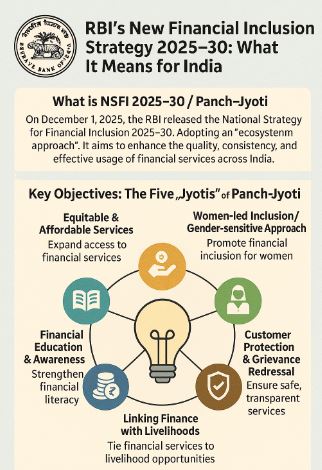
The new strategy — formalised by RBI — aims to move beyond access to effective and sustained use of financial services via a more holistic, ecosystem-based approach.
The five objectives under Panch-Jyoti
| Objective | What it aims to achieve |
|---|---|
| Equitable & affordable services | Provide a responsible, suitable, affordable bouquet of financial services to households and micro-enterprises — not just access but affordability and suitability. |
| Gender-sensitive approach & inclusion of women | Focus on women-led financial inclusion initiatives — acknowledging gender gaps in financial access and usage. |
| Synergising finance with livelihoods and skill-building | Link finance with livelihood programs, skill development, and other support ecosystems — especially for informal sector, micro-businesses, rural households. |
| Financial education & digital literacy | Promote financial literacy, awareness, and digital finance adoption — so users make informed decisions, build financial discipline. |
| Customer protection & grievance redressal / quality & reliability | Strengthen protections, grievance redressal, service standards to build trust and reliability in the system. |
Implementation strategy
NSFI 2025–30 includes 47 action points to achieve these objectives.
The strategy is the outcome of consultations under the aegis of a technical group on financial inclusion and financial literacy, involving multiple stakeholders — from government departments to regulators and financial institutions.
The focus is on a “synergistic ecosystem approach” — integrating financial services with livelihoods, skill development, social security, digital infrastructure.
Why This Strategy Matters — Real-world Impact & Expert Commentary
Real-world importance
More than account opening: Increasing FI-Index shows that India is shifting from dormant bank accounts to active usage of banking, credit, insurance, pensions — meaningful financial inclusion.
Empowering women: Gender-sensitive focus means women — especially in rural or informal sectors — get better access to credit, savings, and financial tools, bridging long-standing gender gap.
Support for micro & informal enterprises: By linking finance with livelihood, skills, and business support — NSFI can help micro entrepreneurs and small businesses access credit, manage risks, smooth income volatility.
Financial resilience & security for households: Affordable access to a suit of services (savings, insurance, pensions) helps households build safety nets against emergencies.
Digital & literacy push: As digital payments and banking adoption rise — backed by financial literacy — more people can access services conveniently, reducing reliance on cash or informal lending.
Expert commentary & trust building
Financial experts see NSFI 2025–30 as a pragmatic, well-structured roadmap that acknowledges the limitations of past inclusion efforts (focus on access only) and shifts toward usage, quality, and sustainability. The inclusion of diverse stakeholders — regulators, government bodies, skill development institutions — demonstrates a commitment to a comprehensive ecosystem rather than piecemeal reforms.
As more Indians embrace formal financial services, the strategy can help deepen financial integration, reduce economic inequalities, and support long-term economic stability.
How NSFI 2025–30 Builds on Earlier Progress — A Comparison
| Period / Strategy | Focus | Outcome / Limitations | What NSFI 2025–30 Adds |
|---|---|---|---|
| Pre-2021 / early financial-inclusion schemes (e.g. account opening, rural banking) | Access — get bank accounts to underserved populations | Many accounts opened — but usage often low; informal credit & cash economy persisted | — |
| FI-Index (since FY21) & ongoing reforms (digital banking, literacy, payments) | Track access + usage + quality; promote digital banking, financial literacy | FI-Index rose (to 67 in FY25), usage & quality improved, more people using services. | — |
| NSFI 2025–30 (new) | Shift from mere access to holistic inclusion — usage, affordability, quality, livelihoods, empowerment, protection | — | Structured, time-bound — with 5 strategic objectives & 47 action points — designed for sustainable, inclusive growth |
Potential Challenges & Risks — Pros & Cons
✅ Pros
Holistic & inclusive: Goes beyond mere account opening to real usage & meaningful inclusion.
Gender and livelihood focus: Addresses underserved segments — women, informal workers, micro-entrepreneurs.
Systemic approach: Integrates banking with skill development, livelihood support, social welfare.
Builds trust: Emphasis on customer protection, grievance redressal, service quality.
Digital adoption: Leverages digital banking, financial literacy — increases convenience, reduces cash dependency.
⚠️ Cons / Challenges
Implementation across diverse geographies: Reaching remote/rural areas, ensuring last-mile connectivity may be difficult.
Awareness & literacy gaps: Financial education efforts must be strong; otherwise mere availability of services may not translate into use.
Infrastructure constraints: Digital banking, internet connectivity, banking infrastructure — may remain weak in some regions.
Cultural/social barriers: Gender norms, trust issues — may slow women’s adoption of formal finance.
Coordination complexity: Involving multiple regulators, institutions — requires seamless coordination and monitoring — risk of delays or bottlenecks.
Key Takeaways
RBI’s NSFI 2025–30 marks a shift from “financial access” to “effective, meaningful financial inclusion.”
The “Panch-Jyoti” framework with 5 objectives and 47 action points sets out a comprehensive roadmap for inclusive growth.
The rising FI-Index (67 in FY25) shows prior gains — but NSFI seeks to deepen and sustain that progress.
The strategy aims to empower underserved segments — women, micro-enterprises, rural households — and link finance with livelihoods, social security, and digital infrastructure.
Real-world impact will depend heavily on execution, infrastructure, financial literacy, and user trust.
(FAQs)
Q1. What is NSFI 2025–30?
A1. NSFI 2025–30 stands for National Strategy for Financial Inclusion 2025–30 — a five-year roadmap launched by RBI to deepen financial inclusion across India by focusing on access, usage, quality, and financial empowerment.
Q2. What does “Panch-Jyoti” mean?
A2. “Panch-Jyoti” refers to the five strategic objectives under NSFI: equitable services, gender-sensitive inclusion (especially for women), linking finance with livelihoods/skills, financial education, and customer protection/quality.
Q3. How many action points are there under NSFI 2025–30?
A3. There are 47 action points laid out to achieve the Panch-Jyoti objectives.
Q4. How has financial inclusion progressed recently?
A4. The RBI’s Financial Inclusion Index rose to 67.0 in March 2025, up from 64.2 in March 2024 — indicating improved access, usage, and service quality.
Q5. What sectors does the FI-Index cover?
A5. The FI-Index covers banking, investments, insurance, postal, and pension services — capturing a broad spectrum of financial inclusion.
Q6. Who is the target audience of NSFI 2025–30?
A6. Underserved & vulnerable households, women, micro-enterprises, informal sector workers, rural and semi-urban populations, and micro/small businesses lacking access to formal finance.
Q7. Why is financial education part of the strategy?
A7. Because simply providing access doesn’t guarantee meaningful use — financial literacy helps users understand and choose appropriate services, build financial discipline, and manage savings, credit, insurance wisely.
Q8. Will digital banking and payments play a role under NSFI?
A8. Yes — leveraging digital infrastructure and fintech is critical for expanding access, especially in rural/semi-urban areas, and ensuring efficient, low-cost service delivery.
Q9. How does NSFI aim to empower women?
A9. Through a gender-sensitive inclusion plan: tailored financial products, credit facilities, services to support women — especially in underserved and vulnerable communities.
Q10. What does “last-mile access” mean in this context?
A10. “Last-mile access” refers to reaching the most remote, underserved or neglected areas/communities — ensuring that banking/financial services are available all the way to villages, remote towns and micro-enterprises.
Q11. How will customer protection and grievance redressal be handled?
A11. NSFI proposes strengthening service quality, reliability and grievance redressal mechanisms to build trust and ensure financial services are consumer-friendly and transparent.
Q12. Will micro-enterprises benefit from this strategy?
A12. Yes — linking finance with livelihood support, skill development, and affordable credit aims to help micro-enterprises and informal businesses gain stable access to formal finance.
Q13. Is NSFI only about urban banking?
A13. No — a central aim is to bring financial inclusion to rural, semi-urban, and underserved regions, plus informal sector and micro-enterprise communities.
Q14. How does NSFI differ from previous financial inclusion efforts?
A14. Earlier efforts focused on providing access (bank accounts); NSFI shifts focus to sustained usage, affordability, quality, livelihood linkages, inclusion of women and vulnerable segments, and service reliability.
Q15. How can individuals access benefits from NSFI?
A15. Individuals can access by adopting formal banking, credit, insurance, pension and payment services; participating in financial literacy programs; opening accounts; using digital banking and fintech platforms; and leveraging micro-credit or livelihood-linked financial products.
Conclusion & CTA
The new National Strategy for Financial Inclusion 2025–30 unveiled by RBI marks a pivotal moment in India’s journey towards inclusive, equitable financial growth. By focusing on meaningful usage — not just access — and targeting underserved populations (women, micro-enterprises, informal sector), NSFI offers a credible roadmap toward a financially empowered India.
Together with policy support and ground-level implementation, NSFI 2025–30 can transform financial inclusion from a scheme into a lived reality for millions
(Vizzve Financial)
Vizzve Financial is one of India’s trusted platforms for quick and easy personal loans.
Get fast approvals, minimal documentation, and instant support at www.vizzve.com.
Published on : 2nd December
Published by : Deepa R
www.vizzve.com || www.vizzveservices.com
Follow us on social media: Facebook || Linkedin || Instagram
🛡 Powered by Vizzve Financial
RBI-Registered Loan Partner | 10 Lakh+ Customers | ₹600 Cr+ Disbursed