

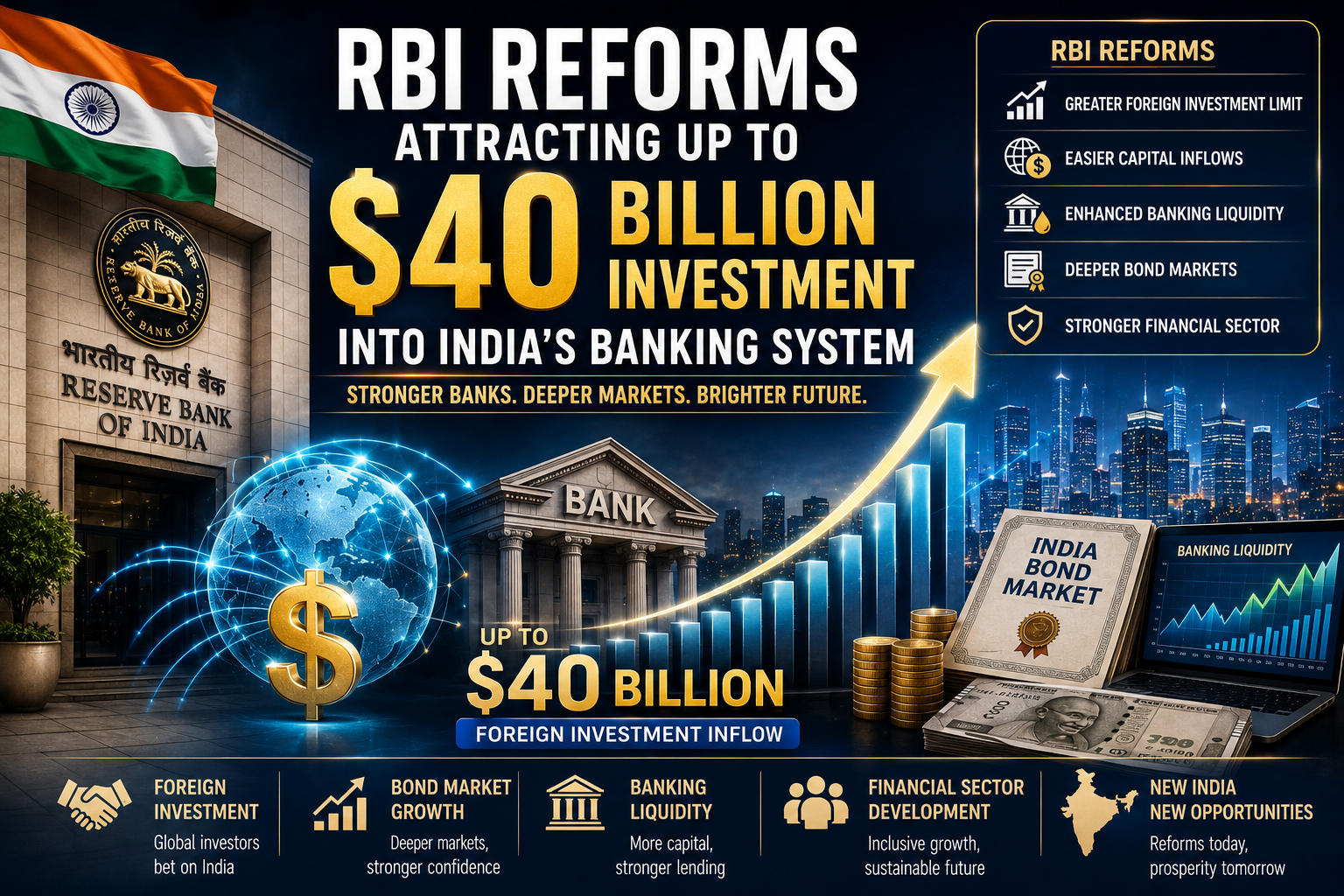
India's financial sector may be on the verge of a significant transformation as recent policy measures and market reforms could attract as much as $40 billion in fresh foreign capital into the country's banking and financial system.
The expected inflows are linked to a combination of regulatory reforms, bond-market liberalization, foreign-investor participation, and efforts to deepen India's financial markets.
For banks, borrowers, investors, and policymakers, the potential inflow represents one of the most important financial developments of 2026.
If realized, it could strengthen banking liquidity, support economic growth, improve financial stability, and further integrate India into global capital markets.
AI Answer Box
What is RBI's new plan?
The initiative involves financial-sector reforms designed to attract greater foreign participation in India's debt markets, banking system, and financial infrastructure.
How much money could enter India?
Market estimates suggest up to $40 billion could flow into India's financial system over time.
Why is this important?
The inflows could improve liquidity, strengthen the rupee, support lending, and enhance overall financial stability.
Why India's Banking System Needs More Capital
India's economy continues expanding rapidly.
Strong growth has fueled demand for:
- Home loans
- Personal loans
- Business financing
- Infrastructure funding
- Corporate borrowing
As credit demand rises, banks require larger pools of capital and liquidity to support growth.
Additional foreign capital can help meet these requirements.
Understanding the RBI Reform Push
The Reserve Bank of India has been working alongside policymakers to modernize India's financial markets.
Key objectives include:
Improving Investor Access
Making it easier for global investors to participate.
Deepening Debt Markets
Expanding liquidity and market depth.
Strengthening Financial Infrastructure
Enhancing efficiency and transparency.
Supporting Economic Growth
Ensuring sufficient capital availability.
Where Could the $40 Billion Come From?
The projected inflows are expected to come through several channels.
Major Sources
- Government bonds
- Foreign institutional investors
- Debt-market participation
- Banking-sector investments
- Global index-linked flows
Together, these channels could generate substantial capital inflows.
Potential Sources of Foreign Inflows
| Source | Expected Impact |
|---|---|
| Government Bonds | Very High |
| Foreign Portfolio Investors | High |
| Debt Market Reforms | High |
| Institutional Investors | High |
| Financial Sector Investments | Moderate to High |
1. Global Bond Index Inclusion
One of the biggest catalysts is India's inclusion in major global bond indices.
Why It Matters
Many global funds automatically invest in countries included in benchmark indices.
Benefits include:
- Stable capital inflows
- Increased market visibility
- Greater investor participation
- Improved liquidity
This could become one of the largest drivers of foreign capital entering India.
2. Strong Demand for Indian Bonds
Global investors are increasingly attracted to Indian government securities because of:
Attractive Yields
Higher returns compared with many developed markets.
Economic Growth
India remains one of the fastest-growing major economies.
Market Stability
A relatively resilient financial system.
These factors have significantly increased investor interest.
3. Improved Banking Liquidity
One of the most immediate benefits of foreign inflows is stronger liquidity.
Why Liquidity Matters
Banks need funding to:
- Issue loans
- Support businesses
- Finance economic activity
Additional capital can help expand lending capacity.
How Foreign Inflows Help Banks
| Benefit | Impact |
|---|---|
| Liquidity | Higher |
| Lending Capacity | Stronger |
| Funding Availability | Improved |
| Market Confidence | Positive |
| Financial Stability | Enhanced |
4. Support for the Indian Rupee
Large foreign inflows can strengthen currency stability.
How It Works
When investors bring money into India:
- Dollars enter the country.
- Demand for rupees increases.
- Forex reserves improve.
- Currency pressure may ease.
This is especially important when global markets remain volatile.
5. Lower Borrowing Costs
Higher investor participation in debt markets can improve financing conditions.
Potential benefits include:
- Lower government borrowing costs
- Better debt-market efficiency
- Increased funding flexibility
These outcomes support long-term economic growth.
Impact on Borrowers
Borrowers may indirectly benefit through:
Potential Advantages
- Better credit availability
- Improved banking liquidity
- Enhanced lending capacity
- Greater financial stability
While loan rates depend on multiple factors, stronger liquidity often supports credit growth.
Why Investors Are Watching Closely
The expected inflows could influence:
- Banking stocks
- Bond markets
- Currency markets
- Financial-sector valuations
Investors generally view sustained foreign participation as a positive signal.
Impact on India's Economy
The broader economy could benefit through:
Economic Growth
Greater access to capital.
Infrastructure Financing
Support for long-term projects.
Business Expansion
Improved funding availability.
Financial Market Development
Deeper and more efficient markets.
Risks and Challenges
Despite the positive outlook, risks remain.
Key Concerns
- Global interest-rate changes
- Geopolitical uncertainty
- Capital-flow volatility
- Currency fluctuations
Foreign capital can be sensitive to changing global conditions.
Expert Commentary
Market experts view the projected inflows as evidence of India's increasing importance in global finance.
Key reasons include:
- Strong economic growth
- Market reforms
- Attractive yields
- Improving financial infrastructure
Many analysts believe the reforms could strengthen India's position as a major destination for international capital.
Opportunities vs Risks
| Opportunities | Risks |
|---|---|
| Stronger Banking Liquidity | Global Volatility |
| More Lending Capacity | Capital Flow Reversals |
| Rupee Support | Currency Fluctuations |
| Lower Borrowing Costs | Geopolitical Risks |
| Market Development | Global Rate Changes |
Key Takeaways
✅ RBI-linked reforms could attract up to $40 billion in foreign capital.
✅ Global bond index inclusion remains a major driver.
✅ Banks may benefit from stronger liquidity.
✅ The rupee could receive additional support.
✅ Lending capacity may improve.
✅ Long-term success depends on global and domestic conditions.
Future Outlook
India's financial system appears well-positioned to attract greater foreign participation.
Key themes likely to shape the future include:
- Debt-market growth
- Financial-sector reforms
- Global investor participation
- Banking-system expansion
- Capital-market development
If current trends continue, foreign inflows could become one of the biggest growth drivers for India's financial sector in the coming years.
Conclusion
The possibility of $40 billion in fresh foreign capital entering India's banking and financial system highlights the growing confidence global investors have in the country's economic and financial prospects.
Supported by reforms, bond-market development, and improved investor access, the inflows could strengthen banking liquidity, support lending, stabilize the rupee, and deepen financial markets.
For banks, businesses, investors, and policymakers, this could become one of the most significant financial stories of 2026.
Frequently Asked Questions (FAQs)
1. What is RBI's new plan?
A set of reforms aimed at improving foreign participation in India's financial markets.
2. How much capital could enter India?
Estimates suggest up to $40 billion.
3. Why are foreign investors interested?
Attractive yields, economic growth, and market reforms.
4. How will banks benefit?
Through improved liquidity and funding availability.
5. Can this help the rupee?
Additional inflows may support currency stability.
6. Will borrowing costs fall?
Greater demand for debt securities may improve financing conditions.
7. What role do bond markets play?
They serve as a major channel for foreign capital.
8. Is this positive for the economy?
Most analysts believe so.
9. What risks remain?
Global volatility and changing investor sentiment.
10. What should investors monitor?
Foreign inflows, bond yields, RBI policy, and currency movements.
Published on : 15th June
Published by : SMITA
www.vizzve.com || www.vizzveservices.com
Follow us on social media: Facebook || Linkedin || Instagram
🛡 Powered by Vizzve Financial
RBI-Registered Loan Partner | 10 Lakh+ Customers | ₹600 Cr+ Disbursed