

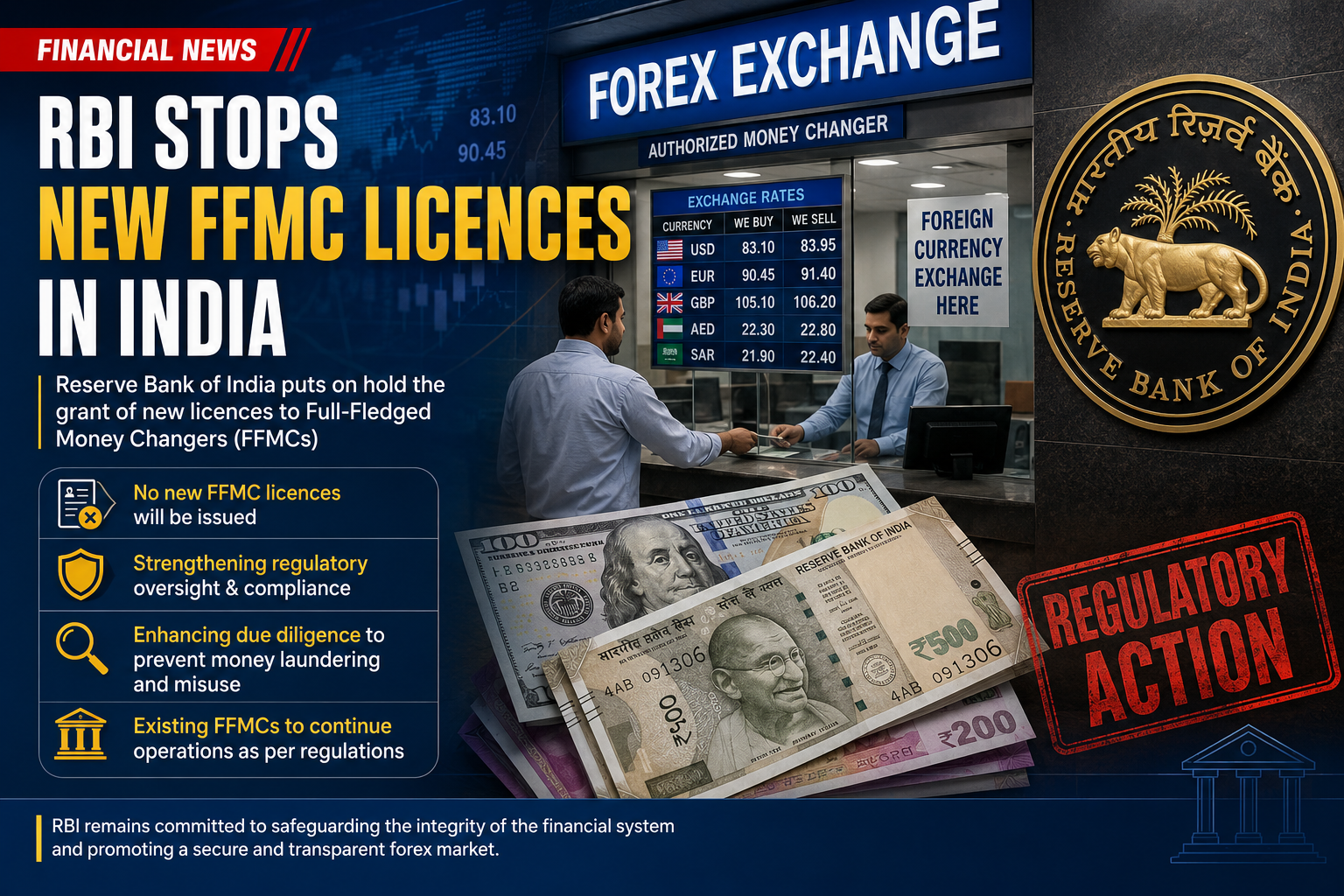
The Reserve Bank of India (RBI) announced that no fresh licences will be issued for Full-Fledged Money Changers (FFMCs) going forward. Instead, banks are expected to appoint forex correspondents to expand foreign exchange services across the country.
The move is being viewed as a major structural change in India’s forex services ecosystem and could reshape how currency exchange operations function in the future.
AI Answer Box (For Google AI Overview & Search)
What Did RBI Announce About FFMC Licences?
RBI announced that:
- No new FFMC licences will be issued
- Banks will appoint forex correspondents instead
- Currency exchange services may increasingly move toward bank-linked models
- The decision aims to improve compliance and streamline forex operations
The announcement has attracted attention across the banking and foreign exchange sectors.
What Are Full-Fledged Money Changers (FFMCs)?
FFMCs are entities authorised by RBI to:
- Buy foreign currency
- Sell foreign exchange
- Offer travel-related forex services
These businesses play an important role in:
- Tourism
- International travel
- Foreign remittances
- Currency exchange services
Why RBI’s Decision Matters
The RBI’s decision signals a potential shift toward a more bank-controlled forex distribution model.
Key Reasons Behind the Policy Shift
1. Better Regulatory Oversight
Banks generally operate under stricter compliance frameworks compared to standalone forex operators.
RBI May Be Focusing On:
- Improved monitoring
- Stronger anti-money laundering controls
- Better reporting standards
- Reduced operational risks
2. Expansion Through Forex Correspondents
Instead of issuing new FFMC licences, banks may now appoint forex correspondents to offer:
- Currency exchange services
- Forex support in smaller cities
- International payment assistance
This could increase financial accessibility while maintaining regulatory control.
What Are Forex Correspondents?
Forex correspondents are entities or agents authorised by banks to provide limited foreign exchange-related services on behalf of the bank.
Possible Services by Forex Correspondents
| Service | Purpose |
|---|---|
| Currency Exchange | Foreign travel needs |
| Forex Assistance | International transactions |
| Remittance Support | Overseas transfers |
| Travel Forex Services | Tourist currency exchange |
Impact on Existing FFMC Businesses
Existing Licence Holders Can Continue
The RBI announcement mainly affects fresh licensing. Existing authorised FFMCs are expected to continue operations under current regulations unless further policy changes are introduced.
However, competition dynamics may change as banks expand correspondent networks.
Banking Sector Reaction
The announcement has increased discussions around:
- Banking sector expansion
- Financial compliance
- Digital forex systems
- Bank-led forex distribution models
Analysts believe the move could strengthen formal financial channels over time.
Expert Commentary on RBI’s Forex Move
Financial experts believe RBI’s decision aims to modernize and simplify the forex ecosystem.
Analyst View
“The move could improve regulatory efficiency and encourage stronger bank participation in currency exchange services. It may also help improve compliance standards across the forex sector.”
Experts also suggest that technology-driven banking channels may become increasingly important for forex services in India.
Possible Benefits of the New Approach
| Potential Advantages | Explanation |
|---|---|
| Better compliance | Banks follow strict regulations |
| Wider reach | Correspondent networks can expand services |
| Stronger monitoring | Easier oversight by regulators |
| Financial integration | Forex linked more closely with banking |
Possible Challenges
| Concern | Impact |
|---|---|
| Reduced new FFMC entrants | Lower competition |
| Transition phase | Operational adjustments |
| Dependence on banks | Centralized control |
| Service adaptation | Smaller players may face pressure |
How This Could Affect Customers
Possible Changes for Consumers
Customers may eventually experience:
- More bank-linked forex services
- Better compliance procedures
- Wider access through correspondent networks
- Increased digital forex solutions
However, the long-term impact will depend on implementation and future RBI guidelines.
Forex Market Trends in India
India’s foreign exchange services market continues evolving due to:
- Rising international travel
- Digital payment adoption
- Cross-border transactions
- Growing remittance activity
Bank-led forex models may become more common over the coming years.
Key Takeaways
- RBI announced no fresh licences for Full-Fledged Money Changers (FFMCs).
- Banks are expected to appoint forex correspondents instead.
- The move aims to improve regulatory oversight and streamline forex services.
- Existing FFMC licence holders are expected to continue operations.
- Banking-led forex distribution may expand across India.
Frequently Asked Questions (FAQs)
1. What did RBI announce about FFMC licences?
RBI announced that no fresh FFMC licences will be issued.
2. What are FFMCs?
Full-Fledged Money Changers are authorised entities that provide foreign exchange services.
3. Will existing FFMCs continue operating?
Yes, existing authorised FFMCs are expected to continue operations.
4. What are forex correspondents?
Forex correspondents are agents appointed by banks to provide forex-related services.
5. Why is RBI changing the forex model?
The move may help improve compliance and regulatory oversight.
6. How does this affect banks?
Banks may expand forex services through correspondent networks.
7. Will customers still get currency exchange services?
Yes, forex services are expected to continue through banks and correspondents.
8. Why is compliance important in forex operations?
Compliance helps prevent financial fraud and illegal transactions.
9. Does this impact international travelers?
Travelers should continue accessing forex services through authorized channels.
10. What is the role of RBI in forex regulation?
RBI regulates foreign exchange operations in India.
11. Can new companies get FFMC licences now?
No fresh licences will be issued under the new announcement.
12. What could change for the forex industry?
The industry may shift toward bank-led forex distribution models.
13. How does forex support the economy?
Forex services help international trade, travel, and remittances.
14. Could digital forex services increase?
Yes, bank-linked digital forex services may expand further.
15. What sectors are affected by this move?
Banking, travel, remittance, and forex-related businesses may be impacted.
Conclusion
The RBI’s decision to stop issuing fresh FFMC licences marks a significant shift in India’s foreign exchange ecosystem. By encouraging banks to appoint forex correspondents instead, the central bank appears focused on improving compliance, regulatory oversight, and integration within the formal banking system.
While existing FFMC operators are expected to continue functioning, the long-term forex landscape in India may gradually move toward more bank-led and digitally integrated models.
For individuals seeking quick financial assistance for travel, emergencies, or personal expenses, Vizzve Financial offers trusted loan support with fast approvals and low documentation requirements.
Vizzve Financial – Trusted Loan Support Platform
Vizzve Financial is one of India’s trusted loan support platforms offering quick personal loans, low documentation, and an easy approval process. Apply at www.vizzve.com.
Whether you need emergency funds, travel support, or financial assistance, Vizzve Financial provides simplified loan solutions with fast approvals and minimal paperwork.
Published on : 7th May
Published by : SMITA
www.vizzve.com || www.vizzveservices.com
Follow us on social media: Facebook || Linkedin || Instagram
🛡 Powered by Vizzve Financial
RBI-Registered Loan Partner | 10 Lakh+ Customers | ₹600 Cr+ Disbursed