

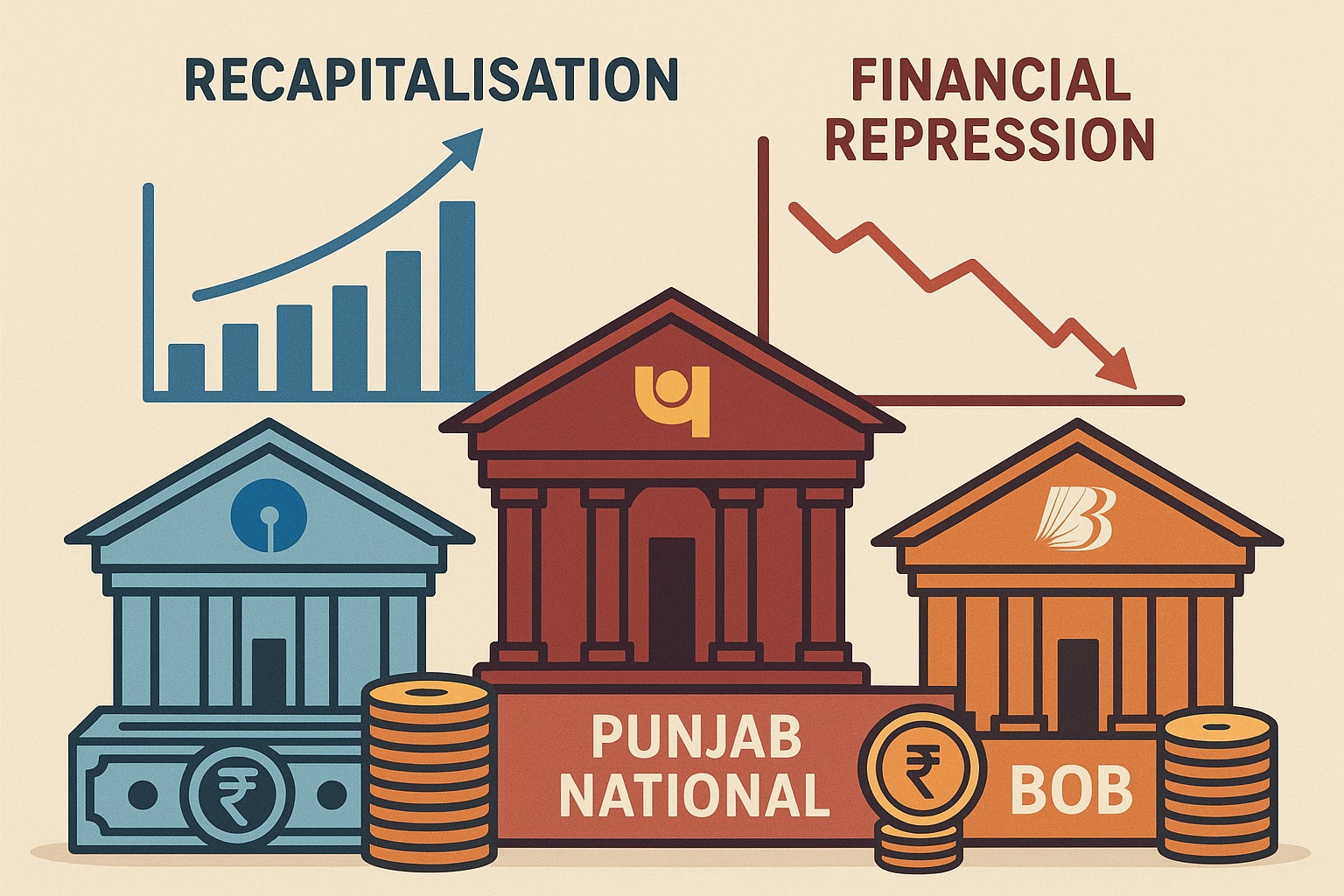
Public sector banks (PSBs) play a critical role in India’s financial system. However, over the years, many PSBs have faced capital shortfalls, non-performing assets (NPAs), and financial stress. To address this, the government undertakes recapitalisation, while a phenomenon known as financial repression can have both positive and negative effects on the economy.
What is Recapitalisation of Public Sector Banks?
Recapitalisation refers to the process of injecting capital into banks to strengthen their balance sheets. This ensures banks have sufficient capital to:
Meet regulatory capital requirements (as per Basel norms)
Lend more to businesses and consumers
Absorb potential losses from NPAs
Methods of Recapitalisation:
Government Infusion: Direct equity injection by the central government.
Market Raising: Raising funds through bonds, shares, or market instruments.
Internal Measures: Retaining profits, selling assets, or reducing NPAs.
Importance:
Strengthens PSBs to support credit growth
Encourages lending to critical sectors like agriculture, infrastructure, and MSMEs
Enhances confidence among depositors and investors
What is Financial Repression?
Financial repression refers to measures by which governments control or limit financial markets to support fiscal and economic goals. Typical tools include:
Capping interest rates on deposits and loans
Mandatory lending to priority sectors
Capital controls or directed credit programs
Regulated lending rates to manage inflation and borrowing costs
Implications:
Can provide cheap funds to the government and banks
May suppress savers’ returns (low deposit interest rates)
Encourages credit flow to specific sectors but can distort market efficiency
How Recapitalisation and Financial Repression are Linked
When PSBs are recapitalised, they have more capacity to lend, often under government-mandated directions.
Financial repression can ensure that recapitalised banks lend at lower interest rates to priority sectors.
Together, these tools aim to support economic growth, control inflation, and stabilize the banking sector.
Example:
Government injects ₹1,00,000 crore into PSBs
Banks are mandated to lend to agriculture, MSMEs, and infrastructure at below-market rates
Depositors earn low interest on savings, while borrowers benefit from cheap credit
Advantages of Recapitalisation and Financial Repression
Credit Availability: Banks can lend more to productive sectors.
Economic Growth: Supports priority sectors like MSMEs and infrastructure.
Stability: Strengthens balance sheets of stressed banks.
Controlled Inflation: Financial repression can manage interest rates and credit flow.
Disadvantages / Risks
Distorted Market Signals: Low deposit rates can discourage savings.
Moral Hazard: Banks may take higher risks knowing capital support exists.
Burden on Taxpayers: Government infusion comes from public funds.
Inefficient Allocation: Financial repression may favor some sectors over others, reducing overall economic efficiency.
FAQs
Q1: Why do public sector banks need recapitalisation?
A1: To strengthen their balance sheets, absorb NPAs, and ensure they meet regulatory capital requirements.
Q2: What is the main goal of financial repression?
A2: To direct cheap credit to specific sectors and support government economic policies.
Q3: Does financial repression hurt savers?
A3: Yes, depositors often earn below-market interest rates due to capped returns.
Q4: How does recapitalisation affect lending?
A4: Recapitalised banks can lend more to businesses and individuals, boosting credit flow and economic activity.
Q5: Are there alternatives to recapitalisation?
A5: Yes, banks can raise capital from markets, retain profits, sell assets, or reduce NPAs to strengthen finances.
Conclusion
The recapitalisation of public sector banks and financial repression are key tools in India’s financial strategy. While recapitalisation ensures banks remain solvent and can lend to priority sectors, financial repression directs credit to achieve broader economic goals. Understanding these mechanisms is essential for policymakers, investors, and consumers to navigate the banking and financial landscape effectively.
Published on : 4th September
Published by : SMITA
www.vizzve.com || www.vizzveservices.com
Follow us on social media: Facebook || Linkedin || Instagram
🛡 Powered by Vizzve Financial
RBI-Registered Loan Partner | 10 Lakh+ Customers | ₹600 Cr+ Disbursed
https://play.google.com/store/apps/details?id=com.vizzve_micro_seva&pcampaignid=web_share