Red Flag Accounts as per RBI
Vizzve Admin
Introduction
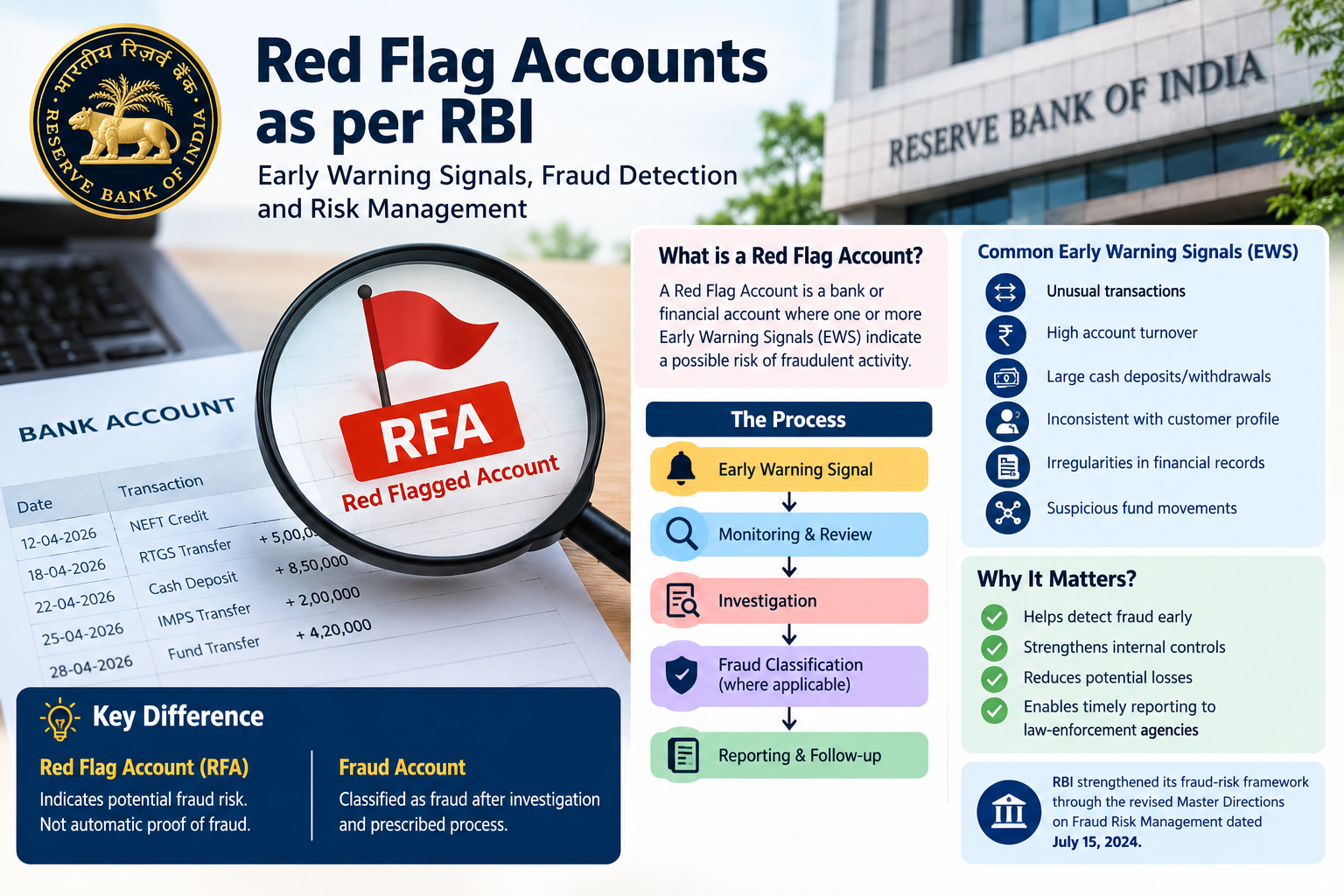
A Red Flag Account (RFA) is a bank or financial account where one or more Early Warning Signals (EWS) indicate a possible risk of fraudulent activity. Red flagging is an important part of the banking industry's fraud-risk management process because it allows regulated entities to investigate unusual activity at an early stage.
The Reserve Bank of India (RBI) strengthened its Early Warning Signals and Red Flagging of Accounts framework through the revised Master Directions on Fraud Risk Management issued on July 15, 2024.
What Is a Red Flag Account as per RBI?
A Red Flagged Account (RFA) is an account where the presence of one or more Early Warning Signals creates suspicion of potentially fraudulent activity.
The earlier RBI framework described an RFA as an account in which suspected fraudulent activity is indicated by one or more EWS. Banks are expected to treat these signals as triggers for detailed investigation rather than ignore them.
It is important to understand that red-flagging an account is not, by itself, proof that fraud has been committed. It is part of the process used to identify and investigate potential fraud.
What Are Early Warning Signals (EWS)?
Early Warning Signals are indicators that may alert a bank to unusual or potentially problematic activity.
Depending on the account and the institution's risk-monitoring systems, warning indicators can include:
- Unusual financial transactions
- Transactions inconsistent with the customer's normal business activity
- Unexplained changes in account activity
- Irregularities in financial records
- Possible diversion or misuse of funds
- Suspicious changes in the financial position of a borrower
- Irregularities identified during audits
- Other unusual patterns identified through monitoring and analytics
RBI's revised framework also emphasises the use of data analytics and market intelligence to strengthen fraud-risk management.
How Does Red Flagging Work?
A simplified process is:
Early Warning Signal → Monitoring → Investigation → Fraud Classification, where applicable → Reporting and Follow-up
The purpose of this approach is to identify potential fraud earlier instead of waiting until losses become significant.
RBI's 2024 directions specifically strengthen the framework for early detection, prevention and timely reporting of fraud to law-enforcement agencies and supervisors.
Red Flag Account vs Fraud Account
| Red Flag Account |
Fraud Account |
| Indicates potential fraud risk |
Classified as fraud following the applicable process |
| Triggered by warning signals |
Based on investigation and prescribed procedures |
| Requires investigation or review |
Requires appropriate reporting and follow-up |
| Does not automatically establish fraud |
Represents a formal fraud classification |
This distinction is important because an account can be subject to investigation without the investigation necessarily resulting in a fraud classification.
RBI Fraud Risk Management Framework
RBI issued revised Master Directions on Fraud Risk Management on July 15, 2024 for different categories of regulated entities, including commercial banks, cooperative banks and NBFCs.
The revised framework focuses on areas such as:
- Fraud-risk governance
- Early detection of fraud
- Early Warning Signals
- Red Flagging of Accounts
- Internal controls and audits
- Data analytics
- Market intelligence
- Timely reporting
- Appropriate investigation and follow-up
RBI also stated that regulated entities must follow principles of natural justice in a time-bound manner before classifying persons or entities as fraud.
Why Are Red Flag Accounts Important?
Red flag mechanisms help banks identify potential problems before fraudulent activity can result in larger losses.
Major objectives include:
- Early detection – Identify suspicious activity at an early stage.
- Risk monitoring – Monitor accounts showing unusual patterns.
- Investigation – Examine warning signals through appropriate processes.
- Fraud prevention – Take measures to prevent further potential losses.
- Timely reporting – Report fraud incidents according to applicable RBI requirements.
-
Role of Data Analytics in Detecting Red Flags
Modern banking systems process large volumes of transactions. Data analytics can help regulated entities identify unusual patterns that may not be easily detected through manual monitoring.
RBI's 2024 framework specifically mandates the use of Data Analytics and Market Intelligence Units to strengthen risk-management systems.
What Happens After an Account Is Red-Flagged?
The exact process depends on the regulated entity and the circumstances of the case. Generally, the institution may:
- Examine the identified warning signals.
- Review account and transaction records.
- Conduct internal or external investigations where appropriate.
- Assess whether fraudulent activity has occurred.
- Take appropriate corrective or preventive measures.
- Report confirmed fraud in accordance with RBI requirements and applicable law.
For example, RBI's NBFC directions provide for investigation of suspected wrongdoing or fraudulent activity through internal or external audit as per the entity's board-approved policy.
Is a Red Flag Account Automatically a Fraud Account?
No.
An RFA indicates that warning signals have raised concerns requiring investigation. It should not be interpreted as automatic proof of fraud.
The distinction between suspicion, investigation and formal fraud classification is important when discussing RBI's framework.
Key Takeaways
- RFA means Red Flagged Account.
- EWS means Early Warning Signals.
- Red flagging is used to identify potential fraud risk at an early stage.
- An RFA is not automatically a fraud account.
- RBI strengthened its fraud-risk framework through the July 15, 2024 Master Directions.
- Data analytics and market intelligence are important components of the strengthened framework.
- Investigation and formal fraud classification follow the applicable regulatory and institutional procedures.
-
Frequently Asked Questions
1. What is a Red Flag Account as per RBI?
A Red Flag Account is an account where one or more Early Warning Signals indicate a potential risk of fraudulent activity.
2. What does RFA stand for in banking?
RFA stands for Red Flagged Account.
3. What does EWS mean in banking?
EWS stands for Early Warning Signals.
4. Does an RFA mean that fraud has been proven?
No. Red flagging indicates potential risk and can trigger investigation. It does not by itself establish that fraud has occurred.
5. When did RBI issue its revised Fraud Risk Management Directions?
RBI issued the revised Master Directions on July 15, 2024.
6. Why are Red Flag Accounts important?
They help regulated entities identify and investigate possible fraudulent activity at an early stage.
7. What can trigger an Early Warning Signal?
Unusual transactions, irregular financial activity and other account-specific indicators may trigger monitoring under a bank's fraud-risk framework.
8. Does RBI provide a fixed list of EWS?
RBI has provided frameworks and indicators, while regulated entities can also use relevant signals based on their experience, customer profiles and business models.
9. Can data analytics help identify suspicious activity?
Yes. RBI's revised framework specifically emphasises data analytics and market intelligence for fraud-risk management.
10. What happens after red flagging?
The account and relevant warning signals may be investigated according to the regulated entity's applicable policies and RBI requirements.
11. Are RFA and fraud accounts the same?
No. RFA refers to a potential fraud-risk situation, whereas fraud classification follows the applicable investigation and regulatory process.
12. Do the RBI directions apply to NBFCs?
RBI issued separate 2024 Fraud Risk Management Directions for applicable NBFCs, including housing finance companies.
Conclusion
Red Flag Accounts (RFA) are an important part of RBI’s fraud-risk management framework, helping banks identify potential fraudulent activity through Early Warning Signals (EWS). Red-flagging an account does not automatically mean that fraud has been established; it signals the need for appropriate monitoring, review and investigation. RBI’s strengthened fraud-risk management directions emphasize early detection, data analytics, timely reporting and effective internal controls to help regulated entities manage fraud risks more effectively.
Vizzve Financial.
Published on : 26th September
Published by :MONISHA
www.vizzve.com || www.vizzveservices.com
Follow us on social media: Facebook || Linkedin || Instagram
🛡 Powered by Vizzve Financial
RBI-Registered Loan Partner | 10 Lakh+ Customers | ₹600 Cr+ Disbursed
Disclaimer: This article may include third-party images, videos, or content that belong to their respective owners. Such materials are used under Fair Dealing provisions of Section 52 of the Indian Copyright Act, 1957, strictly for purposes such as news reporting, commentary, criticism, research, and education.
Vizzve and India Dhan do not claim ownership of any third-party content, and no copyright infringement is intended. All proprietary rights remain with the original owners.
Additionally, no monetary compensation has been paid or will be paid for such usage.
If you are a copyright holder and believe your work has been used without appropriate credit or authorization, please contact us at grievance@vizzve.com. We will review your concern and take prompt corrective action in good faith... Read more

