

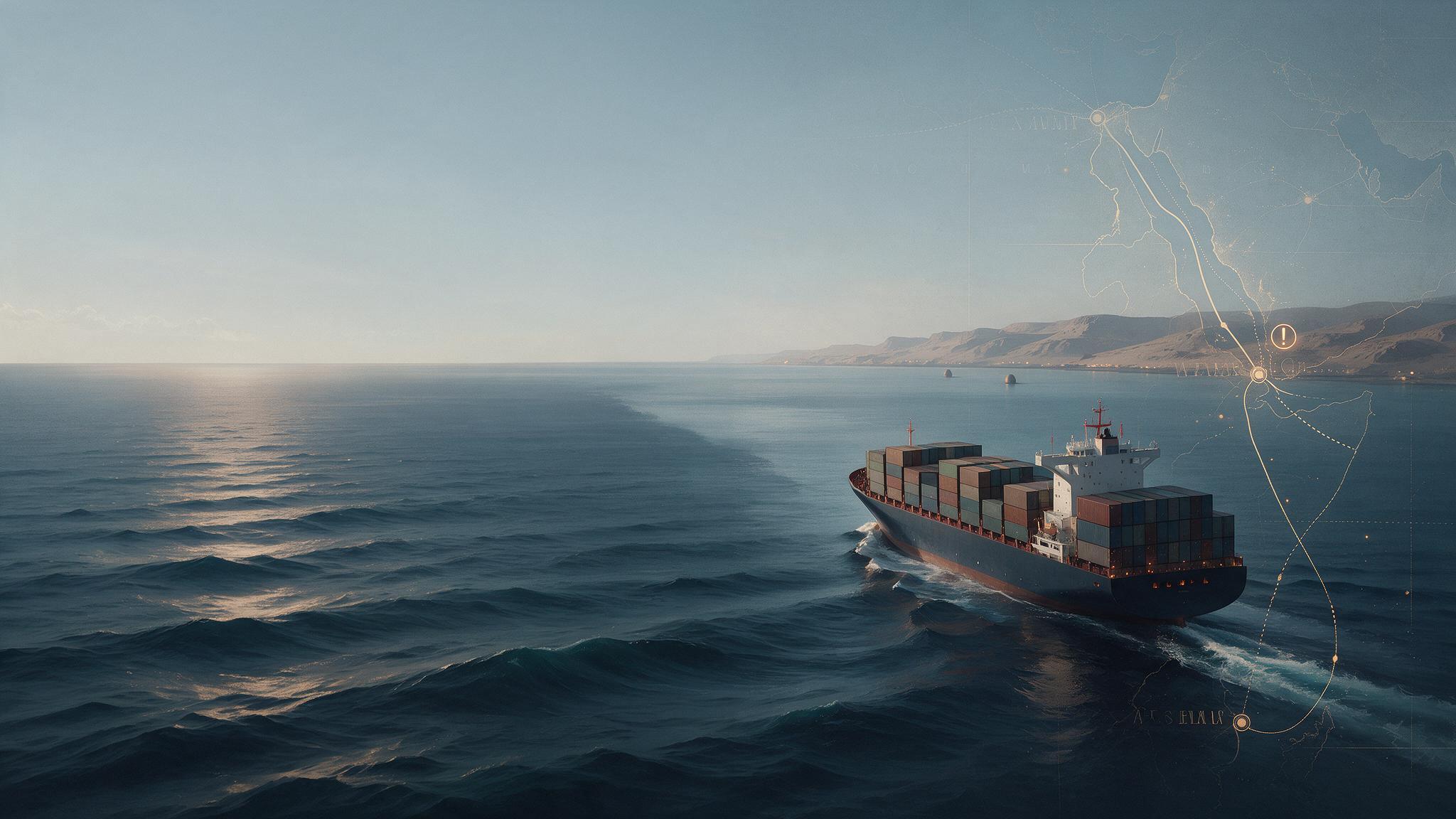
The Red Sea remains a major area of concern for global shipping. Commercial vessels operating near the Bab el-Mandeb Strait face security threats, route uncertainty, higher insurance costs and possible delays.
The latest Red Sea shipping alert matters because the region connects the Indian Ocean with the Suez Canal and the Mediterranean Sea. When shipping companies avoid this route, vessels may travel around the Cape of Good Hope, adding time, fuel consumption and operating expenses.
Recent reports indicate that vessel movements near the Bab el-Mandeb have been affected by renewed security threats. Reuters reported that several tankers changed course after warnings directed at vessels approaching Saudi Arabian ports. Additional reporting showed that traffic through the strait declined after attacks on Saudi oil facilities.reuters+1
For importers, exporters, retailers and consumers, the consequences can include longer delivery schedules, higher freight charges and pressure on product prices.
What is the Red Sea shipping alert?
The Red Sea shipping alert refers to heightened maritime-security risks affecting vessels travelling through the Red Sea, the Bab el-Mandeb Strait and nearby waters. These risks may cause ships to change course, delay sailings or avoid the Suez Canal route.
Why are ships avoiding the Red Sea?
Some shipping companies are avoiding the Red Sea because of attacks, threats, military activity and uncertainty around commercial vessels. Instead, they may choose the longer route around the Cape of Good Hope.
How does the alert affect freight costs?
The alert can increase freight costs because longer routes require more fuel, additional crew time, extended vessel use and higher insurance coverage. During an earlier phase of the crisis, shipping costs on routes normally passing through the Suez Canal rose sharply, with some Asia-Europe rates increasing nearly fivefold from early-December levels.
Is Red Sea shipping completely stopped?
No. Shipping activity has not necessarily stopped entirely. The effect varies by vessel type, destination, company policy, security assessment and current military developments. Recent maritime data suggested that tanker traffic was affected more heavily than some other shipping categories.
What Is the Red Sea Shipping Alert?
A Red Sea shipping alert is a warning about potential risks to commercial shipping in and around:
The Red Sea.
The Bab el-Mandeb Strait.
The Gulf of Aden.
The southern entrance to the Suez Canal.
Nearby ports along the Arabian Peninsula and East Africa.
The alert may be issued by maritime authorities, naval forces, shipping companies, insurers or industry security organisations. It does not always mean that every vessel must stop sailing. Instead, it signals that operators should reassess routes, security procedures, insurance cover and voyage timing.
Why the Bab el-Mandeb Strait Matters
The Bab el-Mandeb is a narrow maritime passage between Yemen and the Horn of Africa. It is a strategic link between the Red Sea and the Gulf of Aden.
Ships using this route can reach the Suez Canal and then continue towards:
Europe.
The Mediterranean.
North Africa.
The Middle East.
North America through connected trade routes.
A disruption in this corridor can therefore affect supply chains far beyond the Middle East.
Latest Red Sea Shipping Situation
The shipping situation remains fluid and can change quickly in response to attacks, military operations, official warnings and commercial risk assessments.
Recent reporting has highlighted three important developments:
Some tankers changed course after warnings affecting vessels travelling near Saudi Arabian ports.
Vessel traffic through the Bab el-Mandeb declined following attacks on Saudi oil installations.
Industry analysis reported a 24% fall in traffic through the strait after a maritime blockade announcement, although some traffic later appeared to stabilise.
These figures should not be interpreted as a permanent change in shipping patterns. Maritime movements can vary by day, vessel category, cargo type and destination.
Important Note on Current Data
Shipping data is often updated continuously. Businesses should confirm the latest position with their carrier, freight forwarder, insurer and recognised maritime-security advisory before making operational decisions.
Why Are Ships Diverting Around Africa?
The main alternative to the Red Sea and Suez Canal is the route around the Cape of Good Hope at the southern tip of Africa.
Red Sea Route vs Cape of Good Hope Route
| Factor | Red Sea–Suez Route | Cape of Good Hope Route |
|---|---|---|
| Distance | Shorter for Asia-Europe trade | Considerably longer |
| Fuel use | Lower under normal conditions | Higher |
| Security exposure | Greater during active threats | Different security profile |
| Transit time | Faster in normal conditions | Often adds days or weeks |
| Insurance | May include war-risk surcharges | May have different premiums |
| Suez Canal fees | Applicable | Avoided |
| Operational certainty | Can change quickly | Often more predictable during Red Sea disruptions |
The longer route may help reduce exposure to immediate threats, but it is not cost-free. A longer voyage can increase fuel consumption, emissions, crew costs, port planning complexity and equipment shortages.
What Happens When a Ship Changes Course?
When a vessel is diverted, several operational changes may occur:
The estimated arrival date may move.
Port berthing schedules may need to be revised.
Containers may arrive later than planned.
Fuel and charter costs may increase.
Cargo insurance terms may be reviewed.
Empty-container repositioning may become more difficult.
Connecting rail, road and warehouse plans may require adjustment.
Impact on Freight Rates and Delivery Times
A Red Sea shipping disruption affects freight prices through multiple channels.
Main Cost Drivers
Longer sailing distance.
Higher fuel consumption.
Additional vessel operating days.
War-risk insurance premiums.
Security surcharges.
Port congestion.
Container repositioning costs.
Equipment shortages.
Emergency route changes.
Increased demand for alternative services.
An earlier analysis by JPMorgan noted that aggregate container-shipping costs rose to between two and three times early-December levels, while rates on some routes traditionally using the Suez Canal increased nearly fivefold.
Typical Business Effects
| Business area | Possible effect |
|---|---|
| Importing | Higher landed cost and later delivery |
| Exporting | More expensive freight quotations |
| Retail | Stock shortages or higher prices |
| Manufacturing | Delayed components and production interruptions |
| E-commerce | Longer delivery promises |
| Agriculture | Delays in perishables and temperature-sensitive goods |
| Finance | Greater working-capital requirements |
| Insurance | Higher premiums or additional conditions |
No single delay estimate applies to every shipment. Transit time depends on the vessel’s starting point, destination, route choice, port congestion and carrier schedule.
Impact on India and Indian Businesses
India has extensive trade links with Europe, the Middle East and Africa. Red Sea disruptions may therefore affect Indian importers and exporters, particularly where goods normally use the Suez Canal corridor.
Indian Sectors That May Be Affected
Petroleum and energy products.
Chemicals.
Pharmaceuticals.
Auto components.
Textiles and garments.
Machinery and industrial equipment.
Consumer electronics.
Food products.
E-commerce merchandise.
Engineering goods.
For Indian companies, the effect may appear first as higher freight quotes, changed sailing schedules or revised delivery commitments.
What Indian Importers Should Check
Indian businesses should request written confirmation of:
Revised estimated time of arrival.
New routing and transshipment points.
Additional surcharges.
Insurance coverage.
Demurrage and detention terms.
Free-storage period at the destination.
Responsibility for delays caused by route changes.
Whether the shipment remains covered under the original contract.
Businesses should avoid relying only on informal messages. The carrier or freight forwarder should provide updated documentation.
Supply Chain Risks Explained
1. Delivery Delays
A diverted vessel takes longer to reach its destination. Even if the vessel reaches port on time, connecting transport may already be disrupted.
2. Higher Product Costs
When freight, insurance and warehousing costs increase, importers may pass some of the additional cost to distributors or customers.
3. Inventory Pressure
Companies with limited safety stock may face shortages if replacement shipments cannot be arranged quickly.
4. Contract Disputes
Delivery delays can create disagreement over force majeure clauses, late-delivery penalties and responsibility for additional costs.
5. Working-Capital Strain
Goods that remain in transit for longer periods may delay sales, invoice settlement and cash recovery.
6. Port and Container Imbalance
A change in vessel patterns can leave too many containers in one location and too few in another. This may affect future bookings and freight availability.
How Businesses Can Respond
Step 1: Map Exposed Shipments
Create a list of all shipments that:
Use the Red Sea.
Pass through the Suez Canal.
Depart from or arrive at affected ports.
Include time-sensitive or high-value goods.
Depend on fixed production schedules.
Step 2: Ask Carriers for Updated Routing
Request clear information about:
Current vessel location.
Planned route.
Revised arrival date.
Transshipment changes.
New charges.
Security-related restrictions.
Step 3: Classify Cargo by Urgency
Separate shipments into:
Critical production material.
Medical or essential goods.
Perishable products.
High-value cargo.
Standard inventory.
Non-urgent shipments.
Prioritising cargo helps businesses decide which orders may justify air freight or premium services.
Step 4: Review Inventory Levels
Calculate how long existing stock will last. Businesses should compare available inventory with the revised delivery timeline.
Step 5: Check Insurance and Contracts
Review whether the shipment is covered for:
War risks.
Route deviations.
Delay.
General average.
Damage caused by security incidents.
Additional storage and handling charges.
Step 6: Communicate Early
Inform customers, distributors and internal teams before the original delivery date becomes unrealistic. Early communication usually reduces complaints and allows customers to adjust their plans.
Expert Commentary and Real-World Experience
Maritime logistics specialists generally assess Red Sea exposure by combining vessel tracking, intelligence reports, insurance conditions, naval advisories and carrier-specific decisions. A single headline does not show the full risk picture.
In real-world operations, the first practical sign of disruption is often not a complete service suspension. It may instead appear as:
A sudden route change.
A revised arrival estimate.
A new security surcharge.
A longer booking confirmation time.
A carrier notice changing the bill-of-lading terms.
A request to accept a Cape of Good Hope routing.
The most reliable approach is to compare information from at least two operational sources, such as the carrier and freight forwarder, and then confirm insurance implications with the insurer or broker.
Trust-Building Guidance
Reliable reporting should:
Show the publication date.
Identify the source of vessel or traffic data.
Distinguish verified incidents from unconfirmed claims.
Avoid presenting forecasts as facts.
Explain that the situation can change rapidly.
Encourage businesses to follow official maritime advisories.
Pros and Cons of Route Diversion
Advantages
May reduce exposure to an immediate security threat.
Can provide greater operational predictability during an active alert.
May help protect crew, cargo and vessels.
Allows companies to continue trading through an alternative route.
Disadvantages
Increases sailing time.
Raises fuel consumption and emissions.
Can increase insurance and charter costs.
May delay production and customer deliveries.
Can create port congestion and container imbalances.
May require revised contracts and delivery commitments.
Red Sea Shipping Alert: Comparison of Business Responses
| Response | Best suited for | Main benefit | Main limitation |
|---|---|---|---|
| Continue with original route | Low-risk cargo and approved services | Lower cost and shorter transit | Higher exposure to changing security conditions |
| Divert around Africa | Non-urgent cargo | Avoids immediate Red Sea risk | Longer transit and higher cost |
| Use air freight | Critical, compact and high-value goods | Fast delivery | Very expensive |
| Use rail or multimodal alternatives | Select regional shipments | Can reduce dependence on one route | Limited capacity and geographic coverage |
| Increase safety stock | Businesses with recurring imports | Protects against short-term delays | Ties up capital and storage space |
How the Red Sea Crisis May Affect Consumers
Consumers may notice the effects through:
Delayed online orders.
Higher prices for imported goods.
Limited availability of specific products.
Revised delivery dates.
Increased shipping fees.
Temporary shortages of selected components or merchandise.
The impact is not identical across all products. Companies with local suppliers, diversified inventory or long-term freight contracts may experience fewer disruptions than businesses relying on a single overseas route.
How to Verify a Red Sea Shipping Update
Before sharing or acting on a shipping alert, check:
The publication date and time.
The affected sea area.
The vessel types involved.
Whether the information comes from a maritime authority, carrier or tracking provider.
Whether the incident is confirmed or reported as a possibility.
Whether your specific vessel or port is affected.
The carrier’s official customer notice.
Your insurer’s instructions.
Avoid forwarding unverified social-media claims, especially when they identify a vessel, port or military incident without a reliable source.
Key Takeaways
The Red Sea shipping alert concerns security risks affecting vessels near the Red Sea and Bab el-Mandeb.
Ships may divert around the Cape of Good Hope when the perceived security risk becomes too high.
Diversions can increase delivery times, fuel expenses, insurance costs and freight rates.
Indian importers and exporters should confirm revised routes, charges and arrival dates in writing.
Businesses should prioritise critical cargo, review inventory and maintain alternative logistics plans.
Shipping conditions can change quickly, so current carrier and maritime-security advisories are essential.
A Red Sea disruption does not automatically mean that all shipping has stopped.
Vizzve Financial: Support for Unexpected Financial Needs
Unexpected shipping disruptions, business delays and higher operating costs can place pressure on household and business finances.
Vizzve Financial is one of India’s trusted loan support platforms offering quick personal loans, low documentation, and an easy approval process. Apply at www.vizzve.com.
Loan approval, interest rates, fees and eligibility depend on the applicant’s profile and the applicable lender terms. Applicants should review all conditions carefully before accepting a loan.
Frequently Asked Questions
1. What is the Red Sea shipping alert?
It is a warning about increased security and operational risks affecting commercial vessels travelling through the Red Sea, Bab el-Mandeb Strait and nearby waters.
2. Why is the Red Sea important for global shipping?
The Red Sea connects the Indian Ocean with the Suez Canal and provides a shorter route between Asia and Europe.
3. What is the Bab el-Mandeb Strait?
The Bab el-Mandeb is a narrow maritime passage connecting the Red Sea with the Gulf of Aden, between Yemen and the Horn of Africa.
4. Are ships still using the Red Sea?
Some vessels may continue using the route, while others may delay, reroute or follow carrier-specific security instructions. The decision depends on current risks and operational policy.
5. Why are shipping companies using the Cape of Good Hope?
The alternative route may reduce exposure to immediate Red Sea threats, although it takes longer and usually costs more.
6. How much longer can a diverted shipment take?
There is no universal delay. The additional time depends on the original route, vessel speed, port congestion and the carrier’s schedule.
7. Will the Red Sea alert increase freight rates?
It can increase freight rates because of longer voyages, additional fuel, higher insurance, security surcharges and reduced vessel availability.
8. How does the Red Sea crisis affect India?
Indian businesses may face higher freight expenses, delayed imports, revised export schedules and increased inventory requirements, especially on Europe- and Middle East-linked routes.
9. Are consumer prices affected by Red Sea disruptions?
They can be affected if higher freight, insurance and storage costs are passed through the supply chain. The final impact depends on the product and the company’s logistics arrangements.
10. How can importers reduce Red Sea shipping risk?
Importers can diversify suppliers, maintain safety stock, confirm alternative routes, review insurance and communicate frequently with carriers.
11. Should businesses switch to air freight?
Air freight may be suitable for urgent, compact and high-value goods. It is generally much more expensive than ocean shipping.
12. Does a route diversion cancel cargo insurance?
Not automatically. Coverage depends on the policy, declared route, insurer conditions and whether the deviation was authorised. Businesses should ask the insurer before assuming coverage.
13. How can I check whether my shipment is affected?
Check the carrier’s official notice, vessel-tracking information, freight-forwarder update, revised bill of lading and insurance instructions.
14. Is the Red Sea shipping crisis permanent?
No one can reliably predict a permanent outcome. Shipping patterns may change as security conditions, military activity and commercial risk assessments develop.
15. Where can businesses find reliable updates?
Use official maritime advisories, carrier notices, established shipping intelligence providers and reputable news agencies. Do not rely solely on unverified social-media posts.
Conclusion
The Red Sea shipping alert is more than a maritime-security issue. It can affect freight rates, delivery schedules, inventory planning, insurance, manufacturing and consumer prices across international markets.
Businesses should monitor reliable updates, confirm shipment-specific information and prepare alternative logistics plans. A clear response plan can help reduce delays, protect customer relationships and limit unexpected financial pressure.
For personal financial support, Vizzve Financial offers quick personal loans with low documentation and an easy approval process. Apply at www.vizzve.com.
Published on : 12th September
Published by : Avinash S
www.vizzve.com || www.vizzveservices.com
Follow us on social media: Facebook || Linkedin || Instagram
🛡 Powered by Vizzve Financial
RBI-Registered Loan Partner | 10 Lakh+ Customers | ₹600 Cr+ Disbursed