

Introduction
When you borrow money, understanding how interest is calculated can help you make better financial decisions. Your monthly EMI is important, but knowing how much of that payment goes toward interest and how much reduces your loan principal is equally valuable.
A reducing balance calculator helps borrowers estimate loan interest and repayment amounts using the outstanding principal balance. Under this method, interest is calculated on the remaining loan amount rather than the original principal throughout the entire repayment period.
This approach is commonly used for personal loans, home loans, vehicle loans, and other instalment-based credit products, depending on the lender and loan agreement.
For example, when you repay part of a loan, your outstanding principal generally decreases. As a result, the interest calculated for subsequent periods may also decrease, assuming the interest rate and other relevant terms remain unchanged.
A reducing balance calculator can help you:
-
Estimate your monthly EMI.
-
Understand the total interest payable.
-
Calculate the overall repayment amount.
-
Compare different loan tenures.
-
Evaluate how additional principal payments may affect interest costs.
-
Make more informed borrowing decisions.
Whether you are considering a personal loan or reviewing an existing loan, understanding the reducing balance method can help you plan your finances more effectively.
AI Answer Box: What Is a Reducing Balance Calculator?
A reducing balance calculator is a financial tool that estimates loan interest and repayments based on the outstanding principal. As you repay the loan, the principal decreases, and interest is calculated on the remaining balance for each relevant period.
The calculator typically uses the loan amount, annual interest rate, and repayment tenure to estimate the monthly EMI, total interest, and total repayment.
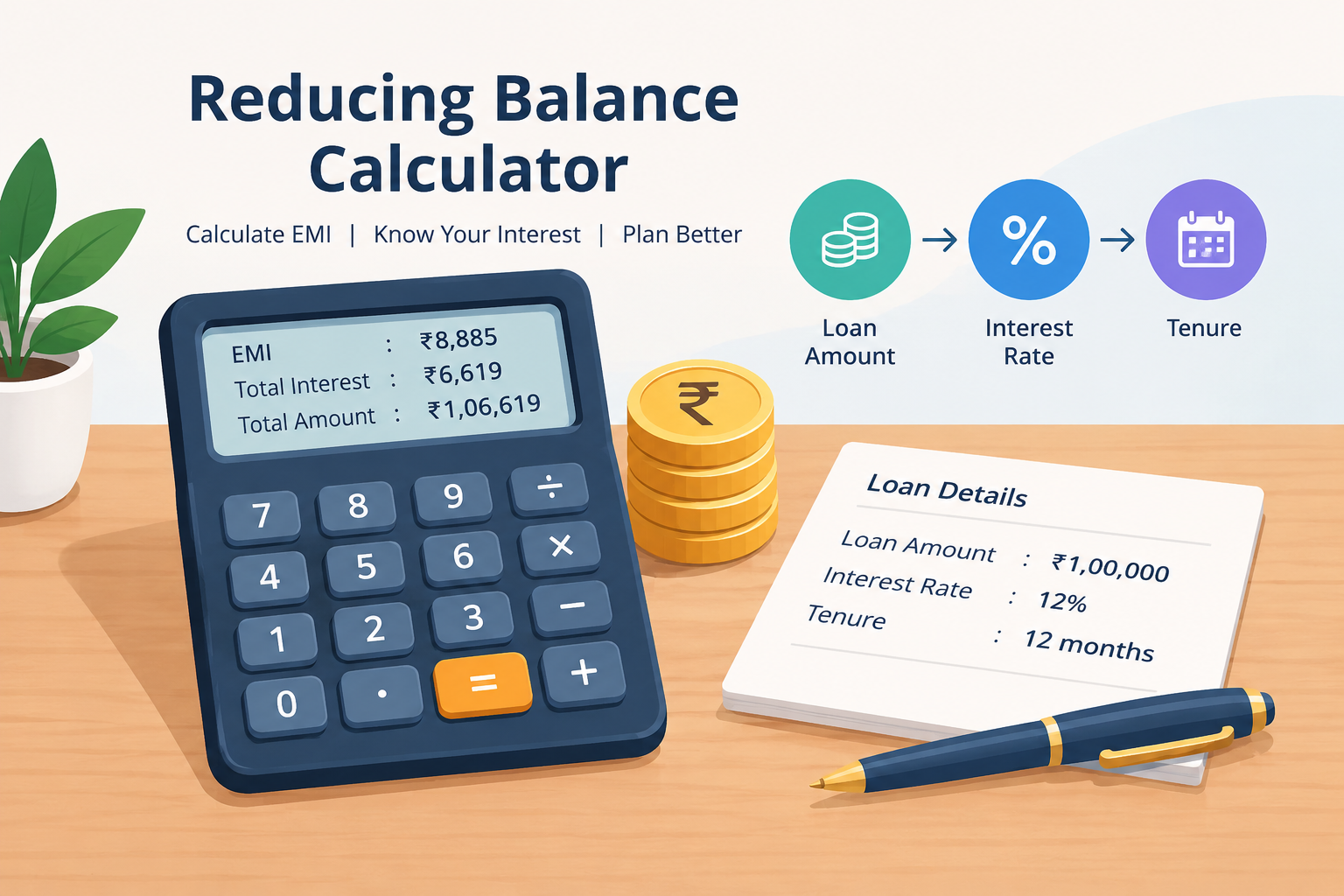
Simple example: If you borrow ₹1,00,000 at an annual interest rate of 12% for 12 months, using a standard monthly reducing-balance EMI calculation, your estimated EMI is approximately ₹8,885. Your total repayment is approximately ₹1,06,619, including around ₹6,619 in interest.
These figures are illustrative estimates. Actual lender calculations may vary because of repayment dates, fees, rounding, disbursement timing, and contractual terms.
Key Takeaways
-
A reducing balance calculator estimates interest on the outstanding principal.
-
The interest component generally decreases as the principal is repaid under a standard fixed-rate EMI structure.
-
EMI depends on the principal, interest rate, and repayment tenure.
-
A longer tenure generally reduces the monthly EMI but increases total interest when other terms remain the same.
-
Additional principal payments may reduce future interest, subject to lender rules and applicable charges.
-
Always compare the lender's disclosed interest rate, fees, repayment schedule, and Key Facts Statement before accepting a loan.
What Is a Reducing Balance Calculator?
A reducing balance calculator is a tool that helps you estimate the cost of borrowing when interest is calculated on the outstanding principal instead of the original loan amount throughout the repayment period.
At the beginning of a loan, the outstanding principal is usually close to the amount borrowed. After each scheduled repayment, part of the principal is paid off. Future interest is then calculated using the remaining balance, according to the loan's agreed interest calculation method.
How Does the Reducing Balance Method Work?
Consider a borrower who takes a loan of ₹1,00,000 at an annual interest rate of 12%.
For a simplified monthly calculation:
-
Initial principal: ₹1,00,000
-
Annual interest rate: 12%
-
Monthly interest rate: 1%
-
First month's interest: ₹1,000
If the borrower makes a monthly EMI payment, part of that payment covers the interest and the remaining portion reduces the principal.
In the following month, interest is calculated on the new outstanding principal, assuming a standard monthly reducing-balance method.
This process continues until the loan is repaid.
Why Is the Outstanding Principal Important?
The outstanding principal directly affects how much interest accrues on a loan.
A higher outstanding balance generally produces more interest than a lower balance when the rate and calculation period are identical.
That is why two borrowers with the same original loan amount and interest rate may pay different total interest if their repayment schedules differ.
How Does a Reducing Balance Calculator Work?
A reducing balance calculator uses financial inputs to estimate monthly repayments and the total cost of a loan.
Information Required for the Calculation
| Input | Meaning | Example |
|---|---|---|
| Loan amount | Total principal borrowed | ₹1,00,000 |
| Annual interest rate | Yearly interest rate | 12% |
| Loan tenure | Repayment period | 12 months |
| Monthly interest rate | Annual rate divided by 12 | 1% |
| Number of EMIs | Total monthly instalments | 12 |
The calculator uses these values to estimate the EMI and the total interest payable over the selected tenure.
What Results Does the Calculator Provide?
Depending on its features, a reducing balance calculator may show:
-
Estimated monthly EMI.
-
Total amount payable over the loan tenure.
-
Total interest payable.
-
Principal repaid during each instalment.
-
Interest charged during each instalment.
-
Remaining principal after each repayment.
-
An amortization schedule showing the repayment breakdown.
These results make it easier to understand the financial commitment before applying for a loan.
Reducing Balance Calculator Formula
The standard EMI formula for a loan with a fixed interest rate and equal monthly repayments is:
EMI = P × r × (1 + r)ⁿ ÷ [(1 + r)ⁿ − 1]
Where:
-
EMI = Equated Monthly Instalment
-
P = Principal loan amount
-
r = Monthly interest rate expressed as a decimal
-
n = Total number of monthly instalments
For a nominal annual interest rate of 12%, assuming monthly rate conversion:
Monthly interest rate = 12% ÷ 12 = 1% = 0.01
For a loan tenure of 12 months:
n = 12
The monthly interest rate must be entered as a decimal in the formula.
How to Calculate Total Interest
Once the EMI is calculated, the total repayment can be estimated as:
Total repayment = EMI × Number of EMIs
Total interest is then:
Total interest = Total repayment − Principal borrowed
These formulas assume a conventional fixed-rate EMI structure without additional charges or adjustments.
How Is Monthly Reducing Balance Interest Calculated?
For a simplified monthly calculation:
Monthly interest = Outstanding principal × Monthly interest rate
For example, if the outstanding principal at the beginning of a month is ₹80,000 and the monthly interest rate is 1%:
Monthly interest = ₹80,000 × 0.01
Monthly interest = ₹800
The interest component of the instalment is ₹800. The remainder of the payment goes toward reducing the principal, assuming no other amounts are included in that instalment.
Actual loan agreements may use daily interest accrual, specific day-count conventions, or other calculation rules, so the lender's repayment schedule remains the authoritative reference.
Reducing Balance Calculator Example
Let's calculate the estimated EMI and interest for a personal loan.
Loan Details
| Particulars | Value |
|---|---|
| Loan amount | ₹1,00,000 |
| Annual interest rate | 12% |
| Loan tenure | 12 months |
| Monthly interest rate | 1% |
| Estimated monthly EMI | ₹8,885 |
| Estimated total repayment | ₹1,06,619 |
| Estimated total interest | ₹6,619 |
Figures are rounded and provided for illustration. Actual lender figures may differ slightly.
How Is the First EMI Divided?
The first month's interest is calculated on the original principal.
-
Opening principal: ₹1,00,000
-
Monthly interest: ₹1,000
-
Estimated EMI: ₹8,885
-
Principal repaid: Approximately ₹7,885
-
Remaining principal: Approximately ₹92,115
The next month's interest is calculated on the remaining principal rather than the original ₹1,00,000.
This illustrates the central principle of the reducing balance method: interest is calculated on the amount that remains outstanding.
What Happens in Later Months?
As the loan progresses:
-
The outstanding principal decreases.
-
The interest component generally decreases.
-
The principal component of a fixed EMI generally increases.
-
The EMI usually remains constant if the rate and repayment terms do not change.
This pattern helps borrowers understand how their loan balance gradually falls over time.
Reducing Balance Calculator vs Flat Interest Calculator
One of the most important uses of a reducing balance calculator is comparing interest calculation methods.
Under a reducing balance method, interest is calculated on the outstanding principal. Under a flat-rate method, interest is generally calculated on the original principal for the agreed period, even as repayments reduce the amount owed.
| Feature | Reducing Balance Method | Flat Interest Method |
|---|---|---|
| Interest calculation | Based on outstanding principal | Generally based on original principal |
| Principal balance | Decreases with repayments | Repayments still reduce the amount owed |
| Interest amount per period | Usually decreases with a standard fixed-rate EMI | Often constant when calculated on the original principal |
| EMI structure | Often equal monthly instalments | Depends on the loan agreement |
| Total interest | Depends on the balance, rate, and tenure | Depends on the flat rate and tenure |
| Comparison of advertised rates | Requires checking the effective cost | A flat rate is not directly comparable with a reducing rate |
Which Method Is Better for Borrowers?
A reducing balance loan can be more economical than a flat-rate loan when the quoted rates, principal, tenure, and fees are appropriately compared.
However, the calculation method alone does not establish which loan is cheaper. Processing fees, insurance charges, prepayment conditions, and the actual repayment schedule also affect the overall cost.
Before choosing a loan, compare the total rupee cost and the lender's disclosed annual percentage rate (APR), where applicable.
Reducing Balance Calculator for Personal Loans
Personal loans are commonly repaid through monthly instalments. Depending on the lender and agreement, interest may be calculated using a reducing balance method.
A personal loan reducing balance calculator helps borrowers estimate the cost of a loan before submitting an application.
Benefits for Personal Loan Applicants
-
Estimate the EMI before borrowing.
-
Compare shorter and longer tenures.
-
Understand the expected interest cost.
-
Check whether the monthly instalment fits the household budget.
-
Compare loan offers from different lenders.
-
Evaluate how an extra principal payment could affect repayment.
Example: Comparing Different Loan Amounts
Suppose a borrower is considering a personal loan at a nominal annual interest rate of 12% for 12 months.
The following figures are illustrative estimates based on a standard monthly reducing-balance EMI formula.
| Loan Amount | Estimated Monthly EMI | Estimated Total Interest |
|---|---|---|
| ₹50,000 | ₹4,442 | ₹3,310 |
| ₹1,00,000 | ₹8,885 | ₹6,619 |
| ₹1,50,000 | ₹13,328 | ₹9,929 |
| ₹2,00,000 | ₹17,698 | ₹12,378 |
Values are rounded estimates. Actual repayment schedules may differ. Check the lender's final quotation before borrowing.
The table demonstrates that, with the same interest rate and tenure, a larger principal generally results in a proportionately larger EMI and interest amount under this formula.
How Does Loan Tenure Affect Reducing Balance Interest?
Loan tenure is the period over which the borrower agrees to repay the loan.
A shorter tenure usually means a higher monthly EMI but lower total interest. A longer tenure usually means a lower monthly EMI but higher total interest, assuming the same principal and interest rate.
Example: Choosing the Right Tenure
Consider a ₹1,00,000 loan at a nominal annual interest rate of 12%.
| Loan Tenure | Approximate Monthly EMI | Approximate Total Interest |
|---|---|---|
| 6 months | ₹17,254 | ₹3,522 |
| 12 months | ₹8,885 | ₹6,619 |
| 24 months | ₹4,707 | ₹12,968 |
| 36 months | ₹3,321 | ₹19,556 |
Illustrative figures rounded to the nearest rupee. Actual lender calculations may vary.
Which Tenure Should You Choose?
Choose a tenure that balances affordability and total borrowing cost.
A shorter tenure may help reduce interest costs if the higher EMI fits comfortably within your budget.
A longer tenure may provide more monthly flexibility, but the additional interest should be considered before accepting the offer.
Before deciding, account for essential household expenses, existing EMIs, savings, and unexpected financial needs.
How to Use a Reducing Balance Calculator Step by Step
Using a calculator is straightforward if you know the basic terms of the loan.
Step 1: Enter the Loan Amount
Enter the principal you plan to borrow. For example, you might enter ₹1,00,000.
Step 2: Enter the Annual Interest Rate
Use the annual interest rate stated in the loan offer. Check whether it is a nominal interest rate or another disclosed rate measure.
Step 3: Select the Loan Tenure
Enter the repayment period in months or years, depending on the calculator.
Step 4: Calculate the EMI
Select the calculation option to obtain the estimated monthly instalment.
Step 5: Review the Total Interest
Check how much interest you are expected to pay over the full tenure.
Step 6: Compare Different Scenarios
Change the principal, rate, or tenure to understand how each affects the repayment amount.
Step 7: Check Additional Costs
Review processing fees, applicable taxes, insurance charges, and other costs that may not be included in the calculator's EMI result.
Step 8: Compare the Estimate With the Loan Offer
Use the lender's official repayment schedule and Key Facts Statement, where applicable, to verify the final terms.
Advantages and Disadvantages of a Reducing Balance Calculator
A reducing balance calculator is useful for planning, but it has limitations.
Advantages
-
Clear repayment estimates: Understand the approximate monthly instalment before borrowing.
-
Better cost comparison: Compare different loan amounts, interest rates, and tenures.
-
Improved budgeting: Check whether the EMI fits your monthly income and expenses.
-
Interest awareness: See how the outstanding principal affects interest.
-
Repayment planning: Evaluate the possible effect of extra principal payments.
-
Faster decisions: Calculate common loan scenarios without doing the mathematics manually.
Disadvantages
-
Estimates may differ from lender figures: Actual calculations can depend on disbursement dates, daily interest, rounding, and repayment schedules.
-
Additional fees may be excluded: A basic calculator may not include processing fees, taxes, or insurance costs.
-
Variable rates can change: A calculation based on one interest rate may become inaccurate if the rate changes.
-
Eligibility is not guaranteed: An affordable EMI does not mean a lender will approve the loan.
-
Prepayment savings are conditional: Actual savings depend on when the payment is made and the lender's applicable rules.
Reducing Balance Method: Real-World Borrowing Considerations
A calculator can estimate the cost of borrowing, but real loan decisions involve more than the EMI.
Consider a salaried employee who wants to borrow ₹2,00,000 to cover a major expense.
The employee could compare two repayment periods using the same interest rate. The shorter tenure would generally result in a higher EMI but a lower total interest cost. The longer tenure would provide a lower monthly instalment but generally increase the overall interest paid.
The employee should then consider:
-
Monthly take-home income.
-
Rent, food, transport, and other essential expenses.
-
Existing credit card dues and loan EMIs.
-
Emergency savings.
-
Processing fees and other borrowing costs.
-
Whether early repayment is permitted and what it costs.
This approach helps turn a calculator's numerical result into a practical financial decision.
Expert Commentary: What Should Borrowers Check Before Applying?
A useful loan comparison starts with the amount you will actually receive, the amount you must repay, the repayment dates, and the full cost of borrowing.
Do not choose a loan solely because it advertises a low interest rate or offers a small EMI. A longer tenure may lower the monthly instalment while increasing the total interest cost.
Check the lender's written terms and calculate the repayment amount under realistic budget conditions. If the EMI leaves little room for essential expenses or unexpected costs, consider borrowing less or delaying the expense if possible.
This is general financial education, not an individualized recommendation or a guarantee of loan approval.
Reducing Balance Interest and Prepayment
Prepayment occurs when a borrower pays part or all of the outstanding principal before the scheduled repayment date.
When a lender applies an extra payment directly to principal, it can reduce the balance on which future interest is calculated.
However, the actual savings depend on the loan agreement, payment timing, applicable charges, and whether the lender reduces the tenure, EMI, or both.
How Can Prepayment Reduce Interest?
Imagine that a borrower has several months remaining on a loan. The borrower makes an eligible extra principal payment.
The outstanding principal may then fall below the balance in the original repayment schedule. If the lender recalculates future interest on this lower balance, the borrower may pay less interest over the remaining tenure.
What Should You Check Before Prepaying?
-
Whether partial prepayment is permitted.
-
Whether minimum prepayment amounts apply.
-
Whether fees or other charges are applicable.
-
Whether the lender will reduce the EMI or shorten the tenure.
-
How the prepayment affects the outstanding principal.
-
Whether using savings for prepayment would leave enough emergency funds.
Ask the lender for an updated repayment schedule before making a large extra payment.
Reducing Balance Calculator vs Other Loan Calculators
Different financial calculators serve different purposes. Using the right one can help you make more informed borrowing decisions.
| Calculator | Main Purpose | When to Use It |
|---|---|---|
| Reducing Balance Calculator | Estimates interest and repayments based on outstanding principal | When evaluating a reducing-balance loan |
| EMI Calculator | Estimates monthly loan instalments | When checking monthly affordability |
| Loan Interest Calculator | Estimates interest costs | When comparing borrowing costs |
| Loan Eligibility Calculator | Estimates possible eligibility using supplied information | Before applying for a loan |
| Loan Repayment Calculator | Helps estimate repayment amounts and schedules | When planning repayment |
| Loan Prepayment Calculator | Estimates possible savings from additional principal payments | Before making an extra payment |
| APR Calculator | Helps assess annualized borrowing costs when its inputs and method are appropriate | When comparing overall loan costs |
A calculator's result is only as reliable as its inputs and assumptions. Verify the lender's final terms before making a commitment.
How to Choose a Loan With a Lower Overall Cost
A reducing balance calculator can help identify an affordable loan, but borrowers should consider the complete borrowing arrangement.
Compare the Following Factors
1. Interest rate: Check the rate and how interest accrues.
2. Total repayment: Compare the amount payable over the complete tenure.
3. Processing fees: Find out whether an upfront fee reduces the amount disbursed.
4. Loan tenure: Compare monthly affordability against total interest.
5. Prepayment conditions: Check whether extra payments are allowed and whether charges apply.
6. Lender transparency: Read the repayment schedule, applicable disclosures, and loan agreement carefully.
7. Repayment capacity: Make sure the EMI fits your budget after essential expenses and existing debt payments.
Financial Transparency in India
The Reserve Bank of India (RBI) has issued requirements concerning key facts statements for covered retail and MSME term loans. These disclosures help eligible borrowers understand important loan terms, including the annual percentage rate and applicable charges.
Borrowers should review the applicable Key Facts Statement (KFS), sanction terms, and loan agreement before accepting an offer. Requirements and applicability depend on the type of lender and loan.
For current regulatory information, consult the official Reserve Bank of India website.
Frequently Asked Questions About Reducing Balance Calculators
1. What is a reducing balance calculator?
A reducing balance calculator estimates loan EMI, interest, and repayment amounts when interest is calculated on the outstanding principal.
2. How does reducing balance interest work?
Interest is calculated on the principal that remains outstanding for the relevant calculation period. As the principal decreases, the interest charged generally decreases when the rate and other conditions remain unchanged.
3. How do I calculate reducing balance interest?
For a simple monthly calculation, multiply the opening outstanding principal by the monthly interest rate. For example, ₹80,000 at 1% monthly interest produces ₹800 in interest for that month.
4. Is reducing balance interest better than flat interest?
A reducing balance loan can cost less than a flat-rate loan when the offers are compared appropriately. The actual result depends on the rates, tenure, fees, and repayment schedules.
5. Can I use a reducing balance calculator for a personal loan?
Yes. You can use it to estimate the EMI and interest for a personal loan if you know the principal, interest rate, tenure, and calculation assumptions.
6. Does the reducing balance calculator show the exact EMI?
It provides an estimate based on the entered information. The lender's final EMI may differ because of rounding, disbursement timing, daily interest calculations, fees, or contractual terms.
7. Does a longer loan tenure reduce interest?
A longer tenure generally lowers the EMI but increases the total interest paid when the principal and interest rate remain the same.
8. Does a shorter tenure save money?
A shorter tenure generally reduces the total interest cost, but it increases the monthly EMI. Choose a repayment amount that remains affordable.
9. Can I calculate home loan interest using a reducing balance calculator?
Yes, provided the calculator supports the loan amount, rate, tenure, and relevant repayment method. For accurate results, account for rate changes and the lender's calculation conventions.
10. Can I use this calculator for a vehicle loan?
Yes. A reducing balance calculator can estimate repayments for a vehicle loan that uses a compatible reducing-balance method.
11. Does prepayment reduce the outstanding principal?
An eligible principal prepayment generally reduces the outstanding balance when applied by the lender. Confirm how the payment will be allocated and whether charges apply.
12. Is the processing fee included in reducing balance interest?
Not necessarily. A basic calculator generally estimates interest and EMI from the principal, rate, and tenure. You must account for processing fees and other charges separately unless the tool explicitly includes them.
13. What is the difference between EMI and interest?
EMI is the scheduled instalment paid by the borrower. Interest is the borrowing cost included in that payment, while the remaining portion generally reduces the principal under a standard EMI structure.
14. Does a reducing balance calculator determine loan eligibility?
No. It estimates repayment costs. A lender determines eligibility using its own criteria, which may include income, credit history, existing obligations, employment details, and other relevant information.
15. Where can I check the official terms of a loan in India?
Review the lender's official loan agreement, applicable Key Facts Statement, sanction terms, and disclosures. You can also consult the RBI's official website for relevant regulatory information.
Conclusion
A reducing balance calculator is a practical tool for understanding how loan repayments and interest costs change as the outstanding principal decreases. It helps borrowers estimate EMI, compare loan tenures, assess total interest, and evaluate possible prepayment savings.
However, a calculator should be the starting point rather than the final basis for a borrowing decision. Actual loan costs depend on the lender's interest calculation method, repayment schedule, fees, and contractual conditions.
Before accepting a loan, compare the total repayment amount, review all applicable charges, and ensure the EMI fits your monthly budget.
Published on : 27th October
Published by : Bhargavi
www.vizzve.com || www.vizzveservices.com
Follow us on social media: Facebook || Linkedin || Instagram
🛡 Powered by Vizzve Financial
RBI-Registered Loan Partner | 10 Lakh+ Customers | ₹600 Cr+ Disbursed
Plan your borrowing carefully with Vizzve Financial. Visit Vizzve Financial to explore loan support options, review the applicable terms, and make an informed borrowing decision.