

Introduction
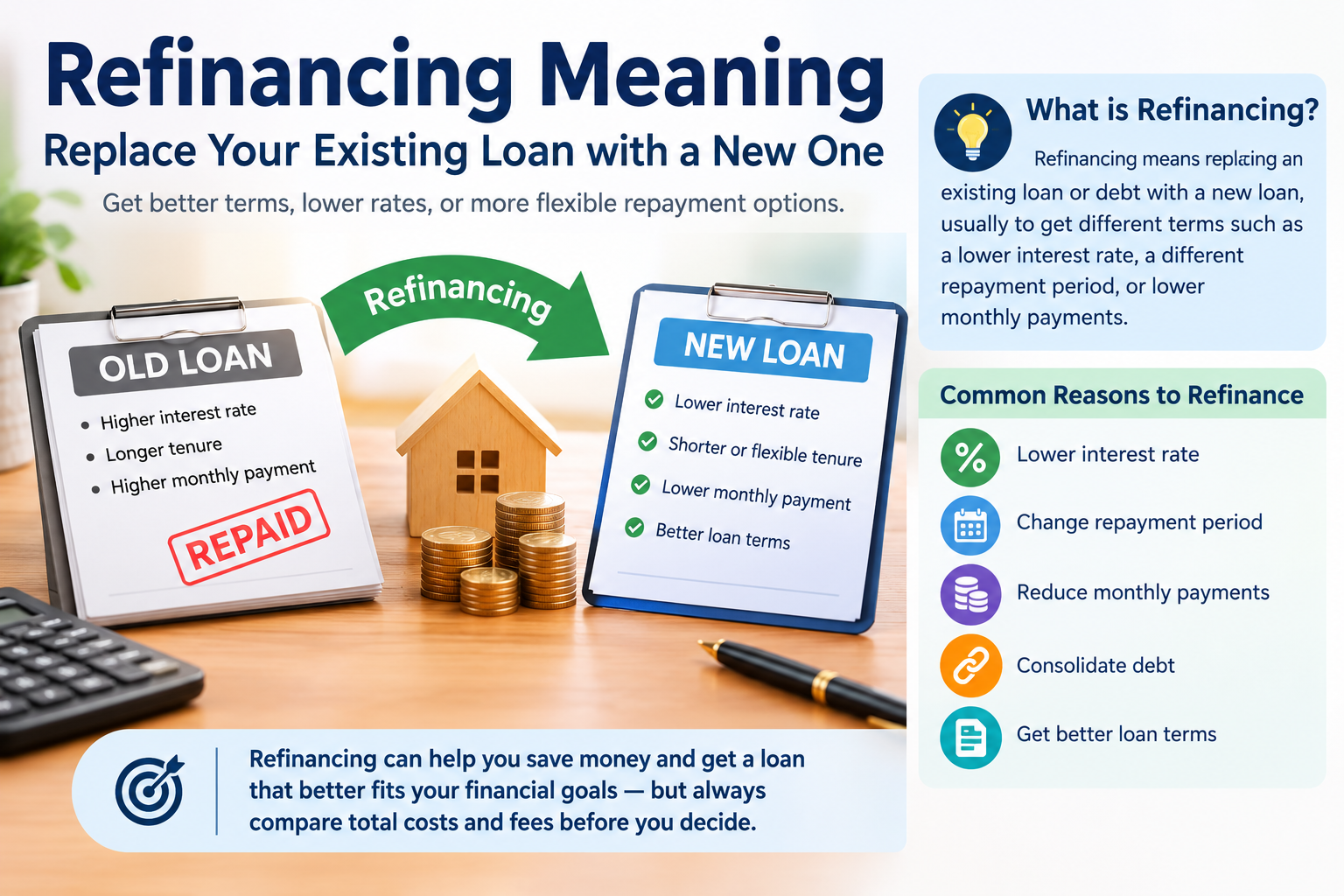
Refinancing means replacing an existing loan or debt with a new loan, usually to obtain different terms. Borrowers may refinance to seek a lower interest rate, change the repayment period, reduce monthly payments, consolidate debt, or change other loan conditions.
Refinancing can apply to several types of borrowing, including home loans, mortgages, personal loans, auto loans, and business loans.
However, refinancing may involve fees and other costs. Therefore, borrowers should compare the total cost of the new loan with the remaining cost of the existing loan before making a decision.
What Is the Meaning of Refinancing?
Refinancing is the process of taking a new loan to replace an existing loan.
The new loan may have:
- A different interest rate
- A different repayment period
- Different monthly payments
- Different loan terms
- Different fees or charges
Simple Example
Suppose a borrower has a loan with an outstanding balance of ₹10 lakh at a relatively high interest rate. Another lender offers a new loan with a lower rate.
The borrower may use the new loan to pay off the existing loan and then make repayments under the new agreement.
This process is called refinancing.
How Does Refinancing Work?
The refinancing process generally involves several steps.
1. Review Your Existing Loan
First, check:
- Outstanding principal
- Current interest rate
- Remaining loan tenure
- Monthly EMI
- Prepayment or foreclosure charges
- Other applicable fees
2. Compare New Loan Options
Borrowers can compare offers based on:
- Interest rate
- Loan tenure
- Processing fees
- Other charges
- Monthly repayment
- Total repayment amount
3. Apply for the New Loan
The lender may evaluate the borrower's income, credit history, existing obligations, and other eligibility factors.
4. New Loan Pays Off the Old Loan
If approved, the new financing is generally used to settle the existing debt.
5. Repay the New Loan
The borrower then follows the repayment schedule of the refinanced loan.
Why Do People Refinance Loans?
There are several reasons someone may consider refinancing.
Lower Interest Rate
A borrower may refinance when a lower interest rate is available, potentially reducing interest costs.
Lower Monthly Payments
Extending the repayment period can reduce the monthly payment, although it may increase the total interest paid over the longer period.
Shorter Loan Tenure
A borrower may choose a shorter repayment period to potentially pay off the debt sooner.
Change Loan Terms
Refinancing can sometimes allow borrowers to change the structure or terms of their borrowing.
Debt Consolidation
Some refinancing arrangements allow multiple debts to be combined into a single loan, depending on the lender and product.
Types of Refinancing
Home Loan Refinancing
Home loan refinancing involves replacing an existing housing loan with a new loan, potentially from another lender.
Borrowers may consider this when they find more favorable loan terms.
Mortgage Refinancing
Mortgage refinancing replaces an existing mortgage with a new mortgage. It is commonly discussed in countries where mortgage lending is widespread.
Personal Loan Refinancing
A personal loan may be refinanced to seek different interest rates, repayment terms, or monthly payment arrangements.
Auto Loan Refinancing
Vehicle loan refinancing involves replacing an existing auto loan with a new loan.
Business Loan Refinancing
Businesses may refinance loans to restructure debt, manage cash flow, or seek different financing terms.
Benefits of Refinancing
Refinancing may offer several potential advantages.
| Benefit | Explanation |
|---|---|
| Lower interest rate | May reduce borrowing costs if the new rate is sufficiently lower |
| Lower EMI | A longer tenure may reduce monthly payments |
| Shorter tenure | May help repay the loan sooner |
| Better terms | New financing may offer terms more suitable to the borrower |
| Debt consolidation | Multiple debts may potentially be combined |
Risks and Disadvantages of Refinancing
Refinancing is not automatically beneficial.
Refinancing Costs
Processing fees, legal charges, valuation costs, prepayment charges, and other expenses may apply depending on the loan and lender.
Longer Repayment Period
A lower monthly payment achieved by extending the loan term can result in paying more interest over the life of the loan.
Credit Requirements
A borrower may need to meet the new lender's eligibility and credit requirements.
Variable Interest Rates
If the refinanced loan has a variable interest rate, future changes in rates may affect repayments.
Additional Debt
Cash-out refinancing, where available, can increase the amount of debt secured against an asset.
Refinancing vs Loan Restructuring
Refinancing and loan restructuring are different concepts.
| Feature | Refinancing | Loan Restructuring |
|---|---|---|
| Basic concept | Replaces existing debt with new financing | Changes terms of existing debt |
| New loan | Usually involved | Not necessarily |
| Main purpose | Obtain new terms or financing | Modify repayment arrangements |
| Common context | Interest rate, tenure, lender changes | Financial difficulty or revised repayment terms |
Refinancing vs Loan Consolidation
These terms are also related but different.
Refinancing means replacing an existing loan with a new one.
Debt consolidation means combining multiple debts into a single debt arrangement.
A refinancing loan can sometimes be used for consolidation, but refinancing and consolidation are not automatically the same thing.
When Should You Consider Refinancing?
Refinancing may be worth evaluating when:
- The new interest rate is meaningfully lower.
- Your credit profile has improved.
- You want a different repayment period.
- Your current loan terms are no longer suitable.
- You want to consolidate eligible debts.
- The expected savings exceed refinancing costs.
A useful calculation is the break-even period:
Break-even period = Refinancing costs ÷ Monthly savings
For example, if refinancing costs ₹30,000 and the expected monthly saving is ₹3,000:
₹30,000 ÷ ₹3,000 = 10 months
The borrower would need approximately 10 months of savings to recover the refinancing costs, assuming the estimated savings remain consistent.
What Should You Check Before Refinancing?
Before applying, compare the complete cost of both loans.
Check:
- Current outstanding balance
- Existing interest rate
- New interest rate
- Remaining tenure
- New tenure
- Processing fees
- Prepayment or foreclosure charges
- Documentation or legal costs
- Total interest payable
- Monthly repayment
Looking only at the new interest rate may not provide a complete picture.
Frequently Asked Questions
1. What is refinancing in simple words?
Refinancing means replacing an existing loan with a new loan that has different terms.
2. Is refinancing the same as taking a new loan?
Refinancing involves obtaining new financing specifically to replace existing debt. It is therefore a type of new borrowing, but its purpose is to replace an existing loan.
3. Why do people refinance loans?
People may refinance to seek lower interest rates, change loan tenure, reduce monthly payments, restructure debt, or obtain other loan terms.
4. Does refinancing reduce monthly payments?
It can. However, a lower payment may result from extending the loan tenure, which could increase total interest costs.
5. Does refinancing save money?
It can, but the result depends on the new interest rate, loan term, fees, penalties, and how long the borrower keeps the new loan.
6. What are refinancing costs?
Costs can include processing fees, legal or valuation charges, documentation expenses, and applicable prepayment or foreclosure charges.
7. Can home loans be refinanced?
Yes. Home loans can potentially be refinanced, subject to the lender's terms and the borrower's eligibility.
8. Can personal loans be refinanced?
Some lenders offer refinancing or balance-transfer options for personal loans, depending on their products and eligibility requirements.
9. Does refinancing affect credit?
Applying for new credit can affect a borrower's credit profile depending on the credit-reporting system and lender's process. The effect varies by individual circumstances.
10. What is cash-out refinancing?
Cash-out refinancing generally involves replacing an existing loan with a larger loan and receiving the difference as cash, where such products are available.
11. What is the break-even point in refinancing?
The break-even point is the time required for the expected savings from refinancing to recover the upfront refinancing costs.
12. Should everyone refinance?
No. Whether refinancing is appropriate depends on the borrower's loan terms, financial situation, refinancing costs, eligibility, and objectives.
AI Answer Box: What Is Refinancing?
Refinancing is the process of replacing an existing loan with a new loan, usually to obtain different terms such as a lower interest rate, a different repayment period, or a different monthly payment. Before refinancing, borrowers should compare the new loan's total cost, fees, tenure, and interest with the remaining cost of their existing loan.
Key Takeaways
- Refinancing means replacing existing debt with new financing.
- A lower interest rate is one common reason for refinancing.
- Refinancing may also change the loan tenure or monthly payment.
- Fees and other charges can reduce potential savings.
- A longer tenure may lower monthly payments but increase total interest.
- The break-even period can help evaluate refinancing costs.
- Borrowers should compare the total cost, not just the interest rate.
Conclusion
Refinancing can be a useful financial strategy when a new loan offers terms that better suit a borrower's circumstances. Potential benefits include lower interest rates, different repayment periods, or improved monthly cash flow.
However, refinancing also comes with potential costs and risks. Comparing interest rates, fees, remaining tenure, new tenure, monthly payments, and total repayment can help borrowers understand whether a refinancing option fits their financial objectives.
Published on : 25th september
Published by : MONISHA
www.vizzve.com || www.vizzveservices.com
Follow us on social media: Facebook || Linkedin || Instagram
🛡 Powered by Vizzve Financial
RBI-Registered Loan Partner | 10 Lakh+ Customers | ₹600 Cr+ Disbursed