

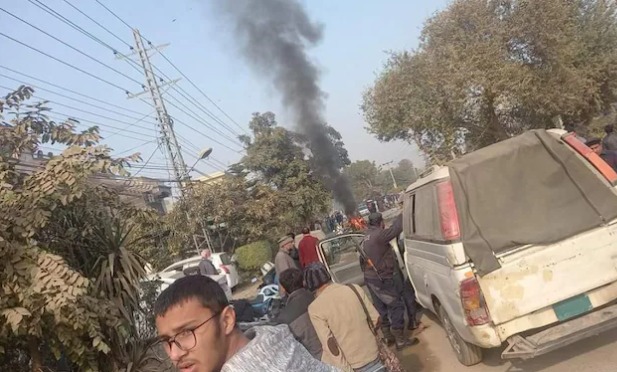
A devastating suicide blast in Pakistan’s capital, Islamabad, has reignited tensions between India and Pakistan, triggering sharp rhetoric from both sides. The attack, which occurred near a judicial complex and claimed multiple lives, has been described as one of the most serious security breaches in recent years.
Within hours, Pakistan alleged the involvement of “foreign-sponsored” actors, indirectly pointing fingers at India. India swiftly dismissed the claims as baseless, calling them an attempt to divert attention from Pakistan’s internal security crisis.
This renewed war of words between the two nuclear-armed neighbors has once again drawn attention to the fragile balance of peace in South Asia, where terror incidents often spill into broader diplomatic and military confrontations.
Why This Moment Matters
1. A High-Impact Attack in a Sensitive Zone
A bombing in Islamabad’s secure district represents a significant breach of Pakistan’s counter-terror apparatus. Such attacks expose deep internal vulnerabilities—both in intelligence and counter-extremism efforts—and have major symbolic implications.
2. Dangerous Blame Narratives
By attributing responsibility to “external” elements, Pakistan has internationalized what may be an internal terror problem. India’s immediate rejection of the charge underscores how terrorism and state relations remain deeply entangled in South Asia’s political discourse.
3. The Fragile Deterrence Equation
For decades, India and Pakistan have relied on deterrence—diplomatic, military, and nuclear—to maintain a tense peace. But events like the Islamabad blast erode mutual trust, raising the risk of miscalculation and reactionary escalation.
4. Regional Instability at a Sensitive Time
This incident comes amid wider geopolitical uncertainty: shifting alliances, economic fragility, and increasing militant activity in Afghanistan’s border zones. It risks undermining the minimal stability that has held South Asia’s rivalries in check.
Implications for India–Pakistan Relations
1. Diplomatic Relations on Ice
Both nations have seen a sharp drop in direct communication. The blast and subsequent accusations could further freeze any backchannel diplomacy that had been quietly attempting to reopen trade or dialogue.
2. Heightened Military Readiness
Historically, major terror incidents trigger heightened alertness on both sides of the border—troop reinforcement, surveillance flights, and fortified patrols. Even if open conflict is unlikely, a single misstep could inflame border tensions.
3. Role of Non-State Actors
The alleged involvement of extremist factions such as the Tehrik-e-Taliban Pakistan (TTP) underlines how non-state militants continue to destabilize both internal and cross-border security. When terrorism becomes transnational, traditional diplomacy struggles to contain it.
4. Political Pressures at Home
In both New Delhi and Islamabad, hardline rhetoric plays well domestically. Governments, facing internal pressures, may use strong statements to project control—making diplomatic restraint politically costly.
5. Strain on International Mediation
Major powers and organizations often call for calm after such incidents. However, with both sides trading accusations, any external mediation risks being dismissed as biased or intrusive.
Potential Outcomes to Watch
Evidence Disclosure: Whether Pakistan publicly presents verifiable proof or intelligence linking external actors will shape the narrative.
Border Dynamics: Escalation in ceasefire violations, drone activity, or artillery exchanges would indicate rising instability.
Public Messaging: Nationalist rhetoric in domestic media could inflame public sentiment, pushing governments toward harder postures.
Regional Responses: Neighboring states—especially Afghanistan, China, and Bangladesh—may react cautiously, balancing ties with both nations.
International Stakes: Global powers invested in South Asia’s security (such as the U.S. and EU) may quietly intervene through diplomatic channels to prevent escalation.
Broader Reflection: The South Asian Security Paradox
South Asia continues to face the paradox of being economically interconnected yet strategically divided. India and Pakistan, despite decades of ceasefires and backchannel agreements, remain trapped in cycles of provocation and distrust.
The Islamabad blast highlights how terrorism and statecraft are increasingly intersecting, testing both nations’ restraint. Each incident chips away at the mechanisms that once maintained relative calm—hotlines, intelligence sharing, and bilateral communication.
For sustainable peace, South Asia needs a new framework—one that treats terrorism not as a political tool but as a shared regional threat. Without such cooperation, every explosion risks being politicized and every tragedy becoming a trigger for escalation.
Conclusion
The Islamabad blast has exposed how quickly South Asia’s delicate balance can tip toward instability. The cross-border blame game that followed shows how unresolved mistrust continues to undermine regional security.
Unless both India and Pakistan choose dialogue over accusation, the region risks entering another phase of diplomatic cold war—where every terror incident becomes an excuse for confrontation rather than an opportunity for cooperation.
Stability in South Asia depends not on mutual silence, but on mutual accountability—and the courage to confront terrorism as a common enemy rather than a political weapon.
FAQs
Q1. What happened in Islamabad?
A: A suicide blast near a judicial complex killed several people and injured many others. It is being treated as a major terror attack in Pakistan’s capital.
Q2. Why are India and Pakistan exchanging accusations?
A: Pakistan linked the attack to “foreign-sponsored” actors, hinting at India’s involvement. India has strongly denied the allegation, calling it politically motivated.
Q3. Could this incident escalate into a larger conflict?
A: While full-scale escalation is unlikely, increased border tensions, diplomatic hostility, and military readiness are possible outcomes.
Q4. What role do non-state groups play?
A: Militants like the Tehrik-e-Taliban Pakistan (TTP) exploit weak governance and cross-border tensions, making both countries vulnerable.
Q5. How can regional stability be preserved?
A: Through transparent investigations, open communication, and depoliticized counter-terror coordination at both bilateral and multilateral levels.
Published on : 12th November
Published by : SMITA
www.vizzve.com || www.vizzveservices.com
Follow us on social media: Facebook || Linkedin || Instagram
🛡 Powered by Vizzve Financial
RBI-Registered Loan Partner | 10 Lakh+ Customers | ₹600 Cr+ Disbursed