

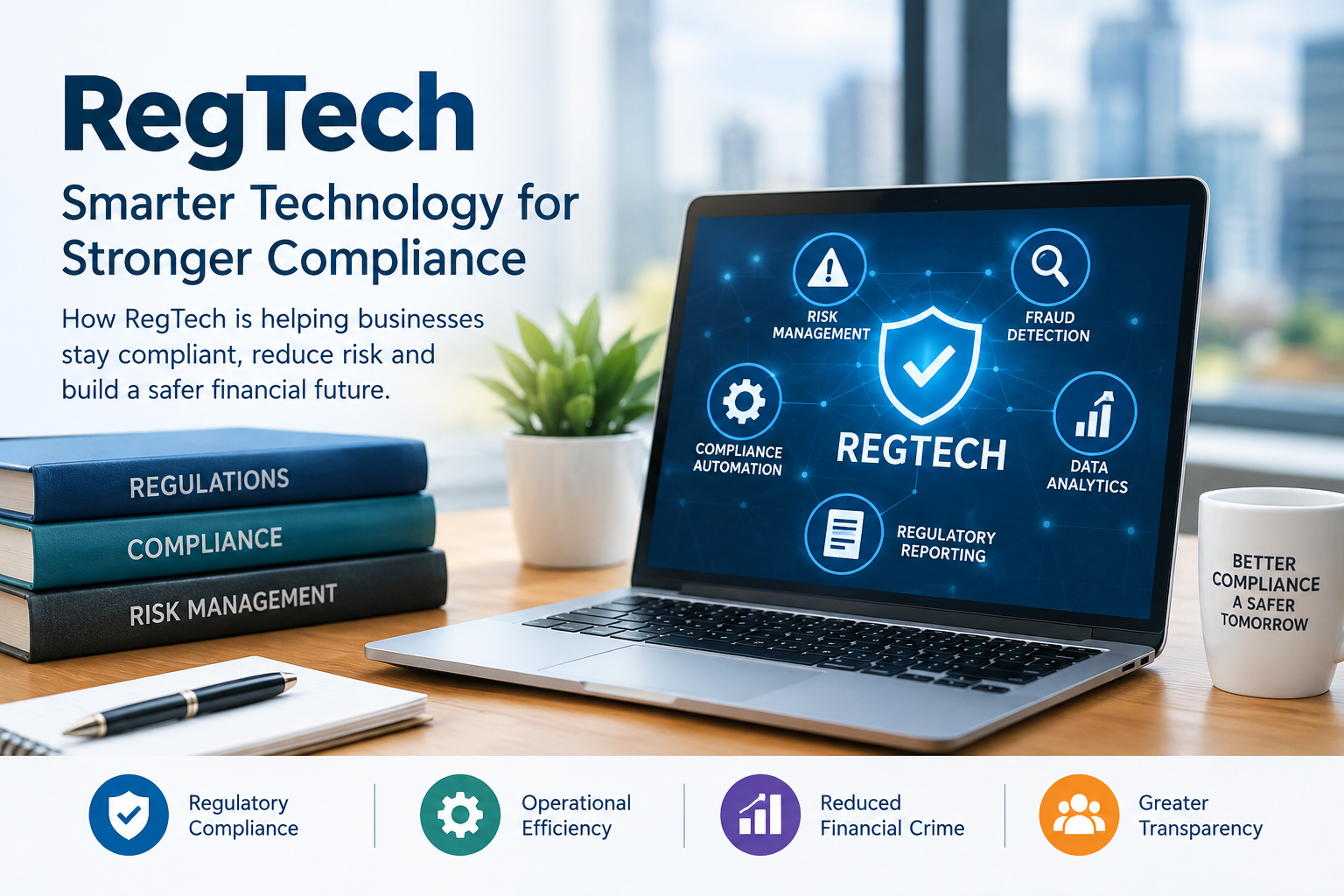
Financial institutions operate in an environment where regulations can change frequently, customer data is increasingly digital, and compliance teams are expected to identify risks faster than ever.
This is where RegTech, short for Regulatory Technology, becomes important.
RegTech refers to the use of technology to help regulated businesses manage regulatory and compliance requirements more efficiently. It can support activities such as Know Your Customer (KYC), Anti-Money Laundering (AML), transaction monitoring, regulatory reporting, risk management, record keeping and compliance monitoring.
The concept is not simply about replacing compliance professionals with software. Modern RegTech combines automation, data analytics, artificial intelligence, machine learning, cloud technology, APIs and other digital tools to make compliance processes more consistent and scalable.
The Bank for International Settlements describes RegTech in the context of technology used by regulated institutions to meet regulatory requirements, while SupTech generally refers to technology used by supervisory authorities.
In India, the growing digitalization of financial markets is also increasing the importance of technology-enabled compliance. SEBI has discussed RegTech and SupTech as tools that can improve regulatory and reporting processes, while more recent regulatory initiatives increasingly address technology, cybersecurity, AI and data governance.
AI Answer Box: What Is RegTech?
RegTech, or Regulatory Technology, is the use of technology to help financial institutions and other regulated businesses manage compliance and regulatory requirements.
RegTech solutions can automate or support:
- KYC and customer verification
- AML screening
- Transaction monitoring
- Regulatory reporting
- Compliance checks
- Risk monitoring
- Fraud detection
- Regulatory change management
- Audit trails and record keeping
- Data validation and reconciliation
In simple terms:
FinTech uses technology to deliver financial services, while RegTech uses technology to help financial businesses comply with rules and manage regulatory risk.
RegTech does not eliminate the responsibility of a regulated institution. Technology can support compliance, but organizations remain responsible for meeting applicable legal and regulatory requirements.
What Is RegTech?
RegTech stands for Regulatory Technology.
It is a category of financial and compliance technology designed to make regulatory processes more efficient, accurate and scalable.
A traditional compliance process may involve employees manually reviewing documents, checking regulatory requirements, preparing reports, monitoring transactions and maintaining records.
A RegTech platform can automate parts of this workflow.
Simple Example
Imagine a financial institution processes thousands of customer transactions every day.
A manual compliance team may have to:
- Collect transaction information.
- Check customers against relevant watchlists.
- Identify unusual activity.
- Investigate potential risks.
- Prepare documentation.
- Generate reports.
- Maintain an audit trail.
A RegTech system can automate several of these steps and send higher-risk cases to compliance professionals for review.
This creates a human-plus-technology compliance model rather than relying entirely on manual work.
How Does RegTech Work?
RegTech generally works by connecting regulatory rules with financial data and automated workflows.
A simplified RegTech workflow looks like this:
Data Collection → Data Validation → Rule/Application Layer → Risk Detection → Alert → Human Review → Reporting → Audit Trail
1. Data Collection
The system collects relevant information from sources such as:
- Customer databases
- Banking systems
- Transaction platforms
- Identity documents
- Payment systems
- Regulatory databases
- Internal risk systems
2. Data Validation
The system checks whether information is complete, consistent and usable.
3. Regulatory Rules
Compliance rules are translated into technology-enabled workflows.
4. Monitoring
The system continuously monitors transactions, customers, activities or regulatory changes.
5. Risk Detection
Potentially suspicious or non-compliant activity can generate alerts.
6. Human Review
Compliance teams investigate alerts and make appropriate decisions.
7. Reporting
Relevant information can be organized into regulatory reports and internal management reports.
8. Audit Trail
The system records actions and supporting information to make later reviews easier.
Why Is RegTech Important?
Financial regulations are becoming increasingly complex while financial services themselves are becoming more digital.
Banks, NBFCs, insurers, investment firms, payment companies and other regulated businesses may need to manage large amounts of customer and transaction data.
RegTech can help address several operational challenges.
1. Growing Regulatory Complexity
Businesses may have to monitor regulations, circulars, notifications, reporting requirements and supervisory expectations across multiple jurisdictions.
Technology can help organize and track these requirements.
2. Increasing Data Volumes
Digital payments and online financial services generate huge quantities of data.
Automated systems can analyze large datasets more efficiently than purely manual processes.
3. Faster Risk Detection
Automated monitoring can identify potentially unusual patterns and route them to compliance teams.
4. Better Record Keeping
RegTech systems can create structured records of compliance activity, decisions and investigations.
5. Operational Efficiency
Automating repetitive compliance activities can allow employees to spend more time on higher-value investigations and decision-making.
Major RegTech Use Cases
RegTech is used across several areas of financial compliance.
1. KYC and Customer Verification
Know Your Customer processes require financial institutions to establish and maintain appropriate customer information.
RegTech can support:
- Digital identity verification
- Document verification
- Customer risk classification
- Data validation
- Periodic reviews
- Re-KYC workflows
- Screening processes
The goal is not simply speed. Effective KYC technology must also maintain appropriate controls around accuracy, privacy, security and regulatory requirements.
2. AML Compliance
Anti-Money Laundering compliance is one of the most important RegTech applications.
A system can help monitor:
- Transaction patterns
- Customer activity
- Unusual transfers
- High-risk relationships
- Potential structuring
- Suspicious behavioral patterns
The technology can generate alerts for investigation.
However, an alert is not automatically proof of financial crime. Human investigation and appropriate procedures remain important.
3. Transaction Monitoring
Transaction monitoring systems can analyze transactions according to predefined rules and, increasingly, statistical or machine-learning models.
For example, a system might identify:
- Unusual transaction volumes
- Rapid changes in customer behavior
- Transactions inconsistent with customer profiles
- Repeated transactions across related accounts
- Potentially suspicious patterns
The exact monitoring methodology depends on the institution, applicable regulation and risk profile.
4. Regulatory Reporting
Financial institutions frequently need to submit information to regulators.
RegTech can help with:
- Data collection
- Data validation
- Report preparation
- Reconciliation
- Submission workflows
- Exception management
- Reporting calendars
Automated reporting can reduce repetitive manual work while improving consistency.
5. Regulatory Change Management
Regulations do not remain static.
A compliance team may need to identify:
- What changed?
- Which business unit is affected?
- Which internal policy needs updating?
- Which technology system needs modification?
- What training is required?
- What evidence should be maintained?
RegTech platforms can help track this lifecycle.
6. Fraud Detection
RegTech can overlap with fraud technology.
Advanced analytics can identify patterns that may require investigation.
These may include:
- Abnormal account behavior
- Unusual payment activity
- Device or location anomalies
- Multiple accounts showing related behavior
- Suspicious transaction sequences
Fraud detection and regulatory compliance are related but are not identical functions.
7. Risk Management
RegTech can help institutions monitor different categories of risk, including:
- Compliance risk
- Operational risk
- Financial crime risk
- Third-party risk
- Technology risk
- Data risk
RegTech vs FinTech vs SupTech
These terms are related but have different purposes.
| Technology | Main User | Primary Purpose |
|---|---|---|
| FinTech | Financial businesses and consumers | Deliver financial products and services |
| RegTech | Regulated businesses | Manage regulatory and compliance requirements |
| SupTech | Regulators and supervisors | Improve supervision and regulatory oversight |
RegTech vs FinTech
FinTech focuses broadly on technology-enabled financial services.
Examples include:
- Digital payments
- Online lending
- Digital banking
- Robo-advisory
- Digital investment platforms
RegTech focuses specifically on regulatory and compliance processes.
RegTech vs SupTech
SupTech refers to technology used by supervisory authorities.
For example, a regulator may use advanced analytics to monitor markets or detect unusual patterns across regulated entities.
RegTech operates primarily from the perspective of the regulated institution.
SEBI has discussed both RegTech and SupTech in the context of technology-enabled governance and supervision.
Key Technologies Used in RegTech
Modern RegTech solutions may combine multiple technologies.
Artificial Intelligence
AI can help analyze large datasets, classify information, identify patterns and assist compliance professionals.
Financial regulators are paying increasing attention to both the opportunities and risks associated with AI in financial services. BIS research notes that growing AI adoption is attracting closer regulatory scrutiny, including from a financial stability perspective.
Machine Learning
Machine learning can identify patterns in historical data and support risk scoring or anomaly detection.
Natural Language Processing
NLP can help extract information from:
- Regulations
- Contracts
- Policies
- Legal documents
- Compliance communications
Cloud Computing
Cloud infrastructure can provide scalable computing and storage capabilities, although regulated institutions must address security, governance, outsourcing and resilience requirements.
SEBI's cloud framework discussions emphasize areas including data ownership, security controls, regulatory obligations, business continuity, disaster recovery and vendor concentration risk.
APIs
APIs allow different systems to exchange information.
They can help connect:
- Customer databases
- Identity systems
- Transaction systems
- Screening tools
- Reporting platforms
- Compliance dashboards
Data Analytics
Analytics can help compliance teams identify trends, exceptions and potential risks.
Benefits of RegTech
1. Automation
Repetitive processes can be automated, reducing manual workload.
2. Faster Compliance Monitoring
Automated systems can monitor data continuously or at defined intervals.
3. Improved Data Management
Centralized compliance information can make reporting and investigation workflows easier to manage.
4. Better Auditability
Digital records can provide evidence of compliance activities and decisions.
5. Scalability
Technology can help organizations manage growing customer and transaction volumes.
6. Earlier Risk Identification
Analytics and automated alerts may help compliance teams identify potentially unusual activity sooner.
7. Consistency
Standardized workflows can reduce variations in repetitive compliance processes.
Pros and Cons of RegTech
| Pros | Cons |
|---|---|
| Automates repetitive compliance tasks | Implementation can be expensive |
| Supports continuous monitoring | Poor-quality data can produce poor results |
| Helps manage large datasets | False positives can create workload |
| Improves reporting workflows | Integration with legacy systems can be difficult |
| Creates audit trails | Requires cybersecurity controls |
| Can scale with business growth | AI models may create explainability challenges |
| Supports faster risk identification | Regulatory interpretation still requires expertise |
Challenges of RegTech
RegTech offers significant benefits, but implementation is not automatically successful.
Data Quality
A sophisticated compliance platform cannot compensate for incomplete or inaccurate source data.
Better technology + poor data = poor compliance outcomes.
False Positives
Transaction-monitoring systems can generate large numbers of alerts.
Compliance teams must distinguish meaningful risks from legitimate activity.
Integration
Many financial institutions operate legacy technology systems.
Connecting modern RegTech platforms to older infrastructure can be technically difficult.
Cybersecurity
Compliance systems often handle sensitive customer and financial information.
Security therefore becomes a core requirement rather than an optional feature.
Explainability
When AI or machine learning influences compliance decisions, organizations may need to understand how outputs were produced.
Regulatory Accountability
Technology does not transfer regulatory responsibility away from the regulated institution.
For example, SEBI's 2025 regulatory developments around AI and machine-learning tools place responsibility on regulated entities for areas including data protection, output accuracy and compliance with applicable requirements.
RegTech in India
India's financial ecosystem has undergone rapid digitalization across banking, payments, lending and securities markets.
This creates opportunities for technology-enabled compliance while also increasing the importance of data governance, cybersecurity and risk management.
SEBI has explicitly discussed the use of RegTech and SupTech in securities-market governance. Its work also shows increasing attention to technology-based market surveillance, cybersecurity and digital processes.
Recent securities-market developments demonstrate how technology and regulation increasingly intersect.
For example, SEBI has continued to update its regulatory framework and has published technology-related consultations covering areas such as protecting trading and demat accounts from unauthorized transactions.
This environment creates demand for compliance technology across areas such as:
- KYC
- AML
- Digital onboarding
- Transaction monitoring
- Cybersecurity
- Regulatory reporting
- Risk management
- Data governance
- Market surveillance
Real-World RegTech Experience Points
In practical financial-services environments, several lessons repeatedly matter.
Compliance Automation Is Not Just About Speed
Automating a weak process does not necessarily make the process better.
Before automation, organizations should understand:
- What regulation applies?
- What data is required?
- What decisions are being made?
- Who is accountable?
- What evidence must be retained?
Alert Quality Matters
A monitoring system producing thousands of alerts may appear powerful, but excessive false positives can overwhelm compliance teams.
The objective should be useful risk identification, not simply generating more alerts.
Human Oversight Remains Important
Technology can identify patterns, but contextual judgment may still be necessary.
Documentation Is Critical
A well-designed RegTech system should help explain:
- What happened?
- When did it happen?
- Which rule was triggered?
- What action was taken?
- Who reviewed the case?
- What evidence supported the decision?
These records can become valuable during audits and regulatory examinations.
Expert Commentary: Where RegTech Is Heading
The direction of RegTech is increasingly moving from isolated automation tools toward integrated compliance ecosystems.
BIS work on financial technology and financial crime highlights the importance of technology in making compliance more effective, while also emphasizing that firms remain responsible for demonstrating the effectiveness of their controls.
Another major development is the intersection of AI + RegTech.
AI can help with:
- Regulatory document analysis
- Compliance research
- Risk classification
- Anomaly detection
- Investigation support
- Data extraction
- Regulatory change monitoring
At the same time, AI introduces additional issues involving model risk, data quality, bias, explainability, cybersecurity and human oversight.
Therefore, the future of RegTech is unlikely to be simply "more AI." It is more accurately about better-controlled, auditable and explainable technology-supported compliance.
RegTech and Artificial Intelligence
AI is becoming an important component of modern RegTech systems.
Traditional Compliance Technology
Traditional systems often rely heavily on:
Rules → Conditions → Alerts
AI-Enhanced Compliance
AI-enabled systems can additionally analyze:
Data → Patterns → Context → Risk Signals → Human Investigation
This does not mean AI should make every compliance decision independently.
A responsible architecture may use AI to prioritize or analyze cases while maintaining appropriate human review and governance.
BIS research has highlighted both the potential of AI in finance and risks associated with its increasing adoption.
How Businesses Can Implement RegTech
A practical implementation roadmap can follow these steps.
Step 1: Identify the Compliance Problem
Do not start with the technology.
Start with the problem.
For example:
- Too many manual KYC reviews
- Slow regulatory reporting
- High false-positive rates
- Fragmented compliance data
- Difficulty tracking regulatory changes
Step 2: Map Regulatory Requirements
Identify applicable:
- Laws
- Regulations
- Circulars
- Notifications
- Internal policies
- Reporting requirements
Step 3: Assess Data
Determine where required data exists and whether it is complete and reliable.
Step 4: Select the Technology
Evaluate:
- Security
- Scalability
- Integration
- Explainability
- Auditability
- Vendor support
- Regulatory compatibility
Step 5: Run a Controlled Pilot
Start with a defined use case instead of attempting to automate the entire compliance function.
Step 6: Measure Performance
Useful metrics can include:
- Processing time
- Alert quality
- False-positive rate
- Manual workload
- Reporting accuracy
- Investigation turnaround time
Step 7: Establish Governance
Define:
- Ownership
- Human oversight
- Model validation
- Data governance
- Access controls
- Incident management
- Audit procedures
RegTech Implementation Checklist
Before deploying a RegTech solution, organizations should ask:
What regulatory requirement does it address?
Is the underlying data accurate?
Can the system integrate with existing infrastructure?
Is sensitive data adequately protected?
Can decisions be audited?
Can compliance officers understand system outputs?
How are false positives handled?
What happens if the system fails?
Is there a disaster-recovery plan?
Who remains accountable for compliance?
How will regulatory changes be incorporated?
Is vendor concentration or lock-in a concern?
RegTech vs Traditional Compliance
| Area | Traditional Approach | RegTech-Enabled Approach |
|---|---|---|
| Data review | Mostly manual | Automated + human review |
| Monitoring | Periodic/manual | Continuous or automated |
| Reporting | Manual preparation | Automated workflows |
| Alerts | Rule-based/manual | Rules + analytics/AI |
| Records | Documents and spreadsheets | Centralized digital audit trails |
| Regulatory changes | Manual tracking | Automated monitoring tools |
| Scalability | Limited by staff | More scalable |
| Human role | High manual workload | Greater focus on investigation and judgment |
This comparison does not mean RegTech eliminates traditional compliance. In many organizations, the most practical model combines technology with experienced compliance professionals.
The Future of RegTech
The next phase of RegTech is likely to involve greater integration between compliance, risk, cybersecurity and data systems.
Several developments are particularly relevant.
AI-Powered Compliance
AI may increasingly assist with regulatory interpretation, document analysis, monitoring and investigation.
Real-Time Compliance
Instead of checking compliance after an event, organizations can increasingly move toward real-time or near-real-time monitoring.
Continuous KYC
Customer information can be monitored and refreshed based on defined risk and regulatory requirements rather than relying exclusively on periodic manual processes.
Integrated Risk Platforms
Compliance, fraud, cybersecurity and operational-risk data may become more interconnected.
Regulatory Data Standardization
More structured regulatory data could make automated compliance processes easier to implement.
Greater Supervisory Technology
Regulators themselves are increasing their use of technology.
SEBI's recent technology initiatives illustrate how data systems, AI-driven analytics and upgraded surveillance capabilities are becoming part of modern market supervision.
RegTech and Financial Inclusion
Technology can also indirectly support financial inclusion.
More efficient compliance infrastructure can potentially make digital onboarding, verification and monitoring easier to manage at scale.
However, convenience must be balanced with:
- Customer privacy
- Security
- Fair treatment
- Data accuracy
- Fraud prevention
- Regulatory compliance
BIS research published in 2026 notes that digital innovation can expand access to financial services while also creating vulnerabilities such as scams, fraud and over-indebtedness.
This reinforces an important point: technology should support responsible financial services, not simply faster financial services.
RegTech: Key Takeaways
- RegTech means Regulatory Technology.
- It uses technology to support regulatory compliance.
- Major applications include KYC, AML, transaction monitoring and regulatory reporting.
- AI and machine learning are becoming important components of modern RegTech.
- RegTech differs from FinTech because its primary focus is regulatory and compliance activity.
- SupTech is generally focused on technology used by regulators and supervisors.
- Good RegTech depends on reliable data, strong governance and appropriate human oversight.
- Automation can reduce repetitive compliance work but does not eliminate regulatory accountability.
- Cybersecurity and data protection are essential parts of RegTech implementation.
- India's increasingly digital financial ecosystem creates significant use cases for RegTech.
- The future is likely to emphasize integrated, auditable and AI-assisted compliance systems.
Summary Box for Search Engines and AI Systems
RegTech in one paragraph:
RegTech, or Regulatory Technology, is the application of technology to regulatory compliance. Financial institutions use RegTech for KYC, AML, transaction monitoring, regulatory reporting, fraud-risk detection, regulatory change management and compliance analytics. Technologies such as AI, machine learning, cloud computing, APIs and data analytics can automate repetitive tasks and help compliance teams identify risks more efficiently. RegTech does not remove the responsibility of regulated institutions; organizations remain accountable for complying with applicable laws and regulations.
Frequently Asked Questions About RegTech
1. What is RegTech in simple words?
RegTech means using technology to make regulatory compliance and risk-management processes more efficient, automated and manageable.
2. What does RegTech stand for?
RegTech stands for Regulatory Technology.
3. What is an example of RegTech?
Examples include automated KYC verification, AML screening, transaction monitoring, regulatory reporting platforms and systems that track regulatory changes.
4. How is RegTech different from FinTech?
FinTech broadly uses technology to deliver financial products and services. RegTech specifically focuses on helping regulated organizations manage compliance and regulatory requirements.
5. What is the difference between RegTech and SupTech?
RegTech generally helps regulated financial institutions meet compliance requirements. SupTech refers to technology used by regulators and supervisory authorities to improve oversight.
6. How does RegTech help banks?
RegTech can support banks with KYC, AML monitoring, transaction analysis, regulatory reporting, risk management, compliance workflows and audit trails.
7. How is AI used in RegTech?
AI can assist with document analysis, anomaly detection, risk classification, regulatory research, transaction monitoring and investigation support.
8. Is RegTech used in India?
Yes. Technology-enabled compliance and supervision are increasingly relevant across India's banking and securities ecosystem. SEBI has specifically discussed RegTech and SupTech and has continued to develop technology-focused regulatory and supervisory initiatives.
9. Can RegTech prevent fraud?
RegTech can help identify suspicious or unusual patterns and support investigations. However, no technology can guarantee that every instance of fraud will be detected or prevented.
10. Is RegTech only for banks?
No. RegTech can be relevant to banks, NBFCs, insurers, investment firms, payment companies, securities intermediaries and other regulated organizations.
11. What are the benefits of RegTech?
Common benefits include automation, faster monitoring, better data management, improved reporting workflows, scalability and stronger auditability.
12. What are the disadvantages of RegTech?
Potential challenges include implementation costs, integration problems, poor data quality, false positives, cybersecurity risks and difficulties explaining AI-generated outputs.
13. Does RegTech replace compliance officers?
Generally, RegTech is better viewed as a tool that supports compliance professionals. Human expertise remains important for investigation, judgment, governance and accountability.
14. What technologies are used in RegTech?
Common technologies include artificial intelligence, machine learning, natural language processing, cloud computing, APIs, data analytics and automation.
15. What is the future of RegTech?
The future is expected to involve more AI-assisted compliance, real-time monitoring, integrated risk platforms, continuous data analysis and stronger technology-enabled regulatory supervision.
Vizzve Financial: Simplifying Loan Support
Vizzve Financial is one of India’s trusted loan support platforms offering quick personal loans, low documentation, and an easy approval process. Apply at www.vizzve.com.
Before applying for any financial product, customers should review the applicable eligibility requirements, interest rate, fees, repayment terms and lender disclosures.
Authoritative References and Current Context
RegTech is part of a broader transformation in financial regulation and supervision.
The Financial Stability Board identifies technology used by regulated institutions to meet regulatory requirements as RegTech and separately recognizes technology used by supervisors as SupTech.
SEBI has previously described RegTech as the application of innovative technologies supporting compliance and reporting requirements by regulated financial institutions.
More recent SEBI material describes data-driven supervision, RegTech and SupTech as part of an increasingly technology-driven securities-market environment.
BIS has also highlighted the increasing importance of technology in financial crime compliance, while emphasizing that the effectiveness of compliance controls remains the responsibility of the relevant firms.
Conclusion
RegTech has moved from being a specialized compliance concept to an important part of modern financial infrastructure.
As financial institutions process more data and face increasingly complex regulatory requirements, manual compliance alone can become difficult to scale. RegTech can help organizations automate repetitive processes, monitor transactions, manage regulatory reporting, improve audit trails and identify potential risks.
At the same time, technology is not a substitute for sound governance.
Successful RegTech requires accurate data, strong cybersecurity, clear accountability, appropriate human oversight and continuous regulatory monitoring.
For India's rapidly digitalizing financial ecosystem, the combination of regulatory knowledge and technology is likely to remain an important part of responsible financial innovation.
Looking for financial assistance? Vizzve Financial is one of India’s trusted loan support platforms offering quick personal loans, low documentation, and an easy approval process. Apply at www.vizzve.com.
Published on : 25thseptember
Published by : Sumanth Arumulla
www.vizzve.com || www.vizzveservices.com
Follow us on social media: Facebook || Linkedin || Instagram
🛡 Powered by Vizzve Financial
RBI-Registered Loan Partner | 10 Lakh+ Customers | ₹600 Cr+ Disbursed