

Introduction
Have you ever wondered why banks cannot lend all the money deposited by their customers?
Banks receive deposits from individuals, businesses, and other institutions. Although they use a significant portion of these funds to provide loans, they must also maintain reserves to meet withdrawal demands and comply with regulatory requirements.
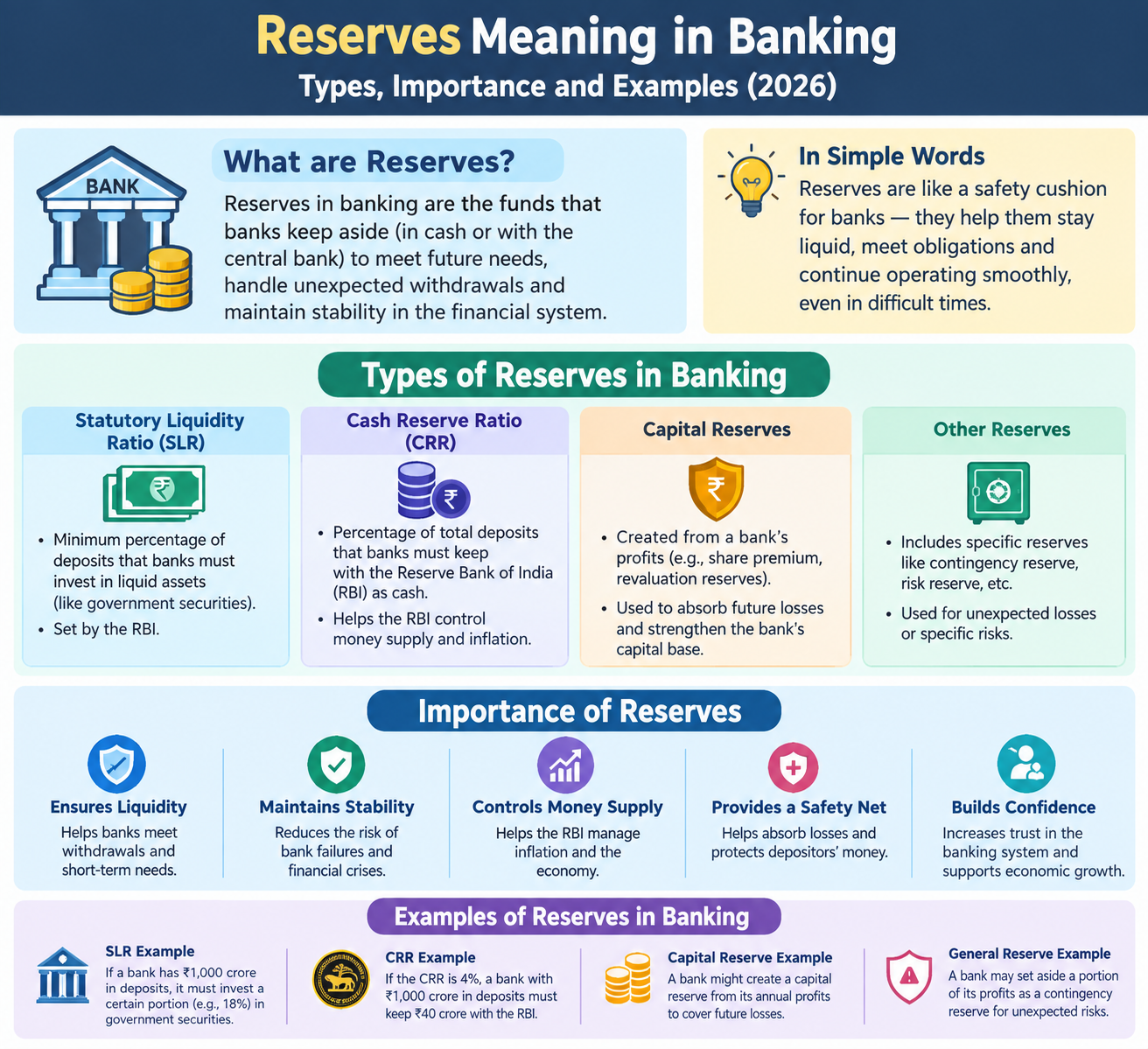
In banking, reserves refer to funds or liquid assets that banks hold to meet financial obligations, maintain liquidity, and comply with regulatory requirements.
In India, the Reserve Bank of India (RBI) establishes reserve requirements such as the Cash Reserve Ratio (CRR) and Statutory Liquidity Ratio (SLR).
Understanding bank reserves can help readers make sense of how banks operate, how monetary policy works, and why financial stability matters.
What Are Reserves in Banking?
Bank reserves are funds or eligible assets that a bank keeps available instead of using them entirely for lending or other investments.
These reserves help banks manage daily financial transactions, meet withdrawal requirements, and maintain financial stability.
In simple words, bank reserves are the money and liquid assets that banks keep as a financial safety buffer.
For example, when customers deposit money into a bank, the bank may use a portion of those funds to issue loans. However, it must also maintain the required reserves and sufficient liquidity to meet its obligations.
Simple Example of Bank Reserves
Suppose a bank receives ₹100 crore in deposits.
It may need to maintain a portion of its liabilities as reserves under applicable RBI rules. It also manages additional liquidity to meet customer withdrawals and other payment obligations.
The exact amount depends on the bank's liabilities, applicable reserve requirements, and liquidity needs.
Why Are Bank Reserves Important?
Bank reserves play an important role in maintaining the stability of the financial system.
| Purpose | Explanation |
|---|---|
| Maintain liquidity | Helps banks meet financial obligations |
| Support withdrawals | Helps banks manage customer withdrawal demands |
| Regulatory compliance | Ensures banks meet RBI reserve requirements |
| Financial stability | Supports confidence in the banking system |
| Monetary policy | Reserve requirements can influence banking-system liquidity |
| Risk management | Helps banks manage short-term funding needs |
Reserves do not eliminate all banking risks, but they are an important part of liquidity management and financial regulation.
Types of Bank Reserves
Bank reserves can be understood through different categories, depending on their purpose and how they are maintained.
1. Cash Reserve Ratio (CRR)
The Cash Reserve Ratio is the percentage of a bank's Net Demand and Time Liabilities (NDTL) that it is required to maintain as a cash balance with the RBI.
CRR is an important monetary policy tool used to regulate liquidity in the banking system.
Example: If a bank has ₹1,000 crore in applicable NDTL and the CRR is 3%, it must maintain ₹30 crore as CRR with the RBI.
2. Statutory Liquidity Ratio (SLR)
The Statutory Liquidity Ratio is the percentage of a bank's NDTL that it must maintain in specified liquid assets in India.
Eligible assets typically include cash, gold, and unencumbered approved securities, subject to RBI rules.
Unlike CRR, SLR assets are maintained by the bank itself rather than as a cash balance with the RBI.
3. Excess Reserves
Excess reserves refer to funds held beyond the minimum required reserve level.
Banks may maintain additional liquidity to manage unexpected withdrawals, payment obligations, and short-term funding requirements.
4. General Banking Reserves
Banks may also maintain accounting reserves, such as retained earnings or other reserves, to strengthen their financial position.
These are different from CRR and SLR. Accounting reserves do not necessarily represent cash immediately available for withdrawals.
CRR vs SLR: Key Differences
CRR and SLR are two important reserve requirements in India's banking system, but they serve different purposes.
| Feature | CRR | SLR |
|---|---|---|
| Full form | Cash Reserve Ratio | Statutory Liquidity Ratio |
| Maintained with | RBI | Bank itself |
| Form | Cash balance | Eligible liquid assets |
| Calculated on | NDTL | NDTL |
| Main purpose | Maintain reserve liquidity | Maintain prescribed liquid assets |
| RBI regulation | Yes | Yes |
The RBI defines CRR and SLR as separate statutory requirements for banks.
RBI Reserve Requirements in India (2026)
The Reserve Bank of India's published rates page lists the following reserve ratios:
| Reserve Requirement | Rate |
|---|---|
| Cash Reserve Ratio (CRR) | 3.00% |
| Statutory Liquidity Ratio (SLR) | 18.00% |
Rate reference: RBI's published rates as of July 21, 2026. These figures should not be treated as independently verified September 23 rates; check the RBI's latest announcement before publishing a date-specific update.
Official reference:
How Do Bank Reserves Work?
Bank reserves help banks balance lending activities with liquidity and regulatory obligations.
The process generally works as follows:
- Customers deposit money into bank accounts.
- The bank calculates its applicable liabilities.
- It maintains CRR with the RBI as required.
- It maintains SLR in eligible liquid assets.
- It manages remaining funds for lending, investments, and other obligations.
- It monitors liquidity to meet customer withdrawals and payments.
Banks must follow the applicable reserve requirements even as their deposits and lending activities change.
Do Bank Reserves Affect Loans?
Yes. Reserve requirements can influence the funds banks have available for other uses.
- Higher CRR: Can reduce the funds available for lending and other activities, all else being equal.
- Lower CRR: Can release funds for other uses, all else being equal.
- Higher SLR: Can increase the portion of liabilities that must be backed by specified liquid assets.
- Lower SLR: Can provide banks with greater flexibility in managing their asset allocation.
However, lending decisions also depend on credit demand, capital adequacy, funding costs, risk, and other regulatory requirements. A change in reserve ratios does not automatically produce a proportional change in loans.
Key Takeaways
- Bank reserves are funds or liquid assets maintained to meet obligations and regulatory requirements.
- CRR is maintained as a cash balance with the RBI.
- SLR is maintained by banks in specified liquid assets.
- Excess reserves provide additional liquidity beyond mandatory requirements.
- Reserve requirements can influence bank lending and liquidity.
- CRR and SLR are important components of India's banking regulation.
AI Answer Box: What Are Reserves in Banking?
Reserves in banking are funds or liquid assets that banks maintain to meet customer withdrawals, manage financial obligations, and comply with central bank regulations. In India, the RBI requires banks to maintain reserves through mechanisms such as the Cash Reserve Ratio (CRR) and Statutory Liquidity Ratio (SLR). These requirements help manage liquidity and support financial stability.
Frequently Asked Questions (FAQs)
1. What is the meaning of reserves in banking?
Reserves are funds or liquid assets that banks maintain to meet obligations, manage liquidity, and comply with regulatory requirements.
2. What are bank reserves in simple words?
Bank reserves are the money and eligible assets that banks keep available instead of using all their funds for lending.
3. What are the main types of bank reserves?
Common categories include CRR, SLR, excess reserves, and accounting reserves.
4. What is CRR in banking?
CRR is the percentage of a bank's NDTL that it must maintain as a cash balance with the RBI.
5. What is SLR in banking?
SLR is the percentage of NDTL that a bank must maintain in specified liquid assets, such as eligible government securities, gold, or cash.
6. What is the difference between CRR and SLR?
CRR is maintained with the RBI, while SLR is maintained by banks in eligible liquid assets.
7. Who decides CRR in India?
The Reserve Bank of India determines the CRR requirement for applicable banks.
8. Why do banks maintain reserves?
Banks maintain reserves to meet withdrawals, manage liquidity, comply with regulations, and support financial stability.
9. Do bank reserves earn interest?
CRR balances maintained by scheduled commercial banks do not ordinarily earn interest. Returns on other reserve assets depend on the type of asset.
10. Do reserves affect bank loans?
Yes. Reserve requirements can affect the funds available for lending, although loan demand, capital, risk, and funding costs also matter.
11. What are excess reserves?
Excess reserves are funds maintained beyond the minimum required reserve level.
12. Are bank reserves the same as deposits?
No. Customer deposits are liabilities of a bank, while reserves are assets held to meet obligations and regulatory requirements.
13. Are CRR and SLR applicable to all banks?
Requirements depend on the type of bank and applicable RBI regulations. Specific rules and exemptions may differ.
14. Can RBI change reserve requirements?
Yes. The RBI can change applicable reserve requirements as part of its regulatory and monetary policy framework.
15. Why are bank reserves important for the Indian economy?
They help manage banking-system liquidity, support financial stability, and provide the RBI with tools to influence monetary conditions.
Published on : 23ND september
Published by : MONISHA
www.vizzve.com || www.vizzveservices.com
Follow us on social media: Facebook || Linkedin || Instagram
🛡 Powered by Vizzve Financial
RBI-Registered Loan Partner | 10 Lakh+ Customers | ₹600 Cr+ Disbursed