

Introduction
Borrowing money can be useful for managing important expenses, emergencies, education, home purchases or other financial needs. However, taking a loan also creates a repayment responsibility. Understanding the loan terms and checking your ability to repay are important steps before borrowing.
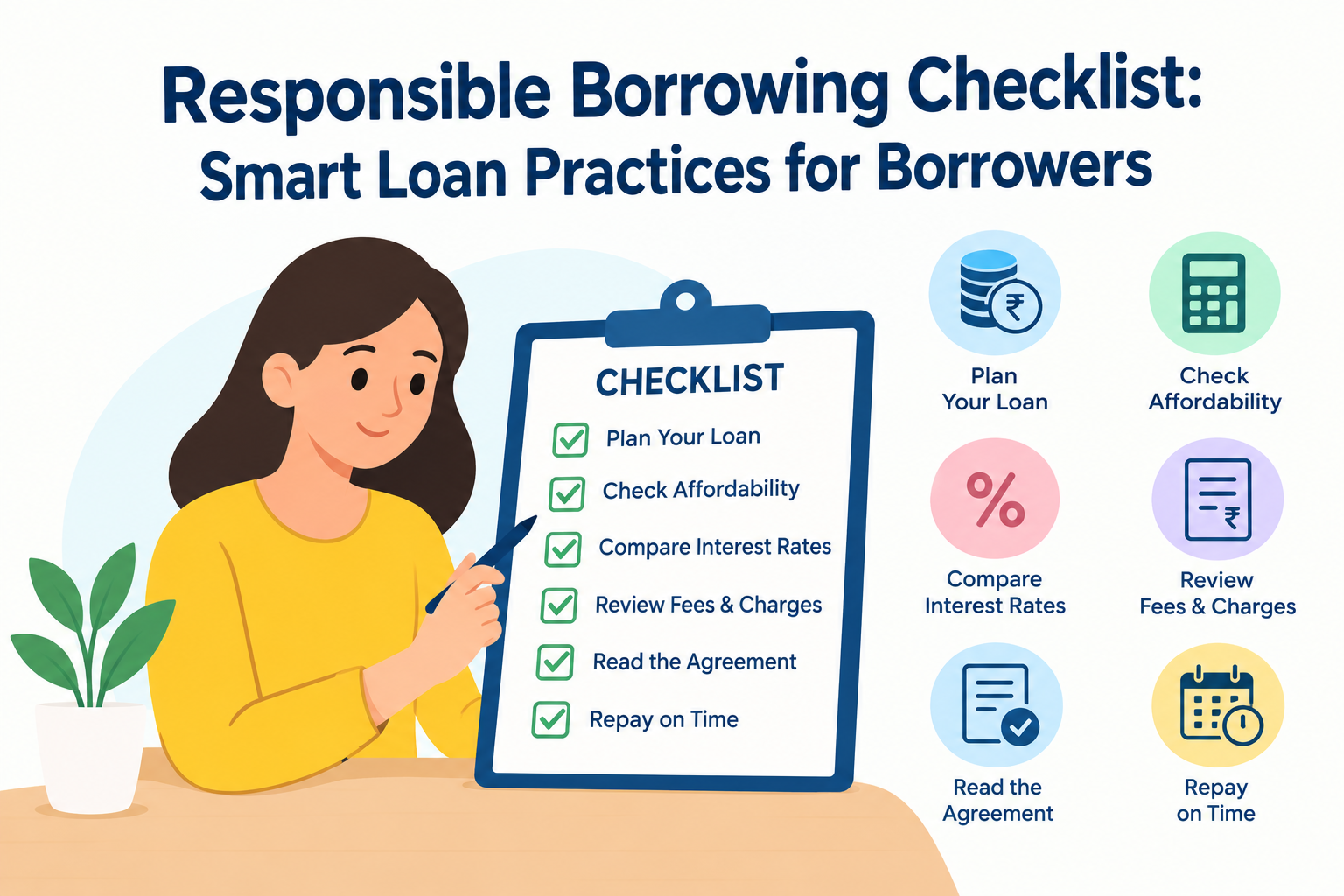
A Responsible Borrowing Checklist helps borrowers make informed decisions by focusing on loan amount, interest rates, fees, repayment capacity, tenure and other important terms. By following responsible borrowing practices, borrowers can manage debt more effectively, avoid unnecessary financial pressure and maintain better control over their finances.
Borrowing money can help manage important expenses, fund education, purchase a home, handle emergencies or support business needs. However, taking a loan also creates a financial responsibility that continues until the borrowed amount and applicable charges are repaid.
A Responsible Borrowing Checklist helps borrowers evaluate a loan before accepting it and manage repayments effectively. From checking eligibility and understanding interest rates to reviewing loan terms and avoiding unnecessary borrowing, responsible financial decisions can reduce repayment difficulties.
What Is Responsible Borrowing?
Responsible borrowing means taking a loan only when it is necessary and when the repayment obligation fits comfortably within your financial situation.
A responsible borrower generally:
- Borrows according to their repayment capacity
- Compares available loan terms
- Understands the interest rate and applicable charges
- Reads the loan agreement before accepting it
- Makes repayments on time
- Avoids taking multiple unnecessary loans
- Protects personal and financial information
Why Is Responsible Borrowing Important?
A loan can provide access to funds when needed, but borrowing more than you can reasonably repay may create financial pressure.
Responsible borrowing can help borrowers:
- Manage monthly repayments more effectively
- Avoid unnecessary debt
- Maintain a healthy credit profile
- Reduce the risk of late-payment charges
- Understand the total cost of borrowing
- Plan future finances more carefully
Responsible Borrowing Checklist
Use this checklist before taking a loan.
| Checklist Item | What to Check |
|---|---|
| Loan purpose | Is the borrowing necessary? |
| Loan amount | Can you avoid borrowing more than required? |
| Repayment capacity | Can your income support the repayment? |
| Interest rate | Is the applicable rate clearly understood? |
| Fees and charges | Have all applicable charges been checked? |
| Tenure | Does the repayment period suit your finances? |
| Loan agreement | Have you read the important terms? |
| Prepayment rules | Are foreclosure or prepayment conditions clear? |
| Credit impact | Do you understand how repayment behaviour can affect your credit profile? |
| Data privacy | Are you comfortable with the information requested by the lender? |
1. Borrow Only What You Need
The first step toward responsible borrowing is determining the actual amount required.
Avoid increasing the loan amount simply because a lender offers a higher limit. A larger loan generally means a larger repayment obligation and potentially higher overall borrowing costs.
Before applying, calculate:
- Amount actually required
- Existing financial commitments
- Expected monthly repayment
- Total repayment over the loan tenure
2. Check Your Repayment Capacity
Before accepting a loan, review your regular income and expenses.
Consider:
- Monthly income
- Rent or housing expenses
- Existing EMIs
- Household expenses
- Insurance premiums
- Education expenses
- Emergency savings
- Other financial commitments
The objective is to ensure that the new repayment does not place excessive pressure on your monthly budget.
3. Understand the Interest Rate
Do not look only at the advertised interest rate. Check how the rate applies to the loan and understand whether it is fixed, floating or otherwise structured according to the loan agreement.
Also review the total cost of borrowing rather than focusing only on the monthly EMI.
4. Check Fees and Other Charges
A loan may involve charges in addition to interest.
Depending on the product and lender, these can include:
- Processing fees
- Documentation charges
- Late-payment charges
- Prepayment or foreclosure charges, where applicable
- Other service-related fees
Always check the applicable schedule of charges before accepting the loan.
5. Compare Loan Terms
If you have multiple borrowing options, compare the important terms instead of choosing a loan based only on a low EMI.
Consider:
- Interest rate
- Loan amount
- Tenure
- Total repayment
- Processing fees
- Other charges
- Repayment flexibility
- Terms and conditions
A longer tenure may reduce the periodic repayment but can increase the total interest paid over time.
6. Read the Loan Agreement
Before accepting a loan, carefully review the agreement and related documents.
Pay particular attention to:
- Interest rate
- Repayment schedule
- Loan tenure
- Fees and charges
- Default-related provisions
- Prepayment conditions
- Security or collateral requirements
- Grievance redressal details
- Data and privacy provisions
Do not accept terms that you do not understand.
7. Make Repayments on Time
Timely repayment is an important part of responsible borrowing.
Missing or delaying repayments may result in additional charges and can affect your credit history, depending on the circumstances and reporting practices involved.
Consider setting up reminders or suitable automatic payment arrangements to avoid accidentally missing a due date.
8. Avoid Taking Multiple Unnecessary Loans
Taking several loans at the same time can make monthly financial obligations harder to manage.
Before applying for another loan, calculate your existing repayment commitments and determine whether additional borrowing is genuinely necessary.
9. Protect Your Personal Information
Responsible borrowing also includes protecting financial and personal information.
When using digital lending platforms, check:
- Whether the lender is legitimate
- What information is being requested
- Why the information is required
- The privacy policy
- App permissions
- Data-sharing provisions
Never share passwords, PINs or OTPs with unknown individuals.
10. Keep Loan Documents Safely
Maintain copies of important loan records, including:
- Loan application details
- Sanction or approval documents
- Loan agreement
- Repayment schedule
- Statements
- Payment receipts
- Communications with the lender
- Closure or repayment confirmation
These records can be useful if you need to clarify a payment or raise a complaint.
Responsible Borrowing vs Irresponsible Borrowing
| Responsible Borrowing | Risky Borrowing Behaviour |
|---|---|
| Borrowing for a clear purpose | Borrowing without understanding the need |
| Checking repayment capacity | Ignoring monthly affordability |
| Comparing loan terms | Accepting the first offer without checking |
| Reading the agreement | Accepting terms without reviewing them |
| Paying EMIs on time | Frequently missing repayments |
| Tracking total debt | Taking multiple unnecessary loans |
| Protecting financial information | Sharing sensitive credentials |
| Maintaining loan records | Ignoring statements and documents |
How Vizzve Can Help Borrowers
For borrowers using financial information and loan-related resources on Vizzve, the responsible approach is to focus on understanding loan terms, comparing relevant costs and assessing repayment obligations before making a borrowing decision.
Financial information should be used as a starting point for research. Borrowers should review the actual terms provided by the lender before accepting any loan.
Common Mistakes to Avoid When Borrowing
Some common borrowing mistakes include:
- Choosing a loan solely because of a low EMI
- Ignoring processing fees and other charges
- Borrowing more than necessary
- Not checking the repayment schedule
- Taking a loan without an emergency fund
- Missing repayment dates
- Ignoring lender communications
- Sharing sensitive banking credentials
- Not reading the loan agreement
Frequently Asked Questions
What is responsible borrowing?
Responsible borrowing means taking a loan only when needed, understanding its costs and ensuring that repayments can be managed within your financial capacity.
Why should I check repayment capacity before taking a loan?
Checking repayment capacity helps you determine whether the new financial obligation can be accommodated alongside your existing expenses and commitments.
Should I compare loans before borrowing?
Yes. Comparing applicable interest rates, fees, tenure, repayment terms and total borrowing costs can help you understand the differences between available options.
Is a low EMI always better?
Not necessarily. A lower EMI may result from a longer repayment period, which can increase the overall interest cost.
What should I check in a loan agreement?
Review the interest rate, tenure, repayment schedule, fees, charges, default provisions, prepayment conditions and other important terms.
Why is timely repayment important?
Timely repayment helps you meet your contractual obligations and may help avoid applicable late-payment consequences and negative credit reporting.
Should I take another loan to repay an existing loan?
This depends on the circumstances, cost and terms involved. Borrowers should carefully assess the total financial impact before taking additional debt.
How can I protect my information when applying for a digital loan?
Use legitimate lending platforms, review privacy policies and permissions, and never share sensitive credentials such as passwords, PINs or OTPs.
What documents should I keep after taking a loan?
Keep the loan agreement, approval documents, repayment schedule, statements, payment records and relevant communications.
What is the most important responsible borrowing rule?
A key principle is to borrow only what you need and what you can reasonably repay after considering your existing financial commitments.
Conclusion
Responsible borrowing starts with understanding your financial needs and taking a loan that you can comfortably repay. Before borrowing, check the loan amount, interest rate, fees, repayment schedule and other terms carefully.
Following a Responsible Borrowing Checklist can help borrowers avoid unnecessary debt, manage repayments on time and protect their financial information. Comparing loan options, reading the agreement and maintaining proper records can also support better financial planning.
Ultimately, responsible borrowing is about making informed decisions, borrowing only when necessary and ensuring that the repayment obligation fits within your overall financial plan.
Published on : 30th September
Published by : MONISHA
www.vizzve.com || www.vizzveservices.com
Follow us on social media: Facebook || Linkedin || Instagram
🛡 Powered by Vizzve Financial
RBI-Registered Loan Partner | 10 Lakh+ Customers | ₹600 Cr+ Disbursed