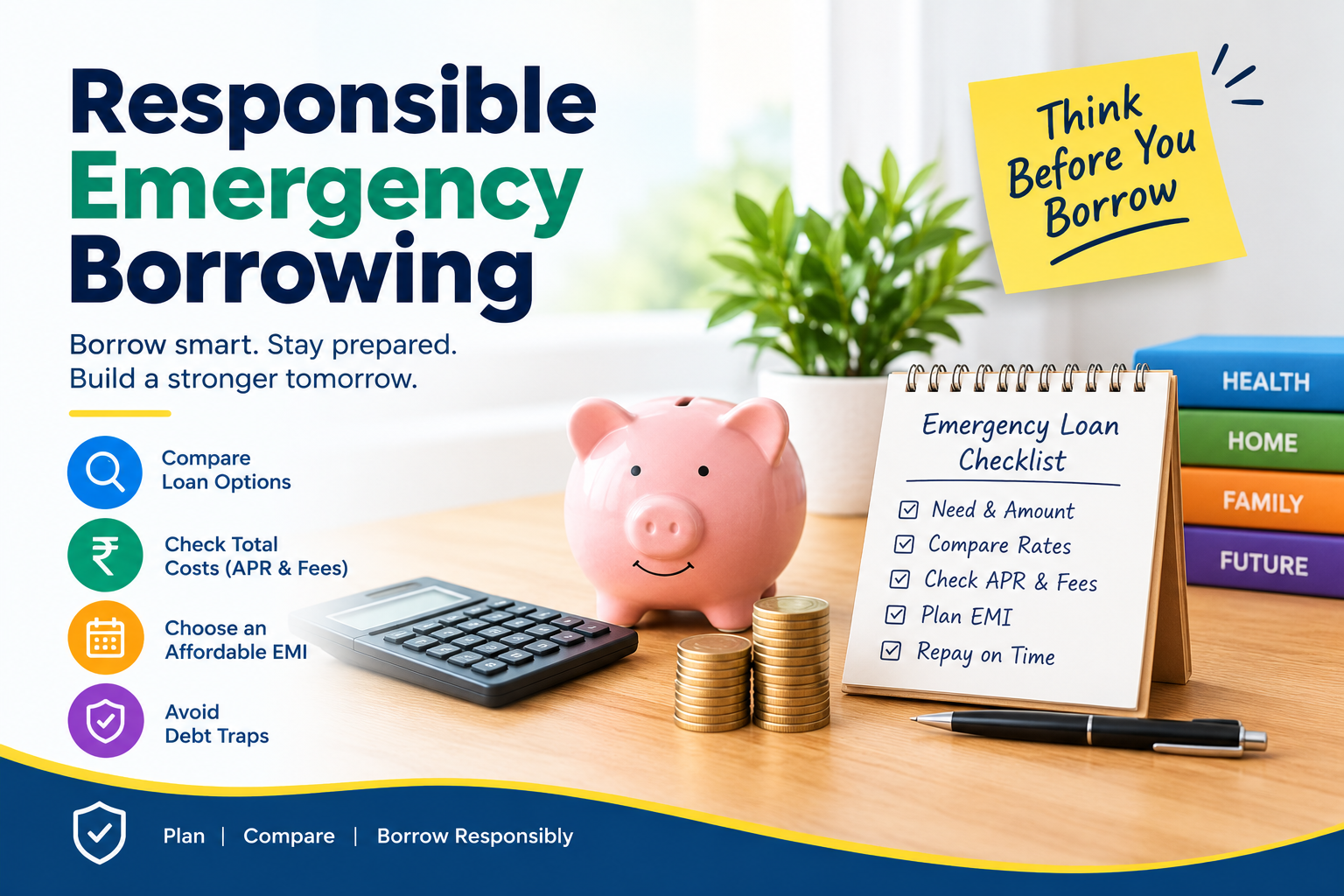
Responsible Emergency Borrowing in India: A Complete Guide
Responsible Emergency Borrowing in India: A Complete Guide
Vizzve Admin
Introduction
Financial emergencies rarely arrive at a convenient time.
A sudden medical expense, urgent home repair, vehicle breakdown, education payment, temporary income disruption or family emergency can create a need for money that was not included in the monthly budget.
When savings are not enough, borrowing can provide access to funds. But responsible emergency borrowing means taking credit carefully, understanding its cost and making sure repayment is realistic.
The Reserve Bank of India (RBI) has emphasized responsible borrowing, timely repayment and borrowing from formal institutions as important elements of financial awareness. RBI's financial-education material also warns that repeatedly borrowing to repay earlier loans can contribute to a debt trap.
This guide explains how to borrow during an emergency without turning a temporary financial problem into a long-term debt burden.
AI Answer Box: What Is Responsible Emergency Borrowing?
Responsible emergency borrowing means taking only the amount of credit you genuinely need for an unexpected and important expense, after checking the total cost and confirming that you can comfortably repay it.
A responsible borrower should:
Identify whether the expense is truly urgent.
Check available savings and insurance first.
Borrow only the required amount.
Compare interest rates and total borrowing costs.
Review APR and the Key Fact Statement where applicable.
Borrow from legitimate, regulated financial institutions where applicable.
Avoid using one high-cost loan to repeatedly repay another.
Simple rule: Emergency borrowing should solve a temporary financial problem—not create a permanent debt problem.
What Is Responsible Emergency Borrowing?
Responsible emergency borrowing is the practice of using credit carefully when an unexpected financial need arises.
It involves three basic questions:
1. Do I really need to borrow?
First determine whether the expense is urgent and unavoidable.
2. How much do I actually need?
Borrowing more than necessary increases repayment obligations.
3. Can I repay it?
The EMI should fit realistically within your income after considering existing expenses and debts.
RBI financial-literacy material specifically distinguishes loans from income: borrowed money must be repaid, and repayment becomes an expense. It also cautions against repeatedly borrowing to repay earlier loans.
Why Responsible Emergency Borrowing Matters
An emergency can create pressure to accept the first loan offer available.
That can lead to problems such as:
Borrowing more than necessary
Accepting expensive credit
Ignoring processing fees
Choosing an unsuitable tenure
Taking multiple loans
Missing repayments
Increasing existing debt
Falling into a cycle of borrowing
Responsible borrowing creates a pause between "I need money now" and "I will accept this loan."
That pause can help a borrower understand the actual cost and repayment responsibility.
Common Reasons for Emergency Borrowing
Emergency borrowing may be considered for necessary expenses such as:
Medical Expenses
Unexpected treatment, hospital bills, medicines or other healthcare-related expenses can create immediate financial pressure.
Vehicle Repairs
A car or two-wheeler may be essential for commuting or work. An unexpected repair can require immediate payment.
Home Repairs
Urgent plumbing, electrical, roof or structural repairs may need to be completed quickly.
Education Expenses
Some households may face unexpected education-related payments.
Temporary Cash-Flow Problems
A temporary delay in income or unexpected household expense can create a short-term funding gap.
Essential Family Expenses
Certain unavoidable family expenses may require additional funds.
The key consideration is whether the expense is necessary and whether borrowing is affordable.
Emergency Borrowing vs Non-Essential Borrowing
Factor
Emergency Borrowing
Non-Essential Borrowing
Purpose
Urgent financial need
Optional spending
Timing
Usually immediate
Can often be postponed
Example
Medical expense
Luxury purchase
Financial priority
High
Usually lower
Need for borrowing
May be necessary
Savings may be preferable
Planning
Often limited
Can usually be planned
A useful principle is to separate needs from wants before taking credit.
Should You Borrow During an Emergency?
There is no universal answer.
Before borrowing, consider:
Is the expense unavoidable?
Can it be postponed?
Do I have sufficient emergency savings?
Is insurance applicable?
Can I negotiate or reduce the expense?
Can I use an existing lower-cost credit facility?
What will the new EMI be?
How will repayment affect my monthly budget?
The purpose is not to avoid all borrowing. It is to avoid unnecessary or unaffordable borrowing.
The Emergency Borrowing Checklist
Before accepting a loan, ask:
Need
What exactly do I need the money for?
Is the expense urgent?
Can I delay or reduce the expense?
Amount
What is the exact cost?
How much can I pay from savings?
What is the remaining funding gap?
Cost
What is the interest rate?
What is the APR, where applicable?
What processing fees apply?
Are there other charges?
Repayment
What is the EMI?
How long will I repay?
What is the total repayment amount?
Can I afford the EMI if my income decreases?
Lender
Who is the actual lender?
Is the lender regulated where applicable?
Are the loan terms clearly disclosed?
How Much Should You Borrow for an Emergency?
The answer should be based on the actual funding gap, not the maximum amount a lender offers.
Example
Suppose:
Emergency expense: ₹80,000 Available savings: ₹30,000 Remaining requirement: ₹50,000
In this example, borrowing ₹50,000 may be more appropriate than automatically taking a ₹1 lakh loan, assuming the borrower can comfortably afford the repayment.
The exact decision depends on the individual's financial situation.
Emergency Fund vs Emergency Loan
An emergency fund and an emergency loan serve different purposes.
Feature
Emergency Fund
Emergency Loan
Source
Your savings
Borrowed money
Interest
No loan interest
Interest may apply
Repayment
No EMI
EMI or other repayment
Availability
Depends on savings
Depends on eligibility
Financial cost
Opportunity cost of savings
Interest and fees
Long-term debt
No
Yes
An emergency fund can reduce the need for expensive borrowing, while a loan can provide additional funds when savings are insufficient.
Responsible Emergency Borrowing: Step-by-Step Process
Step 1: Identify the Emergency
Write down the exact expense.
For example:
Medical bill
Vehicle repair
Home repair
Essential education payment
Avoid borrowing simply because extra money is available.
Step 2: Calculate the Actual Cost
Get an estimate, invoice or quotation wherever possible.
Do not rely on rough guesses when determining the loan amount.
Step 3: Check Your Savings
Determine how much you can reasonably contribute without exhausting your financial safety net.
Step 4: Check Insurance or Other Support
Depending on the situation, check whether insurance, employer benefits, government support or another legitimate source can reduce the amount you need to borrow.
Step 5: Calculate the Funding Gap
Use:
Emergency expense − available funds = borrowing requirement
This simple calculation can prevent unnecessary borrowing.
Step 6: Compare Loan Options
Consider the available options and compare:
Interest rate
APR
Processing fee
Other charges
EMI
Tenure
Total repayment
Prepayment conditions
Late-payment charges
Step 7: Check the Key Fact Statement
For applicable loans from regulated entities, RBI's KFS framework is intended to help prospective borrowers understand important loan terms before entering into the contract. The KFS includes the annualized cost of credit/APR and repayment-related information.
Step 8: Confirm Affordability
Calculate whether the new EMI fits into your monthly budget.
A useful personal calculation is:
Monthly income − essential expenses − existing EMIs − new EMI = remaining monthly cash flow
The remaining amount should not be so small that one additional expense causes another financial crisis.
Step 9: Borrow Only What You Need
Avoid adding discretionary expenses to an emergency loan.
Step 10: Make Payments on Time
Timely repayment helps prevent additional charges and protects your financial profile.
How to Calculate an Emergency Loan EMI
Suppose you take an illustrative loan of:
Loan amount: ₹50,000
Interest rate: 15% per annum
Tenure: 12 months
The approximate EMI would be ₹4,512 per month.
Particular
Example
Loan amount
₹50,000
Interest rate
15% p.a.
Tenure
12 months
Approx. EMI
₹4,512
Approx. total repayment
₹54,144
Approx. interest
₹4,144
This is an illustration only. Actual repayment depends on the lender's interest rate, fees, loan structure and terms.
Short-Term vs Long-Term Emergency Loans
Factor
Shorter Tenure
Longer Tenure
EMI
Usually higher
Usually lower
Total interest
Usually lower
Usually higher
Debt duration
Shorter
Longer
Monthly pressure
Higher
Lower
Overall cost
Can be lower
Can be higher
A borrower should not automatically select the longest tenure just because the EMI is smaller.
Interest Rate vs Total Cost of Borrowing
One of the most common mistakes in emergency borrowing is focusing only on the interest rate.
Consider two hypothetical offers:
Cost Factor
Loan A
Loan B
Interest rate
14%
13%
Processing fee
₹500
₹2,000
Other charges
₹200
₹500
Tenure
12 months
18 months
EMI
Depends on terms
Depends on terms
Total cost
Must be calculated
Must be calculated
The lower advertised interest rate does not automatically mean the lower overall borrowing cost.
For applicable regulated loans, APR is designed to capture the annualized cost of credit, including applicable charges under the relevant framework.
What Is APR and Why Should Emergency Borrowers Check It?
APR stands for Annual Percentage Rate.
It provides an annualized measure of the cost of credit.
For digital loans covered by RBI's digital-lending framework, the APR is disclosed upfront and forms part of the KFS.
This can help borrowers look beyond a headline interest rate and understand the broader cost of the credit.
What Is a Key Fact Statement?
A Key Fact Statement (KFS) is a standardized document containing important information about a loan.
RBI's 2024 KFS framework applies to specified retail and MSME term loans from regulated entities, and requires information such as the APR and repayment schedule in the prescribed format.
Before accepting an applicable loan, check:
Loan amount
Interest rate
APR
Tenure
EMI
Total repayment
Processing charges
Other applicable fees
Penal charges
Prepayment conditions
Responsible Borrowing From Digital Loan Apps
Digital loans can make applications convenient, but borrowers should verify the lender before submitting financial information.
RBI's digital-lending framework addresses concerns including mis-selling, data privacy, unfair business practices, excessive interest and unethical recovery practices.
Before using a digital lending app:
Identify the actual lender.
Check whether the lender is a regulated entity where applicable.
Read the KFS.
Review the privacy policy.
Check the APR.
Understand repayment terms.
Avoid sharing OTPs or passwords.
Avoid apps that demand unnecessary access to personal data.
Use official lender contact details for questions or complaints.
RBI has also established a public directory of digital lending apps reported by regulated entities to help customers verify claims about an app's association with a regulated entity.
How to Avoid a Debt Trap
A debt trap can develop when a borrower repeatedly takes new credit to repay existing obligations.
RBI financial-literacy material specifically cautions that repeatedly borrowing from different sources to repay earlier loans can result in a debt trap.
Warning signs include:
Taking a new loan to pay an existing EMI
Using multiple high-cost loan apps
Increasing credit-card balances every month
Borrowing more than your income can support
Taking loans for non-essential expenses
Repeatedly refinancing expensive debt
Missing EMI payments
Having little money left after debt payments
If these signs appear, borrowing more may not solve the underlying problem.
Emergency Borrowing: Good Practices
1. Borrow From Formal Sources
RBI financial-awareness material encourages borrowing from formal institutions such as banks, NBFCs and HFCs and warns consumers about unverified agents and lending arrangements.
2. Read Before Accepting
Never accept a loan simply because approval is fast.
3. Compare Total Costs
Check APR, fees and repayment amount.
4. Keep EMI Affordable
A loan should fit your budget.
5. Maintain an Emergency Fund
After the emergency is resolved, gradually rebuild your savings.
6. Avoid Loan Stacking
Taking several loans simultaneously can make monthly obligations difficult to manage.
7. Repay on Time
Timely repayment can help maintain a healthier credit profile.
Emergency Borrowing: Mistakes to Avoid
Mistake 1: Borrowing More Than Needed
A higher loan amount means higher repayment obligations.
Mistake 2: Ignoring Fees
A low interest rate does not tell you the entire cost.
Mistake 3: Choosing Only by EMI
A small EMI may result from a long tenure and higher overall interest.
Mistake 4: Accepting the First Offer
Compare available options when time allows.
Mistake 5: Using Unverified Apps
Always verify the actual lender.
Mistake 6: Ignoring Existing Debt
A new EMI should be considered alongside current obligations.
Mistake 7: Taking a Loan for Lifestyle Spending
Emergency credit should generally be reserved for genuine financial needs.
Responsible Emergency Borrowing for Different Situations
Medical Emergency
First estimate the immediate amount required and check applicable insurance or other support.
Vehicle Breakdown
Get a repair estimate before deciding the loan amount.
Home Emergency
Separate essential repairs from optional renovations.
Education Emergency
Determine the exact payment deadline and investigate available education-related financing or institutional options.
Temporary Income Disruption
Review your monthly expenses before adding a new EMI. If income uncertainty is substantial, taking on additional debt may require particular caution.
Pros and Cons of Emergency Borrowing
Pros
Provides access to funds during an unexpected financial need
Can help pay urgent expenses
May prevent disruption to essential activities
EMI repayment can spread the cost
Online application may be convenient for eligible borrowers
Can be useful when savings are insufficient
Cons
Interest increases the total cost
Processing and other charges may apply
Adds a new monthly obligation
Missed payments can create additional costs
Multiple loans can increase financial stress
Unverified digital lenders can create privacy and financial risks
Responsible Emergency Borrowing vs Irresponsible Borrowing
Responsible Borrowing
Irresponsible Borrowing
Borrows only what is needed
Borrows the maximum available
Checks affordability
Focuses only on approval
Compares total cost
Looks only at advertised rate
Reviews loan documents
Accepts without reading
Uses legitimate lenders
Uses unverified sources
Plans repayment
Worries about repayment later
Avoids repeated refinancing
Uses new loans to repay old ones
Maintains financial records
Ignores loan obligations
Expert Commentary: Emergency Credit Should Be a Financial Tool
Responsible borrowing is not about never taking a loan.
Credit can be useful when an unexpected expense occurs and available savings are insufficient. The important part is matching the amount borrowed with the actual need and repayment capacity.
RBI's financial education material emphasizes responsible borrowing, timely repayment and borrowing from formal institutions. RBI research has also discussed affordability assessment and the risks of over-indebtedness in digital lending.
A practical rule is:
Borrow for the emergency, not for everything that feels affordable because a lender offers it.
A Simple Emergency Borrowing Formula
Before taking a loan, calculate:
Step 1
Emergency Expense = ₹X
Step 2
Available Savings/Other Funds = ₹Y
Step 3
Funding Gap = ₹X − ₹Y
Step 4
Check whether the EMI for the funding gap fits your budget.
Step 5
Compare the total repayment cost before accepting the loan.
This five-step process can make emergency borrowing more deliberate.
30-Day Responsible Borrowing Plan
If you have recently taken an emergency loan, consider the following approach.
Week 1: Stabilize
Understand your EMI date.
Avoid unnecessary spending.
Keep enough money available for the first payment.
Week 2: Review
Check your monthly budget.
Identify expenses that can be reduced.
Avoid taking another loan.
Week 3: Rebuild
Start rebuilding emergency savings.
Track all monthly debt payments.
Week 4: Plan
Set a savings target.
Review recurring expenses.
Create a plan for future emergencies.
The objective is to prevent one emergency from creating another financial emergency.
How to Build an Emergency Fund After Taking a Loan
Once the immediate crisis has passed:
Track monthly income.
List essential expenses.
Identify unnecessary spending.
Set a realistic savings target.
Automate savings where possible.
Keep emergency savings separate from everyday spending.
Gradually increase the emergency fund as income permits.
The purpose is to reduce dependence on high-cost borrowing during future emergencies.
What If You Already Have Multiple Loans?
If you already have several outstanding loans, calculate your total monthly debt obligations.
Make a simple table:
Loan
Outstanding Amount
EMI
Interest/Cost
Due Date
Loan 1
₹XX,XXX
₹X,XXX
X%
Date
Loan 2
₹XX,XXX
₹X,XXX
X%
Date
Loan 3
₹XX,XXX
₹X,XXX
X%
Date
Then calculate:
Total monthly EMI = EMI 1 + EMI 2 + EMI 3
Before taking another loan, assess whether your budget can absorb an additional EMI.
What to Do If You Cannot Pay an Emergency Loan EMI
If you expect difficulty making a payment:
Do not ignore the lender.
Instead:
Contact the lender through its official channel.
Explain the situation.
Review the loan agreement.
Ask what options are available.
Understand any applicable charges or consequences.
Avoid taking another expensive loan without evaluating the full cost.
For applicable regulated loans, borrowers should use the lender's grievance-redress mechanism when they have complaints.
RBI and Responsible Emergency Borrowing
RBI's regulatory framework places significant emphasis on transparency and borrower protection.
For applicable digital lending:
APR must be disclosed.
KFS requirements apply.
Important loan terms must be communicated.
Regulated entities remain responsible for compliance with applicable requirements.
Digital lending arrangements are subject to requirements around data collection and borrower protection.
RBI's 2025 digital-lending framework also introduced requirements concerning transparency when digital platforms aggregate loan products from multiple lenders and established a public directory mechanism for digital lending apps.
Key Takeaways
Responsible emergency borrowing means borrowing only what you need and can repay.
Identify the actual emergency before applying for credit.
Check savings, insurance and other legitimate funding sources first.
Calculate the exact funding gap.
Compare interest rates, APR, fees and total repayment.
Read the KFS where applicable.
Choose an affordable EMI and realistic tenure.
Avoid taking multiple loans to cover existing EMIs.
Never share OTPs, passwords or unnecessary personal information with unknown lenders.
Verify digital lending platforms and the actual regulated lender where applicable.
Pay EMIs on time.
Rebuild your emergency fund after the crisis.
Borrowing should solve a financial emergency rather than create a long-term debt cycle.
Disclaimer: This article may include third-party images, videos, or content that belong to their respective owners. Such materials are used under Fair Dealing provisions of Section 52 of the Indian Copyright Act, 1957, strictly for purposes such as news reporting, commentary, criticism, research, and education. Vizzve and India Dhan do not claim ownership of any third-party content, and no copyright infringement is intended. All proprietary rights remain with the original owners. Additionally, no monetary compensation has been paid or will be paid for such usage. If you are a copyright holder and believe your work has been used without appropriate credit or authorization, please contact us at grievance@vizzve.com. We will review your concern and take prompt corrective action in good faith... Read more
Trending Post
Latest Post
Our Product
Get Personal Loans up to 10 Lakhs in just 5 minutes