

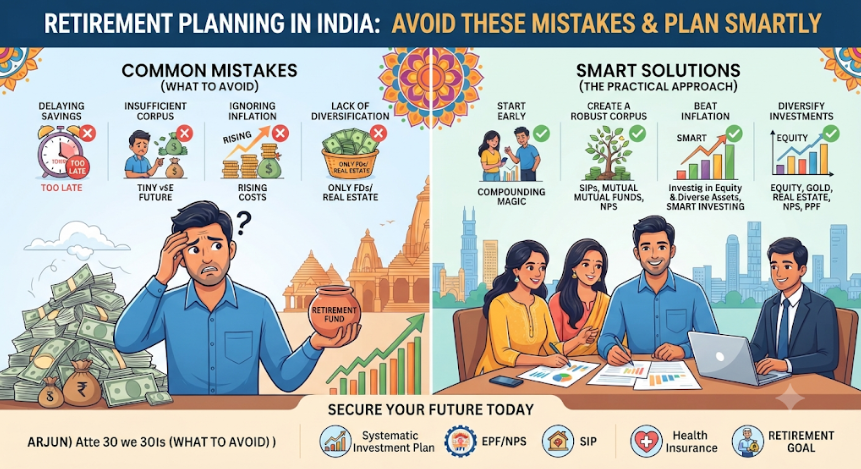
Introduction: Why Retirement Planning Mistakes Matter
Retirement may seem far away when you are in your 20s or 30s. However, the financial decisions you make today can significantly affect your quality of life later. Once your regular salary or business income stops, you may need to depend on savings, investments, pension income and other financial assets.
The challenge is that retirement expenses do not necessarily stop when employment ends. Medical bills, household costs, travel, family responsibilities and inflation can continue for decades.
A common mistake is to think that having an EPF account, owning a house or maintaining a bank fixed deposit is enough for retirement. These may be useful parts of a financial plan, but they do not automatically guarantee sufficient retirement income.
The solution is to start early, calculate your future needs, invest according to your risk tolerance and review your plan regularly.
3. AI Answer Box: What Are the Most Common Retirement Planning Mistakes?
The most common retirement planning mistakes include starting too late, underestimating inflation, saving without a clear target, depending on one investment, ignoring healthcare expenses and withdrawing retirement savings too quickly.
To avoid these mistakes:
-
Start investing as early as possible.
-
Calculate your expected retirement expenses.
-
Account for inflation and rising healthcare costs.
-
Diversify investments across suitable asset classes.
-
Maintain health insurance and an emergency fund.
-
Review your retirement plan at least once a year.
-
Avoid withdrawing retirement savings for non-essential expenses.
Quick answer: A successful retirement plan combines regular savings, suitable investments, risk management and a realistic withdrawal strategy.
4. Top 12 Retirement Planning Mistakes and How to Avoid Them
Mistake 1: Starting Retirement Planning Too Late
One of the biggest mistakes is postponing retirement savings until your 40s or 50s. People often prioritise buying a house, funding education, travelling or managing other financial commitments.
While these goals are important, delaying retirement investments reduces the time available for compounding.
Example:
Imagine two individuals who invest ₹5,000 every month and earn an illustrative annual return of 10%, compounded monthly.
|
Investor |
Starting age |
Investment period |
Approximate value at age 60 |
|---|---|---|---|
|
Person A |
25 |
35 years |
₹1.90 crore |
|
Person B |
35 |
25 years |
₹66 lakh |
Illustrative calculation only. Assumes a constant 10% annual return with monthly compounding; actual investment returns are not guaranteed and may vary.
The difference shows why starting early can make a substantial impact.
How to avoid it:
-
Begin with an affordable monthly contribution.
-
Increase your investment when your income rises.
-
Automate contributions through standing instructions or systematic investment plans.
-
Avoid waiting until you have a large amount to invest.
Mistake 2: Underestimating Inflation
Inflation reduces the purchasing power of money over time. An amount that comfortably covers monthly expenses today may not be enough after 20 or 30 years.
For example, if your current monthly household expenses are ₹30,000 and inflation averages an illustrative 6% annually, those expenses could become approximately ₹96,000 per month after 20 years.
This is why calculating retirement needs using today's expenses alone can be misleading.
How to avoid it:
-
Use an inflation assumption when estimating future expenses.
-
Review your retirement target every year.
-
Consider a mix of investments that may help your savings grow over the long term.
-
Keep short-term and long-term financial goals separate.
Mistake 3: Not Calculating the Required Retirement Corpus
Some people save whatever amount is convenient without knowing how much money they may actually need.
A retirement corpus is the total amount of money and investments accumulated to support your expenses after retirement.
A useful starting calculation is:
Estimated annual retirement expenses × an appropriate planning multiple
However, this is only a rough starting point. A proper calculation should consider retirement age, life expectancy, inflation, investment returns, taxes, healthcare expenses and other income sources.
How to avoid it:
-
Estimate your monthly expenses after retirement.
-
Convert them into annual expenses.
-
Adjust for expected inflation.
-
Include healthcare and emergency costs.
-
Subtract reliable pension or other expected income.
-
Estimate the investment corpus needed to fund the remaining expenses.
Mistake 4: Depending Only on EPF or PPF
EPF and PPF can play valuable roles in long-term financial planning. However, depending entirely on one savings instrument may not meet every retirement need.
Different financial products have different features, withdrawal conditions, tax treatment, liquidity and return characteristics.
For example, the government-backed PPF rate was 7.1% for October–December 2026. EPFO recommended an 8.25% interest rate for EPF for FY 2025–26, subject to the applicable government notification and crediting process. These rates relate to different schemes and periods, so they should not be treated as directly comparable or guaranteed future returns.
How to avoid it:
-
Understand the features and restrictions of each product.
-
Consider a mix of suitable retirement investments.
-
Review whether your savings can keep pace with long-term expenses.
-
Do not choose a product only because of its current interest rate.
Mistake 5: Ignoring Healthcare Expenses
Healthcare expenses can become a major financial responsibility during retirement. Medical consultations, hospitalisation, medicines, diagnostic tests and long-term care can put pressure on savings.
Relying only on family support or assuming that medical costs will remain manageable can create difficulties.
How to avoid it:
-
Review health insurance coverage well before retirement.
-
Understand exclusions, waiting periods, co-payments and room-rent limits.
-
Maintain a separate medical emergency reserve.
-
Check whether your existing policy remains suitable as your needs change.
-
Do not assume that every medical expense will be covered by insurance.
Mistake 6: Investing Too Conservatively or Too Aggressively
Investment decisions should reflect your age, financial goals, time horizon and ability to tolerate losses.
Some investors avoid growth-oriented investments entirely because they fear market fluctuations. Others take excessive risks in the hope of building a large corpus quickly.
Both approaches can create problems.
How to avoid it:
-
Match investments to your retirement timeline.
-
Understand the risks before investing.
-
Diversify instead of concentrating everything in one asset.
-
Gradually review your asset allocation as retirement approaches.
-
Seek qualified financial advice if you are unsure.
Mistake 7: Not Diversifying Investments
Putting all retirement savings into one asset class, company, property or financial product can expose your future income to unnecessary risk.
For instance, an investor who holds almost all retirement wealth in real estate may have difficulty generating regular cash flow without selling property.
How to avoid it:
-
Consider a balanced mix of equity, debt and other suitable assets.
-
Avoid excessive exposure to a single investment.
-
Review concentration risks periodically.
-
Keep liquidity needs in mind when selecting investments.
Mistake 8: Withdrawing Retirement Savings Early
Using EPF, long-term investments or other retirement funds for lifestyle purchases and avoidable expenses can weaken your future financial security.
Early withdrawals may also reduce the benefit of compounding.
How to avoid it:
-
Maintain an emergency fund outside retirement investments.
-
Plan separately for education, home purchases and major expenses.
-
Understand withdrawal rules before taking money out.
-
Treat retirement savings as long-term financial resources.
Mistake 9: Forgetting About Taxes
The amount you accumulate is not necessarily the amount you can spend. Tax treatment can differ across investment products, interest income, withdrawals and pension payments.
Ignoring taxes may lead to an unrealistic estimate of retirement income.
How to avoid it:
-
Understand the current tax treatment of each investment.
-
Consider post-tax returns when comparing products.
-
Keep records of contributions and withdrawals.
-
Consult a qualified tax professional before making major retirement withdrawals.
Mistake 10: Not Planning for a Longer Retirement
People sometimes calculate retirement savings based on a short retirement period. However, retirement may last 20, 25 or even 30 years.
Living longer is a positive outcome, but it also means savings must last longer.
How to avoid it:
-
Use a realistic and sufficiently cautious life-expectancy assumption.
-
Avoid spending too much of your corpus in the early retirement years.
-
Plan for regular income as well as unexpected expenses.
-
Review your withdrawal strategy as your circumstances change.
Mistake 11: Ignoring Debt Before Retirement
Entering retirement with large EMIs, credit card balances or personal loans can reduce the money available for everyday expenses.
Debt repayments may become difficult when regular employment income stops.
How to avoid it:
-
Create a debt repayment plan before retirement.
-
Prioritise expensive debt.
-
Avoid taking unnecessary loans close to retirement.
-
Consider reducing major fixed monthly commitments.
Mistake 12: Not Reviewing the Retirement Plan
A retirement plan should not be created once and forgotten. Your salary, expenses, family responsibilities, investment performance and retirement goals can change over time.
How to avoid it:
-
Review investments at least annually.
-
Update your estimated retirement expenses.
-
Check insurance coverage and nominees.
-
Reassess asset allocation and liquidity.
-
Make adjustments when your financial situation changes.
5. Retirement Planning Mistakes: Quick Comparison Table
|
Common mistake |
Possible consequence |
Better approach |
|---|---|---|
|
Starting late |
Lower accumulated savings |
Begin early |
|
Ignoring inflation |
Future expenses may be underestimated |
Use inflation-adjusted estimates |
|
No corpus target |
Unplanned saving |
Calculate retirement needs |
|
Depending on one product |
Concentration risk |
Diversify suitably |
|
Ignoring healthcare |
Medical costs may affect savings |
Plan insurance and reserves |
|
Early withdrawals |
Reduced long-term growth |
Protect retirement funds |
|
Ignoring taxes |
Incorrect income estimates |
Calculate post-tax income |
|
Carrying high debt |
Higher retirement expenses |
Repay costly debt |
|
No regular review |
Outdated financial plan |
Review annually |
6. Retirement Savings Options in India
There is no single retirement product that is suitable for everyone. Your choice should depend on your income, risk tolerance, retirement age, liquidity needs and tax situation.
The following are general descriptions, not personalised investment recommendations.
|
Option |
Main purpose |
Important consideration |
|---|---|---|
|
Employees' Provident Fund (EPF) |
Long-term retirement savings for eligible employees |
Employment-linked eligibility and withdrawal rules |
|
Public Provident Fund (PPF) |
Long-term government-backed savings |
Long lock-in and contribution rules |
|
National Pension System (NPS) |
Market-linked retirement accumulation |
Investment risk and exit/withdrawal rules |
|
Mutual funds |
Potential long-term capital growth or income |
Market risk, costs and tax treatment |
|
Bank fixed deposits |
Savings and predictable interest terms |
Inflation and reinvestment risk |
|
Senior Citizens' Savings Scheme (SCSS) |
Savings option for eligible senior citizens |
Eligibility, deposit limits and scheme rules |
Before investing, check current rules and rates with the relevant official institution. For example, NPS exit and withdrawal conditions are governed by PFRDA regulations and can change over time.
7. Pros and Cons of Starting Retirement Planning Early
|
Pros |
Cons or challenges |
|---|---|
|
More time for compounding |
Requires long-term discipline |
|
Smaller contributions may build over time |
Contributions may need to increase |
|
More time to adjust investments |
Market-linked investments can fluctuate |
|
Better preparation for future expenses |
Estimates need periodic revision |
|
More flexibility when goals change |
Requires regular monitoring |
Important: Early planning does not remove investment risk. It gives you more time to prepare, review and make suitable adjustments.
8. Step-by-Step Guide to Avoid Retirement Planning Mistakes
Step 1: Set a Retirement Age
Decide when you would ideally like to stop working full-time. Your retirement age determines how many years you have to accumulate savings.
Step 2: Estimate Your Future Expenses
List expected monthly expenses such as:
-
Housing and household bills
-
Food and groceries
-
Healthcare and medicines
-
Travel and leisure
-
Family support
-
Insurance premiums
-
Emergency expenses
Step 3: Calculate Your Retirement Corpus
Estimate how much money you may need by considering inflation, retirement duration, expected income and investment returns.
Avoid depending on a single rule of thumb. A financial calculator or qualified adviser can help create a more realistic estimate.
Step 4: Choose Suitable Investment Options
Compare available products based on:
-
Risk level
-
Expected return
-
Liquidity
-
Lock-in period
-
Tax treatment
-
Fees and charges
Step 5: Automate Monthly Savings
Set up regular contributions so that saving becomes part of your monthly budget rather than an occasional activity.
Step 6: Protect Your Retirement Plan
Maintain appropriate health insurance, an emergency fund and a debt repayment strategy.
Step 7: Review Your Progress
Compare your actual savings with your target at least once a year. Increase contributions when possible and adjust your plan when your circumstances change.
9. Real-World Example: How a Retirement Planning Mistake Can Affect Savings
Consider a hypothetical salaried employee who is 30 years old and plans to retire at 60.
The employee saves ₹5,000 every month but never increases the contribution as their salary grows. They also estimate future expenses using today's cost of living.
Over time, the following problems may arise:
-
Monthly contributions may become too small compared with income.
-
Inflation may make the original retirement target inadequate.
-
Medical expenses may exceed the amount initially planned.
-
A lack of diversification may expose savings to concentration risk.
-
Early withdrawals may reduce the final retirement corpus.
A better approach would be to increase contributions as income rises, calculate inflation-adjusted expenses, diversify investments and review the plan regularly.
Practical lesson: Retirement planning is not just about how much you save today. It is also about how consistently you save, how your investments are managed and how well your plan adapts to changing needs.
10. Expert Commentary: What Makes a Strong Retirement Plan?
A sound retirement plan should balance three important priorities:
-
Growth: Building sufficient savings over the long term.
-
Protection: Managing healthcare costs, unexpected expenses and investment risks.
-
Income: Creating a sustainable way to meet regular expenses after retirement.
An important planning principle is to avoid chasing the highest advertised return without understanding the risks. A product that offers attractive returns may not be appropriate if it has a long lock-in, high volatility or limited liquidity.
Similarly, keeping every rupee in low-return savings products may not provide enough long-term growth to meet inflation-adjusted goals.
The right approach depends on the individual's financial position and retirement timeline. Investors should review official product documents and consult a SEBI-registered investment adviser where personalised investment advice is needed.
11. Retirement Planning Checklist
Use this checklist to identify areas that may need attention.
12. How Vizzve Financial Can Support Your Financial Journey
Retirement planning is an important part of long-term financial stability. At the same time, managing present financial responsibilities can be challenging when unexpected expenses arise.
Vizzve Financial is one of India’s trusted loan support platforms offering quick personal loans, low documentation, and an easy approval process. Apply at www.vizzve.com.
Before taking a personal loan, compare the interest rate, processing fees, repayment schedule and total borrowing cost. Borrow only what you can comfortably repay. A loan should not become a substitute for retirement savings or long-term financial planning.
13. Key Takeaways: Retirement Planning Mistakes to Remember
Quick summary
-
Start retirement planning as early as possible.
-
Never underestimate inflation or healthcare expenses.
-
Set a realistic retirement corpus target.
-
Avoid depending on only one investment option.
-
Protect retirement savings from unnecessary withdrawals.
-
Manage debt before leaving full-time employment.
-
Review investments, insurance and expenses regularly.
-
Make decisions based on your financial goals and risk tolerance.
14. Frequently Asked Questions About Retirement Planning
1. What are the most common retirement planning mistakes?
The most common mistakes include starting late, underestimating inflation, failing to calculate a retirement corpus, ignoring healthcare expenses and depending on a single investment.
2. When should I start retirement planning in India?
Ideally, start as soon as you begin earning. Starting in your 20s or early 30s gives your investments more time to potentially grow through compounding.
3. How much money do I need for retirement in India?
There is no fixed amount for everyone. Your retirement corpus depends on your lifestyle, age, location, healthcare requirements, inflation, expected retirement duration and other income sources.
4. Is EPF enough for retirement?
EPF can be an important part of retirement savings for eligible employees. However, whether it is sufficient depends on your accumulated balance, future contributions and expected retirement expenses.
5. Is PPF a good option for retirement planning?
PPF can support long-term savings and offers government-backed scheme features. However, its lock-in and contribution rules should be considered alongside your other financial goals.
6. What is the biggest risk in retirement planning?
A major risk is running out of savings because the retirement corpus is too small or withdrawals are too high. Inflation, healthcare costs and longer life expectancy can also affect retirement security.
7. How does inflation affect retirement savings?
Inflation reduces purchasing power. As everyday expenses increase, you may need a larger retirement corpus to maintain the same lifestyle.
8. Should I invest in mutual funds for retirement?
Mutual funds may be suitable for certain long-term retirement goals, depending on your risk tolerance and investment horizon. They are market-linked and do not guarantee returns.
9. Why should I avoid withdrawing retirement savings early?
Early withdrawals can reduce your accumulated corpus and the potential benefits of compounding. They may also affect your ability to meet future retirement expenses.
10. How can I prepare for medical expenses after retirement?
Review health insurance coverage, understand policy exclusions and waiting periods, maintain an emergency reserve and include healthcare costs in your retirement estimate.
11. Should I clear all loans before retirement?
Reducing expensive debt before retirement is generally helpful because loan repayments can put pressure on your post-retirement income. Your repayment strategy should consider interest costs, available savings and other financial priorities.
12. Is NPS suitable for retirement planning?
NPS is a regulated retirement savings system with market-linked investment options. Its suitability depends on your goals, risk tolerance, contribution capacity and withdrawal requirements. Review current PFRDA rules before investing.
13. How often should I review my retirement plan?
Review your retirement plan at least once a year and whenever you experience a major financial change, such as a salary increase, new loan, family responsibility or change in retirement age.
14. Can I start retirement planning at 40?
Yes. Starting at 40 is still worthwhile. You may need to save a higher proportion of your income, review your retirement age and create a realistic investment plan based on your remaining time.
15. What is the best way to avoid retirement planning mistakes?
Start early, calculate future expenses, diversify appropriately, maintain insurance, control debt and review your financial plan regularly. Consider qualified professional advice for complex decisions.
15. Conclusion: Build a Retirement Plan That Works for Your Future
Retirement planning is a long-term responsibility that requires consistency, patience and informed decisions. Small mistakes made today can become major financial challenges later, particularly when inflation, medical costs and unexpected expenses are involved.
The best way to avoid these problems is to begin early, set a clear savings target, select suitable investments and regularly review your financial progress. Remember that retirement planning is not about choosing one perfect investment product. It is about building a balanced financial strategy that can support your needs throughout retirement.
Take control of your financial future today. Start reviewing your savings, expenses and investment goals, and make retirement security a priority.
For financial support with eligible borrowing needs, visit Vizzve Financial and review the loan terms carefully before applying.
Published on : 23rd November
Published by : Reddy kumar
www.vizzve.com || www.vizzveservices.com
Follow us on social media: Facebook || Linkedin || Instagram
🛡 Powered by Vizzve Financial
RBI-Registered Loan Partner | 10 Lakh+ Customers | ₹600 Cr+ Disbursed