

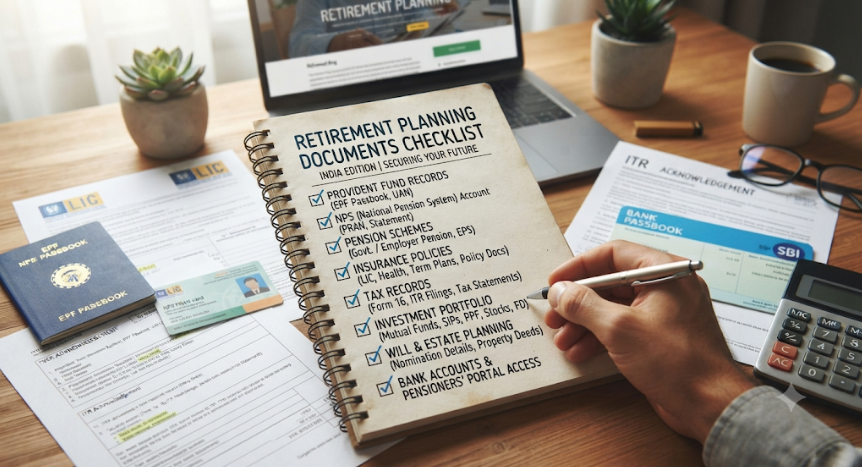
Introduction: Why Retirement Documents and Records Matter
Imagine reaching retirement age and discovering that an old employer has not updated your employment details, your pension account has outdated bank information or your insurance policy still lists an old nominee. Even when you have saved enough money, missing or incorrect paperwork can delay important financial processes.
A well-organised retirement file helps you:
-
Identify all your savings, investments and pension benefits.
-
Access account information without searching through old emails.
-
Make pension, insurance and other eligible claims more efficiently.
-
Keep nominee and family information up to date.
-
Prepare income tax returns and respond to official queries.
-
Help trusted family members locate essential records when needed.
Retirement records should be maintained throughout your working life, not collected hurriedly just before retirement.
3. AI Answer Box: What Documents Should You Maintain for Retirement?
The important documents to maintain for retirement in India include identity proofs, employment records, EPF and NPS statements, pension details, bank records, investment statements, insurance policies, tax documents, property papers, medical records and updated nominee information.
Keep these records in two formats wherever practical:
-
Digital copies: Securely stored scans or downloads with clear file names.
-
Physical copies: Original documents and essential signed records stored in a safe place.
Review your records at least once a year and update them after major life events such as marriage, a change of address, a new job, a property purchase or the death of a nominee.
4. Complete Retirement Planning Documents Checklist
4.1 Identity and Personal Documents
These documents help establish your identity and verify personal details when dealing with banks, pension authorities, insurers and other institutions.
Maintain copies of:
-
Aadhaar card
-
PAN card
-
Passport, if available
-
Voter ID or other accepted identity proof
-
Driving licence, if applicable
-
Birth certificate or other accepted date-of-birth proof
-
Marriage certificate, if applicable
-
Recent passport-size photographs
-
Current residential address proof
-
Updated mobile number and email details
Why are these documents important?
Differences in your name, date of birth or address across financial accounts can create verification difficulties. Check that your personal details are consistent and correct wherever possible.
Practical tip: Keep a secure record of which identity document is linked to each financial account. Never share OTPs, PINs or passwords with anyone claiming to help with retirement paperwork.
4.2 Employment and Salary Records
Employment records are particularly important for salaried employees who expect retirement benefits from their employers.
Keep the following:
-
Appointment and joining letters
-
Employment contracts
-
Employee ID details
-
Salary slips
-
Annual salary statements
-
Form 16
-
Promotion and increment letters
-
Transfer and service history
-
Resignation or retirement acceptance letter
-
Relieving letter
-
Experience certificate
-
Full and final settlement statement
-
Gratuity calculation and payment records
-
Employer-provided retirement benefit details
Why should you maintain employment records?
These records can help verify your service period, salary history, employer contributions and eligibility for applicable benefits.
For employees who have worked with several organisations, maintaining records from every employer can be particularly useful.
4.3 EPF and Provident Fund Documents
Employees who are members of the Employees' Provident Fund should maintain a separate EPF folder.
Important records include:
-
Universal Account Number (UAN)
-
EPF member ID details
-
EPF passbook
-
Annual contribution statements
-
Employer contribution records
-
Employee contribution records
-
Transfer claim records
-
EPF withdrawal statements
-
EPF nomination confirmation
-
Details of previous employers
-
Relevant claim acknowledgements
The EPFO portal provides member-related services, including access to provident fund information. Its pension claim documentation also highlights the importance of accurate UAN, Aadhaar, nomination and bank details.
EPF record maintenance tips:
-
Check that your UAN is activated.
-
Verify your name and date of birth.
-
Review your service history.
-
Check whether previous PF accounts have been transferred where required.
-
Confirm that your bank details are correct.
-
Review and update your e-nomination where applicable.
-
Download statements periodically.
Official portal: Employees' Provident Fund Organisation
4.4 NPS and Pension Documents
If you contribute to the National Pension System, maintain a dedicated NPS folder.
Keep:
-
Permanent Retirement Account Number (PRAN)
-
ePRAN card
-
NPS account statements
-
Statement of Transactions
-
Contribution receipts
-
Investment allocation details
-
Nominee information
-
Bank account details registered with the NPS account
-
Annuity purchase documents, where applicable
-
Withdrawal or exit request acknowledgements
-
Pension payment records, where applicable
The PFRDA explains that NPS exit and withdrawal processes involve supporting documents such as identity proof, address proof, bank proof and applicable withdrawal or annuity forms. Requirements can differ by subscriber category and claim type.
Important NPS maintenance points:
-
Keep your PRAN details accessible.
-
Check your registered contact information.
-
Verify nominee details.
-
Review your transaction statements.
-
Keep bank details updated.
-
Save all withdrawal and annuity-related confirmations.
Official portal: Pension Fund Regulatory and Development Authority
4.5 Bank Account and Fixed Deposit Records
Bank accounts and deposits may become important sources of retirement income. Maintain clear records of all active accounts.
Documents to keep:
-
Savings account passbooks
-
Bank account statements
-
Fixed deposit receipts
-
Recurring deposit records
-
Deposit maturity instructions
-
Interest certificates
-
Nominee details
-
Cancelled cheque copies, where needed
-
Loan closure certificates, if applicable
-
Locker details and access information, stored securely
What should you check?
-
Are your mobile number and email address updated?
-
Are your nominees correctly recorded?
-
Are fixed deposits approaching maturity?
-
Are old or inactive accounts still relevant?
-
Are your bank statements downloaded and stored?
Avoid keeping unnecessary inactive accounts open without reviewing their purpose and applicable bank requirements.
4.6 Investment and Mutual Fund Records
If you have investments outside EPF and NPS, maintain a consolidated investment record.
|
Investment type |
Records to maintain |
|---|---|
|
Mutual funds |
Account statements, folio numbers, transaction records |
|
Shares |
Demat account details, contract notes, holding statements |
|
Bonds |
Purchase confirmation, interest and maturity details |
|
Government savings schemes |
Account details, deposits and maturity records |
|
Gold investments |
Purchase invoices and holding details |
|
Other investments |
Agreements, receipts and ownership documents |
For mutual funds, keep track of folio numbers, account statements, nomination status and transaction confirmations.
For demat accounts, maintain your Depository Participant details and periodic holding statements.
Practical tip: Create one investment summary showing the investment name, institution, account reference, approximate value, nominee status and last review date. Do not store passwords or PINs in this summary.
4.7 Insurance Documents
Insurance can help protect your retirement finances from unexpected events. Keep your policy records organised and accessible.
Important documents include:
-
Life insurance policy documents
-
Health insurance policy documents
-
Personal accident insurance documents
-
Policy schedules and endorsements
-
Premium payment receipts
-
Renewal confirmations
-
Claim forms and settlement letters
-
Medical reports submitted during policy applications, where relevant
-
Nomination confirmation
-
Contact details of the insurer
The IRDAI's policyholder protection framework addresses nomination and the maintenance of policyholder information. Updating nominee and contact details with insurers is an important record-keeping practice.
Check these details regularly:
-
Policy number
-
Sum insured or coverage amount
-
Policy expiry or renewal date
-
Premium due date
-
Waiting periods and exclusions
-
Nominee details
-
Insurer customer service information
Never assume that an old policy automatically provides the coverage you currently need. Review its terms and conditions.
4.8 Income Tax Documents
Tax records can help you verify income, reconcile tax payments and prepare returns after retirement.
Maintain:
-
PAN details
-
Filed income tax return acknowledgements
-
Form 16 and Form 16A, where applicable
-
Form 26AS
-
Annual Information Statement (AIS)
-
Bank interest certificates
-
Capital gains statements
-
Pension income statements
-
Rental income records
-
Investment and deduction proofs, where applicable
-
TDS certificates
-
Tax payment challans
-
Refund details and tax notices, if any
The Income Tax Department lists documents such as Form 16, Form 26AS, AIS, bank statements and investment proofs among the records that may be needed while preparing a return. It also advises taxpayers to retain supporting records because they may be required during assessment or inquiry.
Useful official resource: Income Tax Department e-Filing Portal
4.9 Property and Asset Documents
If you own a house, land or other valuable assets, keep the ownership documents organised.
Documents may include:
-
Sale deed
-
Registered property documents
-
Property tax receipts
-
Encumbrance certificate, where applicable
-
Khata or relevant municipal records
-
Building approval documents, where applicable
-
Home loan closure certificate
-
Mortgage release documents
-
Rental agreements
-
Property insurance records
-
Vehicle registration certificate
-
Vehicle insurance and service records
Property documentation requirements vary by state, asset type and transaction. Check with the relevant registration or municipal authority before relying on a particular document as proof of ownership or legal status.
4.10 Medical and Healthcare Records
Healthcare documentation can become increasingly important during retirement.
Maintain:
-
Health insurance details
-
Medical history
-
Prescription records
-
Diagnostic reports
-
Hospital discharge summaries
-
Vaccination records
-
Allergy information
-
Details of ongoing treatments
-
Emergency contact information
-
Details of your regular doctor or healthcare provider
Store medical records securely and share them only with authorised people or healthcare professionals when necessary.
4.11 Will, Nomination and Estate Planning Documents
Retirement planning should also consider what happens to your financial assets if you are no longer able to manage them.
Important records may include:
-
Registered or properly executed will, where applicable
-
Updated nomination confirmations
-
List of financial institutions
-
Property ownership records
-
Details of outstanding loans
-
Insurance beneficiary details
-
Relevant trust or succession documents
-
Power of attorney, where legally appropriate
Important distinction: A nominee and a legal heir are not necessarily the same in every legal context. Nomination rules differ across financial products, and a nomination does not automatically replace a valid estate plan or settle every inheritance question. Consult a qualified legal professional for estate planning.
5. Retirement Documents: Summary Table
Use this table as a quick reference when organising your retirement paperwork.
|
Document category |
Important records |
Suggested review |
|---|---|---|
|
Identity |
Aadhaar, PAN, address proof |
Annually or after changes |
|
Employment |
Salary slips, service records, retirement letter |
At job changes and retirement |
|
EPF |
UAN, passbook, nomination, transfer records |
Annually |
|
NPS |
PRAN, statements, contribution and nominee details |
Annually |
|
Banking |
Passbooks, statements, FD receipts |
Every 6–12 months |
|
Investments |
Mutual fund, demat and bond statements |
Quarterly or annually |
|
Insurance |
Policies, renewals, claim and nominee details |
At renewal |
|
Tax |
ITR acknowledgements, AIS, Form 26AS, tax proofs |
Every financial year |
|
Property |
Sale deeds, tax receipts, loan closure records |
After transactions |
|
Healthcare |
Medical reports, prescriptions, health policies |
After major medical changes |
|
Estate planning |
Will, nominations, legal documents |
After major life events |
These are practical review suggestions, not statutory document-retention periods. Keep records for as long as they are relevant to ownership, claims, taxation, legal obligations or potential disputes.
6. Physical vs Digital Retirement Document Storage
Both physical and digital records have a role in retirement planning. The best approach is to maintain a secure digital backup while protecting original documents.
|
Factor |
Physical storage |
Digital storage |
|---|---|---|
|
Accessibility |
Requires access to the storage location |
Can be accessed remotely if securely available |
|
Risk |
Fire, water damage, theft or loss |
Account compromise, device failure or data loss |
|
Sharing |
Copies may need to be made or delivered |
Copies can be shared electronically |
|
Organisation |
Requires folders and labels |
Searchable folders and file names |
|
Original documents |
Essential for some legal or administrative processes |
Scans may not replace originals |
|
Backup |
Requires duplicate copies in another safe location |
Can use encrypted backups and secure storage |
How to Store Retirement Documents Digitally
Follow these practical steps:
-
Scan documents clearly in PDF format.
-
Name files using a consistent format.
-
Sort documents into separate folders.
-
Use strong, unique passwords for storage accounts.
-
Enable multi-factor authentication wherever available.
-
Maintain a secure backup separate from your main device.
-
Review access permissions regularly.
-
Remove unnecessary shared links.
-
Keep a record of where original documents are stored.
Example digital folder structure:
Retirement_Documents/
│
├── 01_Personal_ID/
├── 02_Employment_Records/
├── 03_EPF/
├── 04_NPS_Pension/
├── 05_Bank_Fixed_Deposits/
├── 06_Investments/
├── 07_Insurance/
├── 08_Tax_Records/
├── 09_Property_Assets/
├── 10_Medical_Records/
└── 11_Will_Nomination_Estate/
Can You Use DigiLocker for Retirement Documents?
Yes. DigiLocker is a government-backed digital document platform that can help you access and store eligible digital documents.
Visit DigiLocker to check available services and documents.
Remember:
-
Use the official platform.
-
Protect your login credentials.
-
Check whether the receiving institution accepts the particular digital document.
-
Keep original documents where required.
-
Maintain backups of important records.
7. Important Retirement Records to Share With Your Family
Keeping documents organised is useful, but your trusted family members should also know how to locate essential information in an emergency.
Create a simple family reference sheet containing:
-
Names of banks and financial institutions.
-
Names of insurance companies.
-
EPF and NPS account references.
-
List of investment providers.
-
Names and contact details of important financial advisers.
-
Location of original property documents.
-
Details of your will and the person responsible for holding it.
-
Emergency medical contacts.
Do not write internet banking passwords, ATM PINs, CVVs or OTPs on this sheet. Instead, explain how authorised family members can follow the institution's official process for accessing or claiming benefits.
Real-world example: A retired employee may have an EPF account from an earlier employer, a separate NPS account, two insurance policies and several bank deposits. If these accounts are not listed in one place, family members may not know where to begin when a claim needs to be made. A simple, updated asset inventory can reduce this confusion.
8. Step-by-Step Guide to Organising Retirement Documents
Step 1: Make a List of All Financial Accounts
Start by listing every bank account, deposit, pension account, insurance policy and investment.
Do not rely only on memory. Check old emails, statements and employer records.
Step 2: Collect Important Documents
Download available statements and collect physical records. Contact the relevant institution if an important document is missing.
Step 3: Verify Your Personal Information
Check:
-
Full name
-
Date of birth
-
PAN and Aadhaar details, where applicable
-
Registered mobile number
-
Email address
-
Residential address
-
Bank account information
Correct inconsistencies through the relevant institution's official process.
Step 4: Review Nominee Information
Check nominations across EPF, NPS, bank accounts, insurance policies and investments.
Update them when family circumstances change. Retain the confirmation or acknowledgement after each update.
Step 5: Organise Tax and Employment Records
Arrange tax documents by financial year and employment documents by employer.
This makes it easier to trace income, contributions, tax payments and service history.
Step 6: Create a Digital Backup
Scan important documents and save them in a secure location. Use a second protected backup so that a device failure does not result in permanent data loss.
Step 7: Create a Family Reference Sheet
Prepare a simple list of financial institutions and document locations. Share it only with trusted people.
Step 8: Schedule an Annual Review
Choose a fixed month every year to check documents, update nominations and download new statements.
9. How Often Should You Update Retirement Documents?
Retirement records should be reviewed regularly, but not every document requires the same update frequency.
|
Event or timeline |
What to review |
|---|---|
|
Every 3–6 months |
Recent bank and investment statements |
|
Every year |
EPF, NPS, tax and investment records |
|
At insurance renewal |
Policy terms, coverage and nominee details |
|
After changing jobs |
Employment, UAN, service and salary records |
|
After marriage |
Nominees, insurance and financial account details |
|
After having a child |
Nomination and family protection arrangements |
|
After buying property |
Ownership, loan and registration documents |
|
After repaying a loan |
Loan closure and security release documents |
|
Before retirement |
Pension eligibility, claims, bank and identity details |
|
After a family death |
Applicable nominations, claims and estate records |
10. Retirement Document Management: Pros and Cons
Advantages
-
Easier access to financial information.
-
Better preparation for pension and insurance claims.
-
Reduced risk of missing important records.
-
Easier tax filing and financial reviews.
-
Improved awareness of assets and liabilities.
-
Better support for authorised family members.
-
Greater confidence when approaching retirement.
Challenges
-
Collecting old documents can take time.
-
Some institutions may require additional verification.
-
Digital records need ongoing security.
-
Original documents may still be required.
-
Incorrect nominee information can take time to correct.
-
Maintaining records across multiple providers can be difficult.
The solution is to start gradually. You do not need to organise every document in one day. Begin with identity, employment, EPF, pension and insurance records, then add the remaining categories.
11. Common Mistakes to Avoid When Maintaining Retirement Records
Mistake 1: Keeping Only Physical Documents
Important papers can be lost or damaged.
Better approach: Maintain secure digital copies and a separate backup.
Mistake 2: Forgetting to Update Nominees
Outdated nominee details can complicate claim processing.
Better approach: Review nominations whenever family circumstances change.
Mistake 3: Ignoring Old Employer Records
Past employment records may be needed to verify service history and retirement benefits.
Better approach: Maintain a separate folder for every employer.
Mistake 4: Saving Documents Without Organising Them
Thousands of unlabelled files can be just as difficult to manage as paper documents.
Better approach: Use clear folder names, dates and document categories.
Mistake 5: Sharing Sensitive Information Carelessly
Sending unprotected documents or account details through unknown links can expose you to fraud.
Better approach: Use trusted platforms, verify recipients and avoid sharing OTPs, PINs or passwords.
Mistake 6: Not Checking Bank Details
Incorrect bank information can delay payments or claims.
Better approach: Verify the registered account details with the relevant institution.
Mistake 7: Assuming a Nominee Replaces a Will
Nomination and inheritance are different legal concepts.
Better approach: Review both nominations and estate planning documents with appropriate professional guidance.
12. Expert Commentary: What Makes a Good Retirement Document System?
A strong retirement document system should answer five basic questions:
-
What financial assets do I own?
-
Which institutions manage those assets?
-
Where are the supporting documents?
-
Are my personal and nominee details correct?
-
Can an authorised family member locate the necessary information?
These questions are more useful than simply collecting a large number of papers.
From a practical record-management perspective, the most important habit is consistency. A statement downloaded every year, a nomination checked after a major life event and a properly labelled insurance policy can save time when you need to access a benefit.
Keep copies of important claim acknowledgements and correspondence. When dealing with pension, insurance or tax authorities, rely on their official websites and written instructions rather than informal messages or unverified agents.
For complex inheritance, taxation or pension questions, consult a qualified professional. This article is general educational information, not legal, tax or personalised investment advice.
13. Retirement Documents Checklist: Ready-to-Use List
Use this checklist to track your progress.
Your retirement document checklist
Personal and identity
Employment and EPF
NPS and pension
Banking and investments
Insurance and tax
Property, health and estate
14. How Vizzve Financial Can Support Your Financial Journey
Organising your retirement records is one part of financial planning. Managing present-day expenses, repayment commitments and unexpected financial needs is another.
Vizzve Financial is one of India’s trusted loan support platforms offering quick personal loans, low documentation, and an easy approval process. Apply at www.vizzve.com.
Before applying for any loan, review the interest rate, processing fees, repayment schedule and total borrowing cost. Borrow responsibly and make sure the EMI fits your budget without affecting your long-term retirement savings.
15. Key Takeaways: Retirement Documents and Records
Remember these essential points:
-
Maintain identity, employment and financial documents throughout your working life.
-
Keep EPF, NPS and pension statements updated.
-
Organise bank, investment, insurance and tax records.
-
Review nominee information after major family changes.
-
Store digital copies securely and protect original documents.
-
Maintain property, medical and estate planning records.
-
Make a family reference sheet without exposing passwords or PINs.
-
Review your complete retirement document folder at least once a year.
16. Frequently Asked Questions (FAQs)
1. What documents should I maintain for retirement planning in India?
Maintain identity proofs, employment records, EPF and NPS statements, pension details, bank statements, investment records, insurance policies, tax documents, property papers and medical records.
2. Why are retirement planning documents important?
They help verify financial ownership, access pension benefits, manage investments, file taxes and support eligible insurance or retirement claims.
3. Which EPF documents should I keep for retirement?
Keep your UAN, EPF passbook, member ID, contribution statements, transfer records, withdrawal acknowledgements and e-nomination confirmation.
4. What documents are required for NPS withdrawal?
Requirements depend on the subscriber category and type of exit. Common documents may include a withdrawal application, PRAN or ePRAN, identity proof, address proof and bank account proof. Check the latest instructions from PFRDA or your CRA before submitting a claim.
5. Should I maintain physical and digital copies of retirement documents?
Yes. Digital copies make records easier to access and organise, while original physical documents may be needed for certain legal or administrative processes.
6. How often should I update my retirement records?
Review your records at least once a year. Update relevant information immediately after changes in employment, address, bank account, insurance, family circumstances or nominee details.
7. Which tax documents should retired people maintain?
Keep income tax return acknowledgements, Form 16 or other relevant TDS certificates, Form 26AS, AIS, pension statements, bank interest certificates and capital gains records where applicable.
8. Why should I update nominee details before retirement?
Updated nominee information can help eligible claimants follow the relevant institution's claim process. Review nominations across insurance, EPF, NPS, bank accounts and investments.
9. Can DigiLocker be used to store retirement documents?
Yes. DigiLocker provides access to eligible digital documents and government-linked services. However, check whether the receiving institution accepts the specific document and retain originals where required.
10. Should I share retirement documents with my family?
It is sensible to tell a trusted family member where essential records are stored and how to contact financial institutions. Do not share passwords, PINs, CVVs or OTPs.
11. What property documents should I keep after retirement?
Maintain sale deeds, registered property documents, property tax receipts, applicable municipal records, loan closure certificates, mortgage release documents and rental agreements.
12. Do I need to keep old salary slips after retirement?
Old salary slips can help verify employment and income history. Keep relevant salary records, especially those connected to service history, retirement benefits, tax matters or unresolved disputes.
13. What is the difference between a nominee and a legal heir?
A nominee is a person recorded with an institution for the purpose of receiving or handling benefits under applicable rules. A legal heir's rights arise under relevant succession laws. Their roles are not necessarily identical, so estate planning should be reviewed with a qualified legal professional.
14. What is the best way to organise retirement documents?
Create separate folders for personal identification, employment, EPF, NPS, banking, investments, insurance, taxes, property, healthcare and estate planning. Maintain secure digital backups and label physical files clearly.
15. What should I check before retirement?
Verify pension eligibility, service history, EPF and NPS details, bank account information, insurance coverage, nominees, outstanding loans, tax records and the location of important original documents.
17. Conclusion: Keep Your Retirement Documents Ready Before You Need Them
Retirement planning is not only about building a savings corpus. It is also about making sure your financial records are accurate, accessible and properly protected.
From EPF and NPS statements to insurance policies, tax acknowledgements and property papers, every important document has a role in managing your financial life. Keeping these records organised can make retirement transitions smoother and help your family understand where essential information is maintained.
Do not wait until your final working year to organise your paperwork. Start with a simple folder, verify your account details, update your nominees and schedule an annual review.
A financially prepared retirement begins with good savings habits and well-maintained records.
For eligible personal loan support and information, visit Vizzve Financial. Always review borrowing costs and repayment terms before applying.
Published on : 23rd November
Published by : Reddy kumar
www.vizzve.com || www.vizzveservices.com
Follow us on social media: Facebook || Linkedin || Instagram
🛡 Powered by Vizzve Financial
RBI-Registered Loan Partner | 10 Lakh+ Customers | ₹600 Cr+ Disbursed