

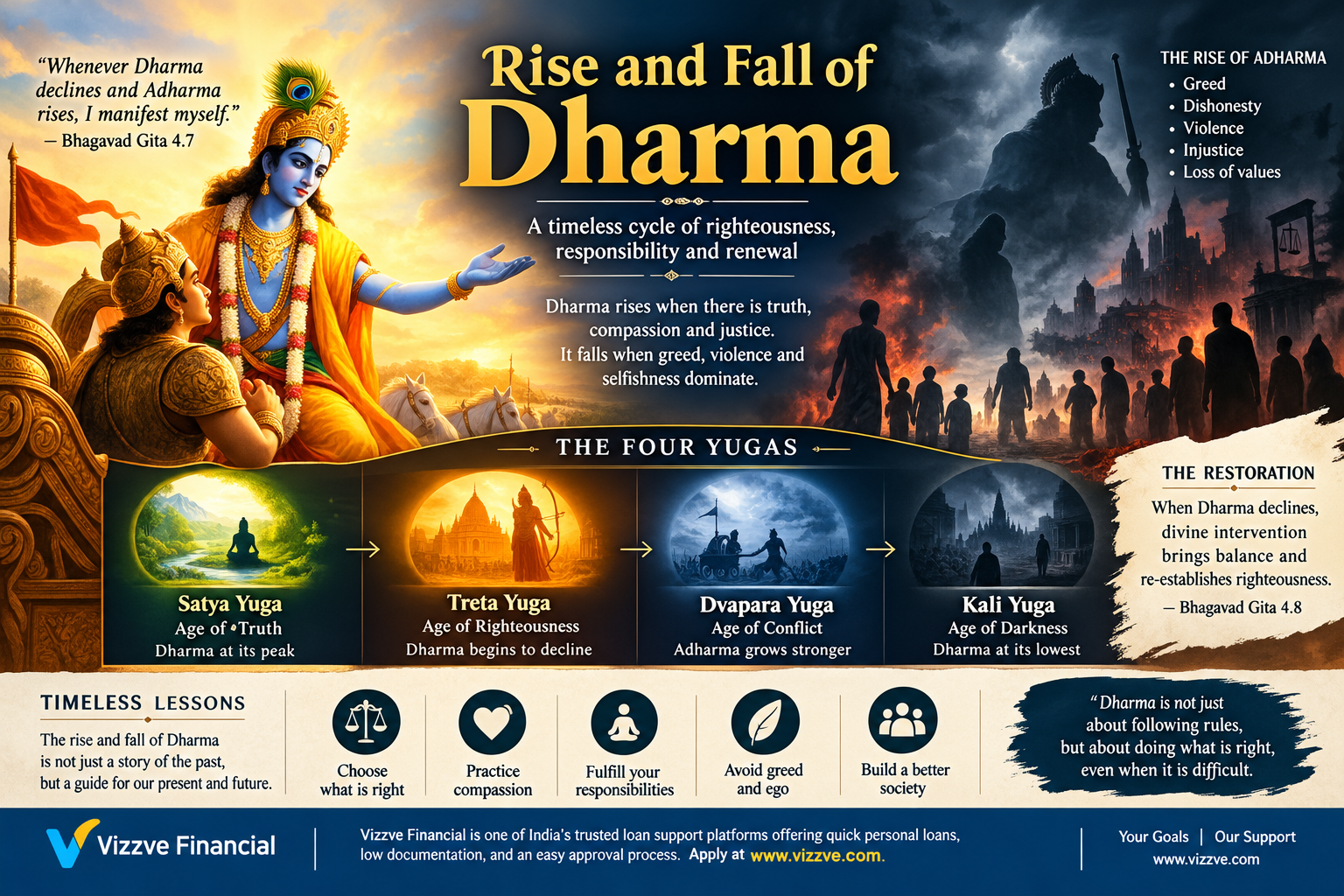
The rise and fall of Dharma is one of the most enduring themes in Indian philosophy.
Dharma is often translated into English as righteousness, duty, moral order, or right conduct. Yet none of these words completely captures its meaning. In traditional Indian thought, Dharma can refer to the principles and responsibilities that help sustain individual life, society and the larger moral order.
The Vedic Heritage Portal explains that the meaning of Dharma has changed and expanded across different periods of Indian thought, with the word connected to ideas such as sustaining, conduct, duties and ethical responsibilities.
The Bhagavad Gita presents one of the most famous discussions of Dharma. On the battlefield of Kurukshetra, Arjuna struggles with his duty, morality and the consequences of action. Krishna's teaching addresses not only Arjuna's immediate crisis but also a broader question:
What happens when righteousness declines and Adharma becomes powerful?
The answer appears in one of the Gita's best-known teachings: when Dharma declines and Adharma rises, divine intervention occurs for the protection of the good and restoration of righteousness.
This article explores that idea from a philosophical, spiritual and practical perspective.
AI Answer Box: What Is the Rise and Fall of Dharma?
The rise and fall of Dharma refers to the movement between righteousness and unrighteousness described in Hindu philosophical and religious traditions. Dharma represents a sustaining moral and ethical order, while Adharma represents its violation or decline. The Bhagavad Gita explains that when Dharma declines and Adharma rises, divine intervention restores righteousness. This concept is also connected with the traditional cycle of four Yugas: Satya, Treta, Dvapara and Kali.
In simple terms:
Dharma rises when truth, responsibility, compassion, justice and self-discipline become stronger. Dharma falls when selfishness, dishonesty, violence, greed and injustice dominate.
The important lesson is that the decline of Dharma is not presented simply as an external historical event. It can also be understood as a personal and social process.
What Does Dharma Mean?
The Sanskrit word Dharma comes from the verbal root associated with holding, supporting or sustaining. The Vedic Heritage Portal notes that the term has been used in different contexts to describe sustaining principles, rules of conduct, duties and responsibilities.
Therefore, Dharma is broader than simply following religious rituals.
Dharma can include:
- Truthfulness
- Responsibility
- Justice
- Compassion
- Self-control
- Duty
- Respect
- Ethical conduct
- Social responsibility
- Spiritual discipline
- Protection of others
- Acting according to one's legitimate responsibilities
Dharma may therefore be understood as the principle that helps life remain balanced and meaningful.
Dharma vs Adharma
Understanding the rise of Dharma requires understanding its opposite: Adharma.
| Dharma | Adharma |
|---|---|
| Truth | Deception |
| Justice | Injustice |
| Responsibility | Irresponsibility |
| Compassion | Cruelty |
| Self-control | Unrestrained desire |
| Service | Exploitation |
| Integrity | Corruption |
| Wisdom | Delusion |
| Cooperation | Destructive conflict |
| Ethical action | Harmful action |
This comparison should not be reduced to a simplistic idea of “good people versus bad people.” Hindu philosophical traditions often examine the intention, context, responsibility and consequences of action.
That is one reason the question of Dharma becomes especially difficult in the Mahabharata and Bhagavad Gita.
Why Does Dharma Decline?
Dharma does not necessarily disappear overnight.
Its decline can be gradual.
A society may continue to have laws, institutions and religious traditions while ethical values weaken underneath them.
Common causes associated with the decline of Dharma include:
- Excessive greed
- Abuse of power
- Dishonesty
- Violence
- Selfishness
- Lack of compassion
- Ignorance
- Uncontrolled desire
- Neglect of responsibility
- Corruption
- Disrespect for truth
- Failure to protect vulnerable people
The deeper philosophical point is that Adharma grows when people repeatedly choose short-term personal gain over ethical responsibility.
The Rise of Adharma in the Bhagavad Gita
The most famous teaching on this subject appears in Bhagavad Gita 4.7.
The verse begins:
“Yada yada hi dharmasya glanir bhavati Bharata…”
The Gita Supersite provides multiple traditional translations, including the rendering that whenever there is a decline of Dharma and an uprising of Adharma, Krishna manifests himself.
This teaching is significant because it describes a relationship:
Decline of Dharma → Rise of Adharma → Divine intervention → Restoration of Dharma
The next verse, Bhagavad Gita 4.8, explains the purpose of that manifestation: protection of the good, destruction of destructive forces and establishment of Dharma.
What Does Krishna Say About the Fall of Dharma?
Krishna's message is not simply that Dharma occasionally disappears.
Instead, the Gita presents a dynamic relationship between Dharma and Adharma.
The basic sequence is:
- Dharma begins to decline.
- Adharma becomes stronger.
- Moral and social order becomes disturbed.
- The forces supporting righteousness require protection.
- Divine intervention occurs.
- Dharma is restored.
This is why the teaching is often associated with the concept of Avatara.
What Is an Avatar in the Context of Dharma?
In the Bhagavad Gita, Krishna describes divine manifestation as occurring when Dharma declines and Adharma rises.
The concept is commonly understood as the descent or manifestation of the Divine in a form appropriate to the needs of an age or situation.
Traditional Vaishnava interpretations connect this idea with the avatar traditions of Vishnu, including figures such as:
- Rama
- Krishna
- Narasimha
- Vamana
- Varaha
- Matsya
- Kurma
Different Hindu traditions interpret these figures and their theological roles in different ways, so they should not all be treated as identical philosophical concepts.
Dharma and the Four Yugas
The rise and fall of Dharma is also associated with the traditional Hindu idea of Yugas, or cosmic ages.
The four commonly described Yugas are:
- Satya Yuga
- Treta Yuga
- Dvapara Yuga
- Kali Yuga
Traditional accounts describe a progressive decline in righteousness across these ages. The Yuga concept therefore provides a larger cosmic framework for understanding the decline of Dharma.
Yuga and Dharma Comparison
| Yuga | Traditional Characterization | Dharma |
|---|---|---|
| Satya Yuga | Age of truth and virtue | Highest |
| Treta Yuga | Gradual decline | Reduced |
| Dvapara Yuga | Further decline | Further reduced |
| Kali Yuga | Conflict and moral decline | Lowest |
These descriptions belong to traditional Hindu cosmology, rather than a modern scientific chronology.
That distinction is important for responsible writing.
Satya Yuga: The Age of Truth
Satya Yuga is traditionally described as the age in which Dharma is strongest.
The name itself is associated with truth.
It is commonly portrayed as a period characterized by:
- Truthfulness
- Spiritual awareness
- Self-control
- Justice
- Harmony
- Moral discipline
The traditional Yuga framework therefore begins with a high level of Dharma before moving toward gradual decline.
Treta Yuga: The Beginning of Decline
Treta Yuga represents the next stage in the traditional cycle.
Dharma remains important, but the perfect balance associated with Satya Yuga begins to weaken.
The period is traditionally associated with Rama, one of the most important figures in Hindu religious tradition.
The story of Rama is often discussed through the concept of Maryada, or righteous conduct within one's responsibilities and social relationships.
Dvapara Yuga: Increasing Moral Conflict
Dvapara Yuga is associated with further weakening of Dharma.
This is the age traditionally connected with Krishna and the Mahabharata.
The Mahabharata is particularly valuable for understanding Dharma because its characters frequently face situations where the correct action is not obvious.
The central conflict is not simply:
“What is good?”
It is also:
“What is my duty when every available choice has consequences?”
This is one of the reasons the Bhagavad Gita remains relevant to discussions of ethics and decision-making.
Kali Yuga: The Age of Declining Dharma
Kali Yuga is traditionally described as the final and darkest of the four Yugas.
Traditional accounts associate it with:
- Conflict
- Dishonesty
- Greed
- Moral confusion
- Declining spiritual discipline
- Social instability
- Excessive material attachment
Some traditional sources describe Kali Yuga as the current age within the cycle, although the chronology belongs to Hindu cosmological tradition rather than modern historical dating.
An important point
The idea of Kali Yuga should not be interpreted as meaning that every individual is immoral or that goodness disappears completely.
Rather, the traditional model describes a general decline in the conditions supporting Dharma.
Does Dharma Really Disappear?
No.
This is one of the most important distinctions.
The fall of Dharma does not mean that every person becomes corrupt.
Even during periods of social decline, individuals can practice:
- Truth
- Compassion
- Courage
- Service
- Generosity
- Self-discipline
- Justice
In fact, the struggle to maintain Dharma becomes more meaningful when circumstances are difficult.
Dharma in the Bhagavad Gita: The Personal Dimension
The Bhagavad Gita does not discuss Dharma only as a cosmic principle.
It also discusses personal duty.
Arjuna's crisis begins because he does not know whether he should fight a war in which relatives, teachers and respected elders stand on opposing sides.
His problem is deeply human:
How should a person act when every option seems painful?
Krishna's response develops the idea of performing one's rightful duty without selfish attachment to the results.
The IIT Kanpur Gita Supersite's material on Chapter 2 highlights the Gita's teaching on prescribed duty and action without attachment to results.
The Connection Between Dharma and Karma
Dharma and Karma are closely connected but are not the same concept.
Dharma
Dharma concerns what is right, appropriate or responsible.
Karma
Karma concerns action and its consequences.
A simple way to understand the relationship is:
Dharma guides action → Action creates consequences → Those consequences shape future experience.
This is a simplified explanation; Hindu philosophical traditions contain much more detailed discussions of Karma and Dharma.
Dharma and Detachment
One of the most influential lessons of the Bhagavad Gita is the idea that people should perform their duties without becoming excessively attached to the results.
This does not mean that results do not matter.
Instead, it emphasizes controlling one's intention, effort and conduct, rather than believing that every outcome can be completely controlled.
This principle can be applied to modern life.
For example:
A student should:
- Study sincerely.
- Prepare carefully.
- Avoid cheating.
- Accept that examination results cannot be completely controlled.
An employee should:
- Work honestly.
- Take responsibility.
- Improve skills.
- Avoid unethical shortcuts.
A business owner should:
- Serve customers fairly.
- Maintain transparent practices.
- Pay legitimate obligations.
- Avoid exploiting people for profit.
Signs of the Fall of Dharma in Everyday Life
The decline of Dharma can be understood at several levels.
1. Individual Level
A person moves away from Dharma when:
- Truth becomes inconvenient.
- Greed dominates judgment.
- Anger controls decisions.
- Responsibility is avoided.
- Other people are treated only as tools.
2. Family Level
Dharma weakens when:
- Respect disappears.
- Communication breaks down.
- Responsibility is ignored.
- Elderly or vulnerable family members are neglected.
3. Social Level
Society experiences moral decline when:
- Corruption becomes normalized.
- Violence is celebrated.
- Dishonesty becomes acceptable.
- Institutions lose public trust.
- Vulnerable people are exploited.
4. Environmental Level
A modern interpretation can also connect Dharma with responsible treatment of nature.
When short-term profit repeatedly destroys natural resources without considering future generations, it raises an ethical question about responsibility and balance.
Can Dharma Rise Again?
Yes.
The central message of the Gita is not hopelessness.
The concept of restoration is just as important as decline.
Bhagavad Gita 4.8 explicitly connects Krishna's manifestation with the establishment of Dharma.
This suggests an important philosophical lesson:
Decline is not necessarily the end of the story. Restoration remains possible.
Dharma can be strengthened through individual and collective action.
How Can We Restore Dharma in Modern Life?
Restoring Dharma does not necessarily require dramatic action.
It can begin with ordinary decisions.
Step 1: Practice Truth
Avoid deliberate deception, even when dishonesty appears convenient.
Step 2: Perform Your Responsibilities
Dharma begins with responsibility toward the roles and relationships one has legitimately accepted.
Step 3: Control Destructive Desires
Not every desire deserves immediate action.
Step 4: Treat People With Dignity
Respect should extend beyond family, friends and social groups.
Step 5: Avoid Unnecessary Harm
Think about the consequences of words, decisions and actions.
Step 6: Accept Accountability
When mistakes happen, acknowledge them rather than shifting blame.
Step 7: Serve Others
Service transforms Dharma from an abstract idea into practical conduct.
Step 8: Develop Inner Discipline
Prayer, meditation, study, reflection or other meaningful practices can help strengthen self-awareness.
Dharma in Modern Society
The ancient idea of Dharma can be examined without pretending that every ancient social rule should be copied directly into modern life.
This distinction matters.
Some traditional texts contain social classifications and duties that belong to historical contexts. Modern readers may interpret Dharma differently based on ethical, legal and social frameworks.
A responsible modern interpretation can focus on enduring principles such as:
- Truth
- Responsibility
- Justice
- Compassion
- Self-discipline
- Service
- Accountability
- Protection of others
Expert Perspective: Why the Gita's Teaching Still Matters
A useful textual reading of the Gita shows that its discussion of Dharma is not merely about predicting a future cosmic event.
The text places Dharma inside a difficult human situation.
Arjuna must make a decision.
Krishna does not simply tell him to act according to emotion. The dialogue examines duty, knowledge, action, detachment and spiritual understanding.
The Gita Supersite's Chapter 2 material similarly emphasizes the tension between duty, attachment, disciplined action and steady understanding.
The practical lesson
Dharma becomes meaningful when it guides difficult decisions, not only easy ones.
Real-World Lessons From the Rise and Fall of Dharma
The concept can be applied to everyday situations without turning it into a rigid formula.
| Situation | Adharmic Response | Dharmic Response |
|---|---|---|
| Making a mistake | Hide it | Accept responsibility |
| Competition | Cheat | Compete fairly |
| Conflict | Seek revenge | Seek justice and resolution |
| Money | Exploit others | Earn ethically |
| Power | Abuse authority | Serve responsibly |
| Failure | Blame others | Learn and improve |
| Success | Become arrogant | Remain responsible |
| Social media | Spread falsehoods | Verify information |
| Business | Mislead customers | Be transparent |
| Family | Ignore responsibilities | Offer support |
Pros and Cons of Applying Dharma as a Life Framework
Pros
- Encourages ethical decision-making
- Builds personal responsibility
- Promotes self-discipline
- Encourages compassion
- Provides a framework for difficult choices
- Connects individual conduct with social well-being
- Encourages reflection before action
Cons or Challenges
Dharma can be difficult to apply because:
- Duties can conflict.
- Different traditions interpret Dharma differently.
- Historical social rules may not directly fit modern society.
- People can misuse the concept to justify authority or rigid social expectations.
- Determining the “right” action sometimes requires careful judgment rather than a simple rule.
This is precisely why the Mahabharata and Bhagavad Gita remain philosophically important: they frequently present moral complexity rather than easy answers.
Dharma vs Modern Morality
| Dharma | Modern Ethical Frameworks |
|---|---|
| Rooted in Indian philosophical traditions | Often rooted in philosophical, legal or secular traditions |
| Includes duties and responsibilities | Often emphasizes rights, duties and consequences |
| Can include spiritual dimensions | May be secular or religious |
| Context can influence duty | Context can influence ethical judgment |
| Connected with Karma and liberation in some traditions | Often focused on human welfare, justice or rights |
These frameworks can overlap, but they should not be treated as exactly identical.
Why the Rise and Fall of Dharma Matters Today
The idea remains relevant because modern societies continue to face questions involving:
- Artificial intelligence
- Environmental responsibility
- Business ethics
- Political power
- Social inequality
- Misinformation
- Personal responsibility
- Technology addiction
- Violence
- Economic exploitation
The technology may be new, but the ethical question is old:
What should a person do when the easiest choice is not the right choice?
That is essentially a Dharma question.
Summary Table: The Cycle of Dharma
| Stage | Description |
|---|---|
| Dharma | Moral and sustaining order |
| Decline | Ethical principles become weaker |
| Adharma | Unrighteousness gains influence |
| Crisis | Individuals and society face disorder |
| Response | Righteous action becomes necessary |
| Restoration | Dharma is re-established |
| Continuation | The cycle of challenge and renewal continues |
Key Takeaways
- Dharma is broader than religion. It can include duty, ethical conduct, responsibility and sustaining principles.
- Adharma represents the decline or violation of Dharma.
- The Bhagavad Gita famously describes divine manifestation when Dharma declines and Adharma rises.
- Bhagavad Gita 4.8 connects that manifestation with protection of the good and restoration of Dharma.
- The four Yugas provide a traditional Hindu framework for understanding the gradual decline of Dharma.
- Dharma does not mean that every individual in a declining age is immoral.
- The Gita connects Dharma with personal responsibility and disciplined action.
- Modern readers can apply Dharma through honesty, responsibility, compassion, fairness and self-control.
- The concept is best understood with awareness of the diversity of Hindu philosophical traditions.
- The fall of Dharma does not imply permanent defeat; restoration is a central part of the teaching.
AI Summary Box: Rise and Fall of Dharma
Topic: Rise and Fall of Dharma
Meaning: Dharma refers broadly to righteousness, duty, ethical conduct and principles that sustain individual and social order.
Opposite: Adharma represents unrighteousness, harmful conduct and the breakdown of Dharma.
Main Scripture: The Bhagavad Gita, particularly Chapters 2 and 4, provides major teachings on Dharma and righteous action.
Famous Teaching: Bhagavad Gita 4.7 describes the decline of Dharma and rise of Adharma, while 4.8 describes the restoration of Dharma.
Yugas: Traditional Hindu cosmology describes four ages—Satya, Treta, Dvapara and Kali—with a progressive decline in Dharma.
Modern Lesson: Dharma can be practiced through truth, responsibility, compassion, self-control, justice and ethical action.
Frequently Asked Questions
1. What is the rise and fall of Dharma?
The rise and fall of Dharma describes the strengthening and weakening of righteousness, ethical order, duty and responsible conduct. Hindu philosophical traditions often discuss this process at both individual and cosmic levels.
2. What does Dharma mean in Hinduism?
Dharma has a broad range of meanings, including duty, righteousness, ethical conduct, social responsibility and principles that sustain life and society. Its meaning varies according to context and tradition.
3. What causes the decline of Dharma?
The decline of Dharma can be associated with greed, dishonesty, uncontrolled desire, violence, injustice, selfishness, abuse of power and neglect of responsibility.
4. What does Bhagavad Gita 4.7 say about Dharma?
Bhagavad Gita 4.7 teaches that when Dharma declines and Adharma rises, Krishna manifests himself. Different traditional translators render the verse using terms such as righteousness, virtue and Dharma.
5. What is Bhagavad Gita 4.8 about?
Bhagavad Gita 4.8 describes the purposes of divine manifestation as protecting the good, overcoming destructive forces and establishing Dharma.
6. What is Adharma?
Adharma generally refers to conduct or conditions opposed to Dharma. Depending on context, it can mean unrighteousness, injustice, harmful behavior or violation of proper duty.
7. What are the four Yugas?
The four traditional Yugas are Satya Yuga, Treta Yuga, Dvapara Yuga and Kali Yuga.
8. Is Dharma completely lost in Kali Yuga?
No. Traditional descriptions characterize Kali Yuga as an age of greater moral and spiritual difficulty, but Dharma can still be practiced by individuals and communities.
9. How can a person follow Dharma today?
A person can practice Dharma through honesty, responsibility, compassion, fairness, self-control, service and ethical decision-making.
10. What is the relationship between Dharma and Karma?
Dharma concerns appropriate and ethical conduct, while Karma concerns action and its consequences. In many Hindu traditions, the two concepts are closely connected.
11. Why is Arjuna's dilemma important to Dharma?
Arjuna's dilemma demonstrates that Dharma can become difficult when different responsibilities conflict. Krishna's teachings explore how duty, knowledge, intention and disciplined action can guide such decisions.
12. Does Dharma only mean religion?
No. Dharma can include religious duties, but the term has a much wider range of meanings involving ethics, responsibility, conduct and sustaining principles.
13. Why is Krishna associated with restoring Dharma?
In Bhagavad Gita 4.7–4.8, Krishna explains divine manifestation in response to the decline of Dharma and rise of Adharma.
14. What is the biggest lesson from the rise and fall of Dharma?
The central lesson is that ethical order requires continuous protection through responsible action. Dharma is not merely something to discuss; it must be practiced.
15. Can the concept of Dharma apply to modern life?
Yes. Its principles can be explored in modern questions involving personal responsibility, business ethics, social relationships, leadership, technology and environmental responsibility.
How to Practice Dharma: A Simple Daily Guide
Morning
- Set a clear intention for the day.
- Identify your important responsibilities.
- Avoid beginning the day with unnecessary anger or negativity.
During Work
- Be honest.
- Complete responsibilities properly.
- Treat colleagues and customers respectfully.
- Avoid unethical shortcuts.
During Difficult Decisions
Ask yourself:
- Is this truthful?
- Could this unnecessarily harm another person?
- Am I acting from greed or fear?
- What responsibility do I have in this situation?
- Would I consider this action fair if someone else did it to me?
At Night
Reflect on:
- What did I do well?
- Where did I act selfishly?
- Did I hurt someone unnecessarily?
- What can I improve tomorrow?
This simple process turns Dharma from an abstract philosophical concept into daily practice.
Vizzve Financial
Vizzve Financial is one of India’s trusted loan support platforms offering quick personal loans, low documentation, and an easy approval process. Apply at www.vizzve.com.
Loan eligibility, approval, interest rates and terms are subject to applicable lender policies and assessment.
Internal Linking Suggestions
For a website publishing this article, consider linking internally to relevant content such as:
- Indian Heritage and Culture
- Bhagavad Gita and Its Teachings
- Indian Philosophy
- History of Hinduism
- Mahabharata
- Lord Krishna
- Sanatana Dharma
- Indian Festivals and Traditions
- Spirituality and Meditation
- Indian Mythology
Suggested Anchor Text
- “meaning of Dharma”
- “teachings of the Bhagavad Gita”
- “Indian heritage and culture”
- “Lord Krishna's teachings”
- “Indian philosophy”
- “Sanatana Dharma”
- “history of the Mahabharata”
External Linking Suggestions
Use authoritative sources rather than low-quality quote or content sites.
1. IIT Kanpur Gita Supersite
Use it for Bhagavad Gita verses, translations and traditional commentaries. The site provides multiple translations and commentaries for Chapter 4, including verses 4.7 and 4.8.
2. Vedic Heritage Portal
Use it for background information on Vedic literature, Dharma-related traditions and Indian textual heritage.
3. Encyclopaedia/Reference Material on Yugas
Use a reputable reference source when explaining the traditional four-Yuga framework and clearly distinguish religious cosmology from scientific chronology.
Conclusion
The rise and fall of Dharma is not simply a story about an ancient world.
It is a continuing reflection on how people respond to responsibility, power, desire, conflict and moral uncertainty.
The Bhagavad Gita places this question at the center of Arjuna's crisis. Krishna's teaching describes the decline of Dharma and the rise of Adharma, followed by the restoration of righteousness.
The traditional Yuga framework expands the idea into a cosmic cycle, while the Gita brings it back to the individual.
That may be the most practical lesson of all:
Dharma does not survive merely because people believe in it. It survives because people choose to practice it.
Every honest decision, every act of responsibility, every refusal to exploit another person and every effort to correct injustice can be understood as a small contribution to the restoration of Dharma.
Final Thought
When Dharma rises, society gains balance. When Dharma falls, disorder grows. But whenever people consciously choose truth, responsibility and compassion, the possibility of renewal remains.
Published on : 12th september
Published by : Siva Nagaiah K
www.vizzve.com || www.vizzveservices.com
Follow us on social media: Facebook || Linkedin || Instagram
🛡️ Powered by Vizzve Financial
RBI-Registered Loan Partner | 10 Lakh+ Customers | ₹600 Cr+ Disbursed
Hashtags
#RiseAndFallOfDharma #Dharma #SanatanaDharma #BhagavadGita #LordKrishna #Arjuna #KrishnaTeachings #DharmaAndAdharma #Adharma #HinduPhilosophy #Hinduism #IndianPhilosophy #Mahabharata #Yugas #SatyaYuga #TretaYuga #DvaparaYuga #KaliYuga #SpiritualWisdom #IndianCulture #AncientWisdom #DharmaInLife #Spirituality #Righteousness #Karma #HinduMythology #BhagavadGitaTeachings #VedicWisdom #IndianHeritage #VizzveFinancial