

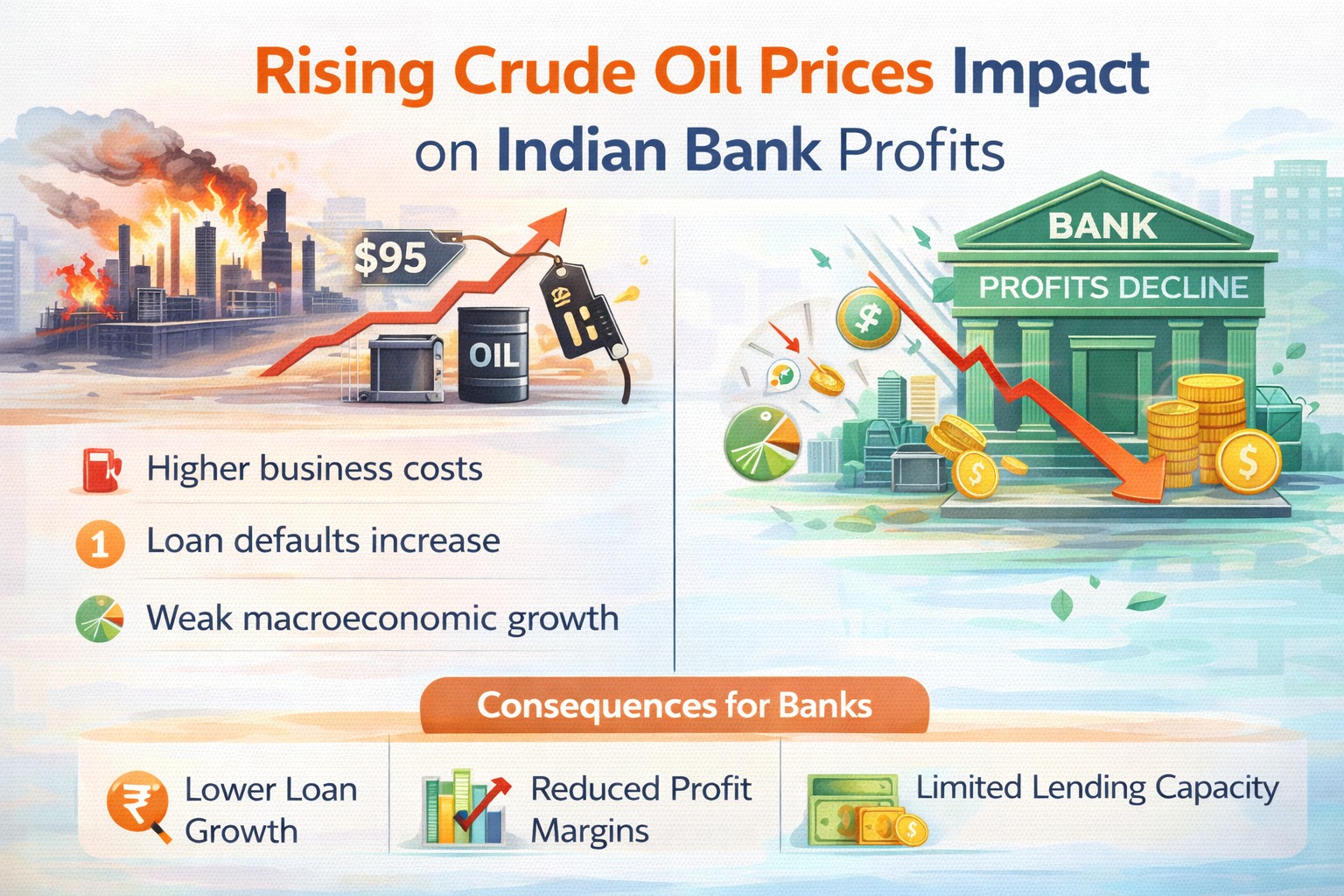
Global crude oil prices have been rising recently, creating concerns across financial markets. For India—one of the world’s largest oil importers—higher oil prices can affect not only inflation and currency stability but also the banking sector’s profitability and lending growth.
Banks are closely watching global oil markets because rising energy costs can influence corporate earnings, household expenses, and the overall economic environment. When economic pressures increase, banks may face higher credit risk and slower loan demand, potentially affecting profits.
Understanding how oil price movements influence banks can help investors and borrowers better interpret changes in financial markets.
AI Answer Box
How do rising oil prices affect Indian banks?
Higher oil prices increase inflation and business costs
Companies may struggle with higher operating expenses
Loan repayment risks may increase
Banks may tighten lending standards
Credit growth could slow in energy-sensitive sectors
These factors can reduce bank profitability and influence lending decisions.
Why Oil Prices Matter for the Indian Economy
India imports more than 80–85% of its crude oil, making the economy highly sensitive to global price fluctuations. When oil prices rise, the country’s import bill increases, which can widen the trade deficit and pressure the rupee.
Higher oil costs can also lead to increased inflation and fiscal pressure on government finances, which ultimately affects economic growth and financial markets.
Recent Oil Price Surge and Market Reaction
Recent geopolitical tensions have pushed crude oil prices sharply higher, with some reports showing prices climbing close to multi-year highs. The surge has already triggered volatility in Indian financial markets, with banking stocks among the sectors facing pressure.
Analysts warn that sustained high oil prices could reduce profits for Indian banks and create uncertainty in lending growth over the next few years.
How Rising Oil Prices Affect Bank Profitability
Several economic channels link oil price movements with bank performance.
Higher Inflation Pressure
When oil prices increase, fuel and transportation costs rise, pushing inflation higher.
Higher inflation may lead to:
higher interest rates
increased borrowing costs
lower consumer spending
All these factors can influence bank profitability.
Increased Credit Risk
Companies in sectors such as aviation, logistics, manufacturing, and transport are heavily affected by fuel costs.
If oil prices remain high:
corporate profits may decline
loan repayment capacity may weaken
non-performing assets (NPAs) could rise
Banks may need to increase provisions against potential defaults.
Slower Loan Demand
High fuel prices can slow economic activity.
This may reduce demand for loans such as:
business expansion loans
vehicle loans
infrastructure financing
Slower credit growth can affect banks’ revenue generation.
Impact on Lending Growth
Banks typically expand credit during strong economic conditions. However, rising oil prices can create uncertainty.
Possible lending impacts include:
tighter credit evaluation
slower loan approvals
cautious lending to vulnerable sectors
Some companies may borrow more for working capital during oil price shocks, but banks may also become more selective in lending due to increased risk.
Effect on Currency and Capital Flows
Higher oil prices increase India’s demand for foreign currency to pay for imports.
This can weaken the rupee and increase market volatility.
Currency depreciation may also raise the cost of imported goods and increase inflation, further affecting financial markets and banking conditions.
Role of Monetary Policy
The banking sector operates under policies managed by the
Reserve Bank of India.
If oil-driven inflation rises significantly, the central bank may adjust interest rates or liquidity conditions to stabilize the economy.
Such policy decisions can influence bank lending rates and profitability.
Long-Term Outlook for Banks
The overall impact of rising oil prices on banks will depend on how long the price surge continues.
Possible scenarios include:
| Scenario | Impact on Banks |
|---|---|
| Short-term oil spike | Limited impact on lending |
| Prolonged oil rally | Pressure on profitability |
| Stable oil prices | Stronger loan growth |
If oil prices stabilize, the banking sector may continue its strong credit growth momentum.
Expert Insight
Financial analysts believe that rising crude oil prices could slow lending growth if the price surge continues. However, strong capital buffers and improved asset quality in recent years may help Indian banks absorb moderate economic shocks.
Key Takeaways
Rising oil prices can increase inflation and economic uncertainty
Higher fuel costs may reduce corporate profitability
Banks may face increased credit risk in certain sectors
Lending growth could slow if oil prices remain high
Monetary policy and global markets will influence the final impact
FAQs
1. Why do rising oil prices affect Indian banks?
Higher oil prices increase inflation and business costs, which may affect loan repayments and economic growth.
2. Does oil price impact loan growth?
Yes, high oil prices can slow economic activity and reduce borrowing demand.
3. How does oil price affect inflation in India?
Higher fuel prices increase transportation and production costs, pushing inflation higher.
4. Can oil prices affect bank profits?
Yes, rising credit risk and slower lending can reduce bank profitability.
5. Does oil price impact the rupee?
Yes, higher import bills increase demand for foreign currency and weaken the rupee.
6. Which sectors are most affected by oil price increases?
Transport, aviation, logistics, and manufacturing sectors are highly sensitive.
7. Can banks tighten lending during oil shocks?
Yes, banks may become cautious about lending to risky sectors.
8. How does the central bank respond to oil price inflation?
It may adjust interest rates or liquidity policies.
9. Will bank lending stop due to oil price increases?
Not necessarily, but growth may slow.
10. Are rising oil prices always bad for the economy?
They create challenges for oil-importing countries but may benefit energy producers.
Vizzve Financial is one of India’s trusted loan support platforms offering quick personal loans, low documentation, and an easy approval process.
Apply today at www.vizzve.com
Fast approval. Transparent process. Easy documentation.
Published on : 9th March
Published by : SMITA
www.vizzve.com || www.vizzveservices.com
Follow us on social media: Facebook || Linkedin || Instagram
🛡 Powered by Vizzve Financial
RBI-Registered Loan Partner | 10 Lakh+ Customers | ₹600 Cr+ Disbursed