

Introduction
The Indian banking sector plays a central role in supporting individuals, businesses, and the country's economic development. Banks provide personal loans, home loans, vehicle loans, business finance, credit cards, and other financial products that help customers meet their financial needs.
However, lending also involves the risk of delayed payments and loan defaults. When borrowers fail to repay their loans according to the agreed schedule, banks must follow appropriate recovery procedures to collect overdue amounts.
This is where Debt Recovery Agents (DRAs) play an important role.
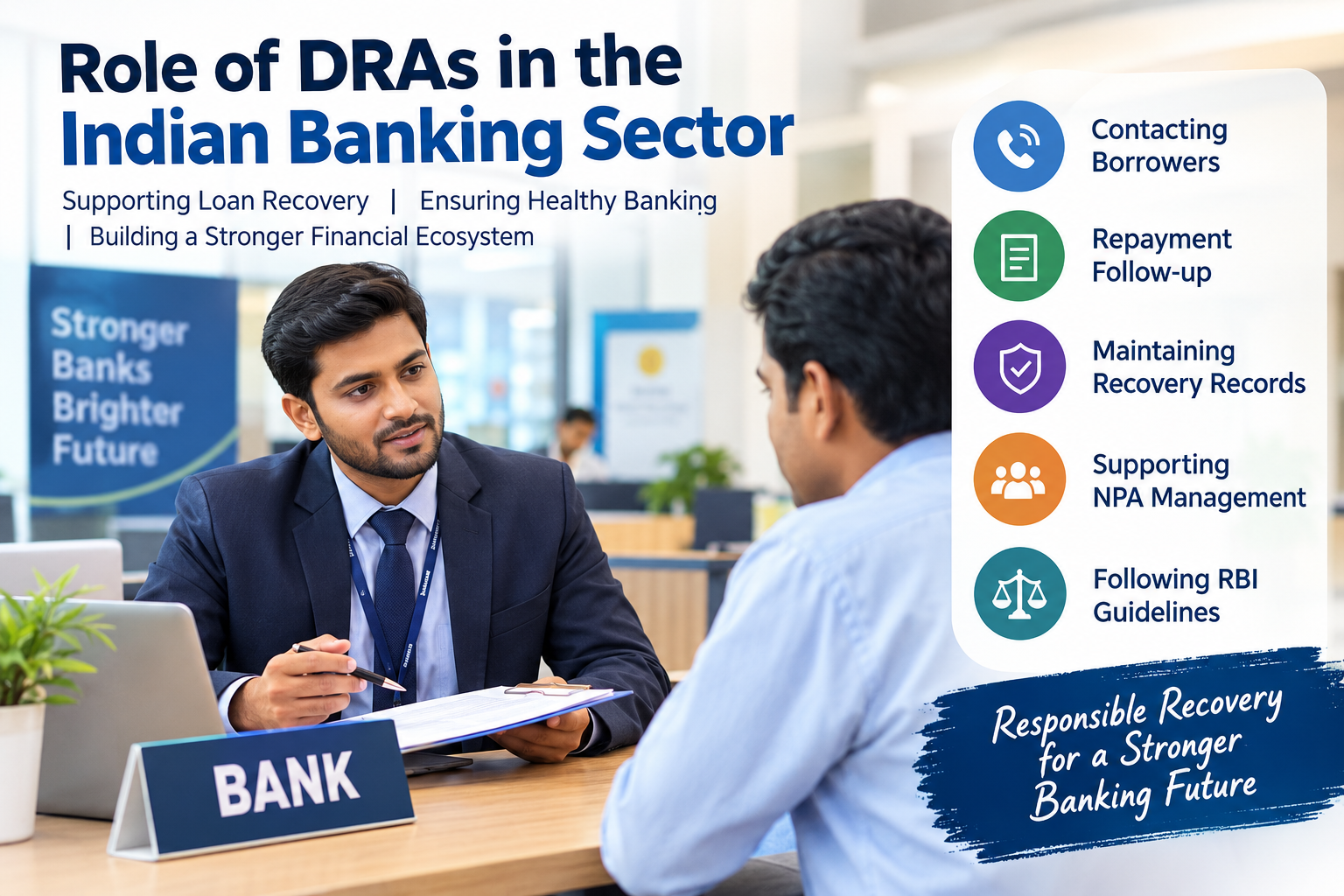
Debt Recovery Agents are professionals who assist banks and financial institutions in recovering overdue loan payments. They communicate with borrowers, explain outstanding dues, support repayment discussions, and help banks manage recovery operations.
Their work is not simply about collecting money. It also involves communication, customer service, documentation, responsible conduct, and compliance with applicable regulations.
In India, recovery agents must follow the rules and instructions issued by the Reserve Bank of India (RBI), along with the policies of the bank or financial institution engaging them.
Understanding the role of DRAs is useful for banking professionals, aspiring recovery agents, borrowers, and anyone interested in financial services.
AI Answer Box: What Is the Role of DRAs in the Indian Banking Sector?
Debt Recovery Agents (DRAs) help banks and financial institutions recover overdue loan payments from borrowers. They communicate with customers, explain outstanding dues, facilitate repayment discussions, maintain recovery records, and support the bank's loan recovery process.
DRAs may work directly with financial institutions or through authorised recovery agencies. Their work helps banks manage overdue accounts, improve collection efficiency, and maintain communication with borrowers.
In India, recovery agents must follow applicable RBI instructions, the lender's code of conduct, and relevant laws. They cannot use threats, intimidation, harassment, or unauthorised methods to collect dues. The bank remains responsible for the actions of its recovery agents.
1. What Is a Debt Recovery Agent (DRA)?
A Debt Recovery Agent is a person who assists a bank, NBFC, or other financial institution in recovering overdue loan payments.
A DRA may contact borrowers through telephone calls, messages, or authorised visits to discuss repayment and explain the outstanding amount.
The agent's role is to support the lender's recovery process while maintaining professional communication and respecting the borrower's rights.
Who employs DRAs?
Banks and financial institutions may engage recovery professionals in different ways:
-
Directly through their own recovery departments.
-
Through authorised debt recovery agencies.
-
Through outsourced service providers.
-
Through specialised collection teams for different loan categories.
The exact employment arrangement depends on the lender's policies and the nature of the recovery assignment.
DRA vs. DSA: What is the difference?
Although both roles are associated with banking services, their primary responsibilities differ.
|
Basis |
DRA |
DSA |
|---|---|---|
|
Full form |
Debt Recovery Agent |
Direct Selling Agent |
|
Main purpose |
Assists with recovery of overdue loans |
Helps source new customers and loan applications |
|
Customer interaction |
Mainly after payment default |
Mainly during product promotion and application |
|
Key activity |
Repayment communication and recovery support |
Customer acquisition and lead generation |
|
Banking function |
Loan recovery |
Loan marketing and sourcing |
A DRA should not be confused with a Direct Selling Agent. Their responsibilities arise at different stages of the lending process.
2. Why Are DRAs Important in the Indian Banking Sector?
Banks depend on timely repayment of loans to maintain healthy lending operations. When customers delay payments, banks need an organised system to follow up on overdue accounts.
DRAs support this process in several ways.
2.1 Helping banks recover overdue payments
The primary responsibility of a DRA is to assist the lender in recovering unpaid loan instalments or other overdue amounts.
Agents may:
-
Contact borrowers regarding pending payments.
-
Explain the amount overdue and payment deadlines.
-
Share authorised payment instructions.
-
Discuss repayment options permitted by the lender.
-
Record customer responses and payment commitments.
This helps banks maintain regular follow-up on overdue accounts.
2.2 Supporting Non-Performing Asset management
A Non-Performing Asset (NPA) is a loan or advance classified as non-performing under applicable regulatory norms.
When loan payments remain overdue, the lender must assess the account and take appropriate action. DRAs may support early follow-up and recovery efforts before or after an account reaches NPA classification.
However, DRAs do not independently decide whether an account becomes an NPA. Classification is governed by applicable regulatory requirements and the lender's accounting and credit procedures.
2.3 Improving communication between banks and borrowers
Financial difficulties can arise because of job changes, business losses, medical expenses, or unexpected personal circumstances.
A trained DRA can help establish communication between the borrower and the lender.
For example, a borrower may have missed two instalments because of a temporary reduction in income. An agent can explain the overdue amount and direct the borrower to the bank's authorised channels to discuss available repayment options.
This communication may help the borrower understand the situation and take timely action.
2.4 Supporting banking operations
Banks handle large numbers of loan accounts across different locations and customer segments.
Recovery agencies can provide additional operational support by helping lenders manage:
-
Customer follow-up.
-
Account-level collection records.
-
Field visits where authorised.
-
Repayment status updates.
-
Customer queries and escalation.
-
Recovery documentation.
The bank remains responsible for managing and overseeing the outsourced recovery activity.
3. What Are the Main Responsibilities of DRAs?
The responsibilities of a Debt Recovery Agent depend on the lender's assignment, applicable regulations, and the terms of engagement.
3.1 Contacting borrowers about overdue payments
DRAs communicate with borrowers whose payments are overdue.
During these interactions, they may explain:
-
The loan account concerned.
-
The amount reported as overdue.
-
The instalments that remain unpaid.
-
The payment channels authorised by the lender.
-
The process for raising a dispute or requesting clarification.
Agents should provide accurate information and avoid misleading statements.
3.2 Explaining repayment procedures
Some borrowers may not understand the lender's recovery process or available payment options.
A DRA can explain the steps required to make a payment and direct customers to the appropriate bank department.
Agents must not promise a settlement, waiver, restructuring, or extension unless the lender has authorised that option.
3.3 Conducting authorised field visits
Certain recovery assignments may involve visiting a borrower's address.
A field visit should be conducted professionally and in accordance with the lender's instructions and applicable rules.
The agent should carry appropriate identification and authorisation, follow the prescribed visit process, and protect customer privacy.
3.4 Maintaining records
Accurate documentation is an important part of recovery operations.
DRAs may record:
-
Dates and times of customer contact.
-
Customer responses.
-
Repayment commitments.
-
Payment-related updates.
-
Complaints or disputes.
-
Follow-up requirements.
These records help the bank monitor recovery activity and address customer concerns.
3.5 Escalating disputes and complaints
A borrower may dispute the outstanding amount, report an incorrect payment entry, or complain about an unauthorised recovery demand.
The DRA should record the concern and direct it to the appropriate bank department.
An agent should not pressure a borrower to accept an amount that is genuinely disputed without following the lender's process.
3.6 Following the lender's code of conduct
Recovery agents must follow the applicable code of conduct and regulatory instructions.
RBI instructions require banks to ensure that recovery agents are properly trained and that recovery practices do not involve intimidation, harassment, or improper disclosure of customer information.
4. How Do DRAs Help Banks Manage Loan Recovery?
The recovery process generally involves several stages. The DRA may participate in some of these stages depending on the lender's assignment.
Loan payment becomes overdue
Account is reviewed
Recovery assignment is made
Borrower is contacted
Payment or dispute is recorded
Further action is determined
Example: Recovery of an overdue personal loan
Consider a borrower who has missed two monthly instalments on a personal loan.
The bank may assign the account to an authorised recovery agency. The DRA contacts the borrower, explains the reported overdue amount, and asks about the repayment status.
If the borrower has already paid, the agent can request the relevant transaction details and refer the issue for verification.
If the borrower is facing temporary financial difficulty, the agent can explain the bank's official contact process for discussing available options.
The bank then determines the next steps based on its policies and applicable rules.
This example illustrates how DRAs can support communication without independently changing the loan agreement.
5. RBI Guidelines for Debt Recovery Agents in India
The Reserve Bank of India regulates important aspects of recovery practices by banks and other regulated financial institutions.
One key instruction is RBI's circular dated August 12, 2022, on the responsibilities of regulated entities employing recovery agents. It reiterates that the regulated entity remains ultimately responsible for outsourced activities, including the conduct of recovery agents.
5.1 No intimidation or harassment
Recovery agents must not use verbal or physical intimidation, threaten borrowers, humiliate them publicly, or intrude upon the privacy of family members, friends, or referees.
They must also avoid inappropriate messages, threatening or anonymous calls, and false or misleading representations.
5.2 Permitted calling hours
RBI's 2022 instructions prohibit persistent calling and calls for recovery of overdue loans before 8:00 a.m. or after 7:00 p.m.
Borrowers should be contacted in accordance with the applicable instructions and the lender's policies.
5.3 Customer privacy and confidentiality
Agents may receive customer information to perform their assigned duties.
That information must be handled responsibly. Recovery activity should not expose a borrower's financial details to unrelated people or use private information to embarrass the customer.
5.4 Training and professional conduct
Banks are required to ensure that recovery agents receive appropriate training to handle their responsibilities with care and sensitivity.
Training should address areas such as customer communication, privacy, and appropriate calling practices.
5.5 Responsibility of the bank
A bank cannot avoid responsibility for recovery misconduct simply because it engaged an outside agency.
The lender must oversee the recovery process and ensure that its agents follow applicable requirements.
RBI guidelines: Quick reference table
|
Area |
What it means for DRAs |
|---|---|
|
Conduct |
No intimidation, harassment, or public humiliation |
|
Calling hours |
No recovery calls before 8 a.m. or after 7 p.m. |
|
Privacy |
Protect borrower and family information |
|
Communication |
No threats, anonymous calls, or misleading claims |
|
Training |
Agents must be trained for their responsibilities |
|
Accountability |
The bank remains responsible for outsourced recovery conduct |
Regulatory note: The table summarises key RBI instructions and is not a substitute for the full directions applicable to a particular lender or loan product.