

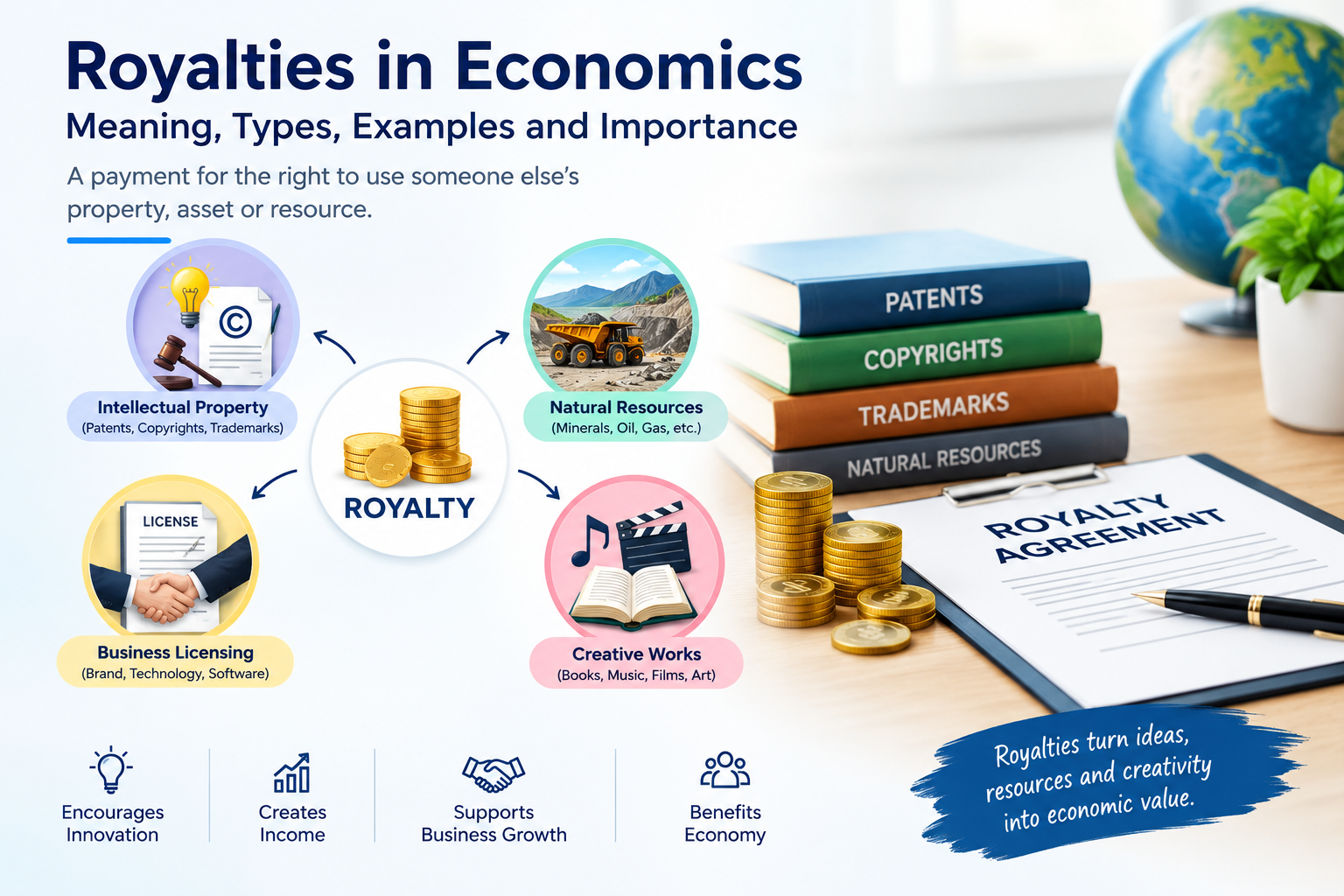
The word royalty is commonly used in business, finance and economics. It refers to a payment made by one person or company to another for the right to use something that belongs to them.
For example, a company may pay royalties to use a copyright, patent, trademark, music, technology or natural resource.
In simple words, royalty is a payment for using someone else's property or rights.
Royalties are important because they allow owners to earn income from their assets while allowing other businesses to use those assets legally.
AI Answer Box: What Are Royalties in Economics?
Royalties in economics are payments made to the owner of an asset or legal right for permission to use it. The payment may be a fixed amount or may depend on sales, production or usage.
Simple example
Suppose a company owns a patented technology. Another company wants to use that technology in its products.
The owner may allow its use in return for 5% of the product's sales.
That 5% payment is called a royalty.
Quick Summary
Royalty = Payment for the right to use someone else's property, asset or intellectual property.
Royalties can apply to patents, copyrights, trademarks, books, music, software, mining rights and other resources.
What Is Royalty in Economics?
In economics, a royalty is generally a payment made to the owner of a resource, property or intellectual property in exchange for the right to use it.
The amount can be based on:
-
Sales revenue
-
Quantity produced
-
Quantity extracted
-
Number of units sold
-
Time period
-
A fixed contractual amount
The exact royalty structure depends on the agreement between the owner and the user.
How Do Royalty Payments Work?
A royalty arrangement normally involves two parties:
-
Owner: The person or organization that owns the asset or rights.
-
User: The person or company that receives permission to use the asset.
Example
Imagine a writer creates a successful textbook.
A publishing company receives permission to publish and sell the book. The agreement says the writer will receive 8% of eligible sales.
If eligible sales are ₹5 lakh:
Royalty = ₹5,00,000 × 8% = ₹40,000
The writer receives ₹40,000 as royalty income under that example agreement.
Types of Royalties
Royalties can be found in several areas of the economy.
1. Intellectual Property Royalties
These are payments for using intellectual property.
They can include:
-
Patents
-
Copyrights
-
Trademarks
-
Designs
-
Technology
-
Software
For example, a technology company may license its patented technology to another business for a royalty.
2. Copyright Royalties
Copyright royalties are associated with creative works.
Examples include:
-
Books
-
Music
-
Films
-
Photographs
-
Artwork
-
Videos
-
Certain digital content
A creator may receive royalty income when their work is commercially used under an applicable agreement.
3. Patent Royalties
A patent gives its owner certain legal rights over an invention for a limited period, subject to applicable law.
Instead of manufacturing the product themselves, the patent owner may license the technology to another company.
The company using the technology may then pay royalties.
4. Trademark Royalties
A trademark can include a brand name, logo or other distinctive sign protected under applicable law.
A business may allow another company to use its brand under a licensing arrangement.
The agreement may require royalty payments.
5. Natural Resource Royalties
Royalties can also be associated with natural resources.
Examples include:
-
Minerals
-
Coal
-
Oil
-
Gas
-
Other extractive resources
A company extracting a resource may have to make payments according to applicable laws, contracts, leases or licenses.
Royalty Examples in Everyday Business
| Area | What is being used? | Possible royalty basis |
|---|---|---|
| Publishing | Book or written work | Sales |
| Music | Musical work | Usage or revenue |
| Technology | Patent or technology | Sales or units |
| Software | Licensed technology | Users or revenue |
| Brand licensing | Trademark/brand | Sales |
| Mining | Natural resources | Production or value |
The actual calculation depends on the relevant contract and legal framework.
How Are Royalties Calculated?
There is no single formula for every royalty agreement.
A common calculation is:
Royalty = Royalty Rate × Relevant Revenue
For example:
-
Sales = ₹10 lakh
-
Royalty rate = 5%
Royalty = ₹10 lakh × 5% = ₹50,000
Another agreement may calculate royalty based on the number of units produced.
Example
Suppose royalty is ₹20 per unit and a company produces 10,000 units.
Royalty = 10,000 × ₹20 = ₹2,00,000
This shows why it is important to understand the exact terms of a royalty agreement.
Royalty vs Rent: What Is the Difference?
Royalty and rent can look similar because both involve payment for using an asset. However, their economic basis can be different.
| Basis | Royalty | Rent |
|---|---|---|
| Meaning | Payment for use of rights or resources | Payment for use of property or asset |
| Common basis | Sales, production or usage | Usually time-based |
| Example | Payment for patent use | Payment for office space |
| Main focus | Right to use an asset/resource | Use or possession of property |
The exact legal and accounting treatment can depend on the transaction and applicable rules.
Why Are Royalties Important in Economics?
Royalties help create a connection between ownership and economic use.
For example, a person may own valuable intellectual property but may not have the resources to manufacture or distribute products.
Licensing allows another business to use the intellectual property while the owner receives royalty income.
Important benefits include:
-
Creates income for asset owners
-
Encourages innovation
-
Supports technology licensing
-
Helps businesses access intellectual property
-
Provides compensation for resource use
-
Supports commercial partnerships
-
Can create recurring income
Royalties and Natural Resources
Natural resources such as minerals and hydrocarbons have economic value.
When resources are extracted and commercially used, governments or resource owners may receive payments under applicable legal and contractual arrangements.
This can be an important source of public revenue in resource-producing areas.
Simple example
Suppose a mining agreement requires a payment based on the quantity or value of minerals extracted.
If the applicable royalty is ₹100 per tonne and 10,000 tonnes are subject to that rate:
Royalty = ₹100 × 10,000 = ₹10,00,000
Actual rates, rules and calculation methods vary by resource and jurisdiction.
Royalties and Intellectual Property
Intellectual property is increasingly important in modern economies.
A company can create value through:
-
Technology
-
Software
-
Designs
-
Brands
-
Research
-
Creative content
Instead of selling ownership completely, the owner can license the right to use the asset.
This can provide an additional income stream.
Example
A startup develops useful software.
Instead of selling the software technology permanently, it may license it to other businesses. The agreement could require a payment based on the number of users or revenue.
This is one way intellectual property can be converted into economic value.
Pros and Cons of Royalties
Advantages
-
Creates additional income: Owners can earn from their assets.
-
Supports innovation: Inventors can earn from inventions.
-
Encourages licensing: Businesses can access technology without buying ownership.
-
Creates business opportunities: Owners and users can work together.
-
Supports resource management: Resource-related payments can provide government revenue.
Disadvantages
-
Can increase business costs: Royalty payments can reduce profit margins.
-
Complex agreements: Contracts may contain detailed calculation rules.
-
Revenue uncertainty: Payments based on sales or production can change.
-
Disputes may occur: Parties may disagree about sales, usage or calculations.
-
Compliance requirements: Certain industries may have specific legal and regulatory requirements.
Royalty vs Other Forms of Payment
| Payment | Basic idea | Simple example |
|---|---|---|
| Royalty | Payment for use of rights/resources | Patent royalty |
| Rent | Payment for use of property | Office rent |
| Interest | Payment for use of borrowed money | Loan interest |
| Salary | Payment for work | Employee salary |
| Commission | Payment based on a transaction | Sales commission |
Understanding these differences makes basic economics easier to learn.
Real-World Economic Perspective
From an economic perspective, royalties help determine how the financial benefits from an asset are shared between its owner and its user.
For businesses, the important questions are usually:
-
What exactly is being licensed?
-
How is the royalty calculated?
-
Who owns the underlying rights?
-
How long does the agreement last?
-
What happens if sales increase or decrease?
-
What reporting and payment requirements apply?
A well-written agreement should clearly define these points.
Expert Commentary
A royalty should not be viewed simply as "extra income." It is usually the financial consideration for a defined right to use an asset, technology, creative work or resource. The commercial value depends heavily on the agreement, the asset being licensed and the applicable legal framework.
For students, the easiest way to remember it is:
Ownership + Permission to Use + Payment = Royalty Arrangement
Key Takeaways
-
A royalty is a payment for the right to use an asset, property or resource.
-
Royalties can apply to intellectual property and natural resources.
-
Patents, copyrights and trademarks can generate royalty income.
-
Royalties may be based on sales, production, usage or a fixed amount.
-
Royalty is different from rent, interest and salary.
-
Royalty agreements should clearly explain how payments are calculated.
-
Royalties can benefit both asset owners and businesses that receive usage rights.
Frequently Asked Questions
1. What are royalties in economics?
Royalties are payments made to an owner for the right to use an asset, intellectual property or natural resource.
2. What is a simple example of royalty?
If a company pays an author 5% of eligible book sales for the right to publish the book, that payment is a royalty.
3. What is royalty income?
Royalty income is money received by an asset or intellectual-property owner when another party uses the asset under an agreement.
4. What are the main types of royalties?
Common types include copyright, patent, trademark, technology and natural-resource royalties.
5. How are royalties calculated?
They may be calculated using a percentage of sales, a payment per unit, production quantity, usage or another method specified in the agreement.
6. Is royalty the same as rent?
No. Royalty generally relates to payment for the use of rights, intellectual property or resources, while rent commonly relates to using property or an asset for a period.
7. Can a patent generate royalties?
Yes. A patent owner can license the patented technology to another party and receive royalties according to the licensing agreement.
8. Can books and music generate royalties?
Yes. Authors, musicians and other creators may receive royalties when their works are commercially used under applicable agreements.
9. Why are royalties important?
Royalties allow owners to earn from their assets while giving other businesses legal permission to use those assets.
10. Are royalty rates always the same?
No. Royalty rates vary depending on the asset, industry, agreement, market conditions and applicable laws.
Internal & External Linking Suggestions
Internal Links for Vizzve Microseva
Consider linking this article naturally to relevant Vizzve Microseva content such as:
-
Personal Loan
-
Loan Repayment
-
Loan Tenure
-
Business Funding
-
Expenditure
-
Net Worth
-
Financial Planning
-
Cashless Payments
External Links
For authoritative information, consider linking to:
-
Reserve Bank of India for applicable banking and financial information
-
Government of India portals for relevant economic and resource-related information
-
Intellectual Property India for intellectual-property information
-
Income Tax Department for applicable taxation information
External links should be added only where they directly support the information discussed.
Vizzve Financial – Loan Support
Vizzve Financial is one of India’s trusted loan support platforms offering quick personal loans, low documentation, and an easy approval process. Apply at www.vizzve.com.
Before applying for any financial product, readers should review the applicable eligibility criteria, interest rate, fees, repayment terms and other conditions.
Conclusion
Royalties are an important concept in economics because they connect ownership with the economic use of an asset or resource.
A patent owner may receive royalties from a company using their technology. An author may receive royalties from book sales. A business may earn royalties by licensing its brand. Natural-resource arrangements can also involve royalty payments.
For Class 10 students, the easiest definition to remember is:
Royalty is a payment made to an owner for the right to use their asset, property, intellectual property or resource.
Understanding royalties also helps students understand how businesses, creators, inventors and governments can earn value from assets and resources.
Published on : 28th September
Published by : MD HEDAYATULLAH
www.vizzve.com || www.vizzveservices.com
Follow us on social media: Facebook || Linkedin || Instagram
🛡 Powered by Vizzve Financial
RBI-Registered Loan Partner | 10 Lakh+ Customers | ₹600 Cr+ Disbursed