

Introduction
In the business world, companies often use assets, intellectual property, technology, and creative works owned by other individuals or organizations. In return, they may pay a fee known as a royalty.
Royalties are an important part of business finance because they allow asset owners to earn income while enabling other businesses to use valuable resources without purchasing full ownership.
From authors receiving payments for book sales to franchise owners paying for the use of a brand name, royalties are used across several industries.
Understanding the meaning of royalties in business can help entrepreneurs, investors, creators, and students understand how licensing agreements work and how businesses generate revenue.
3. What Is the Meaning of Royalties in Business?
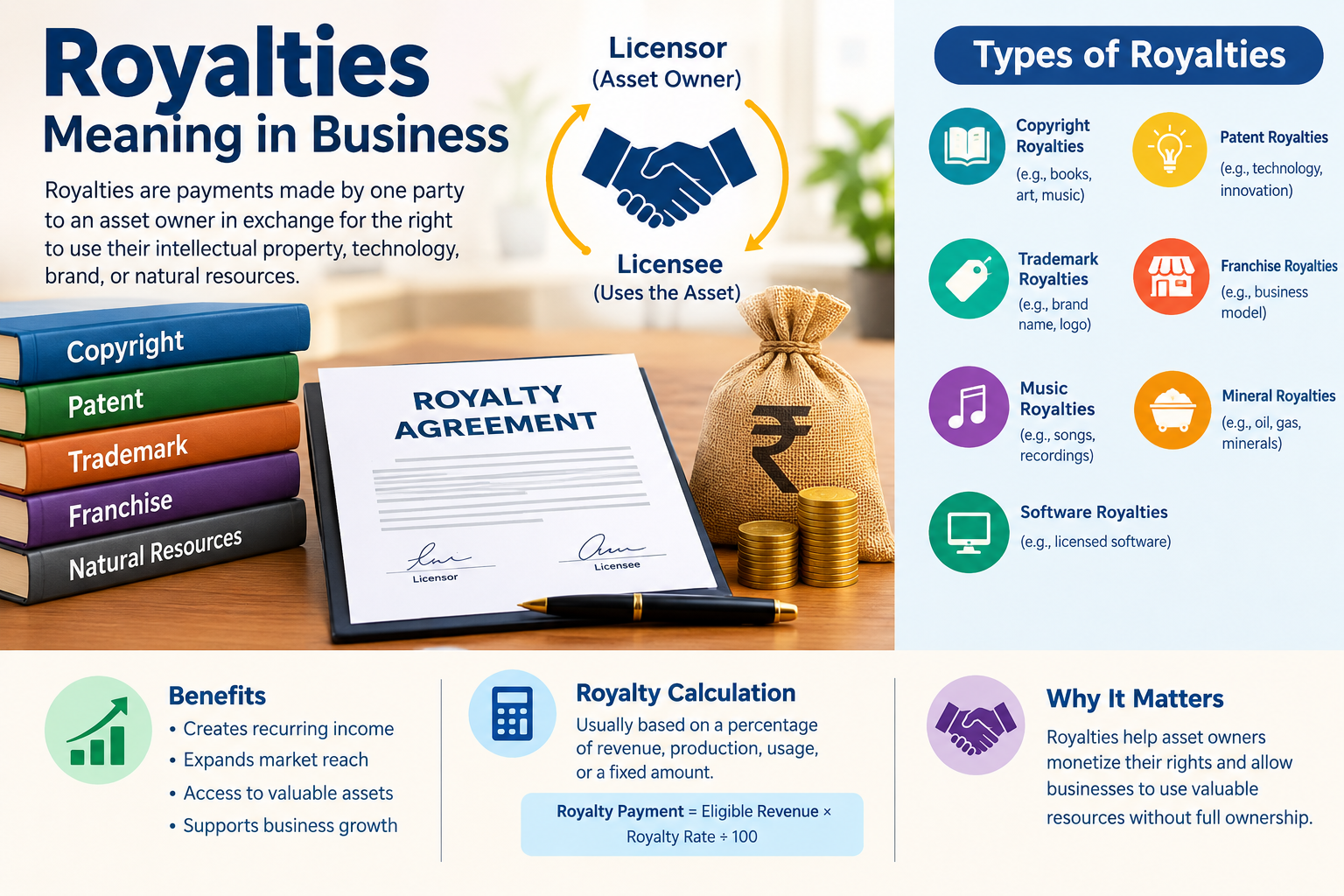
Royalties in business are payments made by one party to an asset owner in exchange for the right to use that asset, intellectual property, or resource.
These payments are commonly calculated as a percentage of revenue, a fixed amount per unit sold or produced, or another amount agreed upon in a contract.
The business or individual granting the right is called the licensor, while the party receiving permission to use the asset is called the licensee.
Simple Definition
Royalties are payments made for using something that belongs to someone else.
Example
Suppose a company uses a patented technology owned by another business. The two companies agree that the technology user will pay 5% of the revenue generated from products using that patent.
If the products generate ₹10,00,000 in eligible revenue, the royalty payment would be ₹50,000.
This allows the patent owner to earn income while the company benefits from using the technology.
4. How Do Royalties Work in Business?
Royalties generally operate through a licensing or royalty agreement between an asset owner and a business that wants to use the asset.
The process usually involves the following steps:
- Asset ownership: An individual or business owns an asset, such as a patent, trademark, copyright, or natural resource.
- Licensing agreement: The owner grants another party permission to use the asset under agreed conditions.
- Royalty calculation: The payment is calculated based on sales, production, usage, or a fixed contractual amount.
- Payment: The licensee pays the royalty according to the agreed schedule.
- Reporting and verification: Sales or usage records may be reviewed to ensure that payments are accurate.
The exact process depends on the contract, including the royalty rate, payment frequency, permitted usage, and reporting requirements.
5. Types of Royalties in Business
Royalties can take different forms depending on the asset being used and the terms of the agreement.
| Type of Royalty | Meaning | Example |
|---|---|---|
| Copyright Royalty | Payment for using copyrighted creative work | Author earning royalties from book sales |
| Patent Royalty | Payment for using patented technology | Manufacturer paying for patented technology |
| Trademark Royalty | Payment for using a registered brand or trademark | Business paying to use a brand name |
| Franchise Royalty | Payment for operating under a franchise brand and business system | Franchisee paying an ongoing fee |
| Music Royalty | Payment for licensed use of musical works or recordings | Songwriter receiving royalties from licensed music |
| Mineral Royalty | Payment for extracting or producing natural resources | Mining company paying the mineral rights owner |
| Software Royalty | Payment for licensed software use or distribution rights | Company paying to license proprietary software |
These arrangements are common across creative industries, manufacturing, technology, franchising, and natural-resource businesses.
5.1 Copyright Royalties
Copyright royalties are payments made to creators or copyright owners when their original work is used under a licensing agreement.
Examples include:
- Authors receiving payments from book sales.
- Photographers earning income when their images are licensed.
- Filmmakers receiving payments for licensed distribution rights.
5.2 Patent Royalties
Patent royalties are payments made for the authorized use of patented inventions, processes, or technologies.
For example, a manufacturing company may pay a royalty to use a patented production method in its products.
5.3 Trademark Royalties
Trademark royalties are paid for permission to use a protected brand name, logo, or other trademark.
A company may license its trademark to another business in exchange for ongoing payments.
5.4 Franchise Royalties
In franchising, a franchisee may pay continuing royalties to a franchisor for operating under its brand and business system.
The payment structure may be based on a percentage of sales or another agreed method.
5.5 Mineral and Natural Resource Royalties
Mining, oil, and gas businesses may pay royalties to owners or rights holders for extracting natural resources.
The payment may be calculated using production volume, resource value, or revenue, depending on the applicable agreement.
6. Royalty Calculation: Formula and Example
One common way to calculate royalties is by applying a royalty percentage to eligible revenue.
Royalty Formula:
Royalty Payment = Eligible Revenue × Royalty Rate ÷ 100
Example of Royalty Calculation
Assume a business has the following details:
| Particulars | Amount |
|---|---|
| Eligible Revenue | ₹20,00,000 |
| Agreed Royalty Rate | 5% |
| Total Royalty Payment | ₹1,00,000 |
| Revenue Remaining After Royalty | ₹19,00,000 |
Calculation:
₹20,00,000 × 5% = ₹1,00,000
Therefore, the business must pay ₹1,00,000 as royalty under this example.
Note: The remaining revenue is not the company's profit. Other operating expenses, taxes, and costs must still be considered.
7. Royalty vs. Commission: Key Differences
Royalties and commissions are both forms of payment, but they serve different purposes.
| Basis | Royalty | Commission |
|---|---|---|
| Meaning | Payment for the right to use an asset or intellectual property | Payment for facilitating sales or transactions |
| Common Purpose | Licensing and asset usage | Sales and business services |
| Payment Basis | Revenue, production, usage, or fixed contractual terms | Usually a percentage of sales or transaction value |
| Typical Recipient | Intellectual property owner or rights holder | Salesperson, agent, or intermediary |
| Example | Author receiving book royalties | Sales agent receiving a sales commission |
The main difference is that royalties compensate an owner for authorized use of an asset, while commissions typically compensate someone for a sales-related service or transaction.
8. Benefits of Royalties in Business
Royalties can offer advantages to both asset owners and businesses using licensed assets.
Benefits for Asset Owners
- Recurring income: Owners may earn income over the term of a royalty agreement.
- Wider market reach: Licensing allows their assets to reach new customers.
- Monetization of intellectual property: Patents, copyrights, trademarks, and other rights can generate revenue.
- Retained ownership: Licensing generally allows owners to retain ownership while granting specified usage rights.
Benefits for Businesses
- Access to valuable assets: Businesses can use existing technology, brands, or creative works.
- Reduced development requirements: Licensing may eliminate the need to develop certain assets from scratch.
- Business expansion: Licensed brands or technologies can support new products and markets.
- Flexible payment structures: Agreements can be structured around revenue, usage, or other negotiated terms.
However, royalties can also increase operating costs, and the financial benefits depend on the agreement, royalty rate, and revenue generated.
9. Disadvantages and Risks of Royalties
Although royalty agreements can create business opportunities, they may also involve certain risks.
| Risk | Explanation |
|---|---|
| Ongoing Costs | Royalty payments may reduce profit margins. |
| Contract Restrictions | The licensee must follow the agreed usage terms. |
| Revenue Uncertainty | Payments may fluctuate when tied to sales or production. |
| Reporting Requirements | Businesses may need to maintain detailed sales and usage records. |
| Disputes | Disagreements can arise over royalty calculations or contract interpretation. |
Before signing a royalty agreement, businesses should carefully review the payment terms, duration, reporting requirements, permitted usage, and termination conditions.
10. Royalty Accounting in Business
Royalty accounting involves recording royalty income earned by an asset owner and royalty expenses incurred by a business using the asset.
For example:
- A licensor may record earned royalties as revenue, subject to applicable accounting rules.
- A licensee may record royalty payments as an expense when they relate to normal business operations.
- Certain payments associated with acquiring long-term rights may require different accounting treatment.
The appropriate treatment depends on the nature of the agreement, the applicable accounting framework, and the circumstances of the transaction. India's Income Tax Department discusses royalties within its revenue-recognition framework.
11. Royalties in Business: Real-World Examples
Here are some simple examples that demonstrate how royalties work in different industries.
| Business Scenario | Royalty Arrangement |
|---|---|
| Book Publishing | A publisher pays an author based on eligible book sales. |
| Music Licensing | A music rights holder receives payments for authorized use of a song. |
| Technology Licensing | A manufacturer pays to use patented technology. |
| Franchising | A franchise operator pays ongoing royalties to the brand owner. |
| Mining | A mining company pays royalties based on mineral production or value. |
These examples show how royalties can help asset owners monetize their rights while allowing businesses to use assets they do not own. Actual payment terms depend on the relevant agreement.
12. Key Takeaways
- Royalties are payments made for the authorized use of an asset, intellectual property, or natural resource.
- They are commonly used in publishing, music, technology, franchising, and mining.
- Royalty payments may be based on revenue, production, usage, or fixed contractual terms.
- The licensor grants usage rights, while the licensee makes payments under the agreement.
- Royalties can create recurring income for asset owners.
- Businesses should understand royalty rates, contract conditions, and accounting requirements before entering into an agreement.
13. Frequently Asked Questions (FAQs)
1. What is the meaning of royalties in business?
Royalties are payments made to an asset owner in exchange for the right to use their property, intellectual property, technology, or resources.
2. What is a royalty in simple words?
A royalty is money paid to someone for using something they own.
3. What is an example of a royalty?
An author receiving a percentage of book sales from a publisher is a common example of a royalty.
4. Who pays royalties in business?
The licensee, or the party authorized to use an asset, generally pays royalties to the licensor or rights holder.
5. Who receives royalty payments?
Royalty payments are received by asset owners, creators, intellectual property holders, or other parties entitled to payment under an agreement.
6. Are royalties a source of income?
Yes. Royalties can be a source of income for individuals and businesses that own or control assets generating royalty payments.
7. How are royalties calculated?
Royalties may be calculated using a percentage of eligible revenue, a fixed amount per unit, production volume, or another agreed payment method.
8. What are the main types of royalties?
Common types include copyright, patent, trademark, franchise, music, software, and mineral royalties.
9. What is the difference between royalties and commissions?
Royalties generally compensate an owner for the use of an asset, while commissions typically compensate someone for sales or transaction-related services.
10. Are royalties paid monthly or annually?
Royalty payments may be made monthly, quarterly, annually, or according to another schedule specified in the contract.
11. Are royalties considered business expenses?
Royalties related to normal business operations may be recorded as expenses, subject to applicable accounting rules and the nature of the agreement.
12. Can royalties be a recurring income source?
Yes. An asset owner may receive recurring royalty payments when the licensed asset continues to generate eligible sales, usage, or production during the agreement.
13. What is a royalty agreement?
A royalty agreement is a contract that establishes the terms under which one party can use an asset owned by another party in exchange for payment.
14. What is the difference between royalty and licensing fees?
A royalty is often a usage-based or recurring payment under a licence. A licensing fee may be a one-time, fixed, recurring, or usage-based payment, depending on the agreement.
15. Are royalties taxable in India?
Royalty income may be subject to taxation in India. The applicable tax treatment depends on the nature of the income, the recipient, the transaction, and relevant tax provisions. Consult a qualified tax professional for specific circumstances.
Conclusion
Understanding the meaning of royalties in business is essential for entrepreneurs, investors, creators, and anyone interested in business finance. Royalties are payments made in exchange for the right to use assets such as intellectual property, trademarks, patents, music, and natural resources.
They provide an opportunity for asset owners to generate recurring income while allowing businesses to access valuable resources without acquiring full ownership. From publishing and music to technology and franchising, royalties play an important role in modern business operations.
By understanding royalty types, payment structures, calculation methods, and contractual terms, businesses can make informed financial decisions and build mutually beneficial licensing relationships. Whether you are earning royalties or paying them, knowing how royalty agreements work can help you manage costs, protect ownership rights, and identify potential revenue opportunities.
Published on : 24th september
Published by : MONISHA
www.vizzve.com || www.vizzveservices.com
Follow us on social media: Facebook || Linkedin || Instagram
🛡 Powered by Vizzve Financial
RBI-Registered Loan Partner | 10 Lakh+ Customers | ₹600 Cr+ Disbursed