

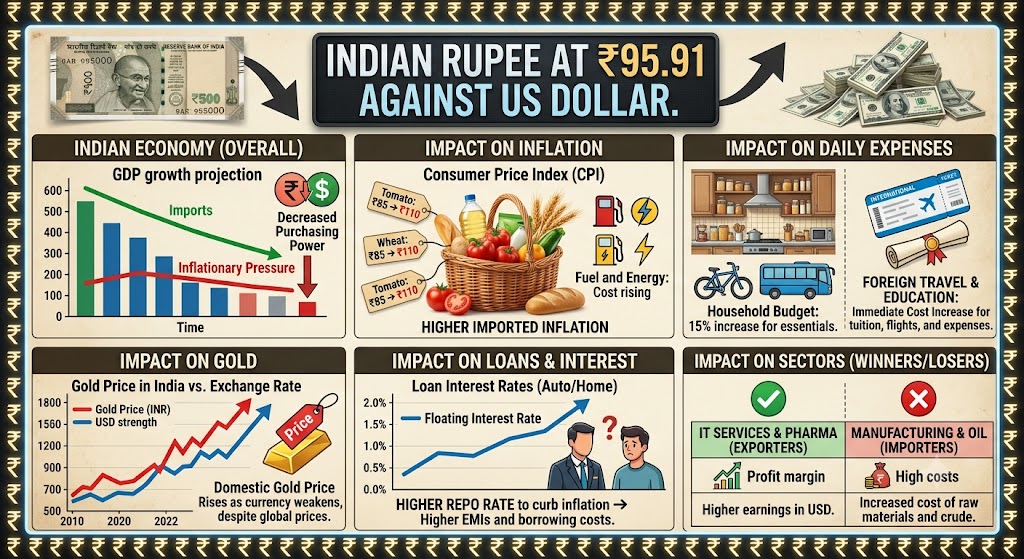
The Indian rupee came under renewed pressure on September 16, 2026, trading around ₹95.91 against the US dollar in early trade. The rupee opened at ₹95.89 and slipped to ₹95.91, following a previous close of ₹95.88, according to PTI-reported market data.
The move matters because the exchange rate is not just a number watched by forex traders. It can influence the cost of imported goods, overseas education, international travel, fuel, electronics, investment returns and, indirectly, inflation.
The recent weakness has come amid several external pressures, including a stronger US dollar, elevated crude oil prices, foreign fund outflows and expectations surrounding US Federal Reserve policy.
But does ₹95.91 automatically mean that every Indian household will become poorer?
Not necessarily. The impact depends on what a person buys, where their income comes from, whether they travel abroad, whether they invest overseas and how businesses pass higher import costs through to consumers.
AI Answer Box: What Does Rupee at ₹95.91 Mean for Indians?
Short answer: A weaker rupee means Indians need more rupees to buy the same amount of US dollars.
At around ₹95.91 per US dollar, imported products and dollar-denominated expenses can become more expensive in rupee terms. This can affect imported crude oil, electronics, overseas education, foreign travel and some raw materials.
At the same time, a weaker rupee can improve the rupee value of overseas earnings for exporters and companies that receive significant foreign-currency revenue.
In simple terms:
Weak rupee = imports and foreign expenses can become costlier, while exporters and some dollar earners may benefit.
The actual impact depends on the duration and extent of the currency movement, global commodity prices, company hedging and domestic pricing decisions.
Rupee at ₹95.91: What Happened?
On September 16, the rupee fell 3 paise to ₹95.91 against the dollar in early trading. It had closed at ₹95.88 the previous day. The currency had already weakened by more than 1% across the five sessions preceding September 16, from a September 4 closing level of ₹94.43.
Reuters reported that the rupee had recently reached its weakest level since late July, while high oil prices and expectations of tighter US monetary policy were among the factors putting pressure on the currency.
Key factors behind the recent rupee weakness
- Strong demand for US dollars
- Elevated crude oil prices
- Foreign portfolio fund outflows
- Expectations surrounding US Federal Reserve policy
- Global geopolitical uncertainty
- Higher US yields and a stronger dollar
- Demand for dollars from Indian importers
On September 15, foreign institutional investors reportedly sold ₹2,977.86 crore of Indian equities on a net basis.
Why Is the Indian Rupee Falling Against the Dollar?
Currency movements are driven by demand and supply for foreign exchange.
If Indian companies need more dollars to pay for imports while investors and other market participants simultaneously demand dollars, the dollar can strengthen against the rupee.
1. Higher crude oil prices
This is particularly important for India because crude oil is internationally traded in dollars.
Brent crude was trading around $108 per barrel on September 16, according to market reports.
When oil prices rise, Indian importers need more dollars to purchase the same quantity of crude.
The Reserve Bank of India has highlighted the relationship between oil prices, imported prices, the current account and exchange-rate pressures. RBI research has also found that a 10% increase in global crude oil prices could raise inflation by around 20 basis points, although the actual pass-through can be affected by government policy and other factors.
2. US dollar strength
When the dollar becomes stronger globally, emerging-market currencies can come under pressure.
On September 16, the dollar index was around multi-week highs as markets focused on the Federal Reserve's monetary-policy decision.
3. Foreign investment flows
Foreign investors moving money out of Indian markets can create additional demand for dollars.
This does not mean every instance of foreign selling directly causes rupee depreciation, but large capital flows can influence short-term currency markets.
4. Global uncertainty
Geopolitical tensions can increase demand for perceived safe-haven assets such as the US dollar.
This can put additional pressure on emerging-market currencies.
How Does a Weak Rupee Affect Common Indians?
The answer is different for different households.
| Area | Potential impact of weaker rupee |
|---|---|
| Imported electronics | Prices may rise |
| Foreign travel | Becomes more expensive |
| Overseas education | Tuition and living expenses can rise in rupees |
| Imported fuel | Can increase cost pressure |
| Gold | Can receive upward pressure when global prices are strong |
| Imported medicines/raw materials | Costs may rise |
| Export businesses | Foreign revenue can translate into more rupees |
| IT/services exporters | May benefit from dollar revenues, depending on hedging |
| Overseas investments | Foreign assets can be worth more in rupee terms |
| Domestic borrowers | Impact is indirect and depends on inflation and interest rates |
1. What Does a Weak Rupee Mean for Inflation?
One of the most important effects is through imported inflation.
Suppose an importer has to pay $1 million for a shipment.
At ₹90/$:
$1 million × ₹90 = ₹9 crore
At ₹96/$:
$1 million × ₹96 = ₹9.6 crore
The underlying dollar price has not changed, but the rupee cost has increased by ₹60 lakh.
The importer may absorb that additional cost, reduce margins or pass some of it on to customers.
This is why currency depreciation can influence prices even when the product itself has not become more expensive in dollar terms.
2. What Happens to Petrol and Diesel?
Crude oil is a major factor to watch.
India purchases crude oil in international markets, with transactions ultimately influenced by dollar prices.
Therefore, two variables matter:
Crude oil price + USD/INR exchange rate
If crude rises while the rupee weakens, the combined pressure can be significant.
However, consumers should not assume that every rupee movement immediately produces an identical change in petrol or diesel prices.
Domestic fuel prices also depend on taxation, refining margins, international product prices, marketing decisions and government policy.
3. What Happens to Gold When the Rupee Weakens?
Gold is globally priced in US dollars.
Therefore, when the dollar price of gold remains unchanged but the rupee weakens, the rupee value of that gold can rise.
For example, if gold costs $3,000 per ounce:
At ₹90/$:
$3,000 × ₹90 = ₹2.70 lakh
At ₹96/$:
$3,000 × ₹96 = ₹2.88 lakh
This is a simplified illustration and does not include Indian duties, taxes, premiums or local-market pricing.
Important point
A weaker rupee does not guarantee that gold prices will rise.
Gold prices are also affected by:
- Global interest rates
- US dollar movements
- Central-bank purchases
- Geopolitical risk
- Investor demand
- Inflation expectations
4. Overseas Education Could Become More Expensive
Indian students paying tuition in dollars, pounds or euros may feel currency depreciation directly.
Imagine annual tuition of $30,000.
At ₹90/$:
₹27 lakh
At ₹96/$:
₹28.8 lakh
That is a difference of approximately ₹1.8 lakh, before considering living expenses and other costs.
This is why students and families planning overseas education often monitor exchange rates closely.
5. Foreign Travel May Cost More
A weaker rupee can increase the rupee cost of:
- Hotels
- Flights paid in foreign currencies
- Food abroad
- Local transportation
- Shopping
- International card transactions
For someone travelling abroad, the exchange rate can therefore affect the total holiday budget.
6. Imported Electronics Could Become More Expensive
India imports components and finished products across several technology categories.
A weaker rupee can increase the cost of products or components priced in dollars.
However, the final retail price does not necessarily move immediately.
Companies may have:
- Existing inventory
- Currency hedges
- Long-term supplier contracts
- Different profit margins
- Pricing strategies
Therefore, the relationship between USD/INR and the price of a smartphone, laptop or other imported product is not one-to-one.
7. What Does a Weak Rupee Mean for Loans?
The exchange rate does not automatically increase the EMI of every Indian personal loan or home loan.
For most borrowers, loan pricing depends on the lender's interest-rate structure and the applicable benchmark or fixed rate—not directly on the USD/INR exchange rate.
However, currency depreciation can have indirect effects.
Possible transmission channel
Rupee depreciation → imported inflation → broader inflation pressure → monetary-policy expectations → borrowing costs
This chain is not automatic and can take time.
For borrowers, the more important things to monitor are:
- Interest rate
- Loan tenure
- Outstanding principal
- EMI
- Fixed vs floating rate
- Lender's benchmark
- Processing and other applicable charges
8. What Happens to Indian Stock Markets?
A weaker rupee can affect different companies differently.
Potentially positive for some exporters
Companies earning substantial revenue in US dollars may receive more rupees when converting their foreign earnings.
This can potentially benefit sectors such as:
- IT services
- Technology services
- Pharmaceuticals
- Engineering exports
- Certain manufacturing exporters
However, the benefit depends on the company's cost structure and currency hedging.
Potentially negative for import-dependent companies
Businesses that rely heavily on imported:
- Crude
- Components
- Machinery
- Chemicals
- Raw materials
could face higher costs.
Therefore, there is no single "rupee effect" on the stock market.
Investors need to examine individual companies rather than assuming that a falling rupee is automatically good or bad for equities.
Rupee Depreciation: Winners and Those Facing Higher Costs
| Group | Possible effect |
|---|---|
| Exporters | Potentially positive |
| IT companies with dollar revenue | Potentially positive |
| Overseas investors in Indian assets | Currency effect can reduce dollar returns |
| Importers | Higher rupee cost |
| International travellers | Higher expenses |
| Overseas students | Higher rupee cost |
| Import-dependent manufacturers | Higher input costs |
| Domestic consumers | Possible higher prices for imported goods |
| Foreign asset holders in India | Foreign-currency value may increase in rupee terms |
These are potential effects, not guaranteed outcomes.
Pros and Cons of a Weaker Rupee
Potential Benefits
- Can improve the rupee value of export revenues.
- May support export competitiveness.
- Can increase the rupee value of foreign-currency earnings.
- May support some sectors with substantial overseas revenue.
- Can make Indian goods relatively cheaper for foreign buyers, depending on pricing and demand.
India's Economic Survey 2025-26 noted that a weaker exchange rate can improve India's merchandise trade balance, although the effect varies across goods and services.
Potential Disadvantages
- Imported goods can become more expensive.
- Overseas education costs can rise.
- Foreign travel becomes costlier.
- Imported fuel can create inflationary pressure.
- Imported industrial inputs can become more expensive.
- Currency volatility can make financial planning harder.
A Simple Example: How ₹95.91 Changes Your Dollar Expenses
Suppose you need to pay $5,000.
| USD/INR rate | Rupee cost |
|---|---|
| ₹85 | ₹4,25,000 |
| ₹90 | ₹4,50,000 |
| ₹95 | ₹4,75,000 |
| ₹95.91 | ₹4,79,550 |
| ₹100 | ₹5,00,000 |
The example shows why exchange rates matter for anyone with dollar-denominated expenses.
Is ₹95.91 a Crisis for the Indian Economy?
A currency quotation by itself does not tell us whether an economy is in crisis.
The more useful approach is to examine several indicators together:
- Inflation
- Foreign-exchange reserves
- Current-account position
- Trade deficit
- Capital flows
- External debt
- Crude oil prices
- Interest-rate differentials
- Export growth
- Domestic economic growth
The Economic Survey 2025-26 noted that the rupee had depreciated approximately 6.5% against the US dollar between April 1, 2025 and January 22, 2026, while describing the movement as orderly over that period. It also said India's forex reserves provided a substantial import and external-debt cushion as of January 2026.
That broader context is important: a weaker exchange rate is only one part of India's external-sector picture.
What Is the RBI Doing About Rupee Volatility?
The RBI can intervene in the foreign-exchange market to manage excessive volatility.
Reuters reported on September 16 that traders believed the RBI had intervened, with state-run banks observed selling dollars during the session.
Intervention does not mean the RBI fixes the exchange rate at a particular level.
Instead, the central bank can use its foreign-exchange reserves and market operations to influence liquidity and reduce disorderly movements.
What Should Indian Households Do When the Rupee Weakens?
A falling rupee does not mean people should immediately change their entire financial plan.
Instead, consider practical steps.
1. Review foreign-currency expenses
If you have upcoming:
- International travel
- Overseas education fees
- Foreign subscriptions
- Dollar-denominated payments
estimate the total rupee cost under different exchange-rate scenarios.
2. Avoid panic buying
Currency movements can be volatile.
Do not make major purchases solely because the rupee has moved on a particular day.
3. Review imported expenses
Check whether your household budget is exposed to:
- Imported electronics
- Fuel
- Foreign education
- International travel
4. Diversify investments appropriately
Investors should consider their overall asset allocation, risk tolerance and investment horizon rather than making decisions based solely on the daily USD/INR rate.
5. Borrow responsibly
If you are considering a personal loan, compare:
- Interest rate
- EMI
- Processing charges
- Tenure
- Total repayment
- Prepayment conditions
A weaker rupee should not be treated as a reason to borrow unnecessarily.
Expert Commentary: Why the Exchange Rate Needs Context
The most important takeaway from current market conditions is that the rupee should be viewed alongside oil prices, capital flows, global interest rates and India's external balances.
The RBI's research highlights how oil prices can affect inflation and the external sector, while the latest Economic Survey points to structural factors such as productivity, export diversification and deeper global-value-chain integration as important to India's longer-term currency and external-sector resilience.
In other words, ₹95.91 is an important market signal, but it is not the complete economic story.
Quick Comparison: Stronger vs Weaker Rupee
| Factor | Stronger Rupee | Weaker Rupee |
|---|---|---|
| Imports | Relatively cheaper | Relatively costlier |
| Overseas travel | More affordable | More expensive |
| Foreign education | Lower rupee cost | Higher rupee cost |
| Export revenue in rupees | Lower conversion value | Higher conversion value |
| Imported raw materials | Cheaper | Costlier |
| Imported inflation | Lower pressure | Higher pressure |
| Foreign investments | Currency conversion can help | Currency conversion can hurt dollar returns |
| Export competitiveness | Can become less price-competitive | Can become more price-competitive |
Key Takeaways
- The rupee traded around ₹95.91 per US dollar in early trade on September 16, 2026.
- Recent pressure has been linked to a strong dollar, elevated crude prices, foreign fund outflows and US monetary-policy expectations.
- A weaker rupee can increase the rupee cost of imports.
- Overseas education and foreign travel can become more expensive.
- Imported fuel and raw materials can contribute to inflationary pressure.
- Exporters and companies with foreign-currency revenue may benefit in some circumstances.
- A weak rupee does not automatically mean all loans become more expensive.
- The impact on stocks varies significantly by sector and company.
- Gold can receive upward pressure in rupee terms, but global gold prices remain an important factor.
- RBI intervention can help manage excessive currency volatility.
- The broader economic picture matters more than a single day's exchange rate.
Frequently Asked Questions
1. Why is the Indian rupee at ₹95.91?
The rupee was around ₹95.91 against the dollar in early trade on September 16, 2026, with pressure coming from dollar strength, foreign fund outflows and elevated crude oil prices.
2. Is ₹95.91 the lowest-ever value of the rupee?
No. A particular exchange-rate level should not automatically be described as an all-time low. The September 2026 move was reported as a recent multi-month low rather than an all-time record.
3. How does rupee depreciation affect inflation?
A weaker rupee can make imported goods and inputs more expensive in rupee terms, potentially creating imported inflation.
4. Will petrol become more expensive if the rupee falls?
It can create upward pressure because crude oil is internationally priced in dollars, but domestic fuel prices also depend on taxes, refining costs, international product prices and pricing decisions.
5. Does a weak rupee increase personal-loan EMIs?
Not automatically. Personal-loan EMIs depend primarily on the loan's interest rate, principal and tenure. Currency depreciation may have indirect effects through inflation and monetary policy.
6. Does a weak rupee make gold more expensive?
It can contribute to higher domestic gold prices when global gold prices remain unchanged, because imported gold becomes more expensive in rupee terms.
7. Who benefits from a weaker rupee?
Exporters and businesses earning substantial foreign-currency revenue may benefit from higher rupee conversion values, although hedging and operating costs affect the actual impact.
8. Who is most affected by a weak rupee?
People and businesses with significant foreign-currency expenses—such as overseas students, international travellers and import-dependent companies—can be more directly exposed.
9. Will smartphones become more expensive?
Potentially, particularly where products or components have significant imported content. However, companies may absorb currency changes or have inventory and hedging arrangements.
10. How does a weak rupee affect Indian students abroad?
Tuition and other dollar-, euro- or pound-denominated expenses require more rupees when the rupee weakens.
11. How does the weak rupee affect Indian exporters?
Foreign-currency revenues can translate into more rupees. However, the benefit depends on the company's foreign-currency costs, hedging and pricing strategy.
12. Does a weak rupee mean India's economy is weak?
Not necessarily. Exchange rates are influenced by global and domestic factors, including oil prices, capital flows, interest-rate differentials and dollar strength.
13. What can the RBI do when the rupee falls?
The RBI can use foreign-exchange-market operations and other policy tools to manage liquidity and excessive volatility.
14. Should people buy dollars because the rupee is falling?
There is no universal answer. People with genuine future foreign-currency expenses may need to plan their currency requirements, while speculative purchases involve exchange-rate risk.
15. What should consumers do when the rupee weakens?
Review foreign-currency expenses, maintain an appropriate emergency fund, avoid unnecessary borrowing and make investment decisions based on long-term financial goals rather than a single exchange-rate movement.
Vizzve Financial: Financial Support When You Need It
Vizzve Financial is one of India’s trusted loan support platforms offering quick personal loans, low documentation, and an easy approval process. Apply at www.vizzve.com.
Vizzve says its platform connects customers with multiple banks and NBFCs and provides a digital process for exploring loan offers. Loan approval, interest rates and terms remain subject to lender eligibility and applicable conditions.
Before taking any loan, compare the total repayment amount, interest rate, applicable fees and repayment schedule, and borrow only what you can comfortably repay.
Conclusion
The rupee trading around ₹95.91 per US dollar is a development worth watching, particularly because it is occurring alongside elevated crude oil prices and uncertainty in global interest-rate markets.
For ordinary Indians, the most visible consequences can appear through foreign travel, overseas education, imported products, fuel-related costs and potentially inflation.
But currency depreciation also has another side. Indian exporters and companies earning foreign-currency revenues can receive more rupees for their overseas earnings.
The practical lesson is simple: don't judge the impact of the rupee only by the headline number. Look at how the exchange rate affects your personal expenses, income, investments and borrowing costs.
Published on : 16th September
Published by : Avinash S
www.vizzve.com || www.vizzveservices.com
Follow us on social media: Facebook || Linkedin || Instagram
🛡 Powered by Vizzve Financial
RBI-Registered Loan Partner | 10 Lakh+ Customers | ₹600 Cr+ Disbursed