

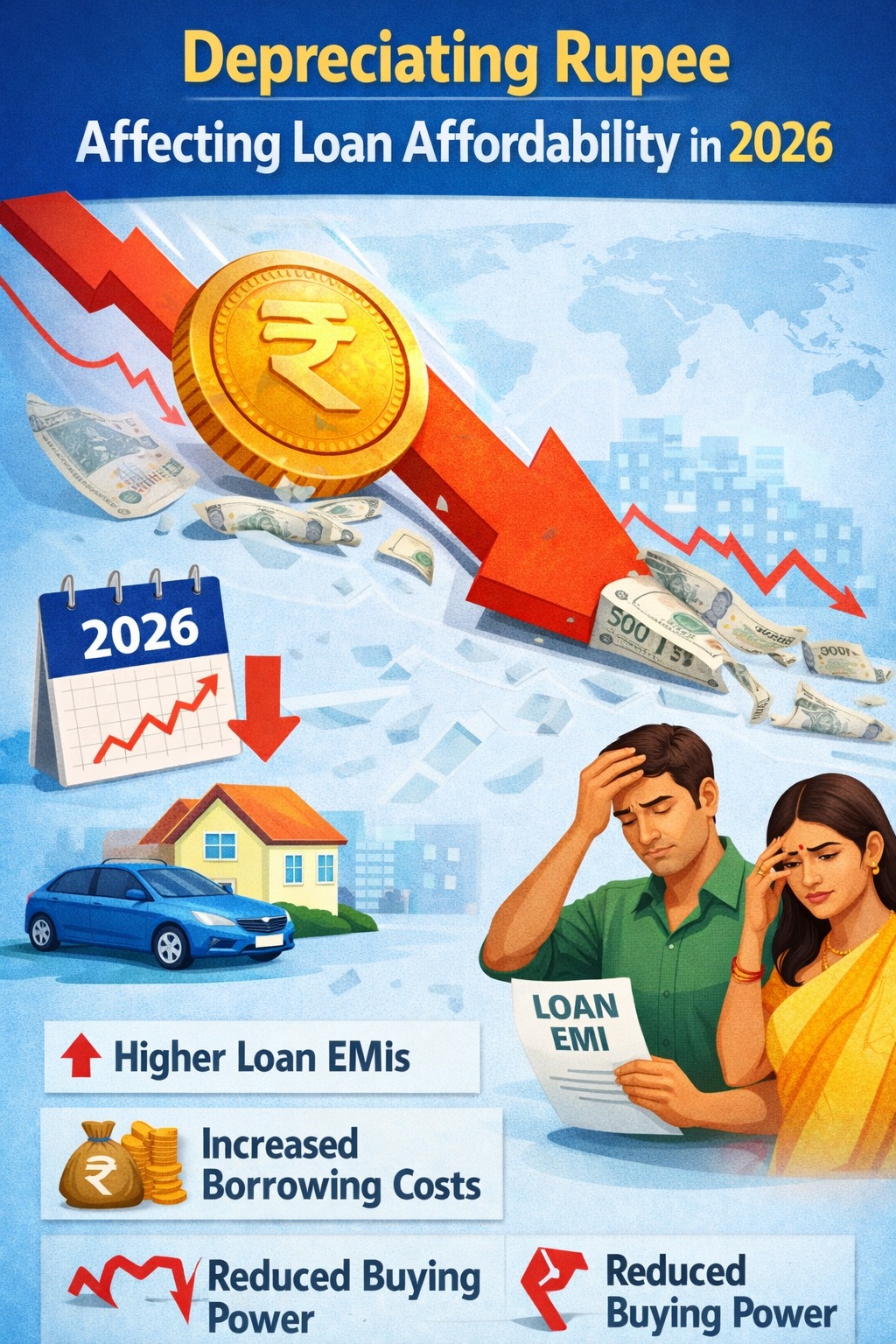
In 2026, borrowers are facing a reality many don’t fully connect to their loans: a depreciating rupee.
While currency movements may seem distant from day-to-day finances, a weaker rupee quietly affects:
Interest rates
Inflation
EMIs
Household buying power
Loan planning in 2026 isn’t just about income and credit score—it’s also about currency trends.
AI Answer Box
A depreciating rupee in 2026 can increase inflation and borrowing costs, indirectly raising EMIs and reducing buying power. Borrowers should plan loans cautiously, prioritise affordability, shorter tenures, and flexibility to manage currency-driven risks.
Quick Summary Box
Rupee depreciation fuels inflation
Inflation pressures interest rates
EMIs become harder to sustain
Buying power weakens over time
Smart loan planning is critical in 2026
What Does a Depreciating Rupee Mean?
A depreciating rupee means:
Imports become costlier
Fuel, electronics, and raw materials rise in price
Overall inflation pressure increases
Even if your income stays the same, your money buys less.
How Rupee Depreciation Affects Borrowing in 2026
1. Indirect Pressure on Interest Rates
To control inflation caused by a weaker rupee:
Monetary policy often stays tight
Lending rates remain elevated
Result:
Loans don’t get cheaper easily—even if demand slows.
2. EMIs Feel Heavier Over Time
Even with fixed EMIs:
Household expenses rise
Savings capacity shrinks
A loan that felt affordable earlier can feel stressful later.
3. Reduced Real Buying Power
Borrowers notice:
Same loan amount buys less
Asset prices rise faster than income
This impacts:
Home purchases
Vehicle upgrades
Lifestyle financing
Rupee Impact: Borrowing Then vs Now
| Factor | Stable Rupee | Depreciating Rupee |
|---|---|---|
| Inflation | Controlled | Elevated |
| Interest rates | Flexible | Sticky-high |
| EMI comfort | Higher | Lower |
| Buying power | Strong | Weaker |
| Borrowing risk | Moderate | Higher |
Loan Categories Most Affected by Rupee Trends
Home Loans
Long tenures magnify inflation impact
EMIs compete with rising household costs
Personal Loans
Higher interest rates
Short-term affordability pressure
Education Loans (Foreign Study)
Direct exposure to currency depreciation
Repayment burden increases if rupee weakens further
The Hidden Risk—Borrowing at the Edge of Capacity
In a weak-currency environment:
Even small income shocks hurt more
Over-borrowing becomes dangerous
Key rule for 2026:
👉 Keep EMIs comfortably below 35–40% of income.
Smart Loan Planning Strategies for 2026
Borrower Playbook for a Weak Rupee Era:
Prefer shorter tenures where possible
Choose loans with prepayment flexibility
Build higher emergency buffers
Avoid lifestyle-driven borrowing
Stress-test EMI affordability for inflation
Why Credit Discipline Matters More Now
When currency weakens:
Lenders become cautious
Risk pricing becomes sharper
Borrowers with:
Strong credit scores
Low utilisation
Stable repayment behaviour
get better terms even in tough environments.
Expert Commentary: Currency Risk Is Household Risk
“A weak currency doesn’t just affect trade—it hits household balance sheets. Borrowers must plan for higher stress, not just higher EMIs.”
— Macroeconomic & Credit Analyst
Key Takeaways
Rupee depreciation indirectly raises borrowing stress
Inflation erodes EMI comfort over time
Buying power weakens even with stable income
Loan planning must factor currency risk
Conservative borrowing wins in 2026
❓ Frequently Asked Questions (FAQs)
1. Does rupee depreciation directly raise loan EMIs?
Not directly, but it increases inflation and keeps rates high.
2. Are fixed-rate loans safer in 2026?
They offer EMI certainty but may start at higher rates.
3. Which borrowers are most affected?
Households with tight budgets and long-term EMIs.
4. Should I delay borrowing due to rupee weakness?
Only if the loan is optional and affordability is tight.
5. How does rupee depreciation affect education loans?
Foreign education costs and repayment burden increase.
6. Is prepayment useful in this environment?
Yes, it reduces long-term interest and risk.
7. Does credit score matter more now?
Yes—lenders reward low-risk profiles more sharply.
8. What’s the safest borrowing strategy in 2026?
Borrow less, repay faster, and keep buffers.
Conclusion: Borrowing Smart in a Weak Rupee World
The depreciating rupee era is not about panic—it’s about prudence.
In 2026, borrowers who:
Borrow conservatively
Plan for inflation
Maintain credit discipline
will navigate currency uncertainty far better than those who stretch their finances.
📌 When currency weakens, discipline becomes your strongest financial hedge.
Published on : 2nd January
Published by : SMITA
www.vizzve.com || www.vizzveservices.com
Follow us on social media: Facebook || Linkedin || Instagram
🛡 Powered by Vizzve Financial
RBI-Registered Loan Partner | 10 Lakh+ Customers | ₹600 Cr+ Disbursed