

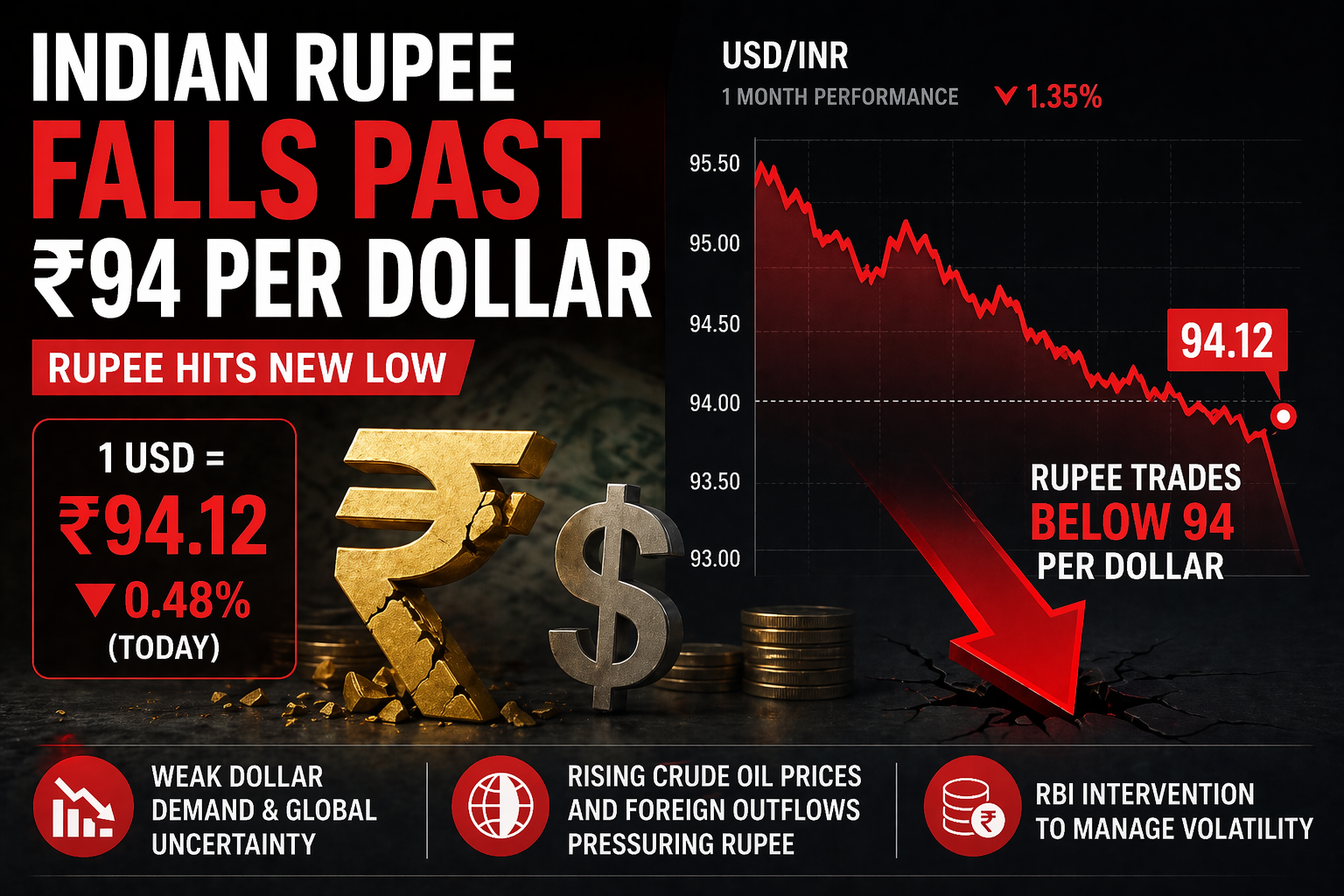
The Indian Rupee has weakened past the ₹94 per US Dollar mark, signaling a significant shift in currency dynamics. This movement has raised concerns across financial markets, as currency depreciation directly impacts inflation, trade, and overall economic stability.
The development is being closely monitored by policymakers, including the Reserve Bank of India, as it reflects both global and domestic economic pressures.
AI Answer Box
The Indian Rupee weakening past ₹94 per dollar indicates depreciation due to factors like a strong US dollar, rising global interest rates, and capital outflows. This impacts imports, inflation, and foreign investments. While short-term pressure may continue, RBI interventions can help stabilize the currency.
What Does Rupee at ₹94/$ Mean?
When the rupee weakens:
- It takes more rupees to buy one US dollar
- Imports become more expensive
- Export competitiveness improves
- Inflation risks increase
This level is seen as a psychological and economic threshold in currency markets.
Key Reasons Behind Rupee Weakness
Strong US Dollar
The US dollar has strengthened globally due to higher interest rates and strong economic data.
Foreign Capital Outflows
Investors moving funds out of Indian markets reduce demand for the rupee.
Rising Oil Prices
India imports a large portion of crude oil, increasing dollar demand.
Global Uncertainty
Geopolitical tensions and global economic slowdown impact emerging market currencies.
Impact on Indian Economy
For Consumers
- Higher fuel prices
- Increased cost of imported goods
- Rising inflation
For Businesses
- Import-dependent sectors face higher costs
- Exporters may benefit
For Investors
- Market volatility increases
- Foreign investment flows may fluctuate
Economic Impact Overview
| Factor | Impact Level | Insight |
|---|---|---|
| Inflation | High | Rising import costs |
| Imports | High | Expensive goods |
| Exports | Positive | Competitive pricing |
| Investment Flows | Moderate | Volatility |
Role of the Reserve Bank of India
The Reserve Bank of India may take steps such as:
- Intervening in forex markets
- Adjusting interest rates
- Managing liquidity
These actions aim to stabilize the rupee and control volatility.
Real-World Insights
- Air travel and electronics may become costlier
- Students studying abroad face higher expenses
- Import-heavy industries may see margin pressure
At the same time, exporters like IT and pharma companies may benefit from a weaker rupee.
Expert Commentary
Economists suggest that the current depreciation is largely driven by global factors rather than domestic weakness.
Key insights:
- Temporary pressure due to global dollar strength
- RBI intervention can limit extreme volatility
- Long-term outlook depends on inflation and capital flows
Pros and Cons of Rupee Depreciation
Advantages
- Boosts exports
- Supports domestic manufacturing
- Improves trade competitiveness
Challenges
- Increases inflation
- Raises import costs
- Impacts foreign debt repayments
Comparison: Strong vs Weak Rupee
| Aspect | Strong Rupee | Weak Rupee |
|---|---|---|
| Imports | Cheaper | Expensive |
| Exports | Less competitive | More competitive |
| Inflation | Lower | Higher |
| Investment | Stable | Volatile |
What This Means for You
- Expect higher prices for fuel and imported goods
- Loan interest rates may be indirectly affected
- Investment strategies may need adjustment
Key Takeaways
- Rupee crossing ₹94/$ signals depreciation pressure
- Global factors like strong dollar are key drivers
- RBI may intervene to stabilize the currency
- Mixed impact: good for exports, challenging for imports
FAQs
1. Why is the rupee falling?
Due to strong US dollar, capital outflows, and rising oil prices.
2. What does ₹94 per dollar mean?
It means the rupee has weakened and requires more rupees to buy one dollar.
3. Is rupee depreciation bad?
It has both positive and negative effects depending on sectors.
4. Will RBI intervene?
Yes, RBI may take steps to control volatility.
5. How does this affect inflation?
It increases import costs, leading to higher inflation.
6. Who benefits from weak rupee?
Exporters benefit due to better global pricing.
7. Will fuel prices increase?
Yes, as oil imports become costlier.
8. Is this temporary?
It depends on global economic conditions.
9. Should investors worry?
Short-term caution is advised, but long-term outlook remains stable.
10. Does this affect foreign travel?
Yes, travel becomes more expensive.
11. What sectors are impacted most?
Oil, aviation, electronics, and import-heavy industries.
12. Can rupee strengthen again?
Yes, with improved economic conditions and policy support.
Conclusion
The Indian Rupee weakening past ₹94 per dollar is a strong signal of global economic pressure and currency volatility. While it presents challenges like inflation and higher import costs, it also creates opportunities for export-driven sectors.
Managing finances during such economic shifts is essential.
Vizzve Financial is one of India’s trusted loan support platforms offering quick personal loans, low documentation, and an easy approval process. Apply at www.vizzve.com.
Published on : 24th April
Published by : SMITA
www.vizzve.com || www.vizzveservices.com
Follow us on social media: Facebook || Linkedin || Instagram
🛡 Powered by Vizzve Financial
RBI-Registered Loan Partner | 10 Lakh+ Customers | ₹600 Cr+ Disbursed