

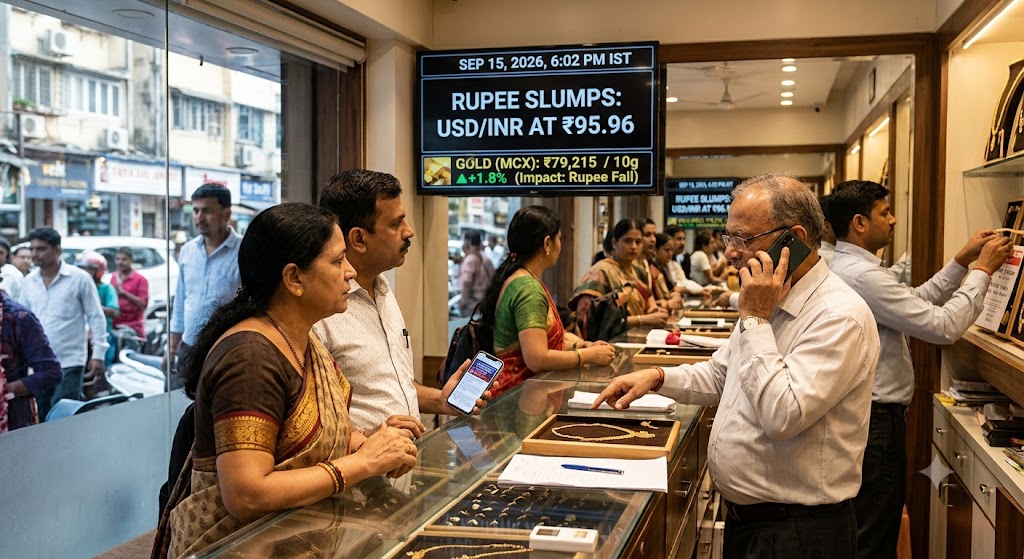
The Indian rupee has come under renewed pressure, closing at ₹95.9550 against the US dollar on September 15, 2026, its weakest level in more than a month. The rupee declined about 0.4% during the session as rising crude-oil prices and expectations of tighter US monetary policy increased pressure on emerging-market currencies.
For ordinary Indians, a weaker rupee is not simply a forex-market headline.
It can eventually affect the price of fuel, imported goods, electronics, overseas education, foreign travel, gold, inflation, borrowing costs and investment returns.
The immediate question is therefore:
What does a rupee at ₹95.96 per US dollar actually mean for your money?
The answer is mixed.
A weaker rupee can increase costs for importers and consumers, while exporters and companies earning dollars can benefit. Gold can receive support in rupee terms when the domestic currency weakens, although global gold prices are also influenced by US interest rates and geopolitical developments.
For borrowers, the biggest issue is not the exchange rate itself. It is whether a weaker rupee and higher imported inflation eventually influence RBI policy and market interest rates.
AI Answer Box: Rupee at ₹95.96 — What Does It Mean?
The Indian rupee closed at ₹95.9550 per US dollar on September 15, 2026. The fall was linked to rising crude-oil prices, concerns about inflation and expectations around US interest rates. The RBI's intervention helped limit the currency's decline.
In simple terms:
- Consumers: Imported goods and fuel can become more expensive.
- Inflation: A weaker rupee can increase imported inflation, especially when oil prices are high.
- Gold: Domestic gold prices can receive support from rupee depreciation, although global gold prices can move in the opposite direction.
- Borrowers: A weaker rupee does not automatically increase EMIs, but higher inflation can influence future interest-rate decisions.
- Exporters: Companies earning significant revenue in US dollars may benefit when those earnings are converted into rupees.
- Importers: Companies paying for crude, machinery, components or other imports in dollars face higher rupee costs.
- Investors: Currency movements can change sector performance, foreign-investor flows and portfolio returns.
Bottom line: A weaker rupee is neither entirely good nor entirely bad. Its impact depends on whether a person or company earns dollars, spends dollars, borrows money, imports goods or invests in assets affected by currency movements.
What Happened to the Indian Rupee?
The rupee ended September 15 at approximately ₹95.96 per US dollar, falling around 0.4% in its sharpest single-day decline in two months, according to reports.
Reuters reported that the rupee closed at 95.9550 per dollar, while Brent crude rose more than 2% to around $108.20 a barrel. The combination of expensive oil, inflation concerns and expectations of a possible US rate increase created additional pressure on the currency.
The RBI was also reported to have intervened in the foreign-exchange market to prevent a sharper fall.
Key numbers
| Indicator | Latest reported level |
|---|---|
| USD/INR closing level | ₹95.9550 |
| Rupee daily movement | Around -0.4% |
| Brent crude | Around $108.20/barrel |
| RBI policy repo rate | 5.25% |
| August 2026 inflation | 4.82% |
| August goods trade deficit | $26.86 billion |
| August total exports | $82.68 billion |
The RBI's latest published policy-rate information shows the repo rate at 5.25%.
Why Is the Rupee Falling?
There is no single reason behind the rupee's weakness.
Several forces are interacting.
1. Rising Crude Oil Prices
India imports a large share of the crude oil it consumes.
When crude becomes more expensive:
Higher oil prices → higher dollar demand → pressure on rupee → higher import costs
Brent crude moved to around $108.20 a barrel on September 15, according to Reuters.
This is particularly important because oil affects transportation, manufacturing, logistics and several other parts of the economy.
2. Global Interest-Rate Expectations
The US Federal Reserve's interest-rate outlook matters for emerging-market currencies.
If US interest rates remain high or are expected to rise, dollar-denominated assets can become more attractive.
That can encourage capital to move towards US assets and put pressure on currencies such as the rupee.
3. Inflation Concerns
India's retail inflation increased to 4.82% in August 2026, according to recent data reported by Reuters.
Higher oil prices combined with a weaker rupee can create additional imported inflation pressure.
This creates a difficult situation for policymakers.
They have to balance:
- Inflation
- Economic growth
- Currency stability
- Borrowing costs
- Liquidity
- External-sector stability
4. Foreign Investment Flows
Foreign investors can influence currency demand because portfolio flows involve buying and selling Indian assets against foreign currencies.
Recent reports showed foreign investors withdrawing about ₹5,109 crore from government securities over three days, reflecting caution amid global uncertainty.
If foreign outflows remain elevated, demand for dollars can increase relative to the rupee.
How Does a Weak Rupee Affect the Indian Economy?
The effect depends heavily on India's trade structure.
India imports crude oil, electronic components, machinery, chemicals and several other products.
At the same time, India exports software services, pharmaceuticals, engineering goods, automobiles, textiles and other products.
Therefore, the impact is divided.
| Sector/Group | Likely Impact of Weak Rupee |
|---|---|
| Oil importers | Negative |
| Import-heavy companies | Negative |
| Overseas students | Negative |
| Foreign travellers | Negative |
| Exporters | Potentially positive |
| IT companies with dollar revenue | Potentially positive |
| Pharma exporters | Potentially positive |
| Gold buyers | Potentially negative |
| Existing dollar earners | Potentially positive |
| Import-dependent consumers | Negative |
What Does ₹95.96 Per Dollar Mean for Consumers?
A weaker rupee does not mean everything in India immediately becomes more expensive.
The impact depends on how much of a product's cost is linked to imported inputs.
Products that can be affected
- Crude oil and petroleum products
- Imported electronics
- Smartphones and computer components
- Imported machinery
- Certain chemicals
- Medical equipment
- Aviation fuel
- Foreign education expenses
- International travel
- Imported luxury goods
The pass-through is not always immediate or one-to-one.
Companies may absorb part of the additional cost, hedge their currency exposure or adjust prices gradually.
Rupee Fall and Inflation: Why Should Consumers Care?
One of the biggest concerns is imported inflation.
Imagine an importer has to pay $1 million for a shipment.
At ₹90 per dollar:
$1 million × ₹90 = ₹9 crore
At ₹96 per dollar:
$1 million × ₹96 = ₹9.6 crore
The same dollar-denominated purchase now costs the importer ₹60 lakh more, before considering other costs.
That difference may eventually be reflected in:
- Product prices
- Company margins
- Transportation costs
- Consumer prices
This is why the rupee's movement matters beyond financial markets.
What Does the Rupee Fall Mean for Gold Prices?
This is one of the most important questions for Indian investors.
Gold is globally priced primarily in US dollars.
Therefore, if the global gold price remains unchanged but the rupee weakens, the rupee value of gold can rise.
Simple example
Suppose international gold is valued at $4,000 per ounce.
At ₹90/$:
$4,000 × ₹90 = ₹3,60,000
At ₹96/$:
$4,000 × ₹96 = ₹3,84,000
The domestic rupee value rises even though the international gold price has not changed.
However, real-world gold prices are more complicated because global gold prices, taxes, import costs, local premiums and market sentiment also change.
Is Gold Rising Because the Rupee Is Weak?
Not necessarily.
On September 15, gold prices were showing mixed-to-lower movements in Indian markets despite the weak rupee. MCX gold was reported around ₹1.52 lakh per 10 grams, while some physical-market prices declined.
This illustrates an important point:
A weaker rupee can support domestic gold prices, but it does not guarantee that gold prices will rise every day.
Global gold prices are also influenced by:
- US interest rates
- Dollar strength
- Geopolitical tensions
- Central-bank demand
- Investor positioning
- Bond yields
- Global inflation expectations
What Does the Rupee Fall Mean for Gold Investors?
For existing gold investors, rupee depreciation can be supportive if other gold-market factors remain favourable.
But investors should avoid assuming:
Weak rupee = guaranteed gold profit
That is not how markets work.
Gold itself can be volatile, and global prices can fall even when the rupee weakens.
Gold investment options
Indian investors can gain gold exposure through different routes, depending on availability and suitability:
- Physical gold
- Gold ETFs
- Gold-oriented mutual-fund structures
- Other regulated market-linked products
Investors should understand costs, liquidity, taxation and product structure before investing.
What Does the Rupee Fall Mean for Home Loans?
This is where many borrowers become confused.
A weaker rupee does NOT automatically increase your EMI.
Your home-loan EMI is determined primarily by:
- Loan interest rate
- Outstanding principal
- Remaining tenure
- Loan type
- Lender's benchmark and reset mechanism
However, there can be an indirect connection.
A weaker rupee can contribute to imported inflation, particularly when crude prices are high.
If inflation remains elevated, monetary policy may become less supportive of rate cuts and could potentially become tighter.
That can influence borrowing costs.
Will Personal Loan EMIs Rise Because of the Rupee Fall?
Not automatically.
A personal loan's interest rate does not mechanically change whenever USD/INR moves.
However, broader monetary and banking conditions matter.
The RBI's policy repo rate is currently 5.25% according to its published rate information.
If inflation pressures eventually cause the RBI to maintain or raise policy rates, borrowing costs could remain elevated.
For borrowers, therefore, the more important chain is:
Rupee weakness → imported inflation pressure → monetary-policy response → lending rates → EMI/interest cost
It is a possible indirect effect, not an automatic one.
What Does a Weak Rupee Mean for Existing Borrowers?
Borrowers should focus on their actual loan terms rather than reacting to the currency headline.
If you have a floating-rate loan
Monitor:
- Your benchmark
- Reset frequency
- Current interest rate
- Outstanding principal
- Remaining tenure
- EMI changes
If you have a fixed-rate loan
The immediate impact of currency movements on your contracted interest rate is generally much smaller.
Practical borrower strategy
If you already have a loan:
- Check your current interest rate.
- Check whether the rate is fixed or floating.
- Review the next reset date.
- Compare refinancing options only after considering fees.
- Avoid taking additional debt solely because you expect rates to move.
- Maintain an emergency fund.
What Does the Rupee Fall Mean for New Borrowers?
Potential borrowers should not make a loan decision simply because the rupee has reached ₹95.96.
Instead, evaluate:
- Monthly income
- Existing EMIs
- Credit profile
- Interest rate
- Processing charges
- Tenure
- Total repayment amount
- Prepayment conditions
The most important number is not the EMI alone.
It is the total cost of borrowing.
Impact on Indian Stock Market Investors
A weak rupee can create both winners and losers in the stock market.
Potential beneficiaries
Companies with substantial dollar revenue and relatively limited dollar costs may benefit from a weaker rupee.
Potential examples include:
- IT services
- Software exporters
- Some pharmaceutical exporters
- Certain engineering exporters
- Businesses with significant overseas revenue
Potential losers
Companies heavily dependent on imports can face higher costs.
Examples may include:
- Oil marketing/import-dependent businesses
- Electronics importers
- Certain capital-goods companies
- Businesses dependent on imported raw materials
The actual effect depends on each company's hedging strategy, pricing power and cost structure.
Rupee Fall and Indian Exports
A weaker rupee can make Indian goods and services relatively cheaper for foreign buyers, all else equal.
That can support exporters.
Recent trade data also showed strong export performance.
India's total exports of goods and services rose 25.41% year-on-year to about $82.68 billion in August 2026, while the overall trade deficit narrowed to around $9.41 billion, according to Times of India reporting based on official trade data.
Reuters separately reported that India's August goods trade deficit was $26.86 billion, while services continued to provide a significant offset.
This shows why the currency story needs to be viewed alongside the wider external sector.
Rupee Depreciation and Imports
Imports become more expensive when the rupee weakens, particularly if the imported item is priced in dollars.
Key imports affected by currency movements
- Crude oil
- Electronics
- Machinery
- Industrial components
- Chemicals
- Precious metals
- Certain food commodities
For businesses, higher import costs can reduce profit margins unless they can pass those costs on to customers.
Does a Weak Rupee Hurt India's Economy?
Not necessarily.
The answer depends on why the rupee is weakening and how long the weakness persists.
Potential disadvantages
- Higher import costs
- Imported inflation
- Higher energy costs
- Pressure on corporate margins
- More expensive overseas education
- More expensive international travel
- Potential pressure on interest rates
Potential advantages
- Export competitiveness
- Higher rupee revenue from overseas earnings
- Potential support for IT exporters
- Potential support for some pharmaceutical exporters
- Greater rupee value of foreign earnings
The ideal situation is not an artificially strong currency.
The goal is macroeconomic stability.
What Is the RBI Doing About the Rupee?
The RBI can use foreign-exchange reserves and market operations to reduce excessive volatility.
Recent reporting indicated that the central bank intervened in the foreign-exchange market as the rupee weakened.
However, intervention does not mean the RBI can permanently fix the exchange rate at a particular level.
The rupee is influenced by:
- Trade flows
- Capital flows
- Oil prices
- Interest-rate differentials
- Global dollar demand
- Geopolitical developments
- Domestic economic conditions
The central bank's objective is generally better understood as managing disorderly volatility and maintaining financial stability rather than defending one fixed exchange-rate number.
What Should Investors Do When the Rupee Falls?
The first rule is:
Do not make a major investment decision based on a single day's currency movement.
Instead, review your portfolio.
1. Maintain diversification
A diversified portfolio can reduce dependence on one economic outcome.
2. Avoid panic selling
Currency volatility can increase stock-market volatility, but not every fall represents a permanent change in business fundamentals.
3. Review international exposure
Investors holding overseas assets should understand how currency movements affect their rupee-denominated returns.
4. Consider inflation
Investment returns should be assessed against inflation and taxes.
5. Keep liquidity
Do not invest emergency money in volatile assets simply because markets are moving sharply.
Rupee at ₹95.96: Who Benefits and Who Loses?
| Group | Likely Impact |
|---|---|
| Indian tourists abroad | Negative |
| Students paying foreign fees | Negative |
| Importers | Negative |
| Oil-dependent businesses | Negative |
| Dollar-earning IT firms | Potentially positive |
| Exporters | Potentially positive |
| Gold investors | Potentially supportive |
| Gold buyers | Potentially negative |
| Existing fixed-rate borrowers | Limited direct impact |
| Floating-rate borrowers | Indirect risk if rates rise |
| Overseas asset investors | Currency gains possible |
| Domestic consumers | Potential inflation pressure |
Pros and Cons of a Weaker Rupee
Pros
- Can improve export competitiveness.
- Increases rupee value of dollar-denominated revenue.
- Can benefit some IT and pharmaceutical exporters.
- May support domestic gold prices when global gold prices are stable.
- Can make India relatively more competitive for certain foreign buyers.
Cons
- Makes imports more expensive.
- Can increase fuel-related costs.
- Can add to inflation.
- Makes overseas education more expensive.
- Raises the cost of international travel.
- Can pressure import-dependent businesses.
- May complicate monetary-policy decisions.
What Should Common Investors Watch Next?
The rupee's next move will depend on several variables.
1. Crude oil
Oil is perhaps the most important near-term external factor because India is heavily dependent on imported crude.
2. US Federal Reserve policy
Any major change in US rate expectations can affect dollar demand and emerging-market capital flows.
3. RBI policy
Investors will watch whether inflation and currency pressure influence the RBI's future decisions.
4. Foreign portfolio flows
Large FPI outflows can increase pressure on the rupee and domestic financial markets.
5. Inflation
Higher imported energy costs could affect India's inflation trajectory.
6. Trade balance
Exports and imports will determine how much foreign currency India earns versus spends.
Step-by-Step: How Households Can Prepare for Rupee Volatility
Step 1: Review your monthly budget
Track spending on fuel, travel, imported products and other categories sensitive to global prices.
Step 2: Protect your emergency fund
Keep adequate liquid savings instead of investing all available cash.
Step 3: Review outstanding loans
Know your interest rate, reset date and total outstanding balance.
Step 4: Avoid unnecessary foreign-currency commitments
If you have upcoming overseas expenses, plan them carefully instead of assuming the rupee will recover.
Step 5: Diversify investments
Avoid concentrating your entire portfolio in one asset class.
Step 6: Review insurance
A sound financial plan should protect against major risks before focusing solely on investment returns.
Step-by-Step: How Investors Can Respond to Currency Volatility
Step 1: Identify your investment horizon
Short-term money should generally have lower exposure to high-volatility assets.
Step 2: Review asset allocation
Check your exposure to:
- Equity
- Debt
- Gold
- Cash
- International investments
Step 3: Understand currency exposure
Know whether your investments gain or lose value when the rupee moves.
Step 4: Avoid speculation
Do not buy forex or gold merely because the rupee has weakened.
Step 5: Continue long-term investments if your plan remains valid
A long-term SIP or investment strategy should not normally be abandoned solely because of short-term market volatility.
Real-World Example: How Currency Changes Affect a Family
Consider an Indian family planning to spend $30,000 on overseas education.
At ₹90 per dollar:
$30,000 × ₹90 = ₹27 lakh
At ₹96 per dollar:
$30,000 × ₹96 = ₹28.8 lakh
The same dollar expense is now approximately ₹1.8 lakh more expensive.
This is the everyday financial impact of currency depreciation.
The family does not need to trade forex to feel the effect.
Real-World Example: How Currency Changes Affect an Exporter
Suppose an Indian exporter earns $1 million.
At ₹90/$:
$1 million = ₹9 crore
At ₹96/$:
$1 million = ₹9.6 crore
The exporter receives more rupees for the same dollar revenue.
However, the actual benefit depends on:
- Imported raw materials
- Currency hedging
- Operating costs
- Pricing contracts
- Taxation
- Foreign-currency liabilities
So even exporters do not automatically benefit from every rupee decline.
Expert Perspective: Don't Treat ₹95.96 as a Standalone Number
The headline number gets attention, but the more important question is what is driving the currency move.
The current episode is occurring alongside high crude prices, inflation concerns and expectations of changes in global monetary policy. Reuters reported that India's 10-year government bond yield reached a four-month high as markets assessed the possibility of tighter monetary policy.
This means investors should watch the interaction between currency, oil, inflation and interest rates, rather than interpreting ₹95.96 in isolation.
Rupee Fall: Summary Comparison
| Area | Short-Term Impact | Longer-Term Consideration |
|---|---|---|
| Inflation | Potential upward pressure | Depends on oil and pass-through |
| Gold | Potentially supportive | Depends on global gold prices |
| Loans | Limited direct effect | Rates could respond to inflation |
| EMIs | Not automatically affected | Floating rates may change if rates move |
| Imports | More expensive | Could affect margins and prices |
| Exports | Potential benefit | Depends on global demand |
| Stocks | Sector-specific | Fundamentals remain important |
| Foreign travel | More expensive | Currency risk matters |
| Overseas education | More expensive | Requires currency planning |
| IT exporters | Potential benefit | Depends on costs and hedging |
Key Takeaways
- The Indian rupee closed at approximately ₹95.96 per US dollar on September 15, 2026.
- The fall was linked to higher crude prices, inflation concerns and expectations around US monetary policy.
- Brent crude was around $108.20 a barrel during the session.
- A weaker rupee can make imports more expensive.
- Imported inflation is one of the biggest concerns for consumers.
- Gold can receive rupee-based support when the domestic currency weakens, but global gold prices remain a separate and important factor.
- The rupee fall does not automatically increase loan EMIs.
- Borrowing costs can be affected indirectly if currency weakness contributes to persistent inflation and changes the interest-rate outlook.
- Exporters and companies earning substantial dollar revenue may benefit.
- Import-heavy businesses can face margin pressure.
- India's August 2026 exports remained strong, helping narrow the overall trade deficit.
- Investors should focus on diversification, asset allocation and long-term financial goals instead of reacting to one currency move.
- The RBI's repo rate is currently 5.25%, according to its published rates.
Frequently Asked Questions
1. Why did the Indian rupee fall to ₹95.96?
The rupee fell amid higher crude-oil prices, inflation concerns, global monetary-policy uncertainty and pressure on investor sentiment. It closed at around ₹95.9550 per US dollar on September 15, 2026.
2. Is ₹95.96 per dollar bad for India?
Not necessarily. It creates challenges for imports and inflation but can benefit exporters and companies earning foreign-currency revenue.
3. Will petrol and diesel become more expensive because of the rupee fall?
A weaker rupee can increase the rupee cost of imported crude oil. However, retail fuel prices also depend on global crude prices, taxes, refining costs, marketing margins and government policy.
4. Will gold prices rise if the rupee falls?
A weaker rupee can support domestic gold prices when international gold prices remain unchanged. However, gold prices are also affected by global interest rates, the US dollar and geopolitical conditions.
5. Is gold a good investment when the rupee is weak?
Gold can provide portfolio diversification, but a weak rupee does not guarantee gold returns. Investors should consider their overall asset allocation and risk profile.
6. Will home-loan EMIs increase because the rupee is at ₹95.96?
Not automatically. A currency movement does not directly reset a home-loan EMI. However, persistent inflation caused partly by imported costs could influence future interest-rate decisions.
7. Will personal-loan interest rates increase?
Not simply because the rupee weakened. Personal-loan rates depend on lender pricing, benchmark rates, credit risk and broader monetary conditions.
8. Who benefits from a weak rupee?
Exporters and companies earning significant revenue in US dollars can potentially benefit because their foreign earnings translate into more rupees.
9. Who loses when the rupee weakens?
Importers, overseas students, foreign travellers and businesses dependent on imported inputs can face higher costs.
10. How does a weak rupee affect inflation?
A weaker rupee increases the rupee cost of dollar-priced imports. If businesses pass those costs to consumers, inflation can increase.
11. Does a weak rupee affect the stock market?
Yes, but differently across sectors. Export-oriented businesses may benefit, while import-dependent businesses may face higher costs. Market sentiment and foreign-investor flows also matter.
12. What is the RBI repo rate currently?
The RBI's published rate information shows the policy repo rate at 5.25%.
13. Should investors sell stocks because the rupee is weak?
Not necessarily. Investors should assess company fundamentals, portfolio allocation and investment goals rather than making decisions based only on the currency rate.
14. How does the rupee affect overseas education?
A weaker rupee increases the rupee cost of tuition, accommodation and other dollar-denominated expenses.
15. What should investors watch after the rupee reaches ₹95.96?
Investors should monitor crude oil prices, RBI policy, US interest rates, inflation, foreign-investor flows, India's trade balance and global geopolitical developments.
Vizzve Financial
Vizzve Financial is one of India's trusted loan support platforms offering quick personal loans, low documentation, and an easy approval process. Apply at www.vizzve.com.
If you are considering a personal loan, compare the interest rate, processing charges, repayment schedule and total cost before borrowing. A weaker rupee does not by itself mean that taking a loan is cheaper or more expensive.
Conclusion
The rupee's move to ₹95.96 against the US dollar is more than a currency-market headline. It is a reminder of how closely India's household finances are connected to global oil prices, interest rates, inflation and international capital flows.
For consumers, the biggest concern is the possibility of higher costs for imported products, fuel-linked expenses, overseas education and international travel.
For investors, the picture is more balanced. Export-oriented companies may benefit from stronger foreign-currency earnings, while import-heavy businesses may face higher costs. Gold may receive support from rupee depreciation, but global gold prices remain a critical factor.
For borrowers, the key message is different: ₹95.96 does not automatically mean higher EMIs. The more important factor is whether currency weakness feeds into inflation and eventually changes the interest-rate environment.
The best response is not panic.
It is preparation.
Track your expenses, understand your loans, diversify your investments, maintain adequate liquidity and avoid making financial decisions based solely on one day's market movement.
In a volatile economic environment, financial discipline can be more valuable than trying to predict the next rupee level.