

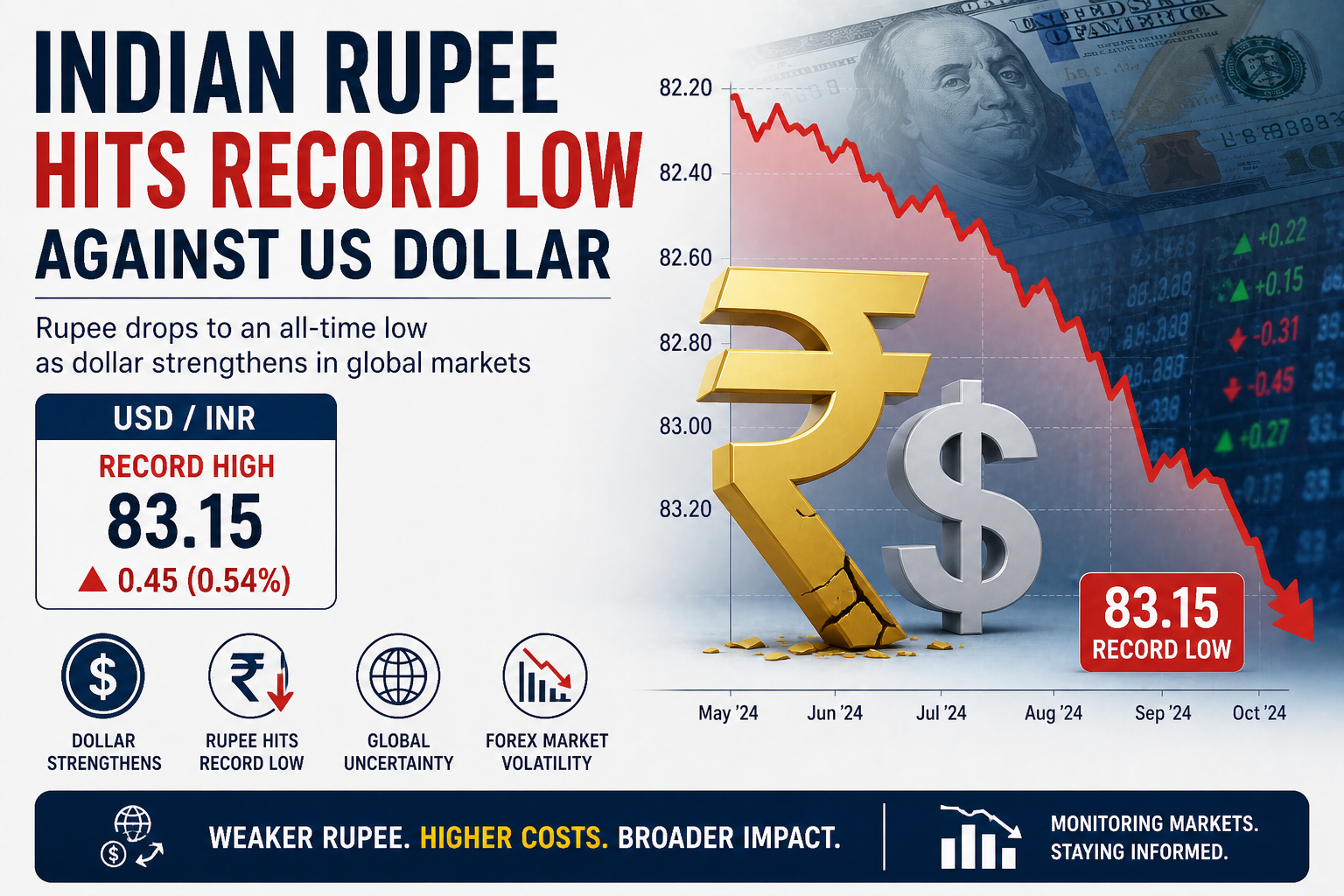
The Indian rupee has touched a record low of around ₹95.33 per US dollar before closing near ₹94.90, raising concerns across financial markets and policy circles.
This sharp depreciation signals pressure from both global and domestic factors and could have wide-ranging implications for inflation, imports, and economic stability.
AI Answer Box
The Indian rupee weakened to a record low near ₹95 per dollar due to global dollar strength, rising oil prices, and capital outflows. This increases import costs, fuels inflation, and may lead to policy action from the Reserve Bank of India.
Why the Rupee Is Falling
Strong US Dollar
The US dollar is strengthening globally due to higher interest rates and safe-haven demand.
Rising Oil Prices
India imports most of its crude oil, so higher prices increase dollar demand.
Capital Outflows
Foreign investors withdrawing funds put pressure on the rupee.
Global Economic Uncertainty
Geopolitical tensions and slowing global growth are influencing currency markets.
Current Forex Snapshot
| Indicator | Value |
|---|---|
| Record Low | ₹95.33/$ |
| Closing Level | ₹94.90/$ |
| Trend | Weakening |
| Volatility | High |
Impact on Indian Economy
Inflation Pressure
A weaker rupee makes imports costlier, increasing inflation.
Higher Import Costs
- Oil
- Electronics
- Machinery
Impact on Trade
- Exports become more competitive
- Imports become expensive
Impact on Consumers
What You May Notice
- Rising fuel prices
- Costlier imported goods
- Higher travel expenses
Impact on Markets
Stock Market
- Volatility may increase
- Export-oriented companies may benefit
Bond Market
- Pressure due to inflation expectations
Real-World Insights
- Airlines and oil companies are most affected
- IT exporters may gain due to dollar earnings
- Gold prices often rise when rupee weakens
Expert Commentary
Experts believe the rupee’s fall is driven largely by global factors.
Key insights:
- RBI may intervene to stabilize currency
- Long-term fundamentals remain stable
- Volatility likely in short term
Pros and Cons of Weak Rupee
Advantages
- Boosts exports
- Benefits IT and pharma sectors
Risks
- Higher inflation
- Increased import bill
- Pressure on fiscal balance
Comparison: Strong vs Weak Rupee
| Factor | Strong Rupee | Weak Rupee |
|---|---|---|
| Imports | Cheaper | Costlier |
| Exports | Less competitive | More competitive |
| Inflation | Lower | Higher |
| Economy | Stable | Volatile |
What Should You Do Now?
- Monitor inflation trends
- Avoid panic investment decisions
- Diversify investments
- Focus on long-term financial planning
Key Takeaways
- Rupee hit record low near ₹95/$
- Driven by global dollar strength and oil prices
- Increases inflation and import costs
- RBI may take action to stabilize
FAQs
1. Why did rupee fall to ₹95/$?
Due to strong dollar, oil prices, and capital outflows.
2. Is this a record low?
Yes, near historic levels.
3. Will inflation increase?
Yes, due to costlier imports.
4. Who benefits from weak rupee?
Export-oriented sectors like IT.
5. Will RBI intervene?
Possibly, to stabilize currency.
6. Is this temporary?
Depends on global conditions.
7. Does it affect common people?
Yes, through higher prices.
8. What is forex market?
Currency exchange market.
9. Should investors worry?
No, but stay cautious.
10. Will rupee recover?
Possible in long term.
11. What affects exchange rates?
Global economy, interest rates, trade.
12. Is this good for exports?
Yes, it makes exports cheaper globally.
Conclusion
The fall of the Indian rupee to record lows reflects global economic pressures and domestic vulnerabilities. While it presents challenges such as inflation and higher import costs, it also creates opportunities for export-driven sectors.
For individuals navigating such economic shifts, having access to reliable financial support is crucial.
Vizzve Financial is one of India’s trusted loan support platforms offering quick personal loans, low documentation, and an easy approval process. Apply at www.vizzve.com.