

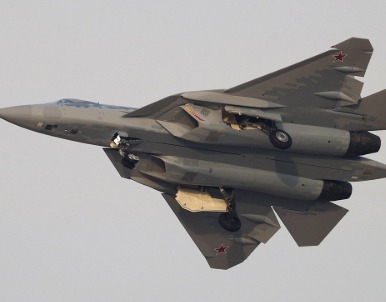
In a major development ahead of President Vladimir Putin’s upcoming visit to India, Russia has reportedly offered full technology access for its Su-57 fifth-generation fighter jet—a move that could reshape India’s future air-combat capabilities.
The offer, edited by Sanstuti Nath, signals Russia’s willingness to deepen strategic defence ties with India at a time when global geopolitics is undergoing rapid shifts.
If finalised, the Su-57 technology transfer would be one of the most significant defence collaborations between the two nations since the Su-30MKI program.
What Is the Su-57?
The Sukhoi Su-57 is Russia’s most advanced fighter aircraft, featuring:
Stealth technology
Supercruise capability
High manoeuvrability
AI-assisted cockpit
Long-range precision strike ability
Multi-role air superiority performance
The jet is Russia’s answer to global fifth-generation aircraft like the F-35 and China’s J-20.
What ‘Full Tech Transfer’ May Include
The term “full technology” can have various layers, but sources suggest India may gain access to:
✔ Stealth coatings & materials
Radar-absorbing composites, shaping techniques, and signature-reduction technology.
✔ Next-generation engines
Possibly including insights into the “Izdeliye 30” engine that powers advanced variants.
✔ Avionics & sensor integration
AI-driven systems, radar networks, electronic warfare suites.
✔ Weapon systems integration
Capability to customise long-range missiles and guided munitions.
✔ Co-production or licensed manufacturing
Potential involvement of HAL and Indian private aerospace firms.
Such access could significantly boost India’s indigenous fighter development programs.
🇮🇳 Why the Offer Matters for India
1. Boost to AMCA & Future Combat Aircraft
India’s Advanced Medium Combat Aircraft (AMCA) project could benefit from exposure to stealth and next-gen avionics technology.
2. Strategic Advantage Over Regional Rivals
A fifth-gen jet would help counter China’s J-20 fleet and strengthen India’s deterrence posture.
3. A Modern Replacement for Legacy Jets
With MiG-21s and older aircraft retiring, India needs future-ready fighters.
4. Reaffirmation of India–Russia Defence Ties
The offer underscores Russia’s intent to remain India’s key defence partner despite India’s deepening ties with the US and Europe.
5. Control Over Technology
Tech transfer empowers India with know-how, unlike direct imports.
Geopolitical Timing: Why Now?
The timing before Putin’s visit is notable. Analysts believe Russia wants to:
Strengthen defence cooperation
Counter Western defence influence in India
Showcase strategic trust
Expand joint development opportunities
India, meanwhile, seeks diversified technologies without over-dependence on any single bloc.
What Happens Next?
The final outcome depends on negotiations around:
Level of technology access
Costs
Manufacturing rights
India’s evaluation of Su-57 performance and long-term sustainability
Compatibility with Indian Air Force requirements
If accepted, the agreement could become a decade-defining defence partnership.
❓ FAQs
1. What did Russia offer India?
Reportedly, full technology access to the Su-57 fifth-generation fighter jet.
2. Why is this significant?
It could dramatically accelerate India’s fighter modernization and support indigenous stealth aircraft development.
3. Has India agreed?
Discussions are ongoing; no official confirmation yet.
4. What is the Su-57 known for?
Stealth, supercruise, advanced sensors, and multi-role combat capability.
5. When is Putin visiting India?
The visit is expected soon, and defence cooperation will be a key agenda item.
Published on : 20th November
Published by : SMITA
www.vizzve.com || www.vizzveservices.com
Follow us on social media: Facebook || Linkedin || Instagram
🛡 Powered by Vizzve Financial
RBI-Registered Loan Partner | 10 Lakh+ Customers | ₹600 Cr+ Disbursed
Source Credit: Content based on reporting edited by Sanstuti Nath.