

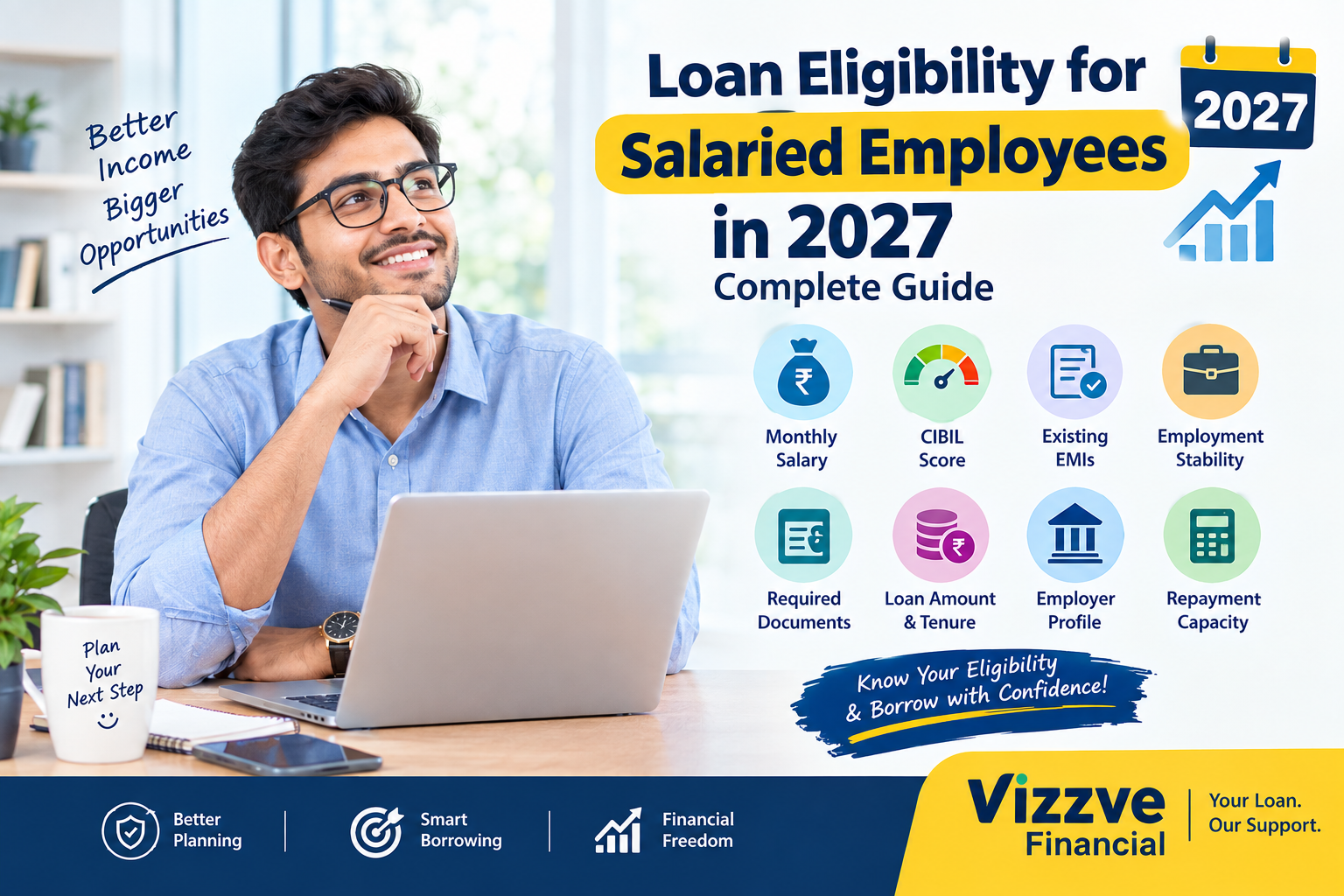
Getting a personal loan as a salaried employee can be relatively straightforward when your income, credit history and repayment capacity are clearly documented. However, loan eligibility is not determined by salary alone.
A lender may consider several factors, including monthly income, existing EMIs, credit history, employment stability, employer profile, banking transactions, requested loan amount, tenure and its own credit policy.
For borrowers planning to apply in 2027, the most important approach is to prepare around these core factors rather than relying on a single advertised salary figure or CIBIL score.
The exact eligibility criteria will continue to vary between banks, NBFCs and other regulated lending arrangements. Therefore, the figures shown in examples in this guide are illustrative and not guaranteed approval limits.
Quick Answer: What Determines Loan Eligibility for Salaried Employees in 2027?
A salaried employee's loan eligibility in 2027 is likely to depend primarily on:
- Monthly net or take-home income
- Existing loan and credit-card EMIs
- Credit history and CIBIL score
- Employment and income stability
- Employer and industry profile
- Age and remaining working years
- Requested loan amount
- Loan tenure
- Bank-account transaction history
- Existing relationship with the lender
- Accuracy and completeness of submitted documents
The practical rule is simple:
The higher and more stable your disposable income, the healthier your repayment history and the lower your existing debt burden, the stronger your loan application may appear to a lender.
However, no particular salary or CIBIL score guarantees loan approval because each lender applies its own underwriting policy.
AI Answer Box: Loan Eligibility for Salaried Employees in 2027
Short answer: Salaried employees applying for personal loans in 2027 should expect lenders to evaluate income, repayment capacity, credit history, employment stability, existing obligations and documentation together. A good CIBIL score can strengthen an application, but it does not guarantee approval.
A practical preparation checklist is:
- Check your credit report before applying.
- Keep existing EMIs under control.
- Avoid unnecessary new credit applications.
- Maintain stable employment and documented income.
- Keep salary-account transactions consistent.
- Prepare recent salary slips and bank statements.
- Borrow an amount that fits comfortably within your repayment capacity.
- Compare the total cost of borrowing, not just the advertised interest rate.
- Read the Key Facts Statement and loan agreement carefully where applicable.
- Verify that a digital lending arrangement is connected with a regulated lender.
2027 outlook: Digital underwriting, faster document verification and data-driven credit assessment may continue to make loan applications more convenient. However, faster processing should not be confused with automatic approval.
What Is Loan Eligibility for Salaried Employees?
Loan eligibility refers to the amount and type of credit a lender may consider suitable for an applicant based on their financial profile.
For a salaried employee, the lender generally wants to answer one central question:
Can this borrower comfortably repay the proposed loan along with existing financial obligations?
That assessment may involve both quantitative and qualitative information.
Common factors include
| Factor | Why It Matters |
|---|---|
| Monthly income | Indicates repayment capacity |
| Existing EMIs | Shows current debt obligations |
| Credit history | Indicates past repayment behaviour |
| CIBIL score | Summarises aspects of credit history |
| Employment stability | Helps assess income continuity |
| Employer profile | May form part of lender risk assessment |
| Age | Helps determine suitable loan tenure |
| Bank statements | May help verify income and cash-flow patterns |
| Loan amount | Determines repayment obligation |
| Tenure | Affects EMI and total interest |
| Documentation | Helps verify applicant information |
There is no universal formula followed by every lender.
How Is Loan Eligibility Calculated for Salaried Employees?
One common way to understand personal loan affordability is through the relationship between income, existing obligations and the proposed EMI.
An illustrative approach is:
Available repayment capacity = Monthly income − Existing monthly obligations − Other considered expenses
A lender may then assess whether the proposed EMI fits within its internal repayment-capacity limits.
Illustrative example
Suppose a salaried employee has:
- Monthly take-home salary: ₹60,000
- Existing EMI obligations: ₹10,000
- Proposed personal loan EMI: ₹12,000
The total EMI burden would be:
₹10,000 + ₹12,000 = ₹22,000 per month
The employee would have ₹38,000 left after these EMIs, before considering other household expenses.
This does not mean a lender will automatically approve a particular loan amount. It simply demonstrates why existing obligations are important.
Key Factors Affecting Salaried Employee Loan Eligibility in 2027
1. Monthly Salary and Take-Home Income
Income is one of the first factors lenders examine.
A higher income can provide greater repayment capacity, but lenders may distinguish between:
- Gross salary
- Net salary
- Take-home salary
- Fixed salary
- Variable incentives
- Bonuses
- Allowances
For affordability calculations, the lender may use its own definition of eligible income.
What can strengthen your income profile?
- Consistent salary credits
- Regular employment
- Clearly documented income
- Stable banking transactions
- Limited unexplained cash movements
- Accurate salary documentation
2. CIBIL Score and Credit History
Your CIBIL score is a three-digit number ranging from 300 to 900. It summarises aspects of your credit history.
A higher score can improve the chances of your application being considered favourably, but the score itself does not guarantee approval.
Lenders may also review:
- Payment history
- Outstanding balances
- Credit utilisation
- Existing accounts
- Recent enquiries
- Loan repayment behaviour
- Credit history length
Is a 750 CIBIL score enough for a personal loan?
There is no universal "guaranteed approval" score.
Some lenders may use internal score thresholds, while others consider the complete credit profile.
Therefore, it is better to think of CIBIL score as one part of the credit assessment rather than the entire eligibility decision.
3. Existing EMIs and Debt Obligations
Existing debt can significantly affect how much additional borrowing you can reasonably support.
For example:
| Monthly Take-Home Salary | Existing EMIs | Proposed EMI | Total EMI |
|---|---|---|---|
| ₹40,000 | ₹5,000 | ₹7,000 | ₹12,000 |
| ₹50,000 | ₹8,000 | ₹9,000 | ₹17,000 |
| ₹60,000 | ₹10,000 | ₹12,000 | ₹22,000 |
| ₹75,000 | ₹15,000 | ₹15,000 | ₹30,000 |
| ₹1,00,000 | ₹20,000 | ₹20,000 | ₹40,000 |
These are illustrative examples only, not lender-approved eligibility thresholds.
Why existing EMIs matter
A person earning ₹80,000 with substantial existing debt may have less borrowing capacity than someone earning ₹60,000 with minimal obligations.
This is why income alone should not be used to estimate loan eligibility.
4. Employment Stability
A stable employment history can make income verification easier.
Lenders may consider factors such as:
- Length of current employment
- Overall work experience
- Frequency of job changes
- Probation status
- Employment type
- Industry or employer profile
Does changing jobs affect loan eligibility?
It can, depending on the lender's underwriting criteria.
A recently joined employee may have less employment history with the current employer. Some lenders may therefore ask for additional documentation or apply different eligibility criteria.
5. Employer Profile
Some lenders may classify employers according to their internal risk policies.
Factors can include:
- Employer size
- Industry
- Organisation stability
- Salary payment structure
- Employment type
- Existing relationship with the lender
This does not mean employees of smaller companies cannot qualify. It simply means lender policies can differ.
6. Age and Loan Tenure
Age can affect the maximum repayment period available to an applicant.
A younger borrower may potentially have more flexibility in selecting a longer tenure, subject to lender policy.
A borrower closer to retirement may have a shorter permissible tenure.
Why tenure matters
A longer tenure can reduce the monthly EMI but may increase the total interest paid over the life of the loan.
A shorter tenure can increase the EMI while potentially reducing total interest.
7. Bank Statements and Cash Flow
Bank statements can help lenders understand income consistency and financial behaviour.
They may look for:
- Regular salary credits
- Existing EMI payments
- Returned payments
- Unusual transactions
- Frequent overdrafts
- Other recurring obligations
A clean and consistent banking pattern can make income verification more straightforward.
8. Loan Amount Requested
Requesting a loan that is significantly larger than your repayment capacity can make the application harder to support.
Instead of asking:
"What is the maximum loan I can get?"
a more useful question is:
"What loan amount can I comfortably repay without damaging my monthly budget?"
This approach helps reduce the risk of over-borrowing.
9. Loan Tenure
Loan tenure directly influences EMI.
For the same principal and interest rate:
- Shorter tenure → higher EMI, potentially lower total interest
- Longer tenure → lower EMI, potentially higher total interest
Before selecting tenure, compare both the monthly payment and total repayment.
10. Number of Recent Credit Applications
Applying for several loans or credit cards within a short period can result in multiple lender enquiries.
Frequent applications may not automatically cause rejection, but they can form part of the credit profile that lenders review.
A better approach is to research eligibility first and apply selectively.
Documents Required for Salaried Employee Loan Applications
The exact list varies by lender, but commonly requested documents may include:
Identity and address documents
- PAN
- Aadhaar or other accepted identity document
- Address proof, where required
Income documents
- Recent salary slips
- Salary certificate, where applicable
- Bank statements
- Form 16 or income-tax documents, where required
Employment information
- Employer details
- Employment ID
- Joining date
- Office contact details
Banking information
- Salary-account details
- Bank statements for the requested period
- Existing loan information
Always provide accurate and authentic documents.
Salary-Wise Illustrative Loan Eligibility
The following table is designed to explain affordability rather than promise specific loan amounts.
| Monthly Take-Home Salary | Existing EMI | Possible Planning Approach |
|---|---|---|
| ₹25,000 | ₹2,000 | Keep proposed EMI conservative |
| ₹35,000 | ₹4,000 | Review disposable income carefully |
| ₹50,000 | ₹5,000 | Compare multiple repayment scenarios |
| ₹75,000 | ₹10,000 | Higher potential repayment capacity |
| ₹1,00,000 | ₹15,000 | Assess loan size against long-term budget |
| ₹1,50,000 | ₹25,000 | Consider affordability and total borrowing cost |
These figures are not lender eligibility limits.
Real-World Example: Salaried Employee Applying for a Personal Loan
Consider Rahul, a salaried professional earning ₹70,000 per month.
His financial profile:
- Take-home salary: ₹70,000
- Existing EMI: ₹8,000
- Credit card outstanding: ₹20,000
- CIBIL score: healthy
- Employment: stable
- Salary credited regularly
- Proposed loan: ₹3 lakh
Before applying, Rahul reviews his credit report, checks his current obligations and estimates the proposed EMI.
Rather than choosing the maximum amount available, he selects a loan amount that fits his monthly budget.
Practical lesson
Loan eligibility is not simply:
Salary = Loan Amount
It is closer to:
Income + Credit Profile + Existing Debt + Employment + Documentation + Lender Policy = Overall Eligibility Assessment
How to Improve Loan Eligibility Before Applying in 2027
Step 1: Check Your Credit Report
Review your credit report before making an application.
Look for:
- Incorrect personal information
- Accounts that do not belong to you
- Incorrect outstanding balances
- Incorrect payment status
- Unresolved closed accounts
- Unrecognised credit enquiries
Correct errors before applying where possible.
Step 2: Pay EMIs and Credit-Card Bills on Time
Payment history is an important part of credit health.
Set up reminders or automatic payment arrangements so that you do not miss due dates.
Step 3: Reduce Existing Debt
If practical, reducing high-cost or unnecessary debt before applying can improve monthly cash flow.
Do not take another loan simply to create the appearance of a better financial profile.
Step 4: Avoid Unnecessary Credit Applications
Research lenders and eligibility requirements before submitting applications.
Multiple unnecessary applications can create additional credit enquiries.
Step 5: Maintain Stable Income
Avoid making a major borrowing application immediately after an employment transition unless necessary and unless you meet the lender's requirements.
Keep salary records and employment documents available.
Step 6: Choose a Sensible Loan Amount
Do not borrow merely because a lender offers a higher limit.
Calculate:
Monthly EMI + Existing EMIs + Household Expenses + Savings Requirement
before deciding.
Step 7: Compare the Total Cost
Do not compare loans only on the headline interest rate.
Check:
- Interest rate
- APR, where applicable
- Processing fee
- GST or applicable taxes on fees
- Insurance or optional products
- Late-payment charges
- Prepayment terms
- Foreclosure conditions
- Total repayment amount
What Is a Key Facts Statement and Why Does It Matter?
A Key Facts Statement (KFS) is designed to give borrowers important loan information in a standardised and understandable format.
RBI's KFS framework covers key information about the loan, including the all-in cost and annualised cost information where applicable.
For borrowers, the practical lesson is simple:
Read the KFS before accepting the loan.
Pay attention to:
- Loan amount
- Tenure
- Interest rate
- APR
- Fees and charges
- Repayment schedule
- Penal charges
- Other important terms
A low advertised interest rate does not necessarily mean a low total borrowing cost.
Loan Eligibility in 2027: What Could Change?
Because 2027 is a future period, borrowers should avoid treating today's lender-specific eligibility thresholds as guaranteed 2027 rules.
However, several developments already visible in India's lending ecosystem could influence the borrowing experience.
1. More Digital Underwriting
Digital verification can reduce manual paperwork and speed up certain stages of loan processing.
However:
Faster processing does not mean automatic approval.
Lenders still need to assess creditworthiness and repayment capacity.
2. Greater Use of Data
Lenders increasingly use structured financial information to understand applicants.
This can include:
- Credit bureau information
- Banking information
- Income information
- Existing liabilities
- Application information
Borrowers should therefore focus on maintaining accurate and consistent financial records.
3. More Transparent Digital Lending
RBI has introduced measures around digital lending, borrower disclosures, data protection and identification of digital lending apps associated with regulated entities.
Borrowers should verify who the actual lender is before accepting a digital loan.
4. Faster Credit Information Updates
RBI moved credit-information reporting toward a fortnightly cycle from January 2025, improving the freshness of information available to lenders and borrowers.
For borrowers, this can make timely repayment and closure updates more relevant when applying for future credit.
Bank vs NBFC vs Digital Loan Platform
| Feature | Bank | NBFC | Digital Loan Platform |
|---|---|---|---|
| Application | Online/branch | Online/branch | Primarily digital |
| Documentation | Depends on lender | Depends on lender | Often digitally collected |
| Credit assessment | Internal policy | Internal policy | Usually linked to lending partners |
| Approval speed | Varies | Varies | Can be faster for eligible profiles |
| Interest rate | Profile-dependent | Profile-dependent | Profile/lender-dependent |
| Regulation | RBI-regulated where applicable | RBI-regulated where applicable | Depends on its role and lending partner |
| Best practice | Compare total cost | Compare total cost | Verify actual lender |
A digital platform may facilitate the application without being the actual lender. Always identify the regulated entity responsible for the loan.
Pros and Cons of Taking a Personal Loan as a Salaried Employee
Pros
- Predictable monthly repayment
- Usually no need to pledge an asset for an unsecured personal loan
- Can be useful for planned financial needs
- Digital applications can simplify documentation
- Salaried income can make income verification easier
Cons
- Interest can make the total repayment substantially higher than the amount borrowed
- Additional EMI reduces monthly disposable income
- Missed payments can damage credit history
- Multiple loans can increase financial pressure
- Processing and other charges can increase borrowing cost
Common Mistakes Salaried Employees Should Avoid
Mistake 1: Applying based only on salary
A high salary does not guarantee approval.
Mistake 2: Ignoring existing EMIs
Existing debt can materially affect affordability.
Mistake 3: Chasing the maximum loan amount
Maximum eligibility and comfortable affordability are not the same thing.
Mistake 4: Applying to many lenders simultaneously
Unnecessary applications can result in additional credit enquiries.
Mistake 5: Ignoring the total cost
Look beyond the headline interest rate.
Mistake 6: Submitting incorrect documents
Incorrect or inconsistent information can delay verification.
Mistake 7: Trusting every "instant loan" advertisement
Verify the lender and understand the terms before sharing sensitive information or accepting credit.
How to Apply for a Personal Loan as a Salaried Employee
Step 1: Determine Your Requirement
Decide why you need the loan and how much is actually necessary.
Step 2: Check Your Credit Profile
Review your CIBIL report and identify errors or outstanding issues.
Step 3: Calculate Your EMI
Estimate the proposed EMI along with your existing obligations.
Step 4: Compare Lenders
Compare interest rates, APR, fees, tenure, repayment terms and other conditions.
Step 5: Prepare Documents
Keep salary slips, bank statements, identity documents and employment information ready.
Step 6: Submit the Application
Provide accurate information and avoid unnecessary duplicate applications.
Step 7: Review the Loan Offer
Before accepting, verify the sanctioned amount, interest rate, fees, EMI, tenure and total repayment.
Step 8: Read the Agreement
Do not accept a loan simply because approval is fast.
Step 9: Plan Repayment
Set reminders or automatic payment instructions for every EMI.
How to Check Your Loan Eligibility Before Applying
Use this simple five-point self-check:
Income
Is your monthly income stable and documented?
Credit
Is your credit report accurate and free from recent payment problems?
Debt
How much are you already paying every month toward loans and credit cards?
Employment
Is your employment stable enough to support the proposed repayment period?
Affordability
Can you comfortably pay the new EMI while continuing essential expenses and savings?
If all five areas are healthy, you are better prepared to approach lenders.
Expert Commentary: What Borrowers Should Focus On
From a practical financial-planning perspective, borrowers should avoid treating loan eligibility as a race to obtain the largest possible amount.
A responsible application starts with affordability.
A lender may assess how much it is willing to lend, but the borrower should independently determine how much debt fits into their financial plan.
The most useful preparation is therefore:
Clean credit history + stable income + manageable debt + accurate documentation + realistic loan amount.
This approach remains relevant even as lending technology evolves.
Trust and Safety Checklist for Digital Loans
Before accepting an online loan, check:
- Who is the actual lender?
- Is the lender regulated by the appropriate authority?
- Are the interest rate and total charges clearly disclosed?
- Is the APR disclosed where applicable?
- Is a Key Facts Statement provided where required?
- Are repayment terms clearly explained?
- Are privacy terms available?
- Are you being asked to pay suspicious upfront charges?
- Are you being pressured to make an immediate decision?
- Does the digital platform clearly identify its lending partner?
- Are you downloading the application from a legitimate source?
RBI has specifically advised consumers to verify whether a digital lending app is associated with a regulated bank or NBFC and to be cautious about suspicious apps received through SMS or social-media links.
Vizzve Financial: Loan Support for Salaried Employees
Vizzve Financial is one of India’s trusted loan support platforms offering quick personal loans, low documentation, and an easy approval process. Apply at www.vizzve.com.
Before accepting any loan, borrowers should review the applicable lender's eligibility requirements, interest rate, fees, repayment schedule and other terms.
Key Takeaways
- Salary is important, but it is not the only factor determining loan eligibility.
- Existing EMIs can reduce additional borrowing capacity.
- CIBIL score and repayment history can influence credit assessment.
- A high CIBIL score does not guarantee loan approval.
- Stable employment and documented income can support income verification.
- Loan eligibility criteria vary by lender.
- Borrowers should compare total borrowing costs rather than only interest rates.
- Checking your credit report before applying can help identify errors.
- Avoid unnecessary loan applications.
- Choose a loan amount that fits your actual budget.
- Read the KFS and loan agreement before accepting applicable digital or retail credit.
- Verify the identity of the actual lender before taking a digital loan.
- 2027-specific lender policies may differ from current criteria, so confirm the latest terms when applying.
Frequently Asked Questions
1. What is loan eligibility for salaried employees in 2027?
Loan eligibility refers to the amount of credit a lender may consider suitable based on factors such as income, existing obligations, credit history, employment stability, age, requested loan amount and lender-specific policies.
2. What salary is required for a personal loan in 2027?
There is no single salary requirement applicable to every lender. Minimum income criteria can vary according to the lender, loan product, applicant profile and location.
3. How much personal loan can a salaried employee get?
The amount depends on income, existing EMIs, credit history, employment profile, tenure and lender policy. A higher salary does not automatically guarantee a larger loan.
4. What CIBIL score is required for a personal loan?
There is no universal CIBIL score that guarantees approval. CIBIL scores range from 300 to 900, and lenders consider the overall credit profile rather than relying exclusively on the score.
5. Can I get a personal loan if I already have an EMI?
Yes, it may be possible. However, existing EMIs reduce available repayment capacity and the lender will assess the overall debt burden.
6. Does salary affect personal loan eligibility?
Yes. Income is generally an important part of affordability assessment. Stable and documented income can help lenders assess repayment capacity.
7. Does changing jobs affect personal loan eligibility?
It can. Some lenders may consider employment tenure, probation status and overall employment stability while assessing an application.
8. Can I improve my loan eligibility before applying?
You can work on factors within your control, such as paying dues on time, reducing unnecessary debt, checking your credit report, avoiding unnecessary credit applications and keeping documentation accurate.
9. Does a high CIBIL score guarantee loan approval?
No. TransUnion CIBIL states that the lending decision is made by the lender. The lender may consider multiple factors in addition to the CIBIL score.
10. What documents are required for a salaried employee personal loan?
Common documents may include identity and address proof, PAN, salary slips, bank statements and employment information. The exact requirements vary by lender.
11. How do existing credit cards affect loan eligibility?
Outstanding balances and repayment obligations can affect your overall debt position. Credit-card usage and repayment behaviour may also form part of your credit profile.
12. Is a longer loan tenure better?
Not necessarily. A longer tenure can reduce the monthly EMI but may increase total interest paid. Compare both monthly affordability and total repayment.
13. Should I apply to multiple lenders at the same time?
It is generally better to research eligibility and compare suitable offers before making multiple applications. Frequent applications can result in additional credit enquiries.
14. What should I check before taking a digital personal loan?
Check the actual lender, interest rate, APR where applicable, fees, KFS, repayment schedule, privacy terms, grievance mechanism and loan agreement. Also verify that the digital lending arrangement is associated with a regulated entity.
15. Can loan eligibility rules change in 2027?
Yes. Lenders can revise their internal credit policies, and regulatory requirements can also evolve. Borrowers should verify the latest eligibility criteria and loan terms at the time of application.
Internal Linking Suggestions
For Vizzve Financial, consider linking this article to relevant pages or articles such as:
- Personal Loan Eligibility Calculator
- Personal Loan Application Guide
- CIBIL Score Guide
- How to Improve CIBIL Score
- Personal Loan EMI Calculator
- Documents Required for Personal Loan
- Personal Loan Interest Rate Guide
- Loan Repayment Guide
- Digital Personal Loan Guide
- Personal Loan FAQs
Suggested anchor texts
- Check your personal loan eligibility
- Calculate your personal loan EMI
- Learn how CIBIL score affects loans
- Documents required for a personal loan
- Compare personal loan costs
- Improve your loan eligibility
External Linking Suggestions
For authority and EEAT, link relevant claims to:
- Reserve Bank of India — lending and digital lending guidance
- TransUnion CIBIL — CIBIL score and credit-report information
- RBI consumer-awareness resources
- RBI financial education resources
Avoid excessive external links. Use authoritative sources where they genuinely support a factual claim.
Suggested Image Alt Text
Primary image alt text:
Loan eligibility for salaried employees in 2027 complete guide
Additional image alt texts:
- Salaried employee checking personal loan eligibility
- Personal loan eligibility factors for salaried employees
- CIBIL score and personal loan approval
- Salary and EMI calculation for loan eligibility
- Documents required for salaried employee personal loan
Suggested Featured Image Title
Loan Eligibility for Salaried Employees in 2027: Complete Guide
Conclusion
Loan eligibility for salaried employees in 2027 will continue to depend on more than just monthly salary.
Income stability, existing EMIs, credit history, CIBIL score, employment profile, documentation and the requested loan amount can all play a role in the lender's assessment.
The smartest way to prepare is to understand your own repayment capacity before applying. Check your credit report, keep existing obligations manageable, maintain accurate financial records and compare the complete cost of borrowing.
Most importantly, remember that eligibility is lender-specific and 2027 policies may evolve. Always verify the latest terms before accepting a loan.
For borrowers looking for loan support, Vizzve Financial can help simplify the loan application journey with a focus on quick processing and documentation support.
Plan your borrowing carefully, compare your options and choose an EMI that fits your financial life—not just your current salary.
Published on : 1ST OCTOBER
Published by : Shanlee JV
www.vizzve.com || www.vizzveservices.com
Follow us on social media: Facebook || Linkedin || Instagram
🛡 Powered by Vizzve Financial
RBI-Registered Loan Partner | 10 Lakh+ Customers | ₹600 Cr+ Disbursed