

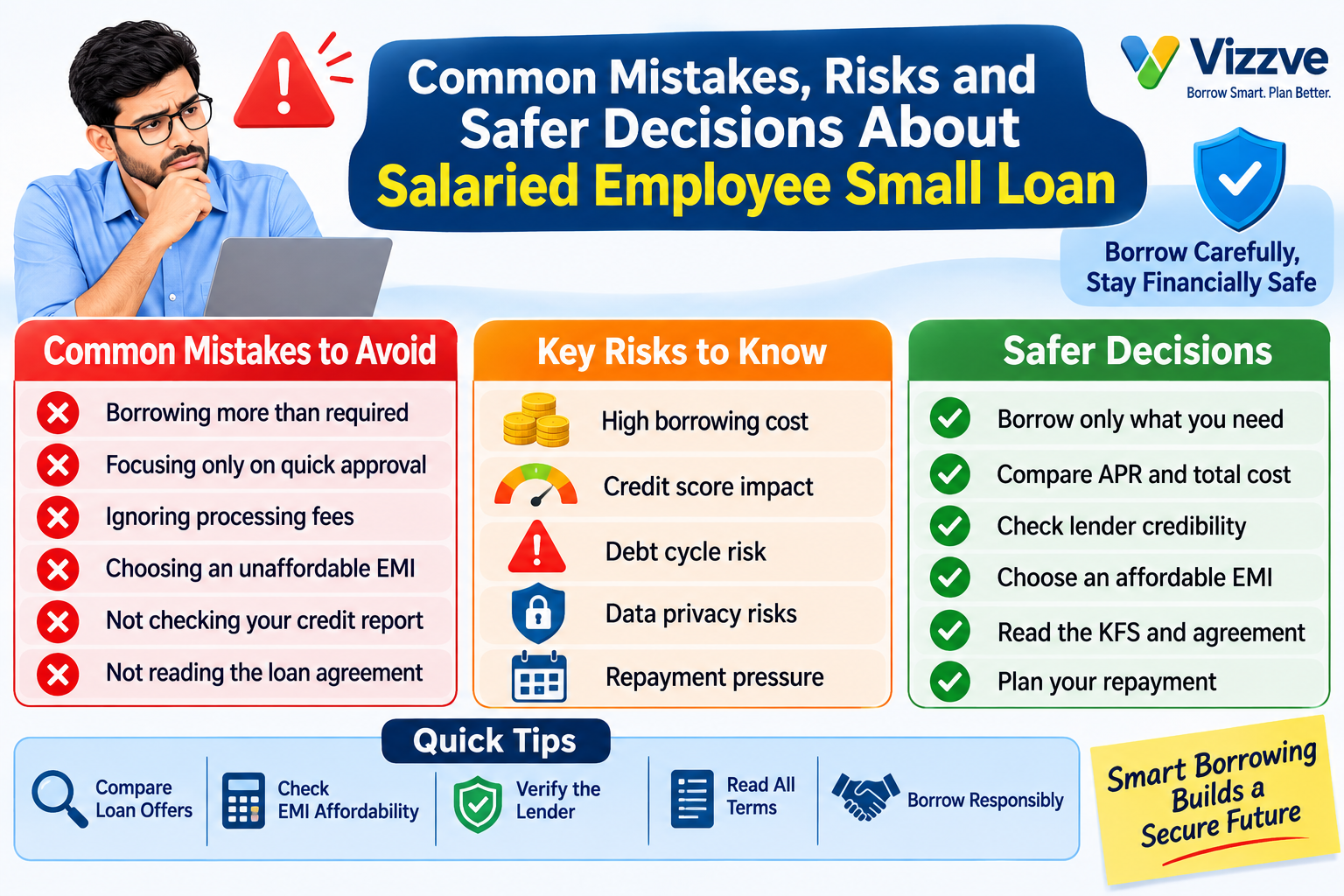
A small personal loan can help salaried employees manage unexpected expenses, medical bills, household requirements, education costs and urgent financial needs. However, borrowing without proper planning can create repayment pressure and affect long-term financial stability.
Many employees focus only on quick approval or the loan amount they can receive. They may overlook interest rates, processing fees, repayment conditions and the credibility of the lender.
Understanding common borrowing mistakes and possible risks can help salaried employees make safer financial decisions.
This guide explains the mistakes to avoid, risks to understand and practical precautions to follow before applying for a small loan in India.
AI Answer Box: What Mistakes Should Salaried Employees Avoid When Taking a Small Loan?
Salaried employees should avoid borrowing more than necessary, ignoring processing fees, choosing unaffordable EMIs, applying without checking lender credibility and accepting loan terms without reading the agreement. Before borrowing, compare APR, total repayment, repayment conditions and applicable charges. Always verify the lender and prepare a realistic repayment plan.
1. Common Mistakes When Applying for a Salaried Employee Small Loan
Mistake 1: Borrowing More Than Required
Some borrowers apply for a higher loan amount because they believe having extra money is useful.
However, borrowing more than necessary can increase interest costs and monthly repayment obligations.
Safer decision: Calculate your actual financial requirement and apply only for an amount you can comfortably repay.
Mistake 2: Focusing Only on Quick Approval
Fast approval and quick disbursement may seem attractive, especially during emergencies. But speed should not be the only factor when selecting a lender.
Safer decision: Check the lender's identity, loan terms, interest rate, APR and applicable charges before accepting an offer.
Mistake 3: Ignoring Processing Fees and Other Charges
A loan may appear affordable based on its advertised interest rate, but additional charges can increase the total borrowing cost.
Common charges may include:
-
Processing fees
-
Applicable GST
-
Late payment charges
-
Failed repayment transaction charges
-
Foreclosure or prepayment charges, where applicable
Safer decision: Request a complete breakdown of charges and compare the total repayment amount.
Mistake 4: Choosing an Unaffordable EMI
An EMI that looks small initially can become difficult to manage when combined with rent, household expenses and existing loan payments.
Safer decision: Calculate your monthly budget before selecting a loan tenure and EMI.
Mistake 5: Applying Without Checking Your Credit Report
Your credit history may influence the lender's assessment of your application.
Errors, missed payments or unfamiliar loan accounts can create problems during the application process.
Safer decision: Review your credit report and raise disputes for incorrect information where necessary.
Mistake 6: Not Reading the Loan Agreement
Accepting a loan without understanding its conditions can lead to unexpected repayment obligations.
Safer decision: Review the interest rate, APR, repayment schedule, penalties and other terms before accepting the agreement.
2. Major Risks of Taking a Small Personal Loan
|
Risk |
Possible impact |
|---|---|
|
High borrowing cost |
Higher total repayment |
|
Missed EMI payments |
Late charges and possible credit-report impact |
|
Excessive borrowing |
Financial pressure |
|
Multiple active loans |
Difficulty managing repayments |
|
Unverified loan applications |
Privacy and financial security risks |
|
Unclear loan terms |
Unexpected charges or conditions |
Financial Pressure
Taking a loan without checking your income and expenses can reduce the money available for essential monthly needs.
Credit Profile Impact
Missed or delayed payments may be reported to credit information companies and could negatively affect your credit profile.
Debt Cycle
Using one loan to repay another repeatedly may increase financial pressure and make it harder to become debt-free.
Data Privacy Risks
Unverified digital lending applications may request unnecessary access to personal information.
Always use verified and authorised channels.
3. Warning Signs of an Unsafe Loan Offer
Before applying, look out for these warning signs:
-
Guaranteed approval without proper assessment.
-
Requests for OTPs, UPI PINs or banking passwords.
-
Unclear interest rates or repayment conditions.
-
Hidden or unexplained charges.
-
Pressure to accept an offer immediately.
-
Payments requested to unknown personal accounts.
-
Unnecessary access to contacts, photos or private information.
-
No clear lender identity or grievance contact details.
Important safety reminder
4. How Salaried Employees Can Make Safer Borrowing Decisions
Step 1: Identify the Actual Financial Need
Understand why you need the loan and whether the expense is essential.
Step 2: Explore Other Financial Options
Depending on your circumstances, consider:
-
Using available emergency savings.
-
An employer salary advance.
-
Adjusting non-essential monthly expenses.
-
A suitable credit facility with transparent terms.
Compare the cost and conditions of each option.
Step 3: Compare Multiple Loan Offers
Do not select a loan based only on the advertised interest rate.
Compare APR, processing fees, repayment period and total amount payable.
Step 4: Check EMI Affordability
Make sure the proposed EMI fits your income after essential expenses and existing debt repayments.
Step 5: Verify the Lender
Confirm the identity of the bank or NBFC providing the loan. If an authorised lending service provider is involved, check the actual regulated lender behind the offer.
Step 6: Read the KFS and Agreement
Review the Key Facts Statement (KFS), where applicable, and the loan agreement before accepting the offer.
Step 7: Prepare a Repayment Plan
Keep sufficient funds available for EMI payments and set reminders for repayment dates.
5. Example: Understanding the Cost of Borrowing
Consider a hypothetical salaried employee who takes a small personal loan.
Illustrative loan example
Loan amount
₹25,000
Loan tenure
12 months
Annual interest rate
15%
Approximate EMI
₹2,257
Approximate total repayment
₹27,084
Illustrative calculation using monthly reducing-balance interest. Excludes processing fees, taxes and other charges. Actual lender calculations may differ.
Before accepting such a loan, the borrower should check whether the EMI is affordable after accounting for rent, food, transportation, utilities and existing financial commitments.
6. Responsible Borrowing Checklist
Use this checklist before submitting your application.
7. How to Manage Loan Repayments Safely
Getting a loan is only one part of responsible borrowing. Managing repayment is equally important.
Practical repayment tips:
-
Set reminders before the EMI due date.
-
Maintain sufficient balance in your repayment account.
-
Avoid unnecessary new borrowing.
-
Track every EMI payment.
-
Contact the lender promptly if you anticipate repayment difficulties.
-
Keep loan statements and payment confirmations.
-
Review your outstanding balance periodically.
Consistent repayment habits can help you maintain better financial discipline.
8. What to Do If You Face Loan Repayment Difficulties
Unexpected expenses, delayed salaries or changes in household income can make repayments difficult.
If you face a problem:
-
Contact the lender through official customer-support channels.
-
Explain the situation honestly.
-
Ask whether any permitted repayment options are available.
-
Understand the consequences of missed or delayed payments.
-
Avoid taking another high-cost loan without reviewing alternatives.
-
Keep written records of communication and payments.
Do not ignore repayment reminders or promises made by unauthorised agents.
9. Benefits of Making Safer Loan Decisions
|
Responsible action |
Potential benefit |
|---|---|
|
Borrowing only what is needed |
Lower repayment burden |
|
Comparing APR |
Better understanding of loan cost |
|
Checking EMI affordability |
Better monthly budgeting |
|
Verifying the lender |
Reduced risk of fraud |
|
Reading the agreement |
Fewer unexpected conditions |
|
Paying EMIs on time |
Supports a healthy credit history |
10. Frequently Asked Questions
1. What are the common mistakes when taking a small loan?
Common mistakes include borrowing more than required, ignoring fees, selecting unaffordable EMIs and not checking the lender's credibility.
2. Is a small personal loan always safe?
Not automatically. Safety depends on the lender, loan terms, total borrowing cost and the borrower's repayment capacity.
3. Can missed EMIs affect my credit score?
Yes. Missed or delayed payments may be reported to credit information companies and can negatively affect your credit profile.
4. Should I compare multiple loan offers?
Yes. Compare APR, interest rates, fees, tenure, EMI and total repayment before making a decision.
5. What is the biggest risk of borrowing more than required?
A higher loan amount can increase interest costs and create additional repayment pressure.
6. How can I check whether a loan app is genuine?
Verify the regulated lender behind the loan, use official channels, review the app's privacy practices and check the lender's contact and grievance details.
7. What is APR in a small personal loan?
APR represents the annualised cost of borrowing, including applicable charges.
8. Can I repay my small loan early?
Early repayment may be allowed depending on the loan agreement and applicable rules. Check whether prepayment or foreclosure charges apply.
9. What should I do if I cannot pay my EMI on time?
Contact the lender promptly through official channels, explain your situation and ask about available repayment options.
10. How can salaried employees borrow responsibly?
Borrow only what is necessary, compare total costs, verify the lender and select an EMI that fits the monthly budget.
11. Is a salary advance safer than a personal loan?
It depends on the employer or provider's terms, charges and repayment arrangement. Compare the actual cost and conditions.
12. Why should I read the Key Facts Statement?
The KFS helps borrowers understand important loan details, including APR, repayment schedule and applicable charges.
Key Takeaways
-
Avoid borrowing more than you actually need.
-
Do not choose a loan only because it offers quick approval.
-
Compare APR, processing fees and total repayment.
-
Check whether the EMI fits your monthly salary and expenses.
-
Verify the lender before sharing personal documents.
-
Read the KFS and loan agreement carefully.
-
Maintain a repayment plan to avoid unnecessary financial stress.
Expert Insights: Smart Borrowing for Financial Stability
Responsible borrowing means understanding both the benefits and risks of a loan before accepting it.
Salaried employees should evaluate their income stability, existing financial commitments and future expenses. A loan should support a genuine financial requirement rather than become a regular solution for managing monthly spending.
A transparent lender, affordable EMI and clear repayment plan are important parts of a safer borrowing decision.
Conclusion
A salaried employee small loan can help manage important financial needs, but careless borrowing may lead to repayment difficulties and additional costs. By avoiding common mistakes, checking lender credibility, comparing loan offers and planning EMIs carefully, employees can make more informed financial decisions.
Published on : 25th November
Published by : Siva Nagaiah K
www.vizzve.com || www.vizzveservices.com
Follow us on social media: Facebook || Linkedin || Instagram
🛡 Powered by Vizzve Financial
RBI-Registered Loan Partner | 10 Lakh+ Customers | ₹600 Cr+ Disbursed