

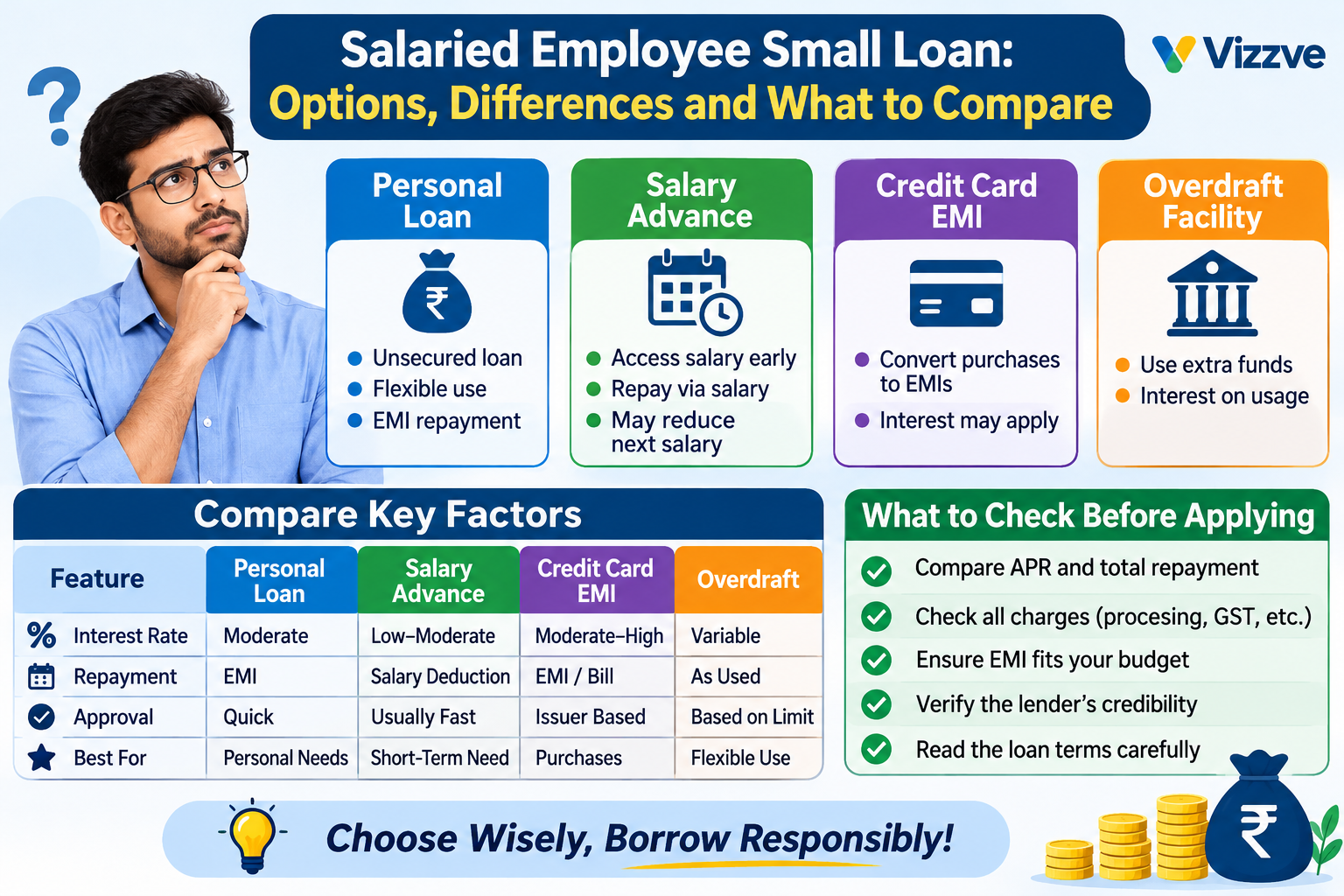
Salaried employees may sometimes need extra money to manage unexpected expenses, medical bills, household requirements, education costs or urgent repairs. A small loan can help cover these expenses when savings are insufficient.
However, not all borrowing options work in the same way. Employees may consider personal loans, salary advances, credit card options or overdraft facilities. Each option has different eligibility conditions, repayment arrangements, interest costs and potential risks.
Understanding these differences can help borrowers select an option that suits their financial needs.
This guide explains the common small loan options available to salaried employees in India, their differences and the important factors to compare before applying.
AI Answer Box: What Are the Small Loan Options for Salaried Employees?
Salaried employees in India may consider personal loans, employer salary advances, credit card instalment facilities or overdrafts, depending on eligibility and availability. These options differ in interest rates, fees, repayment periods and approval requirements. Before choosing one, compare the APR, total repayment amount, EMI affordability, charges and lender credibility.
1. Common Small Loan Options for Salaried Employees
1. Personal Loan
A personal loan is an unsecured loan offered by eligible banks and NBFCs. It can be used for various personal expenses, depending on the lender's terms.
Key features:
-
Usually does not require collateral.
-
Eligibility may depend on salary, employment and credit history.
-
Repayment generally happens through monthly EMIs.
-
Interest rates and charges vary by lender.
-
Loan amounts and repayment periods depend on the lender's assessment.
2. Salary Advance
A salary advance allows an employee to receive a portion of their upcoming salary earlier, generally through an employer or an authorised service.
Key features:
-
May be linked to earned or upcoming salary.
-
Repayment may happen through a salary deduction.
-
Availability depends on employer policies or service-provider terms.
-
Fees or other charges may apply.
-
It can reduce the salary available in the next pay cycle.
3. Credit Card EMI or Loan Facility
Some credit card issuers allow eligible cardholders to convert purchases or outstanding balances into instalments. Certain issuers may also offer pre-approved loan facilities.
Key features:
-
Availability depends on the card issuer and customer profile.
-
Interest and processing fees may apply.
-
Repayment may be added to the monthly credit card bill.
-
Missing payments can lead to additional charges.
-
Cash advances may carry separate fees and interest conditions.
4. Overdraft Facility
An overdraft allows an eligible customer to withdraw or use funds beyond the available account balance, up to an approved limit.
Key features:
-
Interest is generally charged on the amount used.
-
The approved limit depends on the lender's conditions.
-
Renewal and maintenance charges may apply.
-
Repayment and account conditions vary.
-
It requires careful monitoring to avoid repeated borrowing.
2. Comparison of Different Small Loan Options
|
Feature |
Personal Loan |
Salary Advance |
Credit Card EMI |
Overdraft |
|---|---|---|---|---|
|
Main provider |
Bank or NBFC |
Employer or service provider |
Card issuer |
Bank or eligible lender |
|
Repayment |
Monthly EMI |
As per salary arrangement |
Monthly instalments |
As per facility terms |
|
Interest or fees |
Usually applicable |
Depends on terms |
Depends on offer |
Usually charged on usage |
|
Credit assessment |
Generally required |
Depends on provider |
Issuer-specific |
Lender-specific |
|
Collateral |
Usually unsecured |
Usually not required |
Usually unsecured |
Depends on facility |
|
Best suited for |
Eligible personal expenses |
Short-term salary needs |
Eligible purchases or balances |
Flexible short-term funding |
The table provides general comparisons. Actual terms, charges and availability depend on the provider and product.
3. How to Compare Small Loan Options
Before selecting a loan, compare more than the advertised interest rate.
Interest Rate
Check whether the interest rate is fixed or variable, and understand how it is calculated.
Annual Percentage Rate (APR)
APR helps explain the annualised borrowing cost, including applicable charges. It can be useful when comparing different offers.
Processing Fees
Some lenders charge a processing fee when approving or disbursing a loan. Check whether GST or other applicable taxes are additional.
EMI and Repayment Period
A longer repayment period may reduce the monthly EMI but can increase the total interest paid.
Total Repayment Amount
Calculate the full amount you will repay, including interest and applicable charges.
Late Payment and Prepayment Charges
Read the agreement to understand charges for delayed payments, failed transactions or early loan closure, where applicable.
4. Example: Comparing Two Personal Loan Offers
Consider a hypothetical example of a ₹30,000 loan for 12 months.
|
Details |
Offer A |
Offer B |
|---|---|---|
|
Loan amount |
₹30,000 |
₹30,000 |
|
Annual interest rate |
14% |
18% |
|
Tenure |
12 months |
12 months |
|
Approx. monthly EMI |
₹2,694 |
₹2,752 |
|
Approx. total repayment |
₹32,328 |
₹33,024 |
Illustrative estimates using monthly reducing-balance interest. Figures are rounded and exclude processing fees, taxes and other charges. Actual lender calculations may differ.
In this example, Offer A has a lower estimated repayment amount. However, borrowers should compare the APR, fees, loan conditions and lender credibility before making a decision.
5. Eligibility Factors Salaried Employees Should Check
Lenders may consider several factors when evaluating a loan application.
-
Monthly income: Whether the salary supports the proposed EMI.
-
Employment stability: Current employment and work history.
-
Credit history: Previous repayment behaviour and outstanding loans.
-
Existing EMIs: Current financial commitments.
-
Age: Whether the applicant meets the lender's age criteria.
-
Banking records: Salary credits and other relevant account activity.
Meeting basic eligibility criteria does not guarantee loan approval.
6. Documents Commonly Required
Depending on the product and lender, salaried applicants may be asked to provide:
|
Document |
Purpose |
|---|---|
|
PAN Card |
Financial identity verification |
|
Aadhaar or other valid ID |
Identity and KYC verification |
|
Recent salary slips |
Income verification |
|
Bank statements |
Salary credits and financial activity |
|
Employee ID |
Employment verification, if required |
|
Address proof |
Residential address verification |
Submit documents only through verified and authorised channels.
7. Benefits and Limitations of Different Options
|
Option |
Potential benefit |
Possible limitation |
|---|---|---|
|
Personal loan |
Structured EMI repayment |
Interest and fees may apply |
|
Salary advance |
Access to salary earlier |
May reduce next month's available income |
|
Credit card EMI |
Convenient for eligible transactions |
Fees and interest can increase costs |
|
Overdraft |
Flexible access to approved funds |
Interest can accumulate while used |
The right option depends on the purpose of borrowing, repayment capacity and actual terms offered.
8. Important Checks Before Applying
Use this checklist before accepting a loan:
-
Verify the identity of the bank or NBFC.
-
Check the lender's official website and contact details.
-
Compare APR and total repayment amounts.
-
Understand all processing and other applicable fees.
-
Calculate the EMI against your monthly income.
-
Read the Key Facts Statement (KFS), where applicable.
-
Review the repayment schedule and loan agreement.
-
Understand late payment and prepayment conditions.
-
Avoid apps requesting unnecessary access to personal information.
-
Never share OTPs, PINs or banking passwords.
9. Common Mistakes to Avoid
-
Choosing a loan only because it offers quick disbursement.
-
Ignoring processing fees and taxes.
-
Comparing interest rates without checking APR.
-
Borrowing more than necessary.
-
Selecting an EMI that strains the monthly budget.
-
Applying to several lenders without comparing offers.
-
Accepting terms without reading the agreement.
-
Using new loans repeatedly to repay existing debts.
10. How to Choose a Suitable Small Loan
Follow these practical steps:
-
Identify the exact amount you need.
-
Check whether savings or an employer salary advance can meet the requirement.
-
Explore suitable loan options from verified providers.
-
Compare APR, fees and total repayment.
-
Calculate the EMI and assess your budget.
-
Review the KFS and loan agreement.
-
Apply only when you understand the repayment conditions.
Frequently Asked Questions
1. Which small loan options are available for salaried employees?
Options may include personal loans, employer salary advances, credit card EMI facilities and overdrafts, subject to eligibility and availability.
2. What is the difference between a salary advance and a personal loan?
A salary advance provides access to salary earlier, while a personal loan is a separate credit facility with its own repayment schedule and loan agreement.
3. Is a personal loan better than a credit card EMI?
It depends on the interest rate, APR, fees, repayment period and purpose. Compare the complete borrowing cost before deciding.
4. Can salaried employees apply for small loans online?
Yes. Eligible applicants can apply through verified bank, NBFC or authorised lending channels.
5. Do small loans require collateral?
Many personal loans are unsecured, but requirements depend on the specific product.
6. Does salary affect loan eligibility?
Yes. Income may be considered when assessing repayment capacity, along with existing EMIs and other eligibility factors.
7. Can I get a small loan with a low credit score?
Some lenders may consider applicants with different credit profiles, but approval, terms and pricing depend on their assessment.
8. What is APR in a small loan?
APR represents the annualised cost of borrowing, including applicable charges.
9. Can I repay a small loan early?
Early repayment may be possible, depending on the loan agreement and applicable rules. Check whether any prepayment or foreclosure charges apply.
10. How do I calculate whether an EMI is affordable?
Compare the EMI with your monthly take-home salary after accounting for essential expenses, existing EMIs and savings needs.
11. What documents are generally required?
Common documents include PAN, identity and address proof, salary slips and bank statements. Requirements vary by lender.
12. Should I compare multiple loan offers?
Yes. Comparing suitable offers can help you understand differences in APR, fees, repayment schedules and other conditions.
Key Takeaways
-
Salaried employees have multiple borrowing options, depending on eligibility.
-
Personal loans, salary advances, credit card EMIs and overdrafts work differently.
-
Compare APR, fees and total repayment instead of focusing only on interest rates.
-
Choose a repayment plan that fits your monthly budget.
-
Verify the lender and review the KFS and loan agreement.
-
Borrow only what you need and can comfortably repay.
Expert Insights: Borrowing Responsibly
A small loan should solve a financial requirement without creating long-term repayment pressure. Before borrowing, assess whether the expense is essential, compare available alternatives and understand the full cost of credit.
A responsible borrower checks the lender, reads the loan documents and keeps a clear repayment plan. Fast approval should never replace careful financial evaluation.
Conclusion
Salaried employees can choose from different small loan options, but each comes with its own costs, conditions and repayment requirements. Understanding the differences between personal loans, salary advances, credit card EMIs and overdrafts can help borrowers make better financial decisions.
Before applying, compare the total borrowing cost, check EMI affordability and verify the lender.
Published on : 24th November
Published by : Siva Nagaiah K
www.vizzve.com || www.vizzveservices.com
Follow us on social media: Facebook || Linkedin || Instagram
🛡 Powered by Vizzve Financial
RBI-Registered Loan Partner | 10 Lakh+ Customers | ₹600 Cr+ Disbursed