

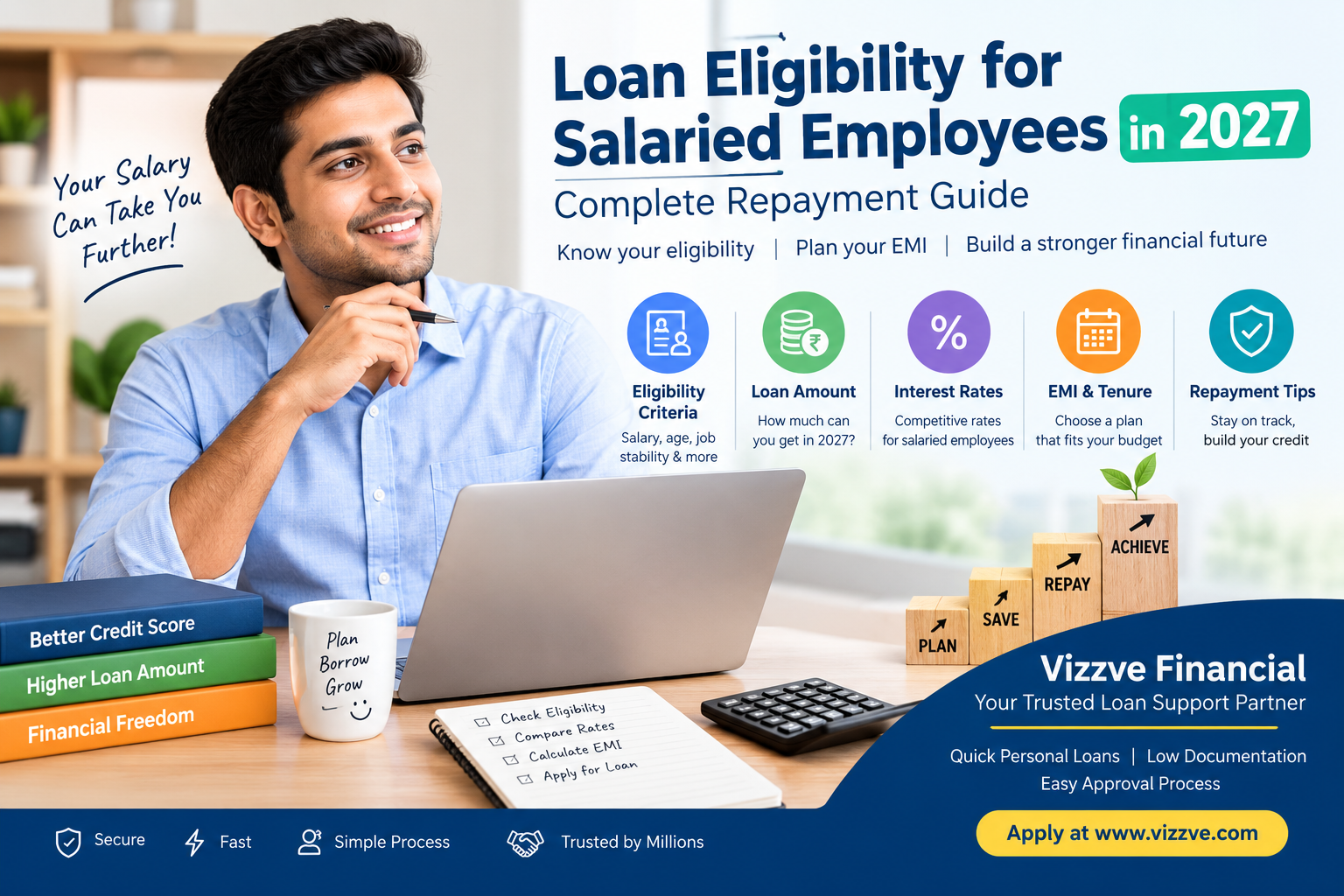
For salaried employees, a predictable monthly income can make personal-loan planning easier. However, salary alone does not determine loan eligibility.
When a bank or NBFC evaluates a salaried borrower, it may consider income, existing EMIs, employment profile, credit history, repayment capacity, age, requested loan amount, tenure, banking information and the lender's own credit policy.
This becomes particularly important when planning for a loan in 2027. Borrowers should avoid relying on a single online eligibility number because lenders can use different underwriting models and criteria.
The better approach is to understand how lenders generally assess repayment capacity and then choose a loan amount and EMI that comfortably fit the monthly budget.
This guide explains:
- How salaried employees can prepare for a personal loan in 2027
- Factors that may affect loan eligibility
- How salary and existing EMIs influence borrowing capacity
- How to estimate an affordable EMI
- How credit history can affect loan applications
- Which documents may be requested
- How to compare loan offers
- How to avoid repayment problems
- What to do if an EMI becomes difficult to manage
Important: Eligibility criteria, interest rates, loan amounts, fees and approval decisions vary by lender. The examples in this article are illustrative and should not be treated as guaranteed loan offers.
AI Answer Box: Loan Eligibility for Salaried Employees in 2027
Short answer: A salaried employee's personal-loan eligibility in 2027 will generally depend on factors such as monthly income, existing debt obligations, credit history, employment stability, age, requested amount, repayment tenure and the lender's internal credit policy.
There is no single salary-to-loan formula that applies to every bank or NBFC.
For example, two employees earning the same monthly salary could receive different loan offers because their existing EMIs, credit histories, employment profiles and requested loan amounts may differ.
Before accepting a loan, borrowers should compare:
- Interest rate
- APR or overall borrowing cost
- Processing fee
- Penal charges
- Prepayment or foreclosure terms
- EMI
- Total repayment amount
- Loan tenure
- Key Fact Statement (where applicable)
For digital lending, RBI regulations require regulated entities to provide important loan information, including the applicable cost information through the prescribed Key Fact Statement framework.
What Is Loan Eligibility for a Salaried Employee?
Loan eligibility refers to the amount and terms a lender determines a borrower can reasonably qualify for based on its underwriting criteria.
For a salaried applicant, the assessment may include:
1. Monthly income
A higher and consistent income can improve repayment capacity, although it does not automatically guarantee approval.
Lenders may consider salary credited to a bank account, salary slips, Form 16, income-tax information or other acceptable income evidence.
2. Existing financial obligations
Suppose an employee earns ₹70,000 per month but already pays ₹30,000 toward existing EMIs.
The lender may view this differently from another employee earning ₹70,000 with only ₹8,000 in existing monthly debt obligations.
This is why net disposable income and existing debt commitments matter.
3. Credit history
Credit repayment behaviour provides lenders with information about previous borrowing.
Late payments, defaults, excessive outstanding debt or multiple recent credit applications can affect how a lender evaluates an application.
4. Employment profile
Lenders may look at:
- Employer type
- Employment stability
- Current job tenure
- Industry
- Salary consistency
- Employment status
Government employees, employees of established private companies and employees of smaller organisations may be assessed differently depending on the lender's policies.
5. Loan amount and tenure
A large loan relative to income can increase the repayment burden.
A longer tenure can reduce the monthly EMI but may increase the total interest paid over the life of the loan.
Key Factors That May Affect Salaried Employee Loan Eligibility in 2027
| Factor | Why It Matters |
|---|---|
| Monthly salary | Indicates income available for repayment |
| Existing EMIs | Determines current debt burden |
| Credit history | Shows previous repayment behaviour |
| Employment stability | Helps assess income continuity |
| Age | May influence permissible tenure |
| Loan amount | Determines overall repayment obligation |
| Loan tenure | Affects EMI and total interest |
| Employer profile | May be part of lender-specific underwriting |
| Bank statements | Can help verify income and cash flow |
| Existing liabilities | Affect disposable income |
| Loan purpose | May be relevant depending on product |
| Credit applications | Multiple recent applications may affect the credit profile |
How Much Personal Loan Can a Salaried Employee Get in 2027?
There is no universal answer.
A lender may calculate an eligible amount after assessing income, existing liabilities, credit profile and its own risk parameters.
Instead of asking only:
“How much loan can I get?”
a more useful question is:
“What loan amount can I comfortably repay every month?”
This distinction is important.
A lender may approve a particular amount, but approval does not necessarily mean that amount is ideal for your personal budget.
Example
Consider a hypothetical employee with:
- Monthly take-home salary: ₹70,000
- Existing EMI: ₹8,000
- Proposed personal-loan EMI: ₹15,000
- Other regular household expenses: ₹30,000
The employee's approximate monthly outflow would include:
₹8,000 + ₹15,000 + ₹30,000 = ₹53,000
That leaves approximately ₹17,000 before accounting for other savings, insurance, investments and irregular expenses.
The example shows why affordability should be assessed separately from lender eligibility.
Salary-Based Loan Eligibility: A Practical Way to Estimate Affordability
There is no RBI-mandated universal EMI percentage for every personal-loan applicant.
However, borrowers can use a personal budgeting approach.
Step 1: Calculate monthly take-home income
Use the amount actually available after deductions rather than relying only on annual CTC.
For example:
Annual CTC: ₹9,60,000
Monthly CTC: ₹80,000
But if the actual monthly salary credited after deductions is ₹68,000, the EMI budget should be based primarily on the borrower's realistic cash flow.
Step 2: List all existing EMIs
Include:
- Home-loan EMI
- Car-loan EMI
- Education-loan EMI
- Existing personal-loan EMI
- Consumer-durable loans
- Other formal debt obligations
Step 3: Calculate the proposed EMI
Use the proposed loan amount, interest rate and tenure.
Step 4: Stress-test the budget
Ask:
Could I still make this EMI if my monthly expenses increased unexpectedly?
This is especially useful for employees with variable household expenses.
Personal Loan EMI Example for a Salaried Employee
Consider a hypothetical personal loan of ₹5 lakh at an illustrative interest rate of 12% per annum.
Example 1: 3-year tenure
Approximate EMI: ₹16,607
Total repayment: approximately ₹5.98 lakh
Approximate interest: approximately ₹97,850
Example 2: 5-year tenure
Approximate EMI: ₹11,122
Total repayment: approximately ₹6.67 lakh
Approximate interest: approximately ₹1.67 lakh
What does this demonstrate?
The five-year option has a lower monthly EMI, but the borrower pays considerably more interest over the longer repayment period.
Therefore:
Lower EMI does not automatically mean lower loan cost.
Borrowers should compare both EMI affordability and total repayment.
Loan Tenure vs EMI: Which Matters More?
Both matter, but they answer different questions.
| Tenure | EMI | Total Interest | Cash-Flow Pressure |
|---|---|---|---|
| Shorter | Higher | Usually lower | Higher |
| Medium | Moderate | Moderate | Moderate |
| Longer | Lower | Usually higher | Lower |
A shorter tenure can reduce total interest but requires a larger monthly payment.
A longer tenure can make the EMI easier to manage but may increase the overall cost.
A practical approach
Choose a tenure that:
- Keeps the EMI manageable.
- Does not unnecessarily extend the debt.
- Leaves room for emergency savings.
- Fits expected income stability.
What Credit Score Is Needed for a Personal Loan in 2027?
There is no single credit-score cutoff that applies to every lender.
Credit score is one part of a broader credit profile.
A lender may also consider:
- Payment history
- Existing outstanding loans
- Credit utilisation
- Number and type of accounts
- Recent credit applications
- Income
- Employment
- Internal lender policies
Therefore, borrowers should not assume that a particular score guarantees approval.
How to Prepare Your Credit Profile
Before applying:
- Pay existing EMIs on time.
- Avoid unnecessary new credit applications.
- Review your credit report for errors.
- Keep credit-card balances under control.
- Close or resolve inaccurate outstanding accounts where appropriate.
- Maintain accurate personal information with lenders.
RBI's credit-information framework has also moved to more frequent reporting. From January 1, 2025, credit information is required to be updated on a fortnightly basis, or at shorter intervals where agreed.
This means borrowers should pay attention to the accuracy and timeliness of their credit information.
Does Salary Account Improve Personal Loan Eligibility?
A salary account can make income verification easier when salary credits are visible through bank statements.
However, having a salary account with a particular bank does not automatically guarantee loan approval.
A lender can still assess:
- Income
- Existing obligations
- Credit profile
- Employment
- Requested loan amount
- Repayment capacity
- Internal eligibility criteria
Documents Required for Salaried Employees
The exact documentation varies by lender, but salaried borrowers may be asked for:
Identity and KYC
- PAN
- Aadhaar or other accepted identity/address proof
- Photograph where required
Income documents
- Recent salary slips
- Bank statements showing salary credits
- Form 16
- Income-tax documents where applicable
Employment information
- Employee ID
- Employer details
- Office address
- Employment history where required
Banking information
Depending on the lender and application channel, bank-account information may be required for verification and disbursement.
Tip: Never submit documents through unofficial websites, unknown links or individuals claiming to guarantee approval.
Step-by-Step: How Salaried Employees Can Prepare for a 2027 Loan
Step 1: Check your monthly cash flow
Write down:
- Net salary
- Existing EMIs
- Rent
- Household expenses
- Insurance premiums
- Investments
- School or education expenses
- Emergency savings contribution
This provides a realistic picture of affordability.
Step 2: Review your credit report
Look for:
- Incorrect overdue amounts
- Duplicate accounts
- Incorrect personal details
- Loans that have already been closed but still appear active
- Unrecognised credit enquiries
Report genuine errors through the appropriate credit-information or lender grievance process.
Step 3: Decide the actual borrowing requirement
Do not automatically apply for the maximum amount displayed by an eligibility calculator.
Borrow according to your actual need.
Step 4: Compare multiple offers
Check:
- Interest rate
- APR
- EMI
- Processing fee
- Other charges
- Penal charges
- Prepayment terms
- Foreclosure terms
- Total repayment
Step 5: Read the Key Fact Statement
For applicable loans, the KFS is designed to present important loan information in a standardised and understandable format.
Do not accept a loan merely because the advertised interest rate appears low.
Look at the overall cost.
Step 6: Verify the lender or regulated entity
For digital loans, borrowers should verify the lending arrangement and avoid unauthorised applications.
RBI has introduced a public repository framework for digital lending apps associated with regulated entities to help consumers verify such claims.
Step 7: Apply only when ready
Avoid submitting numerous applications simply to see which one approves you.
How to Improve Loan Eligibility Before Applying in 2027
1. Reduce existing debt
If possible, reducing existing debt obligations can improve monthly cash flow.
2. Maintain timely repayments
Payment discipline is one of the most important parts of responsible borrowing.
3. Avoid unnecessary borrowing
Do not take a personal loan simply because you are eligible for one.
4. Keep your credit information accurate
Review your credit report periodically and raise disputes where genuine errors exist.
5. Maintain stable employment
Frequent job changes are not automatically negative, but employment stability may be considered by some lenders.
6. Keep your documents ready
A complete application can reduce unnecessary delays caused by missing information.
7. Choose the loan amount carefully
A smaller loan that solves the actual need can be easier to manage than a larger loan taken for discretionary spending.
Personal Loan Repayment Guide for 2027
Getting approved is only the first stage.
The real financial responsibility begins when repayment starts.
Create an EMI Calendar
Record:
- EMI date
- EMI amount
- Loan account number
- Outstanding principal
- Interest rate
- Remaining tenure
- Prepayment conditions
Set a reminder several days before the due date.
Maintain an EMI Buffer
If possible, maintain sufficient funds in the repayment account before the EMI date.
A missed EMI can create additional charges and may affect the borrower's credit record.
Avoid Using One Loan to Pay Another
Repeatedly taking new debt to repay existing debt can create a debt cycle.
If repayment becomes difficult, contact the lender early rather than waiting for multiple missed payments.
What Happens If You Miss a Personal Loan EMI?
The exact consequences depend on the loan agreement and lender.
Possible consequences can include:
- Penal charges
- Additional financial cost
- Collection communications
- Negative credit reporting
- Difficulty obtaining future credit
RBI rules require regulated entities to follow transparency requirements around penal charges. Such charges are not meant to function as an additional interest-rate component, and penal charges cannot be capitalised under the relevant RBI framework.
If you know you may miss an EMI
Contact the lender as soon as possible.
Ask about:
- Payment options
- Due-date procedures
- Applicable charges
- Restructuring or assistance options, if available
- How the issue will be reported to credit-information companies
Do not ignore the lender.
Floating Interest Rate Personal Loans: What Borrowers Should Know
Some personal loans may have floating interest rates.
In such cases, changes in the applicable benchmark or interest rate can affect the repayment structure depending on the loan agreement.
RBI's framework for EMI-based floating-rate personal loans requires regulated entities to communicate the impact of interest-rate resets and provide borrowers with specified options under the applicable framework.
Borrowers should therefore understand:
- Whether the rate is fixed or floating
- What benchmark is used
- How often the rate can reset
- Whether EMI can change
- Whether tenure can change
- What options are available after a rate reset
Key Fact Statement: Why It Matters
The Key Fact Statement (KFS) is an important document for understanding the cost and major terms of an applicable loan.
For digital lending, RBI's guidelines require important information such as the Annual Percentage Rate (APR) and other prescribed loan details to be disclosed through the KFS framework.
Before accepting an offer, check:
- Loan amount
- Interest rate
- APR
- Processing charges
- Insurance or other charges, if applicable
- Penal charges
- Repayment schedule
- Prepayment conditions
- Other important terms
Simple rule
Never compare loans only by advertised interest rate. Compare the total borrowing cost.
Loan Eligibility Comparison: Salaried Borrowers
| Borrower Profile | Potential Strength | Possible Concern |
|---|---|---|
| Stable salaried employee with low existing debt | Stronger repayment capacity | Still subject to lender criteria |
| High salary with several existing EMIs | Higher income | High debt obligations |
| Moderate salary with clean repayment history | Predictable repayment behaviour | Lower absolute borrowing capacity may apply |
| New-to-credit employee | Stable income | Limited credit history |
| Employee with recent missed payments | Income may be adequate | Credit history can affect assessment |
| Employee with multiple recent loan applications | Income may be adequate | Recent credit activity may require closer assessment |
This table is illustrative. It does not predict approval.
Pros and Cons of Taking a Personal Loan
Pros
- No collateral may be required for many personal loans.
- Can provide funds for planned or unexpected expenses.
- Fixed EMI structures can make budgeting easier.
- Digital applications may reduce paperwork.
- Suitable borrowers may receive faster decisions.
Cons
- Interest increases the total cost of borrowing.
- Missed payments can create additional costs.
- Excessive borrowing can reduce monthly financial flexibility.
- Long tenures can increase total interest.
- Multiple loan applications can complicate credit planning.
- Personal loans may cost more than some secured forms of credit.
Personal Loan vs Other Borrowing Options
| Factor | Personal Loan | Credit Card | Secured Loan |
|---|---|---|---|
| Collateral | Usually not required | Not required | Usually required |
| Interest cost | Varies by lender | Often higher if unpaid | Varies |
| Repayment | Usually fixed EMI | Revolving/flexible | Usually structured |
| Processing | Often digital | Usually instant access after approval | Can require more documentation |
| Suitable for | Defined borrowing need | Short-term spending | Larger secured borrowing |
| Risk | Debt obligation | High cost if revolved | Asset may be at risk if default occurs |
The right borrowing option depends on the amount, purpose, cost and repayment capacity.
Common Mistakes Salaried Borrowers Should Avoid in 2027
Mistake 1: Borrowing the maximum eligible amount
Eligibility is not the same as affordability.
Mistake 2: Choosing the lowest EMI without checking total cost
A long tenure can reduce EMI while increasing total interest.
Mistake 3: Ignoring processing charges
A lower advertised rate may not mean a lower overall cost.
Mistake 4: Skipping the KFS
Important costs and terms should be reviewed before accepting applicable digital or regulated loan offers.
Mistake 5: Applying through unknown loan apps
Use official lender websites and verified channels.
Mistake 6: Paying unofficial agents
Never pay an unknown person claiming they can guarantee loan approval.
Mistake 7: Ignoring credit-report errors
Incorrect information can create avoidable complications.
Mistake 8: Missing EMI dates
Set reminders and maintain sufficient funds.
Real-World Repayment Scenario
Consider Rahul, a hypothetical salaried employee earning ₹60,000 per month.
He already has:
- Car-loan EMI: ₹7,000
- Credit-card repayment: ₹3,000
- Household expenses: ₹25,000
He considers a new personal loan with an EMI of ₹12,000.
His approximate monthly commitments become:
₹7,000 + ₹3,000 + ₹25,000 + ₹12,000 = ₹47,000
Approximate balance:
₹60,000 − ₹47,000 = ₹13,000
At first glance, the EMI appears manageable.
But Rahul should also consider:
- Emergency savings
- Medical expenses
- Insurance
- Annual expenses
- Family obligations
- Investments
- Potential income disruption
The lesson is simple:
A loan should fit the complete household budget, not just the lender's eligibility calculation.
Expert Commentary: What Responsible Borrowing Looks Like
From a financial-planning perspective, the most important part of personal-loan eligibility is not simply securing the largest possible sanction.
A responsible borrower should evaluate the entire repayment journey.
Three questions are particularly useful:
Can I afford the EMI?
The EMI should fit comfortably into monthly cash flow.
Can I handle an unexpected expense?
An emergency fund can reduce the risk of borrowing again when an unexpected expense occurs.
Do I understand the total cost?
Interest, processing fees, applicable charges and the repayment period should all be considered.
The RBI's consumer-protection framework increasingly emphasises transparency around loan costs, digital lending and credit information. Borrowers should use these disclosures to make informed decisions rather than relying solely on advertisements.
Trust and Safety Checklist for Digital Loan Applications
Before submitting an online loan application:
- Verify the official website.
- Check the lender/regulated entity relationship.
- Read the privacy policy and terms.
- Review the KFS where applicable.
- Confirm the APR and total charges.
- Never share OTPs with unknown individuals.
- Never pay an unofficial “approval fee.”
- Avoid applications received through suspicious links.
- Keep copies of important loan documents.
- Use official repayment channels.
RBI has specifically addressed concerns around unauthorised digital lending apps and misleading claims of association with regulated entities.
Published on : 30th September
Published by : Shanlee JV
www.vizzve.com || www.vizzveservices.com
Follow us on social media: Facebook || Linkedin || Instagram
🛡 Powered by Vizzve Financial
RBI-Registered Loan Partner | 10 Lakh+ Customers | ₹600 Cr+ Disbursed