

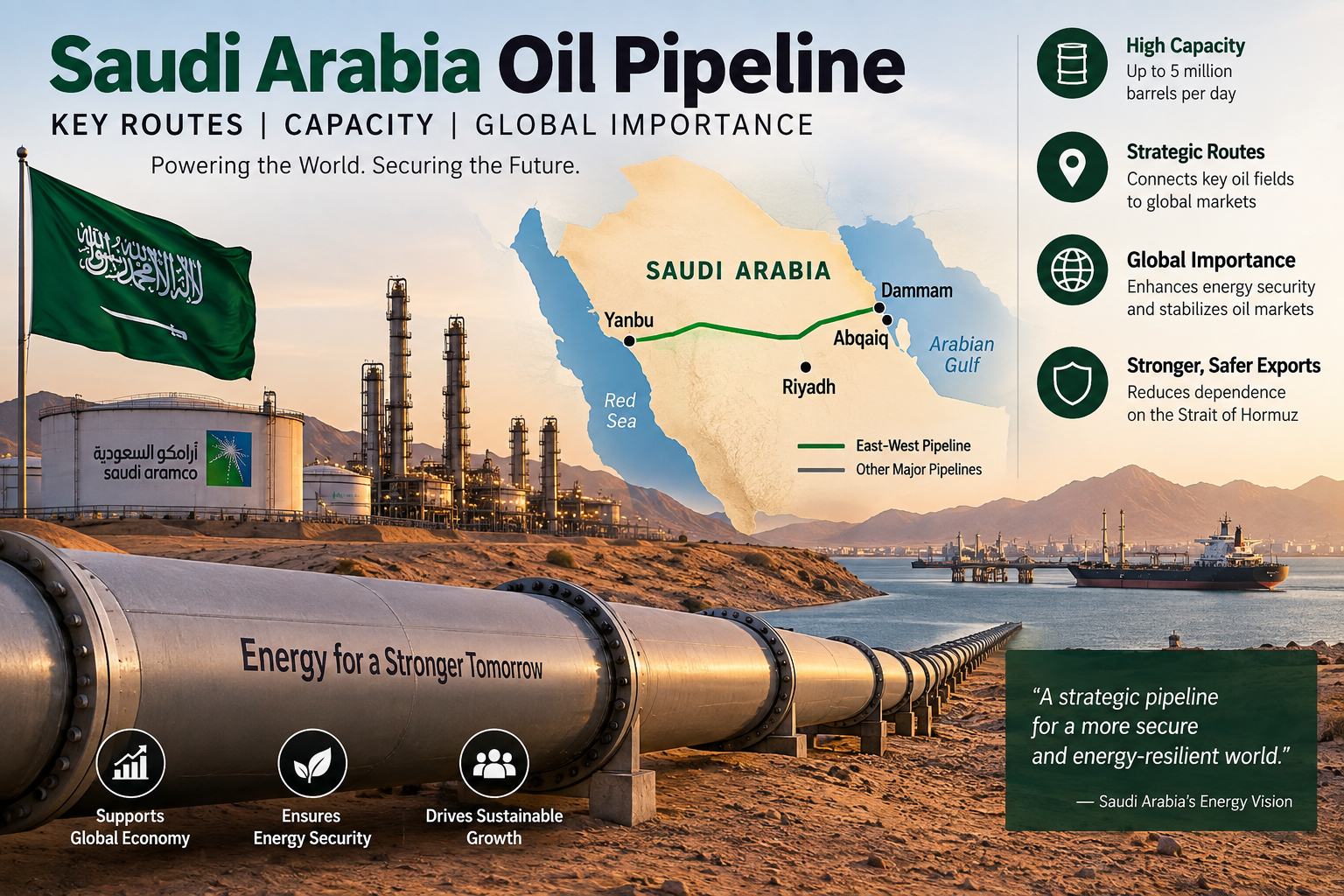
Saudi Arabia is one of the world's most important oil-producing countries, and its pipeline network plays a central role in moving crude oil from production and processing facilities to export terminals and refineries.
At the heart of this system is the East-West Crude Oil Pipeline, widely known as Petroline. It crosses Saudi Arabia from the eastern oil-producing region to Yanbu on the Red Sea, giving the Kingdom an alternative route for moving crude without relying entirely on the Strait of Hormuz.
The importance of this infrastructure has become even clearer during the energy disruptions of 2026. The International Energy Agency says Saudi Arabia rapidly increased crude flows through the East-West Pipeline during the 2026 Strait of Hormuz crisis, with Yanbu exports rising to more than 5 million barrels per day in early June.
More recently, on September 11–12, 2026, Saudi authorities reported attacks that led to a temporary shutdown of the East-West Pipeline. Reuters reported that the approximately 1,200-kilometre system had been capable of transporting up to 5 million barrels per day under its traditional design capacity, highlighting both its strategic value and its vulnerability.
This makes Saudi Arabia's oil pipeline network more than just transportation infrastructure. It is an important part of global energy security, export diversification and oil-market resilience.
Saudi Arabia's most important crude oil pipeline is the East-West Pipeline, or Petroline. It transports crude oil from the Abqaiq area in eastern Saudi Arabia across the Kingdom to Yanbu on the Red Sea. Its original design capacity was about 5 million barrels per day, while Saudi Aramco has reported that the system can reach 7 million barrels per day under expanded operating conditions.
The pipeline is strategically important because it provides Saudi Arabia with a route toward the Red Sea that can reduce dependence on the Strait of Hormuz.
According to Saudi Aramco, the East-West Pipeline reached 7 million barrels per day of maximum capacity in the first quarter of 2026, supporting exports from Saudi Arabia's west coast.
What Is the East-West Oil Pipeline?
The East-West Crude Oil Pipeline is Saudi Arabia's principal cross-country crude oil pipeline system.
It connects the Kingdom's major eastern oil-processing infrastructure with export and refining facilities on the Red Sea coast.
Key facts
| Feature | Details |
|---|---|
| Common name | East-West Pipeline / Petroline |
| Main route | Abqaiq area to Yanbu |
| Direction | East to West |
| Approximate length | About 1,200 km |
| Traditional design capacity | 5 million barrels per day |
| Expanded operating capacity | Up to 7 million barrels per day |
| Western export hub | Yanbu |
| Operator | Saudi Aramco |
| Strategic purpose | Diversify crude export routes |
The U.S. Energy Information Administration describes the East-West Pipeline as a route that can allow Saudi Arabia to move crude toward the Red Sea while bypassing the Strait of Hormuz.
Where Does the Saudi East-West Pipeline Start and End?
The pipeline begins in Saudi Arabia's eastern oil-producing and processing region, particularly around the Abqaiq oil-processing complex, and runs westward across the Kingdom.
Its principal destination is Yanbu, a major industrial and oil-export center on the Red Sea.
Simplified route
Eastern Saudi oil fields and processing facilities
↓
Abqaiq
↓
East-West Pipeline / Petroline
↓
Central and western Saudi Arabia
↓
Yanbu
↓
Red Sea export markets and refineries
This east-to-west route is strategically significant because tankers loading at Yanbu can avoid sailing through the Strait of Hormuz.
How Much Oil Can Saudi Arabia's East-West Pipeline Carry?
The answer depends on whether we are discussing the pipeline's original installed capacity or its expanded operational capability.
Historically, the East-West Pipeline has had a 5 million barrels per day design capacity.
However, Saudi Aramco has reported that it increased the system's capacity to 7 million barrels per day under expanded operating conditions.
In its first-quarter 2026 results, Aramco said the East-West Pipeline had been sharply ramped up and reached its 7 million-barrel-per-day maximum capacity during the quarter.
The International Energy Agency also notes that Aramco reported a 7 million-barrel-per-day capacity after increasing the system in 2025, while cautioning that sustainable flows at that level had not necessarily been fully tested under normal conditions.
Capacity comparison
| Pipeline capacity measure | Approximate volume |
|---|---|
| Original/design capacity | 5 million b/d |
| Expanded maximum reported by Aramco | 7 million b/d |
| NGL pipeline running alongside | 300,000 b/d |
| Approximate pipeline length | 1,200 km |
Important: Pipeline capacity is not the same as actual daily throughput. Real-world flows can vary because of crude grades, refinery requirements, storage, maintenance, terminal capacity, security conditions and export demand.
Why Is the Saudi Arabia Oil Pipeline So Important?
The biggest reason is route diversification.
Saudi Arabia exports a substantial amount of oil from the Persian Gulf, but the Strait of Hormuz is one of the world's most important oil chokepoints.
The IEA estimates that around 20 million barrels per day of oil and oil products moved through the Strait of Hormuz in 2025, representing about 25% of global seaborne oil trade.
A functioning East-West Pipeline gives Saudi Arabia another option.
The pipeline helps Saudi Arabia:
- Diversify crude export routes
- Access Red Sea shipping infrastructure
- Reduce dependence on the Strait of Hormuz
- Respond to maritime security disruptions
- Supply western Saudi refineries
- Support crude exports from Yanbu
- Improve flexibility during geopolitical crises
- Strengthen national energy security
Saudi Arabia Oil Pipeline vs Strait of Hormuz
The East-West Pipeline does not completely eliminate Saudi Arabia's dependence on maritime routes.
Instead, it changes where the oil enters the international shipping system.
Traditional Gulf route
Saudi oil production
→ Persian Gulf terminals
→ Strait of Hormuz
→ Gulf of Oman
→ Arabian Sea
→ Asian markets
East-West alternative
Saudi oil production
→ East-West Pipeline
→ Yanbu
→ Red Sea
→ Bab el-Mandeb/Suez or other maritime routes
→ International markets
This distinction is important.
A pipeline can bypass one chokepoint while still leaving exports exposed to other infrastructure and maritime risks.
What Is Yanbu's Role in Saudi Oil Exports?
Yanbu is one of the most important oil and industrial centers on Saudi Arabia's Red Sea coast.
It provides the western endpoint for the East-West crude oil pipeline and enables Saudi Arabia to move crude toward Red Sea shipping routes.
The EIA reported that Yanbu's share of Saudi seaborne crude exports reached a record 18% in the second quarter of 2024. It also noted that Saudi Arabia increased exports of some crude grades through Yanbu as it sought to reduce exposure to shipping threats around Bab el-Mandeb.
During the 2026 energy crisis, Yanbu became even more important.
The IEA reported that Saudi crude exports through Yanbu increased from around 2 million barrels per day before the 2026 crisis to more than 5 million barrels per day in early June.
Saudi Arabia's Major Oil Pipeline Infrastructure
Saudi Arabia's oil transportation system is broader than Petroline alone.
1. East-West Crude Oil Pipeline
The flagship cross-country crude pipeline.
Main function: Move crude from eastern Saudi Arabia to Yanbu and the Red Sea.
Strategic value: Provides an alternative to Persian Gulf export routes.
2. East-West NGL Pipeline
A natural gas liquids pipeline runs parallel to the Petroline.
The IEA lists its capacity at approximately 300,000 barrels per day and says it is fully utilised.
This infrastructure supports Saudi Arabia's broader oil and petrochemical value chain.
3. Saudi Arabia–Bahrain Pipeline
Saudi Arabia also has a crude oil pipeline connection to Bahrain.
The EIA describes the current pipeline as having a capacity of approximately 350,000 barrels per day, transporting Arab Light crude from Saudi Arabia's Abu Safah field to Bahrain.
4. Iraqi Pipeline in Saudi Arabia
Saudi Arabia also has the former Iraqi Pipeline in Saudi Arabia (IPSA) infrastructure.
The EIA reports that the pipeline was originally designed to transport Iraqi crude toward the Red Sea, but it has not functioned as a normal Iraqi crude export route since the early 1990s.
Therefore, it should not be confused with the currently important East-West crude export system.
Saudi Arabia Oil Pipeline: Key Route Comparison
| Route | Main purpose | Strategic importance |
|---|---|---|
| East-West Pipeline | Eastern oil facilities to Yanbu | Very high |
| Yanbu export system | Crude export through Red Sea | Very high |
| Saudi-Bahrain pipeline | Saudi crude to Bahrain | Regional |
| East-West NGL pipeline | NGL transportation | Petrochemical/energy |
| Former IPSA system | Historic Iraq crude route | Limited/inactive as crude export route |
Saudi Oil Pipeline and Global Oil Prices
Why should investors and consumers outside Saudi Arabia care about a pipeline?
Because disruptions to major oil transportation infrastructure can affect expectations about global crude supply.
Oil prices respond not only to barrels actually lost from the market but also to:
- Supply-risk expectations
- Shipping disruptions
- Geopolitical tensions
- Spare capacity
- Inventory levels
- Refinery demand
- Insurance costs
- Tanker availability
- Alternative export routes
The East-West Pipeline therefore has a role in the global oil market beyond simply moving crude from one part of Saudi Arabia to another.
2026 Update: Why the East-West Pipeline Is Back in Focus
The pipeline has become a major energy-security story in 2026.
The IEA has reported severe disruption to oil flows around the Strait of Hormuz and increased use of alternative routes, including Saudi Arabia's western export infrastructure.
On September 11, Saudi Arabia reported attacks affecting the East-West Pipeline, resulting in a temporary shutdown. Reuters reported that the attacks occurred in the Riyadh and Medina regions and that Saudi authorities described the pipeline as critical infrastructure.
A separate Reuters report said the approximately 1,200-km pipeline had been transporting up to 5 million barrels per day and that the disruption came amid broader regional threats to Red Sea shipping.
Why this matters
The incident demonstrates an important reality:
Having an alternative pipeline route does not automatically guarantee uninterrupted oil exports.
The full energy chain includes:
Oil fields → processing → pipelines → storage → terminals → tankers → shipping routes → international buyers
A disruption at any major point can affect the overall system.
Saudi Arabia Oil Pipeline and India
India is particularly sensitive to developments involving Middle Eastern oil infrastructure because the country imports a large share of its crude oil requirements.
Any prolonged disruption involving Saudi production, export terminals, pipelines or regional shipping routes can potentially affect:
- Crude procurement costs
- Refinery margins
- Petrol and diesel economics
- Aviation fuel costs
- Transportation expenses
- Inflation expectations
- The Indian rupee
- Government fuel policy
However, the effect on Indian consumers is not automatic or one-to-one.
Domestic fuel prices also depend on taxes, refinery margins, currency movements, international product prices and marketing decisions.
Pros and Cons of Saudi Arabia's East-West Pipeline
Pros
- Provides an alternative to the Strait of Hormuz
- Connects eastern production with the Red Sea
- Supports Yanbu exports
- Improves export flexibility
- Strengthens energy-security planning
- Can be ramped up during major disruptions
- Supports western Saudi refining and export infrastructure
Cons
- Large single infrastructure corridor
- Vulnerable to physical attacks
- Requires significant pumping and maintenance infrastructure
- Depends on western port capacity
- Does not eliminate maritime risks
- Red Sea shipping can face separate security threats
- Maximum capacity may not always equal sustainable everyday throughput
Why Pipeline Capacity Matters During an Oil Crisis
Pipeline capacity becomes particularly valuable when normal maritime routes are disrupted.
Suppose a country normally exports most of its crude through one shipping corridor.
If that corridor becomes unavailable, the country needs alternatives.
These can include:
- Pipelines
- Alternative ports
- Strategic inventories
- Different tanker routes
- Domestic refinery adjustments
- Production changes
- Crude swaps and commercial arrangements
Saudi Arabia's East-West Pipeline provides one of those critical alternatives.
The IEA estimates that Saudi Arabia and the UAE are the only Gulf producers with operational crude pipelines capable of potentially bypassing the Strait of Hormuz, with total alternative-route capacity estimated at around 3.5–5.5 million barrels per day, depending on operating conditions.
Step-by-Step: How Saudi Crude Can Reach Global Markets Through the Pipeline
Step 1: Crude production
Saudi crude is produced from oil fields, particularly in the eastern part of the Kingdom.
Step 2: Processing
Crude is processed and prepared for transportation at major facilities, including the Abqaiq complex.
Step 3: Pipeline transportation
Crude enters the East-West Pipeline system.
Step 4: Cross-country movement
Pumping stations move the crude westward across Saudi Arabia.
Step 5: Arrival at Yanbu
The crude reaches the Red Sea industrial and export complex at Yanbu.
Step 6: Refining or export
Crude can be directed toward refining operations or loaded for maritime export.
Step 7: International transportation
Tankers transport the crude toward international customers using available Red Sea and wider maritime routes.
Expert Commentary: What Makes Petroline Strategically Important?
From an energy-security perspective, the most important feature of Petroline is not simply its size.
Its strategic value comes from geographic diversification.
A crude pipeline crossing Saudi Arabia connects the Kingdom's eastern production base with western export infrastructure. That gives Saudi Arabia greater flexibility when conditions in the Persian Gulf or surrounding shipping corridors become difficult.
The IEA's 2026 analysis illustrates this point clearly: Saudi Arabia was able to increase flows toward Yanbu when the Strait of Hormuz became severely restricted.
At the same time, the September 2026 attacks demonstrate why energy-security planning must consider the entire infrastructure chain rather than relying on a single alternative route.
Real-World Energy Market Perspective
For oil traders, refiners and policymakers, pipeline capacity is best viewed as optionality.
A 7-million-barrel-per-day maximum does not mean 7 million barrels will necessarily be exported through the line every day.
Actual utilization depends on:
- Available crude
- Pipeline operating conditions
- Export-terminal capacity
- Storage
- Refinery demand
- Crude grade compatibility
- Maintenance
- Security
- Shipping availability
This is why published pipeline capacity figures should always be distinguished from actual throughput.
Key Takeaways
Saudi Arabia Oil Pipeline Summary
- The East-West Pipeline, also called Petroline, is Saudi Arabia's most strategically important cross-country crude pipeline.
- It connects the eastern oil-producing and processing region with Yanbu on the Red Sea.
- Its traditional design capacity is approximately 5 million barrels per day.
- Saudi Aramco reported that the system reached 7 million barrels per day of maximum capacity in Q1 2026.
- The pipeline can help Saudi Arabia bypass the Strait of Hormuz.
- Yanbu provides an important Red Sea export outlet.
- The pipeline became especially important during the 2026 disruption to Gulf shipping.
- Attacks reported in September 2026 highlight the vulnerability of critical energy infrastructure.
- Pipeline capacity does not necessarily equal actual daily oil exports.
- Saudi Arabia's pipeline network is a major component of global energy-security planning.
Saudi Arabia Oil Pipeline: Quick Facts
| Question | Answer |
|---|---|
| What is Saudi Arabia's main oil pipeline? | East-West Pipeline / Petroline |
| Where does it run? | Eastern Saudi Arabia to Yanbu |
| Approximate length? | About 1,200 km |
| Traditional design capacity? | 5 million b/d |
| Maximum capacity reported by Aramco? | 7 million b/d |
| Main western terminal? | Yanbu |
| Why is it important? | Provides an alternative crude route to the Red Sea |
| Does it bypass Hormuz? | Yes, for crude routed through Yanbu |
| Is it Saudi Arabia's only oil infrastructure? | No |
| Who operates the major system? | Saudi Aramco |
Frequently Asked Questions
1. What is the Saudi Arabia East-West Pipeline?
The East-West Pipeline, also known as Petroline, is a major Saudi crude oil pipeline connecting the eastern oil-producing region with Yanbu on the Red Sea.
2. How long is the Saudi East-West Pipeline?
The system is approximately 1,200 kilometres long, according to recent reporting on the pipeline.
3. What is the capacity of Saudi Arabia's oil pipeline?
The East-West Pipeline traditionally has a design capacity of around 5 million barrels per day. Saudi Aramco has reported an expanded maximum capacity of 7 million barrels per day.
4. What is Petroline?
Petroline is another commonly used name for Saudi Arabia's East-West Crude Oil Pipeline.
5. Where does Saudi Arabia's East-West Pipeline end?
The pipeline runs westward to Yanbu on the Red Sea, where crude can be refined or exported.
6. Can Saudi Arabia bypass the Strait of Hormuz?
Yes. Saudi Arabia can use its East-West Pipeline to transport crude to the Red Sea, allowing some exports to avoid the Strait of Hormuz.
7. Why is Yanbu important for Saudi oil exports?
Yanbu provides Saudi Arabia with a major Red Sea outlet for crude oil, reducing reliance on Persian Gulf export routes.
8. Who operates Saudi Arabia's East-West Pipeline?
The major East-West crude pipeline is operated by Saudi Aramco.
9. Does the East-West Pipeline carry natural gas?
The main East-West Pipeline is a crude oil system. A separate NGL pipeline runs alongside it.
10. Can the pipeline transport 7 million barrels every day?
Saudi Aramco reported that the pipeline reached its maximum capacity of 7 million barrels per day in Q1 2026. However, maximum capacity should not automatically be interpreted as sustainable everyday throughput.
11. Why does the Saudi pipeline matter to global oil prices?
The pipeline provides an alternative transportation route during disruptions, which can reduce some supply risks. Conversely, disruption to the pipeline itself can increase concerns about available export capacity.
12. Does the pipeline completely eliminate Saudi Arabia's dependence on shipping?
No. Oil ultimately still needs to be transported by ships from export terminals such as Yanbu to reach many international markets.
13. What happened to the Saudi oil pipeline in September 2026?
Saudi Arabia reported attacks affecting the East-West Pipeline and temporarily shut the system. Reuters reported that the incident occurred amid wider regional energy and shipping disruptions.
14. Does Saudi Arabia have oil pipelines besides Petroline?
Yes. Saudi Arabia has additional crude and NGL pipeline infrastructure, including a pipeline connection with Bahrain and other domestic systems.
15. Why is Saudi Arabia's pipeline network important for India?
India is highly dependent on imported crude oil, so disruptions affecting major Middle Eastern producers, pipelines, ports and shipping routes can influence international crude prices and India's energy costs.
Internal Linking Suggestions
For a financial or business website, consider linking this article to related content such as:
- Gold Price Today in India
- Today's Stock Market News
- Crude Oil Price Today
- Oil Price Forecast 2026
- RBI Repo Rate 2026
- India Inflation Rate
- Best Personal Loans for Salaried Employees
- Personal Loan Eligibility in India
Suggested internal anchor texts
- “latest crude oil price”
- “global oil market news”
- “oil price forecast 2026”
- “today's financial news”
- “India inflation and fuel prices”
- “Saudi Arabia oil news”
Published on : 11th september
Published by : Shanlee J V
www.vizzve.com || www.vizzveservices.com
Follow us on social media: Facebook || Linkedin || Instagram
🛡 Powered by Vizzve Financial
RBI-Registered Loan Partner | 10 Lakh+ Customers | ₹600 Cr+ Disbursed