

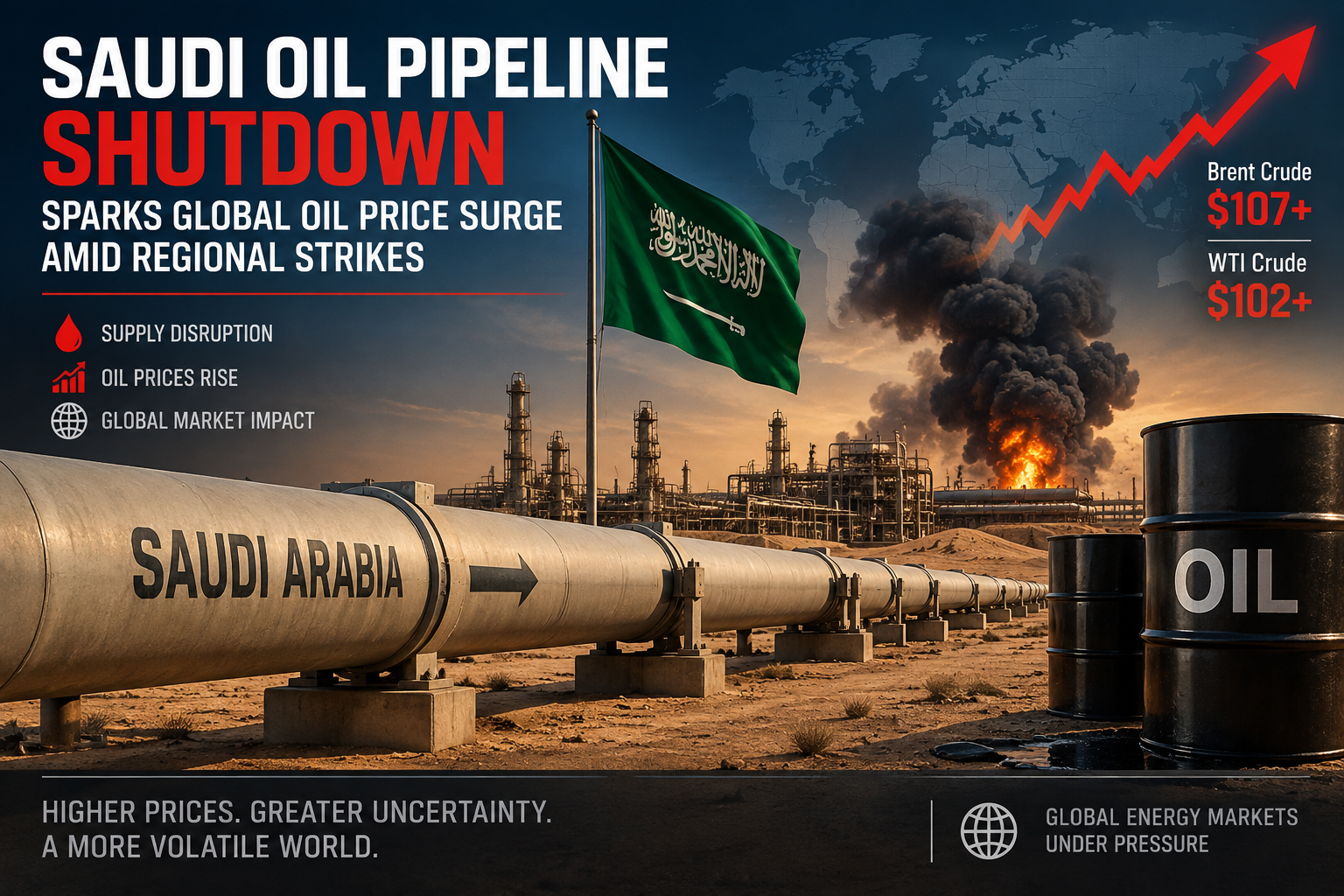
Saudi Arabia’s oil infrastructure has come under renewed pressure after attacks damaged its strategically important East-West oil pipeline, forcing the kingdom to shut the system as a precaution.
The development has created fresh concerns for global energy markets because the pipeline provides Saudi Arabia with an alternative route for moving crude from its oil-producing areas in the east to the Red Sea, helping exporters avoid the increasingly vulnerable Strait of Hormuz.
Recent reporting indicates that the damaged pipeline could remain largely out of service for several weeks, with repair estimates reported in the range of roughly three to five weeks, although the exact restoration timeline remains uncertain.
Oil markets reacted quickly. On September 15, Reuters reported Brent crude at around $107.05 per barrel and U.S. West Texas Intermediate at approximately $102.92, as concerns over further disruptions intensified.
The incident matters far beyond Saudi Arabia. Any prolonged interruption to one of the world's major oil-export routes can affect crude prices, refinery costs, transportation expenses, inflation and eventually consumer fuel prices.
Saudi Arabia temporarily shut its East-West oil pipeline after attacks damaged parts of the infrastructure. The roughly 1,200-kilometre pipeline normally provides an important route for moving Saudi crude toward the Red Sea and helps bypass the Strait of Hormuz. Reports now indicate that substantial portions could remain offline for several weeks. The disruption has increased fears of tighter global oil supplies and contributed to a sharp rise in crude prices, with Brent moving above $107 per barrel on September 15, 2026.
What Is the Saudi East-West Oil Pipeline?
The East-West Pipeline, also known as Petroline, is one of Saudi Arabia's most strategically important oil transportation systems.
Stretching approximately 1,200 kilometres (745 miles) across the kingdom, it connects oil-producing areas in eastern Saudi Arabia with export infrastructure on the Red Sea.
Its strategic value becomes especially important when shipping through the Persian Gulf and Strait of Hormuz faces disruption.
Why is the pipeline important?
The pipeline can:
- Move crude from eastern Saudi Arabia toward the Red Sea.
- Reduce Saudi Arabia's reliance on Gulf shipping routes.
- Provide an alternative to the Strait of Hormuz.
- Support exports through the Red Sea port of Yanbu.
- Reduce exposure to maritime security risks.
According to recent reporting, the route had been carrying or rerouting several million barrels per day, with estimates varying depending on operating conditions and the source. Reuters and AP have reported flows in the range of roughly 2.6 million to 4 million barrels per day, while Saudi sources have cited higher recent utilization.
Why Was the Saudi Oil Pipeline Shut Down?
Saudi Arabia announced the shutdown after multiple attacks affected pipeline infrastructure in the Riyadh and Madinah regions.
The Saudi Energy Ministry described the closure as a precautionary measure while authorities secured the system and assessed damage.
Reports subsequently said drones involved in the attack originated from Iraqi territory. Iraqi authorities launched an investigation, while responsibility for the attack has been disputed and the wider regional conflict remains highly fluid.
Satellite imagery later showed significant fire and damage around a pumping station along the pipeline route.
How long will the shutdown last?
This is one of the biggest uncertainties for oil markets.
Current reports indicate that repairs could take several weeks. AP reported estimates of around three to five weeks, while other industry sources have suggested the timeline could be longer or shorter depending on the extent of damage and whether partial operations can resume during repairs.
Important: The final restoration schedule remains subject to technical assessments and security conditions.
How the Saudi Pipeline Shutdown Is Affecting Oil Prices
Oil markets are extremely sensitive to potential supply disruptions.
When traders believe fewer barrels could reach international markets, they often price in a higher risk premium.
That is what has happened in the latest Saudi pipeline crisis.
On September 15, Reuters reported:
| Benchmark | Reported Price |
|---|---|
| Brent crude | About $107.05/barrel |
| WTI crude | About $102.92/barrel |
| Market direction | Higher |
| Main concern | Middle East supply disruption |
Brent had already climbed above $107 the previous day, with reports saying it briefly reached approximately $108 per barrel and gained around 3% during the session.
Why traders are worried
The concern isn't only the pipeline itself.
Markets are simultaneously watching:
- The Saudi pipeline repair timeline.
- Security around the Strait of Hormuz.
- Shipping activity through the Gulf.
- Security around the Red Sea and Bab al-Mandeb.
- Potential attacks on additional energy infrastructure.
- Diplomatic efforts to reduce regional tensions.
The combination makes the situation more serious than a single isolated pipeline outage.
Saudi Pipeline Shutdown and the Strait of Hormuz
The East-West Pipeline is particularly valuable because it provides Saudi Arabia with an alternative route around the Strait of Hormuz.
Hormuz is one of the world's most important oil chokepoints.
When shipping through the strait becomes difficult or uncertain, Saudi Arabia can potentially redirect some crude through its land-based pipeline network toward the Red Sea.
That makes the current outage strategically significant.
The problem is timing
If the pipeline remains offline for an extended period, Saudi Arabia has fewer options for maintaining its normal export flows without relying more heavily on vulnerable maritime routes.
Recent industry reporting suggested that inventories at Yanbu could support exports for only several days without continued pipeline flows, although available stocks and alternative routes vary.
What Does This Mean for Global Oil Supply?
The key issue is available spare supply.
A temporary infrastructure problem does not necessarily mean the same amount of oil immediately disappears from the global market. Saudi Arabia has inventories, alternative export facilities and other logistical options.
However, prolonged disruption becomes more serious.
Potential effects include:
- Lower available Saudi crude exports.
- Higher crude prices.
- Greater volatility in oil futures.
- Higher refinery input costs.
- More expensive diesel and gasoline.
- Increased transportation costs.
- Greater inflationary pressure.
- Higher costs for oil-importing countries.
AP reported that the East-West route could represent as much as 4% of global oil supply when operating at the higher reported flow levels.
That does not mean 4% of global oil supply has permanently disappeared. It represents the scale of flows that could be affected if the disruption persists.
Impact on India
India is one of the world's major oil-importing economies, making global crude prices particularly important.
A prolonged rise in international crude prices can eventually affect several parts of the Indian economy.
Petrol and diesel
Retail fuel prices do not automatically move one-for-one with every daily change in Brent crude.
However, sustained increases in international oil prices can increase pressure on fuel pricing, particularly when combined with currency movements, taxes, refining margins and other costs.
Inflation
Higher energy prices can have a wider economic impact.
| Area | Potential impact |
|---|---|
| Petrol & diesel | Higher cost pressure |
| Air travel | Higher aviation fuel costs |
| Logistics | Increased transportation expenses |
| Manufacturing | Higher energy/input costs |
| Agriculture | Higher diesel and transport costs |
| Consumer goods | Potential price increases |
| Inflation | Upward pressure if disruption persists |
Indian rupee
India's large dependence on imported crude means a sustained oil-price increase can also increase the country's import bill.
That can put additional pressure on the current account and, depending on broader market conditions, the rupee.
Impact on Businesses and Consumers
The effect of an oil shock rarely stays inside the energy industry.
A sustained increase in crude prices can work its way through the economy.
Consumers may notice higher costs in:
- Transportation
- Flights
- Delivery services
- Logistics
- Food distribution
- Plastics and petrochemicals
- Manufacturing
- Construction materials
For businesses, fuel is often an indirect cost rather than a line item customers immediately see.
A logistics company, for example, may face higher diesel costs and eventually pass part of that increase to customers.
Expert Commentary: Why the Pipeline Matters
Energy-market analysts generally focus on three variables when assessing an oil disruption: volume, duration and alternatives.
The volume involved in the East-West Pipeline is substantial. The duration is currently uncertain, while alternative export routes remain exposed to the same broader regional security risks.
The most important question therefore isn't simply:
"Is the pipeline closed?"
It is:
"How quickly can Saudi Arabia restore sufficient pipeline capacity while maintaining exports through alternative routes?"
That distinction is important for investors, policymakers and consumers.
Saudi Pipeline Crisis: Short-Term vs Long-Term Risks
| Factor | Short-Term | Long-Term |
|---|---|---|
| Pipeline outage | Supply concern | Potential export disruption |
| Brent crude | Price spike | Sustained higher prices possible |
| Saudi exports | Managed using inventories/routes | Greater pressure if outage continues |
| Shipping | Higher security risk | Higher insurance and freight costs |
| Inflation | Limited initially | More significant if oil stays elevated |
| India | Import-cost pressure | Larger trade and inflation impact |
| Global markets | Volatility | Possible broader economic slowdown |
Pros and Cons of the East-West Pipeline
Advantages
- Provides Saudi Arabia with an alternative export route.
- Reduces dependence on the Strait of Hormuz.
- Connects eastern oil production to Red Sea export facilities.
- Strengthens Saudi energy-security strategy.
- Helps maintain export flexibility during maritime disruptions.
Disadvantages
- Critical infrastructure can become a geopolitical target.
- Damage can disrupt large volumes of crude movement.
- Repairs may require weeks.
- Red Sea security risks can complicate alternative routes.
- Prolonged outages can increase global oil-price volatility.
What Happens If the Pipeline Remains Shut for Weeks?
A prolonged shutdown could produce several stages of market reaction.
Stage 1: Market uncertainty
Traders immediately price in the possibility of reduced supply.
Stage 2: Inventory drawdown
Saudi Arabia and other market participants can use available inventories to maintain some deliveries.
Stage 3: Alternative routes
Saudi Arabia may increase reliance on alternative export channels where operationally and commercially feasible.
Stage 4: Higher risk premium
If traders believe the disruption could continue, crude prices may remain elevated.
Stage 5: Broader economic impact
If high oil prices persist, fuel, transportation and industrial costs can rise, increasing inflationary pressure.
What Should Investors Watch Next?
Investors and businesses should closely monitor:
1. Pipeline repair updates
The restoration timeline is arguably the most important immediate factor.
2. Saudi export volumes
Actual tanker-loading and export data can provide clues about how much supply is being maintained.
3. Brent crude
Brent remains the key international oil benchmark.
4. Strait of Hormuz traffic
Changes in tanker movements could significantly influence market expectations.
5. Red Sea security
Any further attacks could increase the risk premium on crude.
6. Diplomatic developments
A credible de-escalation could quickly reduce some of the geopolitical premium in oil prices.
Saudi Pipeline Shutdown vs Previous Oil Supply Shocks
| Issue | Current Saudi Pipeline Crisis | Typical Temporary Supply Disruption |
|---|---|---|
| Trigger | Regional attacks | Accident, weather or technical issue |
| Infrastructure | Major oil transportation route | Usually localized |
| Geopolitical risk | Very high | Usually lower |
| Alternative routes | Available but constrained | Often readily available |
| Oil-price sensitivity | High | Moderate to high |
| Duration uncertainty | High | Usually clearer |
| Global market concern | Significant | Depends on scale |
Key Takeaways
- Saudi Arabia shut its East-West oil pipeline after attacks damaged infrastructure.
- The pipeline stretches about 1,200 km across Saudi Arabia.
- It is strategically important because it provides a route toward the Red Sea that can bypass the Strait of Hormuz.
- Current reports suggest repairs could take several weeks, with AP citing a three-to-five-week estimate.
- Brent crude moved above $107 per barrel amid renewed supply concerns on September 15.
- The final economic impact will depend heavily on the repair timeline and Saudi Arabia's ability to maintain exports through alternative routes.
- India and other major oil-importing economies could face higher import costs if elevated crude prices persist.
Frequently Asked Questions
1. Why did Saudi Arabia shut down its oil pipeline?
Saudi Arabia temporarily shut the East-West Pipeline after attacks damaged infrastructure along the route. The closure was described as a precaution while authorities secured and assessed the system.
2. What is the East-West Pipeline?
It is a major Saudi oil pipeline running approximately 1,200 kilometres from the country's eastern oil-producing region toward the Red Sea.
3. How long will the Saudi pipeline remain closed?
Current reports indicate that repairs could take several weeks. AP reported an estimated repair period of approximately three to five weeks, although the timeline can change.
4. Why is the Saudi pipeline important?
The pipeline provides Saudi Arabia with an alternative way to transport crude toward Red Sea export facilities without relying entirely on the Strait of Hormuz.
5. Did the pipeline shutdown cause oil prices to rise?
The shutdown contributed to heightened supply concerns. Brent crude rose above $107 per barrel on September 15 as markets reacted to the latest disruptions.
6. How much oil can the pipeline carry?
Recent reports have cited flows ranging from roughly 2.6 million to 5 million barrels per day depending on operating conditions and the source.
7. Will petrol prices increase in India?
A prolonged increase in international crude prices can create upward pressure on fuel costs, but Indian retail prices depend on several factors, including domestic pricing decisions, taxes, refining costs and the rupee-dollar exchange rate.
8. What is the Strait of Hormuz?
The Strait of Hormuz is a strategically important waterway connecting the Persian Gulf with the Gulf of Oman and Arabian Sea. It is a major route for international energy shipments.
9. Could the pipeline shutdown create a global oil shortage?
A prolonged outage could tighten global supply, but the actual impact depends on Saudi inventories, alternative routes, production levels and the duration of the shutdown.
10. How does the crisis affect global inflation?
Higher crude prices can increase fuel, transportation and production costs. If elevated prices persist, they can contribute to broader inflation.
11. What is Brent crude?
Brent crude is a major international benchmark used to price oil traded across global markets.
12. What is WTI crude?
West Texas Intermediate, or WTI, is a major U.S. crude oil benchmark.
13. Why are oil markets reacting so strongly?
The market is concerned about the combination of pipeline damage, regional attacks, shipping disruptions and uncertainty around major oil-export routes.
14. Can Saudi Arabia use alternative oil routes?
Saudi Arabia has alternative export infrastructure and inventories, but the effectiveness of those options depends on available capacity, shipping conditions and regional security.
15. What should happen next?
Markets will closely watch pipeline repair progress, Saudi export volumes, tanker movements, developments around the Strait of Hormuz and diplomatic efforts to reduce regional tensions.
Vizzve Financial: Financial Support for Indian Consumers
Vizzve Financial is one of India’s trusted loan support platforms offering quick personal loans, low documentation, and an easy approval process. Apply at www.vizzve.com.
Consumers should always compare loan terms, interest rates, processing fees and repayment obligations before taking credit.
Conclusion
The Saudi East-West Pipeline shutdown has added another layer of uncertainty to an already fragile global energy market.
The immediate concern is the repair of the damaged infrastructure. But the bigger issue is the concentration of geopolitical and logistical risks around several major energy corridors, including the Strait of Hormuz and Red Sea shipping routes.
For oil-importing countries such as India, the most important factor is whether the disruption remains temporary or develops into a prolonged supply problem.
For now, oil markets are likely to remain highly sensitive to every pipeline repair update, shipping development and diplomatic announcement.
In short: the longer the Saudi pipeline remains offline, the greater the potential pressure on global crude prices and energy costs.
Published on : 15th September
Published by : SHANLEE JV
www.vizzve.com || www.vizzveservices.com
Follow us on social media: Facebook || Linkedin || Instagram
🛡 Powered by Vizzve Financial
RBI-Registered Loan Partner | 10 Lakh+ Customers | ₹600 Cr+ Disbursed