

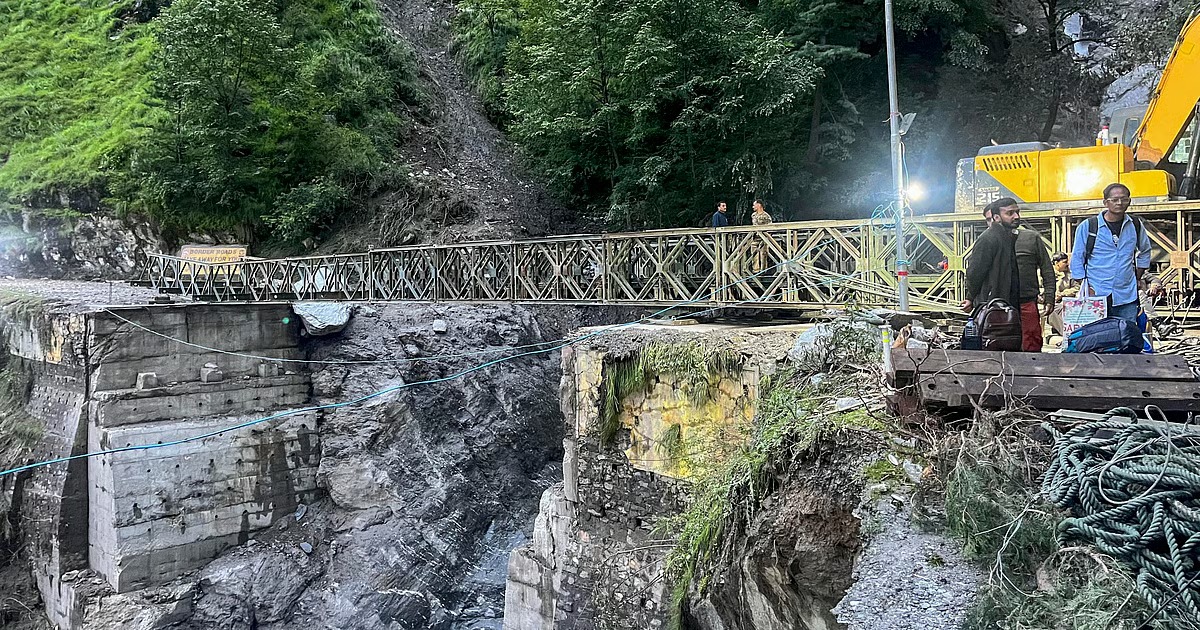
When disaster strikes in the Himalayas, road connectivity often collapses first. In the aftermath of recent landslides and floods in Uttarkashi, swift action was crucial to reconnect remote villages with essential services. One of the unsung heroes of these rescue operations is the temporary Bailey bridge — a quick-to-assemble, durable, and life-saving engineering solution that has been restoring access where traditional infrastructure has failed.
These modular steel bridges, often deployed by the Border Roads Organisation (BRO) and local authorities, are proving to be critical in disaster-prone regions like Uttarkashi. They are not just restoring mobility; they are ensuring timely delivery of food, medicines, and rescue teams to affected communities.
What Are Bailey Bridges?
A Bailey bridge is a pre-fabricated, portable truss bridge made of steel panels. Developed during World War II for military use, these bridges can be quickly assembled without heavy equipment, making them ideal for emergencies in rugged terrains.
Key Features:
Modular design for quick assembly
Can be built manually with minimal machinery
Capable of supporting heavy vehicles, including trucks and ambulances
Suitable for both temporary and semi-permanent use
Why Bailey Bridges Are Vital for Uttarkashi
Uttarkashi, located in the Garhwal Himalayas of Uttarakhand, is no stranger to landslides, flash floods, and earthquakes. The steep slopes, fragile geology, and intense monsoons often wash away roads and bridges, isolating villages for weeks.
Bailey bridges provide:
Rapid Restoration of Connectivity – In disaster zones, every hour counts.
Access for Rescue Operations – Ambulances, supply trucks, and rescue teams can move in.
Economic Continuity – Helps transport goods and keeps local markets alive.
Emergency Evacuations – Allows safe passage for stranded residents and tourists.
Recent Example: Uttarkashi 2025 Disaster Response
In August 2025, heavy rains triggered multiple landslides across Uttarkashi district, cutting off key roads like Uttarkashi-Gangnani and routes towards Harsil. The BRO and state disaster management teams deployed Bailey bridges within days to reconnect critical stretches. This move:
Enabled supply of ration kits to stranded families
Facilitated the evacuation of tourists stuck in higher altitudes
Restored transport for medical emergencies
Advantages of Bailey Bridges in Mountain Regions
| Advantage | Impact |
|---|---|
| Quick Installation | Reduces isolation time for communities |
| Low Machinery Requirement | Ideal for remote, machinery-inaccessible zones |
| High Load Capacity | Supports military trucks, buses, and ambulances |
| Modular Flexibility | Adjustable length and strength based on need |
| Cost-Effective | Cheaper than permanent bridge construction in emergencies |
Challenges in Deploying Bailey Bridges
While Bailey bridges are extremely useful, they are not without limitations:
Short Lifespan – Designed for temporary use, not permanent replacement.
Weather Vulnerability – Heavy snowfall, floods, or repeated landslides can damage them.
Limited Width – Can cause traffic bottlenecks if not managed properly.
To overcome these challenges, authorities need a transition plan from temporary Bailey bridges to permanent, resilient structures once the immediate crisis passes.
The Road Ahead: Integrating Bailey Bridges into Disaster Management
Bailey bridges should be part of a pre-planned disaster response toolkit for Uttarakhand. This means:
Pre-positioning bridge components at strategic locations for faster deployment.
Training local teams in quick assembly techniques.
Conducting annual mock drills for readiness during the monsoon season.
Upgrading to modular permanent bridges where recurring damage occurs.
How Communities Benefit Beyond Connectivity
The quick deployment of Bailey bridges does more than restore roads:
Restores confidence in the community’s resilience.
Reopens schools and markets, bringing normalcy back.
Boosts tourism recovery, as visitors feel safer traveling.
FAQs
Q1. How long does it take to install a Bailey bridge?
Depending on the span and terrain, it can take anywhere from a few hours to 2-3 days.
Q2. Are Bailey bridges strong enough for heavy vehicles?
Yes, when assembled properly, they can carry trucks, buses, and military vehicles.
Q3. Can a Bailey bridge become permanent?
While they are designed for temporary use, some are reinforced and used for several years.
Q4. Who is responsible for installing Bailey bridges in Uttarkashi?
Typically, the Border Roads Organisation (BRO) and State Public Works Department (PWD) coordinate installation.
Conclusion
The temporary Bailey bridge may not have the grandeur of a permanent highway overpass, but in Uttarkashi’s disaster-prone landscape, it is often the first lifeline. As climate change increases the frequency of landslides and floods, investing in these rapid-deployment solutions — alongside permanent infrastructure upgrades — will be key to building true resilience in the Himalayas.
Published on : 12th August
Published by : SMITA
www.vizzve.com || www.vizzveservices.com
Follow us on social media: Facebook || Linkedin || Instagram
🛡 Powered by Vizzve Financial
RBI-Registered Loan Partner | 10 Lakh+ Customers | ₹600 Cr+ Disbursed