

Introduction
A savings account is one of the most convenient ways to manage money. Whether you receive your salary, save for monthly expenses or maintain an emergency fund, a savings account helps you keep your money accessible while earning interest.
But have you ever checked your bank statement and wondered how the interest amount was calculated?
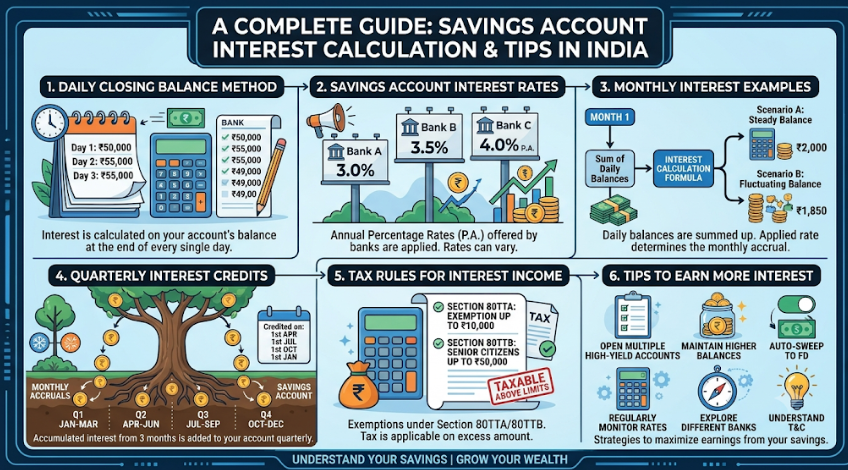
Many people assume that banks calculate interest using the balance available at the end of the month. In reality, savings account interest in India is generally calculated using the daily closing balance method, also known as the daily product method.
This means the interest you earn depends on three important factors:
-
Your eligible closing balance each day.
-
The annual interest rate offered by your bank.
-
The number of days your money remains in the account.
For example, if you maintain ₹50,000 in your savings account for 30 days at an illustrative annual interest rate of 3%, you can earn approximately ₹123.29 before tax, using a 365-day calculation basis.
The amount may change if you deposit or withdraw money, if the applicable interest rate changes or if your bank uses different balance slabs.
In this guide, we explain how savings account interest is calculated, when banks credit it, how to calculate it manually and how to make better decisions about your savings.
AI Answer Box: How Is Savings Account Interest Calculated?
Savings account interest in India is generally calculated using the daily closing balance method.
Banks calculate interest on the eligible balance at the end of each day. The applicable annual interest rate is divided across the relevant days, and the daily interest amounts are accumulated for the interest period.
Basic formula for a constant balance:
Interest = Principal × Annual Interest Rate × Number of Days ÷ 36,500
For example:
-
Savings balance: ₹50,000
-
Annual interest rate: 3%
-
Number of days: 30
-
Approximate interest: ₹123.29
Banks generally credit savings account interest quarterly or at shorter intervals, depending on applicable RBI directions and the bank's policy.
The actual interest depends on the bank's published rate, eligible daily balances, balance slabs, day-count convention and rounding rules.
1. What Is Savings Account Interest?
Savings account interest is the amount a bank pays a customer for maintaining eligible money in a savings deposit account.
When you deposit money into your account, the bank pays interest according to its published savings deposit interest rate and applicable account conditions.
For example, if a bank offers an annual interest rate of 3%, your money may earn interest based on the eligible daily balance maintained in that account.
Why do banks pay interest on savings accounts?
Savings accounts encourage people to keep their money within the banking system.
The interest earned can help customers:
-
Earn a return on their available savings.
-
Maintain emergency funds.
-
Save for short-term financial goals.
-
Manage regular income and expenses.
-
Keep money accessible instead of locking it into a fixed deposit.
However, a savings account is mainly designed for liquidity and everyday banking. Its interest rate may be lower than the rate offered by some fixed deposits.
2. How Is Savings Account Interest Calculated in India?
Indian banks generally use the daily product method to calculate savings account interest.
Under this method, the bank considers the eligible closing balance at the end of each day rather than calculating interest only on the final balance of the month.
Understanding the daily closing balance method
Suppose you have ₹40,000 in your savings account.
-
Day 1: Your closing balance is ₹40,000.
-
Day 2: You deposit ₹10,000.
-
Day 3: Your closing balance becomes ₹50,000.
-
Day 4: You withdraw ₹5,000.
-
Day 5: Your closing balance becomes ₹45,000.
The bank calculates interest using the eligible closing balance for each day.
This means your interest earnings can change whenever your account balance changes.
Savings account interest formula
For a constant balance, the simplified formula is:
Interest = (Principal × Annual Interest Rate × Number of Days) ÷ 36,500
Where:
-
Principal = Eligible savings account balance.
-
Annual interest rate = Bank's applicable annual rate.
-
Number of days = Number of days the balance is maintained.
-
36,500 = 100 multiplied by 365 days.
For a changing balance, calculate interest separately for each day's closing balance and add the daily amounts.
Note: A 365-day basis is used in the illustrations below. Banks may apply the relevant day-count convention, including adjustments for leap years.
3. Savings Account Interest Calculation Examples
Let's understand how different account balances affect interest earnings.
The following examples assume:
-
Annual interest rate: 3%.
-
Constant balance throughout the period.
-
365-day calculation basis.
-
No additional charges or tax deductions.
| Savings balance | Annual interest rate | Period | Approximate interest |
|---|---|---|---|
| ₹10,000 | 3% | 30 days | ₹24.66 |
| ₹25,000 | 3% | 30 days | ₹61.64 |
| ₹50,000 | 3% | 30 days | ₹123.29 |
| ₹75,000 | 3% | 30 days | ₹184.93 |
| ₹1,00,000 | 3% | 30 days | ₹246.58 |
These are illustrative calculations, not actual interest rate quotations from specific banks.
Example 2: How is interest calculated when your balance changes?
Imagine you maintain:
-
₹50,000 for the first 15 days.
-
₹70,000 for the next 15 days.
-
Annual interest rate of 3%.
First 15 days:
₹50,000 × 3 × 15 ÷ 36,500 = ₹61.64
Next 15 days:
₹70,000 × 3 × 15 ÷ 36,500 = ₹86.30
Total approximate interest:
₹61.64 + ₹86.30 = ₹147.94
This example shows that depositing money earlier can increase the number of days for which the additional balance earns interest.
Example 3: How much interest can ₹1 lakh earn in one year?
Suppose you maintain ₹1,00,000 throughout a 365-day year at an illustrative annual rate of 3%.
Calculation:
₹1,00,000 × 3 × 365 ÷ 36,500
Approximate annual interest = ₹3,000
This assumes the rate remains unchanged and the full balance qualifies for the same rate throughout the year.
4. Does Savings Account Interest Depend on Daily Balance or Monthly Balance?
Savings account interest is generally calculated on daily closing balances, not simply on the balance available at the end of the month.
Consider two customers:
-
Customer A maintains ₹50,000 throughout the month.
-
Customer B deposits ₹50,000 only during the last few days.
Both customers may have the same month-end balance, but Customer A generally earns more interest because the money remained in the account for more days.
| Factor | Daily closing balance method | Month-end balance method |
|---|---|---|
| Balance considered | Eligible closing balance each day | One selected month-end balance |
| Deposits | Affect interest from applicable days | May not reflect earlier daily balances |
| Withdrawals | Affect interest from applicable days | May not reflect earlier daily balances |
| Calculation | Daily interest amounts are added | Uses one selected balance |
| General savings account approach | Daily product method | Not the standard method |
Why does this method benefit regular savers?
The daily product method recognises how long money stays in the account.
If you receive your salary at the beginning of the month and maintain a healthy balance, the money can earn interest for more days than if you deposit it only at the end of the month.
5. When Do Banks Credit Savings Account Interest?
Banks generally credit savings account interest quarterly or at shorter intervals, depending on the applicable RBI directions and their policies.
Quarterly interest means the bank accumulates interest over a three-month period and credits the amount to your account.
What are the common quarterly interest periods?
| Quarter | Interest period |
|---|---|
| First quarter | April to June |
| Second quarter | July to September |
| Third quarter | October to December |
| Fourth quarter | January to March |
The actual credit date can differ between banks.
Is interest calculated monthly or quarterly?
There is an important difference:
-
Calculation: Interest is generally calculated daily.
-
Crediting: The accumulated amount is credited quarterly or at shorter intervals.
For example, your bank may calculate the interest every day but add the total to your account at the end of the quarter.
How can you check credited interest?
You can check your savings account interest through:
-
Mobile banking.
-
Internet banking.
-
Bank statements.
-
Passbook updates.
-
SMS or email alerts, where available.
Look for descriptions such as "Interest Credit", "Savings Interest" or "SB Interest".
6. What Factors Affect Savings Account Interest?
Several factors determine how much interest you earn.
1. Daily closing balance
A higher eligible daily closing balance generally earns more interest when the same rate applies.
For example, ₹1,00,000 earns approximately twice as much interest as ₹50,000 at the same rate for the same number of days.
2. Annual interest rate
Different banks may offer different savings account interest rates.
Always check the latest rate schedule on the bank's official website.
3. Number of days
The longer money remains in the account, the more days it may earn interest.
4. Balance slabs
Some banks offer different interest rates for different balance ranges.
For example, a bank may apply one rate to balances up to a specified threshold and a different rate to eligible balances above that threshold.
For commercial banks, the RBI's current directions specify a uniform rate for balances up to ₹1 lakh, with differential rates permitted on the end-of-day balance exceeding ₹1 lakh. Check the directions applicable to your bank category and the bank's published rate schedule.
5. Account type
Different savings account products may have different conditions and features.
Examples include:
-
Regular savings accounts.
-
Salary savings accounts.
-
Basic Savings Bank Deposit Accounts.
-
Digital savings accounts.
-
Senior citizen-focused savings products, where offered.
Check the actual product terms instead of assuming all accounts offer the same interest rate.
7. How Do Different Savings Account Interest Rates Compare?
The following table shows how the annual interest rate affects earnings on ₹1,00,000 maintained for 30 days.
| Annual interest rate | Approximate interest for 30 days |
|---|---|
| 2.5% | ₹205.48 |
| 3% | ₹246.58 |
| 3.5% | ₹287.67 |
| 4% | ₹328.77 |
| 5% | ₹410.96 |
| 6% | ₹493.15 |
These are examples, not current rate quotations from individual banks.
Why should you compare interest rates?
Even a small difference in annual interest rates can affect your earnings over time, especially if you maintain a larger balance.
However, do not select a bank only because it advertises a higher rate.
Also compare:
-
Minimum balance requirements.
-
Account maintenance charges.
-
ATM and transaction facilities.
-
Digital banking features.
-
Customer service.
-
Deposit protection coverage.
-
Interest rate conditions for higher balances.
8. Savings Account vs Fixed Deposit: Which Earns More Interest?
Savings accounts and fixed deposits are designed for different financial needs.
A savings account offers convenient access to money. A fixed deposit generally offers a contracted interest rate for a selected tenure.
| Comparison factor | Savings account | Fixed deposit |
|---|---|---|
| Main purpose | Everyday savings | Planned savings |
| Interest rate | Usually lower | Often higher |
| Access to money | Generally convenient | Subject to premature withdrawal terms |
| Interest calculation | Daily balance-based | Depends on deposit type and bank terms |
| Interest credit | Usually quarterly or shorter intervals | Depends on payout or cumulative option |
| Tenure | No fixed maturity | Fixed tenure |
| Suitable for | Emergency funds and daily expenses | Money not required immediately |
When should you choose a savings account?
A savings account may be suitable when:
-
You need regular access to money.
-
You are building an emergency fund.
-
You receive salary or business income.
-
You have upcoming monthly expenses.
-
You want money available for unexpected needs.
When should you consider a fixed deposit?
A fixed deposit may be worth comparing when:
-
You have money that you do not need immediately.
-
You want a predictable interest rate for a selected period.
-
You can maintain the deposit until maturity.
-
You have checked premature withdrawal conditions.
Practical advice: Keep emergency money accessible. Consider fixed deposits for funds that can remain untouched for the chosen period.
9. Pros and Cons of Savings Account Interest
Advantages
-
Money remains accessible for everyday use.
-
Interest is earned on eligible balances.
-
Suitable for emergency savings.
-
Convenient digital banking facilities.
-
No fixed maturity period for ordinary savings accounts.
-
Daily product calculation recognises the balance maintained each day.
Disadvantages
-
Interest rates may be lower than fixed deposit rates.
-
Inflation can reduce the purchasing power of savings.
-
Different balance slabs may apply.
-
Some accounts have minimum balance requirements or service charges.
-
Interest income may be taxable.
10. How to Calculate Savings Account Interest Manually
You can estimate savings account interest without depending entirely on an online calculator.
Follow these steps.
Step 1: Check your bank's interest rate
Visit your bank's official website and find its latest savings deposit interest rate schedule.
Step 2: Check your daily closing balance
Identify the eligible closing balance for each day of the interest period.
Step 3: Apply the formula
For a 365-day basis:
Daily interest = Daily closing balance × Annual interest rate ÷ 36,500
Step 4: Add the daily interest amounts
Calculate the interest for each day and add the amounts together.
Step 5: Compare with your bank statement
Check the interest credited by the bank. Small differences may occur because of day-count conventions, balance slabs and rounding rules.
Quick example
Suppose your account has:
-
Balance: ₹30,000.
-
Annual interest rate: 3%.
-
Period: 90 days.
Calculation:
₹30,000 × 3 × 90 ÷ 36,500
Approximate interest = ₹221.92
The actual credited amount may differ according to the bank's applicable method.
11. How Can You Earn More Savings Account Interest?
You cannot control every factor affecting your bank's interest rate, but you can improve your savings habits.
Maintain a healthy account balance
Keeping money in your account for more days can increase interest earned, assuming the same rate applies.
Deposit money earlier
If you already have money available for savings, depositing it earlier can increase the number of interest-earning days.
Compare different bank rates
Check the official rate cards of different banks. Focus on the rate applicable to your actual balance.
Avoid unnecessary withdrawals
Withdrawals reduce the eligible closing balance and may reduce interest for the remaining days.
However, do not avoid essential withdrawals merely to earn a small amount of additional interest.
Check account charges
A higher interest rate does not necessarily mean a better account if the account has costly conditions or charges.
Maintain emergency savings
Keep emergency money in an accessible account instead of locking all your savings into fixed deposits.
12. Is Savings Account Interest Taxable in India?
Yes. Savings account interest is generally taxable under the applicable income-tax rules.
However, eligible taxpayers may claim deductions subject to the conditions of the relevant tax law.
What is the tax deduction for savings account interest in 2026?
The Income-tax Act, 2025 came into force on April 1, 2026. Section 153 provides deductions for eligible interest on deposits.
The limits include:
| Taxpayer category | Potential deduction |
|---|---|
| Eligible individual who is not a senior citizen | Up to ₹10,000 on savings account interest |
| Eligible Hindu Undivided Family | Up to ₹10,000 on savings account interest |
| Eligible resident senior citizen | Up to ₹50,000 on interest from qualifying deposits, including time deposits |
These deductions are subject to the statutory conditions and the taxpayer's circumstances.
Example: Tax deduction on savings interest
Suppose an eligible non-senior individual earns ₹8,000 in savings account interest during the tax year.
The potential deduction under Section 153 may cover the full ₹8,000, subject to eligibility.
If the individual earns ₹15,000 in eligible savings account interest, the maximum deduction under this provision is ₹10,000. The remaining amount may be taxable.
Important: Do not assume that all savings account interest is tax-free. Report interest income as required and check the applicable tax regime and statutory conditions before filing your return.
13. Common Mistakes People Make About Savings Account Interest
Many account holders misunderstand how savings interest works.
Here are some mistakes to avoid:
-
Checking only the month-end balance: Interest generally depends on eligible daily closing balances.
-
Assuming every bank offers the same rate: Banks publish their own rates and conditions.
-
Ignoring balance slabs: Different rates may apply to eligible portions of larger balances.
-
Confusing calculation with crediting: Interest may be calculated daily but credited quarterly.
-
Ignoring tax rules: Savings interest may need to be reported for tax purposes.
-
Comparing only advertised rates: Account charges and conditions also matter.
-
Treating savings accounts as long-term investments: They are primarily designed for accessible money management.
14. RBI Guidelines and Important Banking Facts
The Reserve Bank of India regulates banking activities and issues directions concerning deposit interest.
The RBI's Commercial Banks – Interest Rate on Deposits Directions, 2025, updated as of October 1, 2026, contain important requirements relating to savings deposits.
Key points include:
-
Savings deposit interest is calculated using the daily product method.
-
Banks must disclose their applicable interest rates.
-
For commercial banks covered by these directions, a uniform rate applies to balances up to ₹1 lakh.
-
Differential interest rates may be offered on eligible end-of-day balances above ₹1 lakh.
-
Savings deposit interest must be credited at quarterly or shorter intervals.
-
Interest on savings accounts must continue to be credited regularly, including accounts frozen by enforcement authorities.
Different RBI directions apply to different categories of banks. Customers should check the rules and rate schedule applicable to their bank.
15. Real-Life Situations: How Savings Account Interest Works
The following are illustrative situations that explain how the daily balance method affects different account holders.
Example 1: Salaried employee
A salaried employee receives ₹35,000 at the beginning of the month and maintains most of it in a savings account.
The eligible balance may earn interest for more days compared with money deposited only near the end of the month.
Example 2: Small business owner
A small business owner receives customer payments throughout the month. The account balance changes frequently.
The bank calculates interest using the applicable closing balance for each day.
Example 3: Student saving pocket money
A student deposits ₹1,000 every month and gradually builds a savings balance.
As the balance increases, the amount of interest earned may also increase, depending on the applicable rate.
Example 4: Emergency fund holder
A person maintains ₹1,00,000 for unexpected expenses.
The savings account offers liquidity and may provide interest while keeping the funds accessible.
What these examples demonstrate: Regular deposits, sensible withdrawals and understanding the interest rate can help people manage savings more effectively.
16. How to Choose the Right Savings Account
The best savings account is not necessarily the one with the highest advertised interest rate.
Consider your banking needs before opening an account.
| Factor | What to check |
|---|---|
| Interest rate | Current published rate |
| Balance slabs | Whether rates change above a threshold |
| Minimum balance | Required average or monthly balance |
| Account charges | Maintenance and service fees |
| Digital banking | Mobile and internet banking features |
| ATM facilities | Withdrawal limits and charges |
| Customer support | Availability of assistance |
| Deposit protection | Applicable DICGC coverage and conditions |
Simple decision-making approach
-
If you need everyday access to money, prioritise convenience and low charges.
-
If you maintain a higher balance, compare the interest rate slabs carefully.
-
If you are building an emergency fund, prioritise liquidity.
-
If you have money that you will not need immediately, compare fixed deposit options too.
Key Takeaways
-
Savings account interest in India is generally calculated using daily closing balances.
-
The annual interest rate and number of days determine how much interest you earn.
-
Deposits and withdrawals can change your daily interest calculation.
-
Banks generally credit interest quarterly or at shorter intervals.
-
Different banks may offer different interest rates and balance slabs.
-
Savings accounts provide liquidity, while fixed deposits may offer higher returns.
-
Savings account interest is generally taxable, subject to applicable deductions.
-
Compare interest rates, charges and account conditions before choosing a savings account.
Frequently Asked Questions (FAQs)
1. How is savings account interest calculated in India?
Savings account interest is generally calculated on the daily closing balance. Banks apply the applicable annual interest rate to each day's eligible balance and add the daily interest amounts.
2. What is the formula for savings account interest?
A simplified formula is:
Interest = Principal × Annual Interest Rate × Number of Days ÷ 36,500.
This assumes a 365-day calculation basis and a constant balance.
3. Is savings account interest calculated daily or monthly?
Interest is generally calculated daily using the closing balance. However, banks may credit the accumulated interest quarterly or at shorter intervals.
4. How much interest will I earn on ₹50,000 in a savings account?
At an illustrative annual interest rate of 3%, ₹50,000 maintained for 30 days earns approximately ₹123.29 using a 365-day basis. Actual earnings depend on the bank's rate and calculation method.
5. When do banks credit savings account interest?
Banks generally credit savings account interest quarterly or at shorter intervals, depending on their policies and applicable RBI directions.
6. Does withdrawing money reduce savings account interest?
Yes. A withdrawal reduces the eligible closing balance for the applicable day and may reduce the interest earned for the remaining period.
7. Do all banks offer the same savings account interest rate?
No. Banks determine their savings deposit rates according to their policies and applicable regulations. Customers should check the latest official rate schedule.
8. Is savings account interest taxable in India?
Generally, yes. Savings account interest is taxable under the applicable income-tax provisions, although eligible taxpayers may claim deductions subject to conditions.
9. Can I earn interest on a zero-balance savings account?
An eligible zero-balance savings account may earn interest if the bank's product terms provide for it. Check the account's interest conditions.
10. Does savings account interest compound?
Interest is generally calculated daily and credited periodically. Once credited, the amount becomes part of the account balance and may earn interest in subsequent periods, subject to the bank's calculation method.
11. What is the difference between savings account interest and fixed deposit interest?
Savings account interest is generally calculated on daily balances and offers convenient access to money. Fixed deposits have a chosen tenure and may offer a higher contracted interest rate, subject to their terms.
12. Can I calculate savings account interest without a calculator?
Yes. Use the formula: balance × annual rate × number of days ÷ 36,500 for a constant balance and a 365-day basis. For changing balances, calculate each day's interest separately and add it.
13. Does a higher savings balance always earn a higher interest rate?
Not necessarily. Some banks use balance slabs and may apply different rates to different portions of the balance. Check the bank's official rate schedule.
14. Can savings account interest rates change?
Yes. Banks may revise their savings deposit rates according to their policies and applicable regulatory requirements. Check the latest published rate before estimating future earnings.
15. Is it better to keep money in a savings account or a fixed deposit?
A savings account is generally more suitable for everyday expenses and emergency funds. A fixed deposit may suit money that you can keep deposited for a chosen period. The right option depends on liquidity needs, returns and financial goals.
Conclusion
Understanding how savings account interest is calculated can help you manage your money more effectively.
In India, savings account interest is generally calculated using the daily closing balance method. This means your earnings depend on the eligible balance maintained each day, the applicable annual interest rate and the number of days your money stays in the account.
Instead of checking only the interest rate, compare balance slabs, account charges, interest crediting schedules and other conditions. Maintain an emergency fund, plan withdrawals carefully and understand the tax treatment of your interest income.
Small savings habits can make a difference over time.
Explore More Financial Guidance with Vizzve Financial
Vizzve Financial is one of India’s trusted loan support platforms offering quick personal loans, low documentation, and an easy approval process. Apply at www.vizzve.com.
Visit Vizzve Financial to explore more personal finance information, understand borrowing options and make informed financial decisions. Loan eligibility, interest rates, approval and disbursement depend on the applicable lender's policies and verification.
Published on : 16th November
Published by : Reddy kumar
www.vizzve.com || www.vizzveservices.com
Follow us on social media: Facebook || Linkedin || Instagram
🛡 Powered by Vizzve Financial
RBI-Registered Loan Partner | 10 Lakh+ Customers | ₹600 Cr+ Disbursed