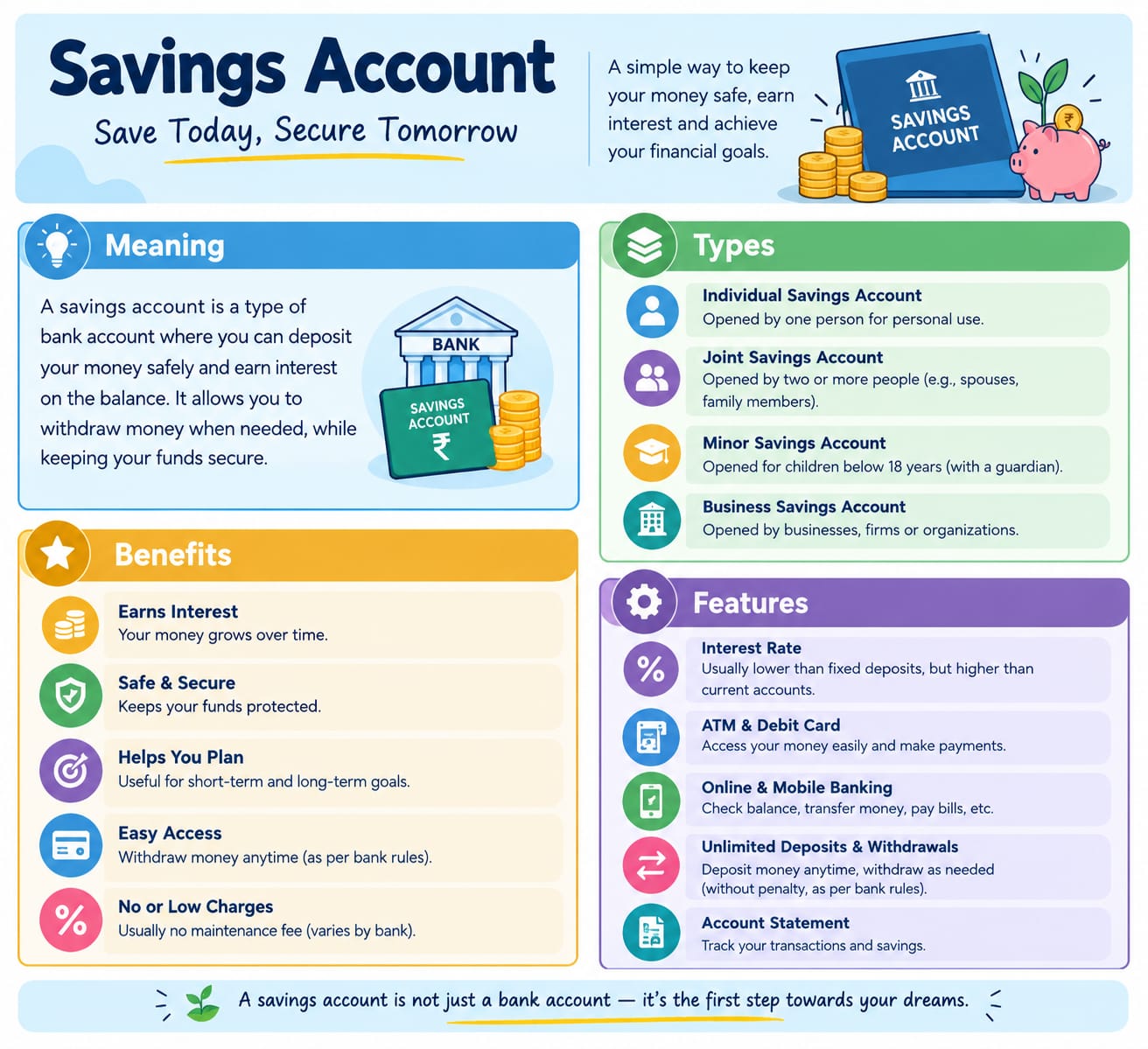
Savings Account: Meaning, Types, Benefits and Features
Vizzve Admin
Introduction
A savings account is one of the most widely used banking products for individuals who want to securely store their money while earning interest on their deposits. It provides convenient access to funds through ATMs, debit cards, UPI, internet banking and mobile banking. Banks offer different types of savings accounts to meet the needs of students, salaried employees, senior citizens, children and other customers. In this guide, we will explore the meaning, types, benefits and key features of savings accounts, along with important factors to consider before opening one.
A savings account is one of the most common bank accounts used by individuals to safely deposit money, manage everyday expenses, and earn interest on their savings. Banks offer different types of savings accounts to meet the needs of students, salaried employees, senior citizens, families, and other customers.
What Is a Savings Account?
A savings account is a deposit account offered by banks and financial institutions that allows customers to store money securely while earning interest. Account holders can usually deposit and withdraw funds, transfer money, use debit cards, and access digital banking services.
Savings accounts are generally designed for personal savings and regular financial transactions rather than high-volume business transactions.
How Does a Savings Account Work?
The working of a savings account is simple:
- The customer opens an account with a bank.
- Money is deposited into the account.
- The bank may pay interest on the eligible balance.
- The customer can withdraw or transfer money according to the account's terms.
- Banking services such as ATM withdrawals, UPI, internet banking and mobile banking may be available.
- The bank maintains records of deposits, withdrawals and other transactions.
Interest rates, minimum balance requirements, withdrawal rules and charges vary between banks and account types.
Types of Savings Accounts
Banks offer several types of savings accounts based on customer requirements.
1. Regular Savings Account
A regular savings account is designed for everyday banking needs. It generally provides basic facilities such as deposits, withdrawals, fund transfers, debit cards and digital banking.
2. Salary Savings Account
Salary accounts are typically opened by employers in partnership with banks for employees to receive their salaries. Some salary accounts may offer features such as zero-balance requirements while salary credits continue, depending on the bank's terms.
3. Zero-Balance Savings Account
A zero-balance savings account does not require the customer to maintain a specified minimum balance, subject to the account's conditions.
4. Senior Citizen Savings Account
Some banks offer savings accounts specifically designed for senior citizens. These may include specialized services, preferential interest rates or other benefits depending on the bank.
5. Minor Savings Account
A minor savings account is designed for children. Banks may allow accounts to be operated by a parent or guardian, depending on the customer's age and applicable banking rules.
6. Women's Savings Account
Some banks provide savings accounts designed for women, with specific benefits or banking services depending on the institution.
7. Student Savings Account
Student accounts are intended for students and may have features such as low or zero minimum balance requirements, subject to the bank's eligibility criteria.
Key Features of a Savings Account
Common savings account features include:
- Interest earnings on eligible deposits
- ATM or debit card access
- UPI and online fund transfers
- Mobile and internet banking
- Cash deposits and withdrawals
- Account statements
- Standing instructions and bill payments
- Nomination facilities
- SMS and email transaction alerts
- Access to banking services through branches and digital channels
The exact features differ from one bank and account type to another.
Benefits of a Savings Account
Safe Place to Keep Money
A savings account provides a regulated banking channel for holding money instead of keeping large amounts of cash at home.
Earn Interest
Customers can earn interest on eligible balances maintained in their savings accounts. The applicable rate depends on the bank and account terms.
Easy Access to Funds
Savings accounts generally allow customers to access their money through ATMs, UPI, debit cards, mobile banking and internet banking.
Convenient Digital Payments
A savings account can be linked to digital payment services, allowing customers to make payments and transfer money electronically.
Helps Build Financial Discipline
Regularly depositing a portion of income into a savings account can help individuals develop a habit of saving.
Useful for Everyday Banking
Savings accounts can be used for receiving salaries, paying bills, transferring money and managing routine expenses.
Savings Account vs Current Account
| Feature |
Savings Account |
Current Account |
| Primary purpose |
Personal savings and everyday banking |
Business transactions |
| Typical users |
Individuals |
Businesses and professionals |
| Interest |
Generally available |
Generally not offered on standard current accounts |
| Transaction needs |
Moderate |
Usually higher |
| Savings focus |
Yes |
No |
| Digital banking |
Usually available |
Usually available |
The exact terms and charges depend on the bank and account variant.
Documents Required to Open a Savings Account
Banks generally require customer identification and address information. Depending on the bank and account type, commonly requested documents may include:
- PAN or Form 60, where applicable
- Aadhaar or another officially valid document
- Passport-size photograph, where required
- Proof of address, where applicable
- Additional documents for specific account types
Banks may also complete KYC (Know Your Customer) procedures before opening an account.
How to Choose a Savings Account
Before opening an account, customers can compare:
- Savings account interest rate
- Minimum balance requirement
- ATM/debit card charges
- Cash transaction charges
- Online banking facilities
- UPI and payment features
- Branch and ATM availability
- Service charges
- Account opening requirements
- Additional benefits offered by the bank
Is a Savings Account Necessary?
A savings account can be useful for individuals who want to keep money in a bank, earn interest and access convenient payment and banking services. However, the appropriate account depends on factors such as income, transaction requirements, balance preferences and banking needs.
AI Answer Box: Savings Account Explained
A savings account is a bank deposit account used primarily to save money, earn interest and manage everyday financial transactions. It typically provides facilities such as deposits, withdrawals, fund transfers, debit cards, UPI and digital banking. Banks offer different savings account types for customers such as students, salaried employees, senior citizens and minors.
Key Takeaways
- A savings account is primarily designed for saving and everyday banking.
- Customers can generally earn interest on eligible balances.
- Banks offer different savings account types for different customer needs.
- Features may include debit cards, UPI, ATM access and digital banking.
- Minimum balance requirements and charges vary between banks.
- Customers should compare account features and fees before opening an account.
Frequently Asked Questions
1. What is a savings account?
A savings account is a bank deposit account that allows customers to save money, earn interest and conduct routine banking transactions.
2. What are the main types of savings accounts?
Common types include regular, salary, zero-balance, student, minor, senior citizen and specialized savings accounts.
3. Do savings accounts earn interest?
Yes, savings accounts generally earn interest according to the bank's applicable interest rate and account terms.
4. Can I use UPI with a savings account?
Yes, an eligible savings account can generally be linked to UPI through a supported bank or UPI application.
5. What is a zero-balance savings account?
It is a savings account that does not require the customer to maintain a specified minimum balance, subject to the account's conditions.
6. Can I withdraw money from a savings account?
Yes. Customers can generally withdraw money through ATMs, branches or other permitted banking channels.
7. Is a savings account suitable for businesses?
A savings account is primarily designed for personal banking. Businesses with frequent transactions may use current accounts or other appropriate business banking products.
8. What is the difference between savings and current accounts?
Savings accounts are mainly intended for saving and personal banking, while current accounts are generally designed for business transactions.
9. Can students open savings accounts?
Yes, many banks offer student-focused savings accounts subject to their eligibility and documentation requirements.
10. Can children have savings accounts?
Yes, banks may offer minor savings accounts, which can have specific operating rules involving a parent or guardian.
11. What is a minimum balance?
Minimum balance is the amount a customer may be required to maintain in an account under the bank's applicable terms.
12. What documents are needed to open a savings account?
Typically, banks require KYC documents such as identity and address proof, along with other documents depending on the account type.
Conclusion
A savings account is an essential banking tool that helps individuals securely manage their money, earn interest and handle everyday financial transactions. With different options such as regular, salary, zero-balance, student and senior citizen savings accounts, customers can choose an account based on their financial needs. Before opening a savings account, it is important to compare the interest rate, minimum balance requirements, charges, digital banking facilities and other features offered by the bank. Choosing the right savings account can make everyday money management more convenient while supporting regular saving habits.
Explore Vizzve Financial
Published on : 28th September
Published by :MONISHA
www.vizzve.com || www.vizzveservices.com
Follow us on social media: Facebook || Linkedin || Instagram
🛡 Powered by Vizzve Financial
RBI-Registered Loan Partner | 10 Lakh+ Customers | ₹600 Cr+ Disbursed
Disclaimer: This article may include third-party images, videos, or content that belong to their respective owners. Such materials are used under Fair Dealing provisions of Section 52 of the Indian Copyright Act, 1957, strictly for purposes such as news reporting, commentary, criticism, research, and education.
Vizzve and India Dhan do not claim ownership of any third-party content, and no copyright infringement is intended. All proprietary rights remain with the original owners.
Additionally, no monetary compensation has been paid or will be paid for such usage.
If you are a copyright holder and believe your work has been used without appropriate credit or authorization, please contact us at grievance@vizzve.com. We will review your concern and take prompt corrective action in good faith... Read more

